
Results
-
 £69.95
Ceremony - Jonathan Bates
DIFFICULTY: 2nd+. DURATION: 10'00". 'Ceremony' was commisioned by Musica da Domat, Switzerland and their Musical Director Gian Stecher in 2019. The concept of the work revolves around a number of religious processions which take place around the mountainous region of Graubunden in the south of the country and in more musical terms, a specific setting of the 'Stabat Mater' (heard in fragments throughout the piece, but only at the finale is it heard in it's entirety) which is traditionally the ceremonies around this area. Through-composed yet in 4 clear sections, 'Ceremony' opens with 3 fanafare trumpets/cornets positioned antiphonally across the back of the stage, each paired with a different pitched tenor drum, and in a different key - inspired by the idea of being able to hear the different ceremonies from all regions of Graubunden echoing up the valley in equal strength. Following this opening fanfare section, the procession around the hills begins with a tongue-in-cheek quasi-march in a far more upbeat and jovial mood. The centrepiece of the work is simply entitled 'Echoes', and once again returns to the idea of music breaking the almost eerie-silence as it reverberates around the vast valleys, before the culmination of the piece returns to material from the opening 'Ceremony' section in a more grandioso and bold style. . .
In Stock: Estimated dispatch 1-3 working days
-
.png) £34.95
£34.95Christmas Carol, A - Jonathan Bates
DURATION: 4'00". DIFFICULTY: 3rd+. Composed for Strata Brass in 2020 as part of their COVID-19 induced, virtually recorded 'A Christmas Carol' (a new suite for brass bandlasting around 30 minutes in total), 'A Christmas Carol' was used as the grand finale to the whole show in which Ebenezer Scrooge has been shown the error of his ways by 3 ghosts on Christmas Eve and becomes a transformed man just in time for Christmas day. This uplifting and energetic work portrays all the joyous emotions associated with the festive period, incorporating a number of well-cherished Christmas carols and various quotes from through the 'A Christmas Carol' suite of music. .
In Stock: Estimated dispatch 1-3 working days
-
 £29.95
Fall of Icarus, The - Jonathan Bates
DURATION: 4 minutes. DIFFICULTY: 2nd+. The Fall of Icarus was composed for the Lions Youth Brass Band as the finale to their runers-up set at the 2018 National Youth Brass Band Championships of Great Britain. The music is inspired by the steady rise towards the sun of the Greek mythological character Icarus, as his impending fate becomes closer and closer. This work was designed as a more widely accesible alternative to the much loved March from the Pines of Rome by Respighi.
In Stock: Estimated dispatch 1-3 working days
-
 £34.95
The Battle for Pride Rock - Jonathan Bates
DURATION: 4'00". DIFFICULTY: 1st+. 'The Battle for Pride Rock' was composed for Skelmanthorpe Band's programme of music celebrating the 30th anniversary of Walt Disney's 'The Lion King' at the 2024 Red Admiral Entertainment Championships. As the finale to the band's programme, the music depicts the fierce final battle between Scar and Simba as the latter aims to overthrow his wicked uncle and retaks control of the pride lands.
In Stock: Estimated dispatch 1-3 working days
-
 £62.00
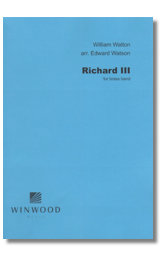
Richard III (Score only) - William Walton
It takes a special ability to compose film scores which serve the images perfectly yet translate into first class concert music. William Walton was such a talent as the continuing popularity of his brilliantly evocative film music shows. This suite presents a rich, vivid musical tapestry with all the drama of the original captured to perfection. Winwood Music are delighted to bring this music from Laurence Olivier's classic film to the brass band world in a fabulous arrangement by Edward Watson - so idiomatic that you'll think this is the original version! There are seven movements: 1. Prelude 2. Fanfare and Processional 3. Sound Drums and Trumpets & Recessional 4. Elegy 5. The Princes in the Tower 6. The Battle of Bosworth Field 7. Death of Richard and Finale
Estimated dispatch 7-9 working days
-
 £74.00
Richard III (Parts only) - William Walton
It takes a special ability to compose film scores which serve the images perfectly yet translate into first class concert music. William Walton was such a talent as the continuing popularity of his brilliantly evocative film music shows. This suite presents a rich, vivid musical tapestry with all the drama of the original captured to perfection. Winwood Music are delighted to bring this music from Laurence Olivier's classic film to the brass band world in a fabulous arrangement by Edward Watson - so idiomatic that you'll think this is the original version! There are seven movements: 1. Prelude 2. Fanfare and Processional 3. Sound Drums and Trumpets & Recessional 4. Elegy 5. The Princes in the Tower 6. The Battle of Bosworth Field 7. Death of Richard and Finale
Estimated dispatch 7-9 working days
-
 £59.95
Judd: Caelum Corona - Stephen Bulla
Stephen Bulla's 'Caelum Corona' ('Crown of Heaven') portrays, in sound, a Christian's walk in faith, intended metaphorically via a musical narrative reminiscent of the early church pilgrims, their struggles and triumphs. The composer initially evokes the atmosphere of Rome at the time of St. Paul and other martyrs, thus the Latin title. Bulla marks his imaginative tone poem with dark, brooding music in the first two of three parts, in each of which he has embedded an appropriate hymn or song reference as thematic material. The first of these sounds in a minor key following a symphonic exposition made up primarily of fanfare-like motives, the music at times quite harsh and abrasive. The song is Paul's statement of exuberant faith (2 Timothy 1:12) in the midst of prison and persecution: 'For I know whom I have believed, and am persuaded that he is able to keep that which I've committed unto him against that day.' More challenging, aggressive music returns until a further point of reflection on Christ's sacrifice is reached. The music graphically evokes the barren landscape of Golgatha, the horror of the crucifixion, including stark wind sounds, a loss of stability via eerie, dissonant chord clusters, and even the nails being driven into Christ's body. The Baritones and then Flugel Horn softly play 'He died of a broken heart.' Yet the Christian life, despite its perils - both at the time of Paul and now - is a victorious life, and the composer resolves the tensions of the work in a scintillating finale, a brilliant setting of the old song about spiritual warfare and the ultimate triumph of Christ the King: 'Victory for me!' (T.B. 841). The chorus of that tune proclaims: 'No retreating, hell defeating, shoulder to shoulder we stand; God look down, with glory crown our conq'ring band.' That crowning is the same one sought and claimed by St. Paul (2 Timothy 4:8): 'Now there is in store for me a crown of righteousness, which the Lord, the righteous judge, will award me on that day, but also to all who have longed for his appearing.' Believers look forward to participating in the final coronation of their Saviour - King of Kings and Lord of Lords - while humbly desiring their own 'crown of heaven.'
Estimated dispatch 7-14 working days
-
£137.50
Beyond the Tamar - Harper, P
World Tour for Brass Band1. Intrada2. Hymn of the Alps3. Storm Over Leningrad4. Indian Daybreak5. Tongoyo6. Salsa Tres'Pardo7. Finale
In Stock: Estimated dispatch 1-3 working days
-
£40.00
Colossus - Venables, M
Winner of the closely-fought RWCMD Cory Composition Prize in 2019, this music is not only heroic and battle call-esque, but also features contrasting sections of beauty and fierceness, all culminating in one final colossal finale.1st section +Duration 4 mins Listen here - Courtesy of Cory Band
In Stock: Estimated dispatch 1-3 working days
-
£60.00
Exterminate! - Harper, P
Included as part of Cory Band's Dr Who programmes of 2023, this piece is an exciting finale which taps into the spirit of Dr Who and the Daleks, whilst quoting from diabolical music from Liszt and Holst.Click here to listen to a short excerptChampionship SectionDuration 4 mins 30 seconds
In Stock: Estimated dispatch 1-3 working days
 View Music