
Results
-
 £89.99
Arctic Funk - Torstein Aagaard-Nilsen
Arctic Funk might just as well have been a flashing sequel to a scene from Leonard Bernstein's West Side Story. Popular music but with a difference, as indicated by the title. The work's quiet section temporarily soothes down the heated passion of its two corner movements, but everywhere else action is required throughout. The work was commissioned in 1991 by Troms? Brass. Situated just above the Polar Circle, Troms? is one of Norway's northernmost towns. Topographically, the town probably comes across as freezing cold, but Troms? is famous for its 'warm' night-life. The Composer: In Arctic Funk you might get a feeling of a party that takes place betweenice-rocks and snow-capped mountains.
Estimated dispatch 5-14 working days
-
 £69.99
Czardas (Xylophone solo) - Monti - Gert Bomhof
Vittorio Monti was born on January 6, 1868 in Naples (Italy). His musical education (Violin and composition), he enjoyed at the conservatory there. Around his 30's Monti went to Paris. He earned a living as a conductor and wrote several ballets and operettas. In his last years, before his death in 1922, Monti devoted himself to teaching and composing. His famous 'Czardas' has made his name known even today.Initially the Czardas was a Hungarian folk dance, but after the mid-nineteenth century it was even a dance for the upper-class. Czardas begins with a slow introduction, the Lassan (slow and sad), and then the fast part,Friska, follows. Czardas is not, as so many people think, typical gypsy music.
Estimated dispatch 5-14 working days
-
 £104.99
Cambridgeshire Impressions - Rieks van der Velde
In a four-part composition Rieks van der Velde takes us to the richly varied area surrounding the university city of Cambridge. The Dutch composer was especially inspired by the atmosphere of Cambridgeshire, the county which lies north ofLondon. 1. The Journey. Although on arrival the area looks peaceful and friendly, the ruggedness of its inhabitants and landscape have an unmistakable influence on the music. In the course of the tour, which starts with an Allegromovement, we are shown the vitality, energy and freshness of the Cambridgeshire countryside. Short themes, swift and sudden motifs and rhythmical patterns supported by the drive of percussion instruments give expression to this image. Thefirst part is concluded by two Calmo movements in which the music expresses how the cathedral in the city of Ely comes into sight and is gradually approached. 2. Visit to Ely Cathedral. The famous Norman cathedral church of Ely, whichwas built in 1109, has attracted tourists from all over the world apart from being a place of worship and heritage site. A cornet solo introduces the contemplative mood of the composition at this point. The mystical atmosphere of thecathedral runs through this lyrical part like a continuous thread. 3. The Pub. The thirst caused by this intensive journey makes a visit to the local pub a definite must. These "public houses", which may be open until the earlyhours of the morning, offer all kinds of entertainment. Drinks are served liberally and the atmosphere is lively. 4. The Journey Back. Time has flown: In other words, the moment of departure has come sooner than one would havewished. In a flashback which recaptures elements of the first part of the composition we say goodbye to Cambridgeshire in a fitting manner. Two scintillating final measures bring us abruptly back to the present.
Estimated dispatch 5-14 working days
-
 £54.99
The Irish Dancemaster - William Vean
During the eighteenth century a person called 'the Dance Master' made his appearance in Ireland. He was a travelling dance-teacher, who moved from one village to another to teach the people there how to dance. They were often flamboyant personalities, gorgeously dressed and holding a staff in one hand. In order to teach their pupils the difference between their right and left leg, the dance master used to tie a small bunch of straw or hay to their leg and then would order them to either lift their 'hay-leg' or their 'straw-leg'. The dancing masters used to stay in one particular village for about six weeks (if they were not claimed by a neighbouringvillage), after which they continued their journey. Having a famous dance master gave a village a certain distinction and did not seldom lead to boasting and pride. Also on account of the popularity of Celtic music in general at the moment, William Vean was inspired to writing 'The Irish Dance Master'. He 'teaches' you two dances, the Reel and the Jig. In between these two dances there is a short breathing space, during which a traditional Irish rhythm can be enjoyed.
Estimated dispatch 5-14 working days
-
 £109.99
Columbus - Rob Goorhuis
Christopher Columbus was born in Genoa in 1451. His father was a wool merchant. Originally he seemed destined to follow in his father's footsteps, and thus sailed the oceans to countries as far apart as Iceland and Guinea. In 1476 his ship was sunk during a battle off the coast of Portugal. Columbus saved his own life by swimming to shore. In 1484 he conceived the idea of sailing to the Indies via a westward sea route, but it was only in 1492 that he was able to realize this plan. On this first voyage he was in command of three ships: the flag-ship, called the Santa Maria, the Pinta, and the Ni?a. From Spain Columbus sailed via the Canary Islands to the Bahamas, whichhe sighted on October 12th 1492. Without being aware of it Columbus discovered the 'New World' he thought he had landed in the eastern part of Asia. The motif from Dvooak's 9th Symphony 'Aus der neuen Welt' forms a little counterfeit history at this point in the composition. After this first voyage Columbus was to undertake another three long voyages to America. These voyages were certainly not entirely devoid of misfortune. More than once he was faced with shipwreck, mutiny and the destruction of settlements he had founded. After Columbus had left for Spain from Rio Belen in 1503, he beached his ships on the coast of Jamaica. The crew were marooned there and it was only after a year that Columbus succeeded in saving his men and sailing back to Spain with them. In the music the misunderstanding about which continent Columbus discovered in his lifetime resounds, for does this part in the composition not contain Asiatic motifs? Poor Columbus! In 1506 the famous explorer died in Valladolid.
Estimated dispatch 5-14 working days
-
 £54.99
Skyfall (arr. Sparke) (Score/Parts) - Paul Epworth - Philip Sparke
Skyfall, the title song for the latest Bond film, with its echoes of the original Bond theme, is perhaps the most archetypal Bond song of all. This up-to-the-minute arrangement by Philip Sparke makes it super easy to recreate on stage the exciting atmosphere of the most famous secret agent in the history of film.
Estimated dispatch 5-14 working days
-
 £64.40
Vera Lynn Forever - Willy Hautvast
Lady singer Dame Vera Lewis-Welch, better known as Vera Lynn, performed with the bands of Joe Loss, Charlie Kunz and Ambrose. During the Second World War she inspired all British soldiers involved in the war and got the surname Sweetheart Of The Forces. In the fifties she presented her own B.B.C. television shows. Willy Hautvast arranged her four most famous songs We'll Meet Again, Now Is The Hour, From The Time You Say Goodbye and The White Cliffs Of Dover. (Newly engraved 2016)
Estimated dispatch 5-14 working days
-
 £115.60
Angels We Have Heard on High - Fredrick Schjelderup
"Angels We Have Heard" on High is one of the most famous Christmas carols all over the world. Of French origin, it's also entitled Les Anges dans nos campagnes. The Irish bishop James Chadwick has written lyrics to the melody. His lyrics are the most widely used also today. For this Brass Band arrangement there are also optional parts for SATB Choir and Organ.
Estimated dispatch 5-14 working days
-
 £115.60
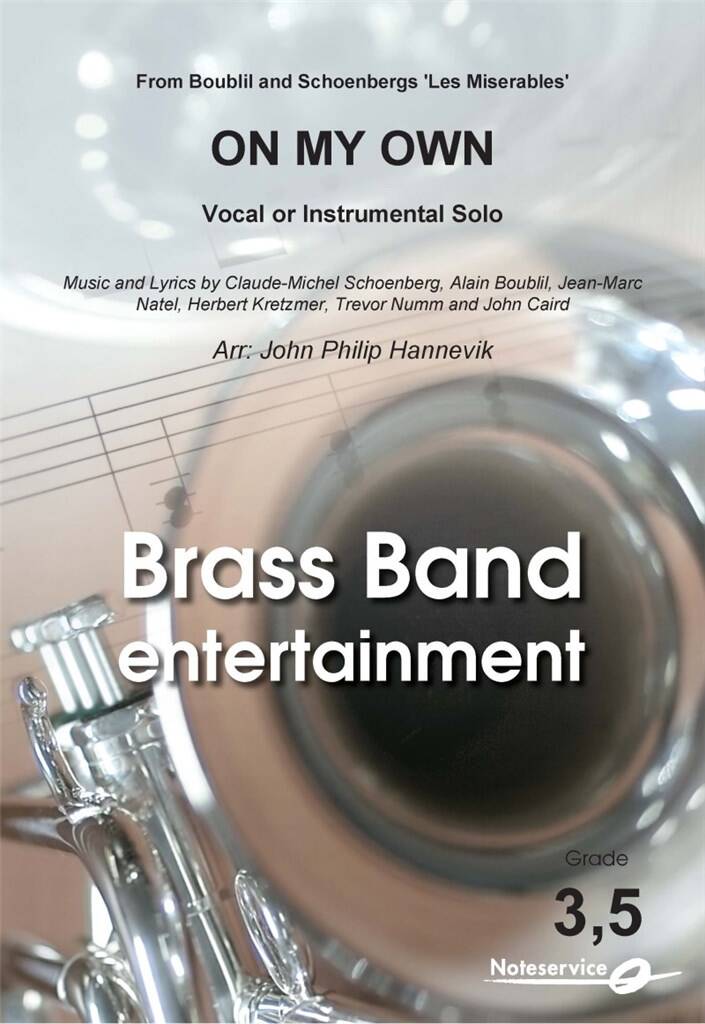
On My Own - Boublil - John Philip Hannevik
"On my Own" is now regarded as one of the most famous songs from "Les Miserables", the incredibly popular musical by Claude-Michel Schonberg and Alain Boublil. The story is based on a novel by Victor Hugo. In the song, Eponine sings about her love for Marius, and she dreams about having a life with him. Solo-Options in this arrangement: Vocal. Bb-Instruments, Eb-Instruments
Estimated dispatch 5-14 working days
-
 £127.30
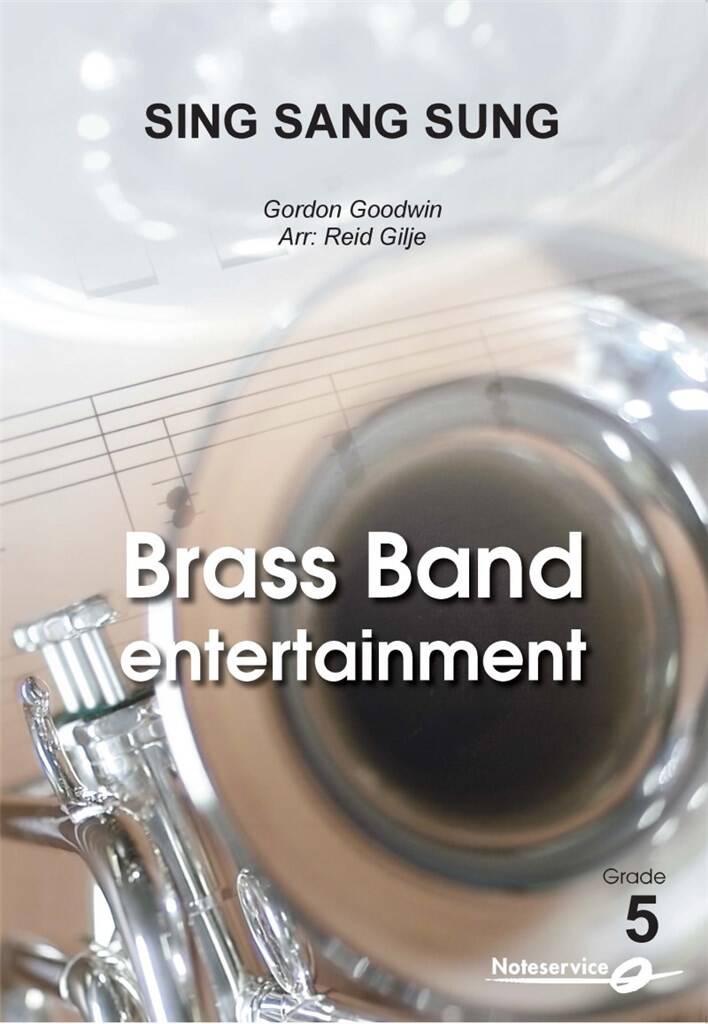
Sing Sang Sung - Gordon Goodwin - Reid Gilje
"Sing Sang Sung" is inspired by "Sing Sing Sing" from the legendary 1938 Carnegie Hall Concert by Benny Goodman & His Orchestra. The famous "Jungle Groove" presented by drummer Gene Krupa and the opening riff from the 1938 performance is retained in this brilliant, swinging tune composed by Gordon Goodmin. The style changes from swing to "jungle groove" (with extensive use of tom-toms), is essential for both these tunes. The best sound recording of "Sing Sang Sung" is "Swingin' For the Fences" by Gordon Goodwin Big Phat Band released in 2000. But, you should also listen to the original "Sing Sing Sing" from the 1938 Benny Goodman recording as well!
Estimated dispatch 5-14 working days
 View Music