
Results
-
 £69.95
Horn Concerto (Horn Solo with Brass Band)
Horn in F/E flat with Brass BandComposed in 1971 for Ifor James, the Concerto for French Horn and Band revealed some of those elements that have made Gregson's music so popular with audiences (and not just brass band audiences) worldwide: the boldness of his melodies, with the interval of the fourth revealing his admiration for the music of Paul Hindemith; his incisive rhythms, betraying the influence of another favourite composer, Bla Bartk; an admirable economy of means; and the clarity of his scoring.Each of the Concerto's three movements displays a different facet of the French Horn's character. The first is serious, symphonic in impulse, the rising fourths of the opening gesture giving the music an almost Germanic weight. In the slow movement, the soloist becomes the first among equals, sharing with the cornet soloist some typically haunting melodies. The lyrical flow is interrupted at the mid-point by mysterious, fleet-of-foot cadenzas. A rondo finale brings the concerto to a lighthearted conclusion. The rising fourths here are the impulse for a jaunty theme which reveals another of Gregson's early influences - William Walton, and in particular that composer's Partita for orchestra.
Estimated dispatch 7-14 working days
-
 £34.20
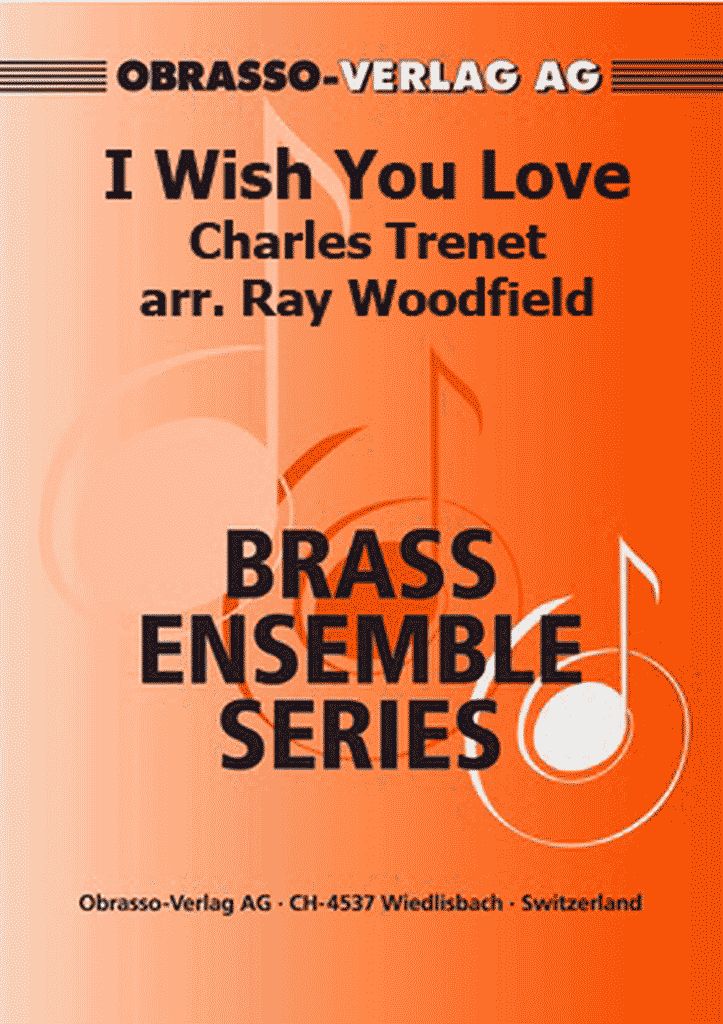
I Wish You Love
Parts included for:Part 1: Bb Trumpet or Bb Cornet and Eb Trumpet or Eb CornetPart 2: Bb Trumpet or Bb CornetPart 3: Bb Trumpet or Bb CornetPart 4: Bb Trumpet or Bb Cornet or Flugel HornPart 5: F Horn or Eb HornPart 6: Trombone (BC) or Trombone (TC)Part 7: Trombone (BC) or Trombone (TC)Part 8: Trombone (BC) or Trombone (TC)Part 9: Bass Trombone (BC) or Bass Trombone (TC)Part 10: C Tuba or Eb Bass or Bb BassPercussion
Estimated dispatch 7-14 working days
-
£50.90
Il Barbiere di Siviglia - The Barber of Seville (10 Piece Brass Ensemble)
Parts included for:Part 1: Bb Trumpet or Bb Cornet and Eb Trumpet or Eb CornetPart 2: Bb Trumpet or Bb CornetPart 3: Bb Trumpet or Bb CornetPart 4: Bb Trumpet or Bb Cornet or Flugel HornPart 5: F Horn or Eb HornPart 6: Trombone (BC) or Trombone (TC)Part 7: Trombone (BC) or Trombone (TC)Part 8: Trombone (BC) or Trombone (TC)Part 9: Bass Trombone (BC) or Bass Trombone (TC)Part 10: C Tuba or Eb Bass or Bb BassPercussion
Estimated dispatch 7-14 working days
-
 £24.95
Judd: The Invincible Army
When the New York Staff Band toured England in 1960 they featured much new music written for them by Erik Leidzen, including this march. The trio section is in the unusual key (brass band pitch) of Db major, a major third away from the opening key of F major, rather than the more predictable subdominant of Bb major. This presents a technical and mental challenge to the players but provides a particularly brilliant sonority when played in tune!
Estimated dispatch 7-14 working days
-
 £34.95
Judd: Tucker
Originally in the Festival Series in 1933 and written by the master of solo writing, Erik Leidzen, this has become in SA circles a 'standard' for all aspiring cornetists, exploring the full range of the instrument from bottom F# to top D.
Estimated dispatch 7-14 working days
-
 £5.00
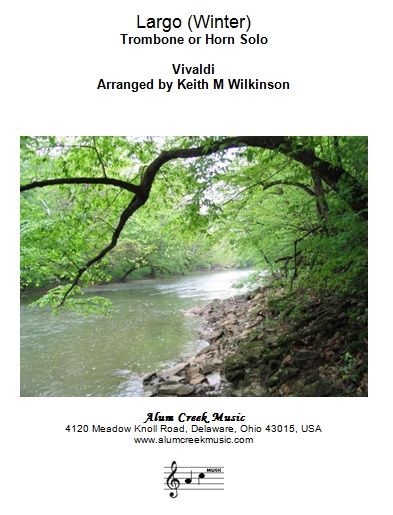
Largo (Winter) (Trombone or Horn Solo and Piano Accompaniment)
In 1723 Antonio Vivaldi (1678-1741) composed four concerti for violin and small orchestra entitled The Four Seasons. Winter is the fourth of these and the Largo is its central slow movement depicting a cosy scene by the fireside watching the falling rain.This arrangement was prepared at the request of Brett Baker and has been recorded by him accompanied by Brass Band Of The Western Reserve, music director Dr Keith M Wilkinson, on the CD Slides Rule!Parts included for Trombone BC, Trombone TC, Eb Horn, F Horn and Piano Accompaniment
Estimated dispatch 7-14 working days
-
 £87.95
Masquerade (Score and Parts)
The first performance took place on the 4th. September 1993 at the Free Trade Hall in Manchester during the British Open Brass Band Championships.Note by Philip Wilby:Masquerade is a centenary tribute to Verdi's last opera Falstaff and takes its final scene as the basis for my own piece. Thus I have used some of Verdi's music, and some of Shalespeare's plot, and woven them into a fabric with highly demanding music of my own to produce a work in the great tradition of operatically-based brass band pieces. Such scores date from the very beginnings of band repertory and are often not direct arrangements in the established sense but new compositions produced in homage to a past master. They may still offer performers and audience alike something familiar interwoven with something new. My own piece reuses some elements from the original story: . .Falstaff has been caught in a web of his own lies by the ladies of the town, who propose to teach him a lesson. The story opens at night in Windsor Great Park. The plotters, variously disguised in Hallowe'en fashion (as fairies,elves hobgoblins etc!) assemble in the park to await Falstaff's arrival (musicologists will, perhaps, note a rare use of 'large bottle in F' being used during this scene of suppressed alcoholic revelry!). Falstaff's companions, Bardolph,Piston and Robin, enter (represented here by the three trombones!), and are variously abused by the masqueraders. At the height of the Tout an alarm sounds and Falstaff (euphonium cadenza) enters as Midnight strikes. From a safe hiding place he watches as the disguised Nanetta (principal comet) sings a serene solo as the moon appcars above the trees. With sudden force the others seize him and drag him from his hiding place. As in the traditional game 'Blind Man's Buff', he is roughly turned seven times (a sequence of solo accelerandi) until, at last, he recognizes his assailants as his sometime friends. Far from complaining, Verdi's character concludes the opera with a good-humoured fugue on the words.... 'All the World's a Joke... Every mortal laughs at the others, But he laughs best who has the final laugh. Philip Wilby.
Estimated dispatch 7-14 working days
-
 £44.95
Masquerade (Score Only)
The first performance took place on the 4th. September 1993 at the Free Trade Hall in Manchester during the British Open Brass Band Championships.Note by Philip Wilby:Masquerade is a centenary tribute to Verdi's last opera Falstaff and takes its final scene as the basis for my own piece. Thus I have used some of Verdi's music, and some of Shalespeare's plot, and woven them into a fabric with highly demanding music of my own to produce a work in the great tradition of operatically-based brass band pieces. Such scores date from the very beginnings of band repertory and are often not direct arrangements in the established sense but new compositions produced in homage to a past master. They may still offer performers and audience alike something familiar interwoven with something new. My own piece reuses some elements from the original story: . .Falstaff has been caught in a web of his own lies by the ladies of the town, who propose to teach him a lesson. The story opens at night in Windsor Great Park. The plotters, variously disguised in Hallowe'en fashion (as fairies,elves hobgoblins etc!) assemble in the park to await Falstaff's arrival (musicologists will, perhaps, note a rare use of 'large bottle in F' being used during this scene of suppressed alcoholic revelry!). Falstaff's companions, Bardolph,Piston and Robin, enter (represented here by the three trombones!), and are variously abused by the masqueraders. At the height of the Tout an alarm sounds and Falstaff (euphonium cadenza) enters as Midnight strikes. From a safe hiding place he watches as the disguised Nanetta (principal comet) sings a serene solo as the moon appcars above the trees. With sudden force the others seize him and drag him from his hiding place. As in the traditional game 'Blind Man's Buff', he is roughly turned seven times (a sequence of solo accelerandi) until, at last, he recognizes his assailants as his sometime friends. Far from complaining, Verdi's character concludes the opera with a good-humoured fugue on the words.... 'All the World's a Joke... Every mortal laughs at the others, But he laughs best who has the final laugh. Philip Wilby.
Estimated dispatch 7-14 working days
-
 £94.00
Montage (Brass Band - Score and Parts)
Each of the movements of the symphony take as their starting point forms originating in music of the 16th and 17th centuries.The first, an intrada, introduces the main thematic material (based on the interval of a minor third) in its embryonic state. As the piece progresses, this material is developed and manipulated in a variety of ways. The interval of the third remains central to the overall scheme of the work, even unifying the three movements on a tonal plane (I: F (minor); II: A flat (major); III: C flat (minor). The internal structure of the intrada is an arch form: ABCBA, roughly modelled on the first movement of Concerto for Orchestra by Witold Lutoslawski, to whose memory the movement is dedicated.A chaconne follows - the basic material now transformed into expansive solo lines underpinned by a recurring sequence of five chords (again, a third apart). The movement's structure combines both ternary form and golden section principles and the chaconne's continuous cycle of chords may be visualised as circles.The final movement, a rondo, bears the dramatic weight of the entire work, as the underlying tonal tensions surface. A musical journey ensues, making diversions through lyrical territories as well as through more spiky, jazz-flavoured ones. The aural (and visual) montage is perhaps most apparent towards the climax of the piece, where three keys and polyrhythms sound simultaneously in the upper brass, xylophone, horns, and timpani. The climax itself combines the lyrical music heard earlier with the rondo theme, now presented by cornets and trombones in canon.The teleological thrust of the movement (if not the entire work) can be symbolized by the flight of an arrow, as it steers a predetermined course towards its target.
Estimated dispatch 7-14 working days
-
£34.20
Nadia's Theme (10 Piece Brass Ensemble)
Parts included for:Part 1: Bb Trumpet or Bb Cornet and Eb Trumpet or Eb CornetPart 2: Bb Trumpet or Bb CornetPart 3: Bb Trumpet or Bb CornetPart 4: Bb Trumpet or Bb Cornet or Flugel HornPart 5: F Horn or Eb HornPart 6: Trombone (BC) or Trombone (TC)Part 7: Trombone (BC) or Trombone (TC)Part 8: Trombone (BC) or Trombone (TC)Part 9: Bass Trombone (BC) or Bass Trombone (TC)Part 10: C Tuba or Eb Bass or Bb BassPercussion
Estimated dispatch 7-14 working days