
Results
-
£24.50
Triumphant - Bill Willis
TriumphantThis is a bright concert march in a traditional style and should pose no problems for the majority of bands.The first half of the march moves between the related keys of A min and C majThe march starts with a bold opening 2 bar statement in A min. At B the rhythm from the middle of the band should not be allowed to slow the pace of the march. C sees a majestic bass melody from Baritones downwards moving to D where a repeat of the original theme is presented before moving to the TRIO section. This moves between the related keys of F maj and D min. The melody heard at E is repeated at G with a florid counter-melody heard from 1st Baritone and Euphonium leading to the finish.
In Stock: Estimated dispatch 1-3 working days
-
 £29.50
Sibelius Fantasy - Gavin Somerset
Composed in 2003 for a composition competition, this work uses elements of three major work by the Finnish composer Jean Sibelius (1865-1957). The three being... Symphony No.5, Finlandia, Karelia Suite (March) The piece starts with an atmospheric opening before setting of in bar 10 with a tempo that will remain for most of the piece. The main original theme is brought in at A before the famous sequence from Sibelius' Symphony No.5 enters at B and then very distinctly at C. The music then rollercoasts through keeping all sections of the band busy, until we reach J when the solo Euphonium can shine, helped along by Flugel and Repiano. The Molto Vivo before K sets off with dazzling trills from the cornet section, and bringing with it the theme from Finlandia in bar 165, followed shortly by the March from the Karelia Suite. From N to the end, all three pieces are brought to a final climax together. A rousing piece and makes an interesting change to a direct transcription.
In Stock: Estimated dispatch 1-3 working days
-
 £7.99
£7.99Christmas Collection - Bb Euphonium TC - March Card Size
Christmas Collection is a newly revised carol book with original, additional and rearranged carols from New Christmas Praise as well as 10 extended pieces. Parts are now also available in large print A4 size!Titles:A child this day is bornA Christmas lullabyA great and mighty wonderAll I want for Christmas is youAll my heart this night rejoicesAngels, from the realms of Glory (Come and worship)Angels, from the realms of Glory (Iris)Angels we have heard on highA starry nightAs with gladness men of oldAuld lang syneA virgin most pureAway in a manger (The manger scene)Away in a manger (Traditional)A winter's taleBethlehemBrightest and best (Spean)Brightest and best (Traditional)Calypso CarolCarol for the NativityCarol of the bellsCarol of the drumChild of MaryChristians Awake!Christ is born (Il est n)Christ was born on Christmas DayCome and join the celebrationCome, children, come quicklyCoventry CarolDeck the hallDing dong! merrily on highDo you hear what I hear?Frosty the snowmanGabriel's MessageGaudeteGlory in the highestGlory in the highest HeavenGod of God, the uncreatedGod rest you merry, gentlemenGood Christian men, rejoiceGood King WenceslasGo, tell it on the mountain!Happy Christmas (War is over)Hark the glad sound!Hark! the herald angels singHave yourself a merry little ChristmasHere we come a-wassailingHow far is it to Bethlehem?Huron CarolInfant HolyIn the bleak midwinter (Cranham)In the bleak midwinter (Darke)I saw mommy kissing Santa ClausI saw three ships come sailing inIt came upon a midnight clear (Traditional)It came upon a midnight clear (Willis)It's beginning to look a lot like ChristmasIt's the most wonderful time of the yearI wish it could be Christmas everydayI wonder as I wanderJesus, good above all otherJingle BellsJingle bell rockJoy to the world!Last ChristmasLet it snow!Little baby JesusLittle children, wake and listenLittle DonkeyLittle Jesus, sweetly sleepLo! he comes with clouds descendingLong, long agoLove came down at ChristmasMary's boy childMary's ChildMasters in this hallMerry Christmas everyoneMistletoe and wineNoelO Christmas treeO come, all ye faithfulO come, ImmanuelO Heaven-sent KingO holy night!O little town of Bethlehem (Christmas Carol)O little town of Bethlehem (Forest Green)O little town of Bethlehem (St Louis)Once in royal David's cityPast three o'clockPatapanPersonent HodiePraise ye the LordRing the bellsRise up, shepherd!Rockin' around the Christmas treeRudolph, the red-nosed reindeerSans day carolSanta Claus is comin' to townSaviour's DaySee, amid the winter's snowSilent Night!Sleigh RideSoftly the night is sleepingSo here it is, merry ChristmasStars are shiningStill, still, stillStop the cavalrySussex CarolSweet chiming bellsSweet chiming Christmas bellsThe candle songThe cherry tree carolThe Christmas songThe first NowellThe holly and the ivyThe infant KingThe light has comeThe shepherds' farewellThe stable doorThe star in the eastThe twelve days of ChristmasThe virgin Mary had a baby boyThey all were looking for a kingThou didst leave thy throneThree kings' marchUnto us a boy is bornWalking in the airWe gather round the manger-bedWe three kings of Orient areWe wish you a merry ChristmasWhat child is this?When a child is bornWhen Santa got stuck up the chimneyWhence is that goodly fragrance flowing?When wise men came seekingWhile shepherds watched (Cranbrook)While shepherds watched (Handel)While shepherds watched (Winchester Old)White ChristmasWho is he?Winter WonderlandWorldwide Christmas messageZither CarolA starry nightChristmas JoyChristmas PraiseCoventry CarolInfant HolyMid-winterRudolph, the red-nosed reindeerThe everlasting lightTo celebrate his birthYuletide Rag
Estimated dispatch 7-14 working days
-
 £59.99
Marcho Brioso - Philip Sparke
Marcho Brioso was commissioned by The Brioso Brass, a British-style brass band from Hokkaido, Japan. They gave the first performance in January 2012.The commission was for a bright and breezy march that the band could use as their theme tune, so Marcho Brioso falls into the composer's series of Broadway-style marches, which includes Slipstream, The Bandwagon and Jubiloso.After a short introduction a solo cornet plays the main theme, accompanied by a euphonium counter-melody. A secondary phrase from the horns and baritones leads to a tuttiversion of the main theme which is followed by the traditional 'bass' strain. A change of key heralds the trio section, which features a cantabile melody on euphonium; this is then taken up by the full band after a short bridge passage and further change of key.This takes us back to the home key which sees a quiet staccato version of the main theme lead to a recapitulation and a short coda which brings the march to a close.
Estimated dispatch 5-14 working days
-
 £65.00
Four Sketches - Simon Dobson
Simon Dobson wrote his 'Four Sketches' at the request of Peter Bossano, Head of Brass at the Royal College of Music, in recognition of the 25th anniversary of Benjamin Britten's death. The first movement, 'Fanfare',quotes directly from the opening violin melody from Britten's song cycle Les Illuminations. This melodic line is superimposed upon sonorous Lydian mode chords to project a majestic sound. The second movement, 'Prayer', is adefinite contrast, being and much more reflective and pensive in it's mood, and featuring a dream like euphonium cadenza. The third movement, 'Funeral March', builds from a soft chordal opening to a chaotic andconfusedfortississimo climax with flourishes in the cornets and pounding tri-tones across the basses, before plunging into silence for a flugel cadenza to finish. The final Finale movement is much more positive from the off, withits jaunty melodies over a Brittenesque ostinato. The block chordal passages offer a crashing climax, making for an exciting conclusion to an excellent new work for the medium. Simon Dobson's 'Four Sketches' was the winningentry in the European Brass Band Composer Competition held in Brussels in March 2002.
Estimated dispatch 5-14 working days
-
 £159.99
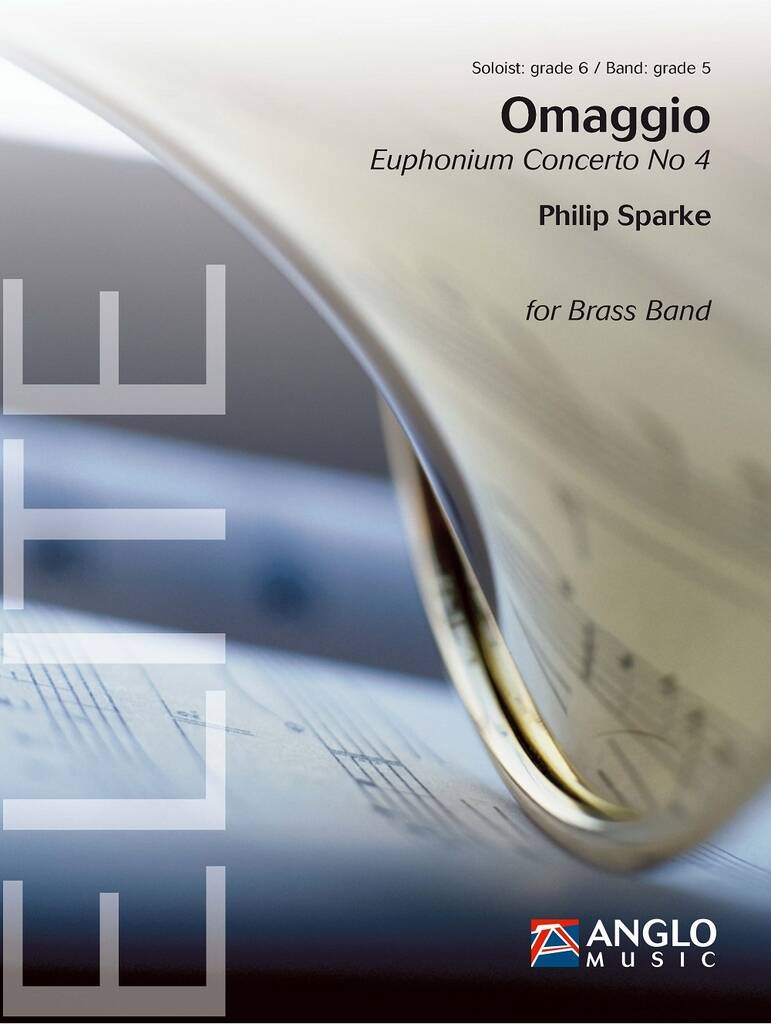
Omaggio - Philip Sparke
Omaggio was commissioned by Steven Mead in celebration of his 60th birthday and in memory of his father, Rex. He gave the premiere of the brass band version in Rome in March 2022, accompanied by the Italian Brass Band conducted by Filippo Cangiamilla. The concert band premiere took place on 6th July that year as part of the 2022 Spanish International Tuba Euphonium Conference, accompanied by the Banda municipal de musica de Malaga. The concerto is set in 3 continuous movements, which are united by a recurring syncopated interval of a fifth. The first movement, FANTASIA, opens with this motive accompanying an extended monologue for the soloist. This is followed by a lengthy bridge passage by the band (piano), which is eventually joined by the soloist, who guides the music back to the opening soliloquy, leading to an energetic central section. This develops until the opening material again returns to introduce the second movement, BALLAD, which revolves around an expressive melody for the soloist, interspersed by accompanied cadenzas. The third movement, THE KING TRIUMPHANT, pays homage to Steven's late father, Rex, and its title alludes both to Rex's name ('Rex' being Latin for 'king') as well as his love of Eric Ball's Salvationist masterpiece, The Kingdom Triumphant. The finale is an energetic tour-de-force featuring an acrobatic 6/8 melody, which is interrupted twice by the magnificent hymn tune, Helmsley, which Ball uses so effectively in The Kingdom Triumphant. A galloping coda brings the work to a close.
Estimated dispatch 5-14 working days
-
 £38.95
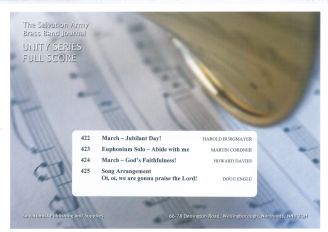
Unity Series Band Journal October 2014 Numbers 422 - 425
No. 422 March - Jubilant Day! (Harold Burgmayer)This accessible march was written for the small, but faithful, corps band in Lock Haven, Pannsylvania, USA, on the occasion of the corps' 125th anniversary.No. 423 Euphonium Solo - Abide with me (Martin Cordner)A sensitive three-verse setting of William H. Monk's well-known tune for Euphonium and band.No. 424 March - God's Faithfulness! (Howard Davies)This march was written to assist celebrations for a recent Salvation Army Congress held in the Indonesian Territory. The music is deliberately written in the style of a 'parade (or street) march' with a steady and unhurried tempo.No. 425 Song Arrangement - Oi, oi, we are gonna praise the Lord! (Doug Engle)This chorus by Doug Horley uses some 'invented' words, but it clearly communicates how our response should be to a God who loves us.
Estimated dispatch 7-14 working days
-
 £59.99
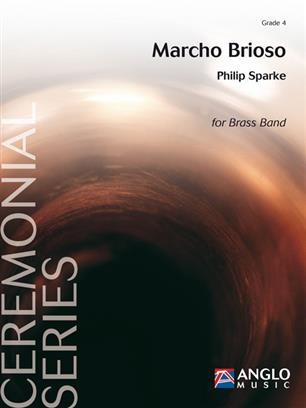
Marcho Brioso (Brass Band - Score and Parts)
Marcho Brioso was commissioned by The Brioso Brass, a British-style brass band from Hokkaido, Japan. They gave the first performance in January 2012.The commission was for a bright and breezy march that the band could use as their theme tune, so Marcho Brioso falls into the composer's series of Broadway-style marches, which includes Slipstream, The Bandwagon and Jubiloso. After a short introduction a solo cornet plays the main theme, accompanied by a euphonium counter-melody. A secondary phrase from the horns and baritones leads to a tutti version of the main theme which is followed by the traditional 'bass' strain. A change of key heralds the trio section, which features a cantabile melody on euphonium; this is then taken up by the full band after a short bridge passage and further change of key.This takes us back to the home key which sees a quiet staccato version of the main theme lead to a recapitulation and a short coda which brings the march to a close.Duration: 3:40
Estimated dispatch 7-14 working days
-
 £33.62
Jingle Bells Forever (Brass Band) Pierpont/Sousa/Smith arr. Lythaby
Jingle Bells Forever is a setting of two American favourites that weaves the melodic line from Pierpont's Jingle Bells with Sousa's umistakable march style. Drawn from The Stars and Stripes Forever, Sousa's immortal march that has become the official national march of the United States of America, the familiar strains provide the perfect accompaniment for the most festive of Christmas melodies. Sousa's famous grandioso with the piccolo descant (here scored for soprano cornet) and trombone countermelody draw this festive standard to a rousing conclusion. PDF download includes score and parts. Sheet music available from: UK - www.brassband.co.uk USA - www.solidbrassmusic.com Difficulty Level: 4th Section + Instrumentation: Soprano Cornet Eb Solo Cornet Bb Repiano Cornet Bb 2nd Cornet Bb 3rd Cornet Bb Flugel Horn Bb Solo Horn Eb 1st Horn Eb 2nd Horn Eb 1st Baritone Bb 2nd Baritone Bb 1st Trombone Bb 2nd Trombone Bb Bass Trombone Euphonium Bb Bass Eb Bass Bb Timpani Drum Set Cymbals Sleigh Bells Glockenspiel
In Stock: Estimated dispatch 1-3 working days
-
 £14.95
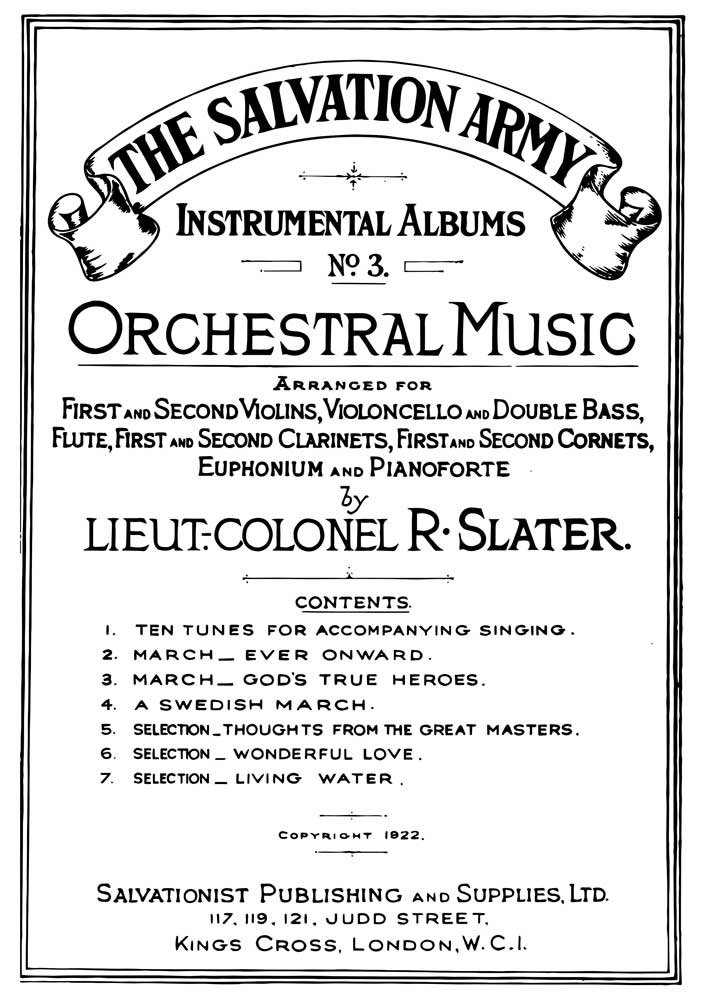
Instrumental Album No.3 - Orchestral Music
Includes: Ten tunes for accompanying singing; March - Ever Onward; March - God's true heroes; A Swedish March; Selection - Thoughts from the great masters; Selection - Wonderful Love; Selection - Living waterInstrumentation: 1st & 2nd Violins, Cello & Double Bass, Flute, 1st & 2nd Clarinets, 1st & 2nd Cornets, Euphonium & Piano
Estimated dispatch 7-14 working days
 Listen to MP3
 View Music