
Results
-
 £95.00
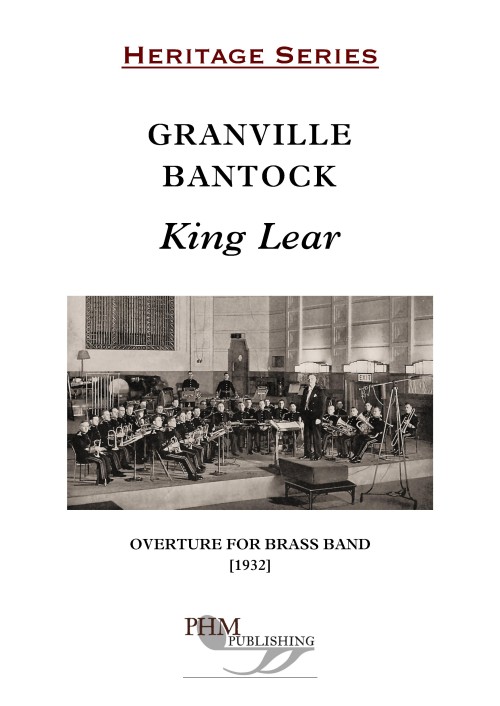
King Lear (Brass Band - Score and Parts) - Bantock, Granville - Hindmarsh, Paul
Sir Granville Bantock (1868 - 1946) composed the second of his five major brass band work for Callender's Cableworks Band, completing the commission on 30 November 1932. Based in the Thames-side district of Belvedere near Erith, the band was active between 1898 and 1961. The works band of the Callender Cable & Construction Co. Ltd, it was at the peak of its popularity during the 1930s and was a frequent broadcaster on the radio. The band employed an in-house arranger and played saxophones in its lighter material. King Lear was one of the band's major commissions and was not published in Bantock's lifetime. The manuscript score and parts were thought to be lost for decades, but were found in the library of the Haydock Band (Lancashire), which had inherited part of Callender's library of manuscripts material and bespoke arrangements after it has been transferred to nearby Prescott Cables Band after Callender's Cable Works closed.King Lear is a substantial work, in essence a dramatic tone poem in the romantic Tchaikovskian manner, presenting a series of character portraits of the foolish old king and his three daughters, Goneril, Regan and Cordelia. The music is dramatic and lyrical by turns, with the most generous lyrical episode revealing perhaps the warm-hearted Cordelia. An expansive melody that flows from this is brought back towards the end as the main climax of the work.In 2001, Bantock's score was recorded by the University of Salford Brass Band, conducted by Dr. Roy Newsome. The original is serviceable, but in comparison with the orchestral version he made in 1936 (part of which was recorded on a Paxton 78 rpm) and later brass band scores, performing editions of which were prepared by others, it lacks colour and range typical of Bantock's orchestral work. Above all it lacks percussion, which can be heard on the recorded extract. With the kind permission of the Bantock Estate, I have prepared a performing edition for publication that incorporates percussion, derived from the orchestral recording and added editorially in similar manner elsewhere. I have revoiced some of the low- lying instrumental parts to present the material in more comfortable ranges. Editorial interventions more elaborate than revoicing the original text have been identified as cue notes.- Paul HindmarshDuration: 15.00
Estimated dispatch 7-14 working days
-
£40.00
King Lear (Brass Band - Score only) - Bantock, Granville - Hindmarsh, Paul
Sir Granville Bantock (1868 - 1946) composed the second of his five major brass band work for Callender's Cableworks Band, completing the commission on 30 November 1932. Based in the Thames-side district of Belvedere near Erith, the band was active between 1898 and 1961. The works band of the Callender Cable & Construction Co. Ltd, it was at the peak of its popularity during the 1930s and was a frequent broadcaster on the radio. The band employed an in-house arranger and played saxophones in its lighter material. King Lear was one of the band's major commissions and was not published in Bantock's lifetime. The manuscript score and parts were thought to be lost for decades, but were found in the library of the Haydock Band (Lancashire), which had inherited part of Callender's library of manuscripts material and bespoke arrangements after it has been transferred to nearby Prescott Cables Band after Callender's Cable Works closed.King Lear is a substantial work, in essence a dramatic tone poem in the romantic Tchaikovskian manner, presenting a series of character portraits of the foolish old king and his three daughters, Goneril, Regan and Cordelia. The music is dramatic and lyrical by turns, with the most generous lyrical episode revealing perhaps the warm-hearted Cordelia. An expansive melody that flows from this is brought back towards the end as the main climax of the work.In 2001, Bantock's score was recorded by the University of Salford Brass Band, conducted by Dr. Roy Newsome. The original is serviceable, but in comparison with the orchestral version he made in 1936 (part of which was recorded on a Paxton 78 rpm) and later brass band scores, performing editions of which were prepared by others, it lacks colour and range typical of Bantock's orchestral work. Above all it lacks percussion, which can be heard on the recorded extract. With the kind permission of the Bantock Estate, I have prepared a performing edition for publication that incorporates percussion, derived from the orchestral recording and added editorially in similar manner elsewhere. I have revoiced some of the low- lying instrumental parts to present the material in more comfortable ranges. Editorial interventions more elaborate than revoicing the original text have been identified as cue notes.- Paul HindmarshDuration: 15.00
Estimated dispatch 7-14 working days
-
 £68.80
When the Lights Go Down (Brass Band - Score and Parts) - Houben, Kevin
Kevin Houben created with When the Lights Go Down, a wonderful chorale that can be a moment of reflection in any concert program. The resigned, magnificent melodies at the beginning of this composition slowly build up to a highlight with an increasing orchestration. The piece starts with a suggestive Adagio Meditativo, after which the main theme is immediately announced. A central bridge section takes the listener along through the different spheres at which the melodic and rhythmic drums embellish the chorale melodies. Thematic elements from the introduction brings the piece to a quiet and peaceful end. The sheer simplicity with which this work is written, makes it a resplendent, magnificent concert piece. 'When the Lights Go Down', refers to a moment when time stand still for a while, stillness within and around yourself.Duration: 9.00
Estimated dispatch 7-14 working days
-
 £144.99
No Man's Land (Brass Band - Score and Parts) - Deleruyelle, Thierry
No Man's Land was commissioned by the Noordlimburgse Brass Band. Thierry Deleruyelle has written this work in 2018, 100 years after the end of World War I. This work is related to his first work written for brass band, Fraternity, which tells the story about the mining accident in Courieres, France. Eight years later, World War I broke out. Instead of helping each other, no man's land arose.Duration: 19.30
Estimated dispatch 7-14 working days
-
 £134.99
Sinfonietta: The Town Beneath the Cliff (Brass Band - Score and Parts) - Sparke, Philip
Sinfonietta: The Town Beneath the Cliff was commissioned by Holmestrand Ungdomskorps from Vestfold in Norway. The work is in four movements: a spectacular fanfare followed by a moto perpetuo-like toccata. The third movement Hymn is a beautiful piece of music allowing the band to show its musicality and sound. The last movement Scherzo Finale opens with a short phrase from Holmestrand's own town song, Holmestrandsangen, which comes again in full at the end of the piece, accompanied by a florid passage based on the opening theme.Duration: 13.45
Estimated dispatch 7-14 working days
-
 £174.99
The Turing Test (Brass Band - Score and Parts) - Dobson, Simon
Alan Turing is considered the father of modern computational science and much, if not all, of our modern computer technology and the connectivity that we now take for granted is born of the work of this one great, but troubled man. His famous test was designed to prove whether artificial intelligence (AI) could successfully imitate human thought. The single movement of The Turing Test is essentially non-programmatic, but it does seek to show something of the emotion and colour of Turing's life in its different sections. The composer employs bi-tonality and complex rhythms to show opposing worlds colliding. At the end of each test, we must decide: has true AI been born? Duration: 19.45
Estimated dispatch 7-14 working days
-
 £89.95
Four Etudes (Brass Band - Score and Parts) - Gregson, Edward
This work was written during August and September 2016. In it, I wanted primarily to explore the elements of timbre, rhythm, texture and colour. The first three tudes (or studies) are based on a set of piano pieces I composed in 1982, whilst the last, the longest of the set, was composed specially. My reference point was the Four tudes for orchestra of 1928 by Stravinsky, a work I have always admired, and of which the first three also happen to be based on a set of earlier pieces, in his case for string quartet, with the last being a re-arrangement of a work for pianola. I have also borrowed the titles he gave to the individual studies as they seemed to fit the mood of my pieces.However, the exception is the final study, where instead of the exuberant mood of his colourful portrayal of Madrid, mine was influenced by the terrible human tragedy that was unfolding in Aleppo at the time I was writing it, and thus reflects the violence and barbarism of those events; yet towards the end it does offer a glimmer of hope for humanity with a return to the Canticle (Song) of the first study, and concludes quietly with the chords and bells that began the work. The titles of the tudes are Canticle, Dance, Excentrique, and Aleppo. Like Stravinsky's, the set is relatively short, lasting around 8 minutes.The Four tudes were commissioned by Black Dyke Band and were written specially for the recording marking the conclusion of my year as Composer-in-Residence. The concert premiere will be given by Black Dyke Band, conducted by the composer, at the RNCM Festival of Brass in January 2017.- Edward GregsonDuration: 8.00
Estimated dispatch 7-14 working days
-
 £37.95
Four Etudes (Brass Band - Score only) - Gregson, Edward
This work was written during August and September 2016. In it, I wanted primarily to explore the elements of timbre, rhythm, texture and colour. The first three tudes (or studies) are based on a set of piano pieces I composed in 1982, whilst the last, the longest of the set, was composed specially. My reference point was the Four tudes for orchestra of 1928 by Stravinsky, a work I have always admired, and of which the first three also happen to be based on a set of earlier pieces, in his case for string quartet, with the last being a re-arrangement of a work for pianola. I have also borrowed the titles he gave to the individual studies as they seemed to fit the mood of my pieces.However, the exception is the final study, where instead of the exuberant mood of his colourful portrayal of Madrid, mine was influenced by the terrible human tragedy that was unfolding in Aleppo at the time I was writing it, and thus reflects the violence and barbarism of those events; yet towards the end it does offer a glimmer of hope for humanity with a return to the Canticle (Song) of the first study, and concludes quietly with the chords and bells that began the work. The titles of the tudes are Canticle, Dance, Excentrique, and Aleppo. Like Stravinsky's, the set is relatively short, lasting around 8 minutes.The Four tudes were commissioned by Black Dyke Band and were written specially for the recording marking the conclusion of my year as Composer-in-Residence. The concert premiere will be given by Black Dyke Band, conducted by the composer, at the RNCM Festival of Brass in January 2017.- Edward GregsonDuration: 8.00
Estimated dispatch 7-14 working days
-
 £24.00
Evening Prayer (Cornet Duet with Brass Band - Score and Parts) - Humperdinck, Engelbert - Wilkinson, Keith M.
This beautiful music is from the end of Act 2 of the opera Hansel and Gretel by German composer Engelbert Humperdinck (1854-1921). The duet is a prayer by the brother and sister as they seek the protection of angels before falling asleep on the forest floor. The opera, Humperdinck's most famous composition, is based on the fairy tale by the Grimm brothers, and has libretto by the composer's sister. It was first performed in December, 1893.
Estimated dispatch 7-14 working days
-
 £59.95
The Long Cloud of Witnesses (Brass Band - Score and Parts) - Downie, Kenneth
This music was written for the Amsterdam Staff Band's 50th Anniversary. The idea for using this theme in appreciation of the pioneers of the band who had gone before came to me during the thanksgiving service for my own mother's life. She was a life-long Salvationist, and the large crowd that gathered for her thanksgiving in Winchester gave such an inspiring rendition of this hymn at the end of the service that it moved me to write the music. In the closing pages of the score I have tried to suggest that final parade when those who loved the Lord join the 'long cloud of witnesses' in procession to their eternal home. - Kenneth Downie
Estimated dispatch 7-14 working days
 View Music