
Results
-
 £37.35
Polonaise from 'Scenes de Ballet' (Brass Band) Glazunov arr. Rob Bushnell
Alexander Glazunov was a Russian composer who was a gifted musician from childhood. He was seen as the natural heir to the nationalist revolution that had started with the Mighty Handful. Despite quickly turning from this to absolute forms of music, taking a keen interest in ballet music, his compositions still alludes to Russian folk tunes. He wrote four dance compositions, of which Scenes de Ballet was the first in 1894. The suite Scenes de Ballet, opus 52 has eight movements and was dedicated to the orchestra of the Russian Opera, St Petersburg. First performed in 1895 at a concert of the Imperial Music Society with Glazunov conducting. This arrangement of the final movement is for the British-style brass band, with alternative parts for horns in F and bass-clef lower brass. A recording of the original composition can be found here: https://www.youtube.com/watch?v=BS-Yx-bmxPg Duration: approx. 5.20 minutes Difficulty Level: 2nd Section + PDF download includes parts and score. Sheet music available at www.brassband.co.uk (UK) or https://satradecentral.org (USA) Instrumentation: Soprano Cornet Eb Solo Cornet Bb Repiano Cornet Bb 2nd Cornet Bb 3rd Cornet Bb Flugel Horn Bb Solo Horn Eb 1st Horn Eb 2nd Horn Eb 1st Baritone Bb 2nd Baritone Bb 1st Trombone Bb 2nd Trombone Bb Bass Trombone Euphonium Bb Bass Eb Bass Bb Timpani Percussion 1 - Snare Percussion 2 - Triangle, Cymbal & Bass Drum
In Stock: Estimated dispatch 1-3 working days
-
 £42.35
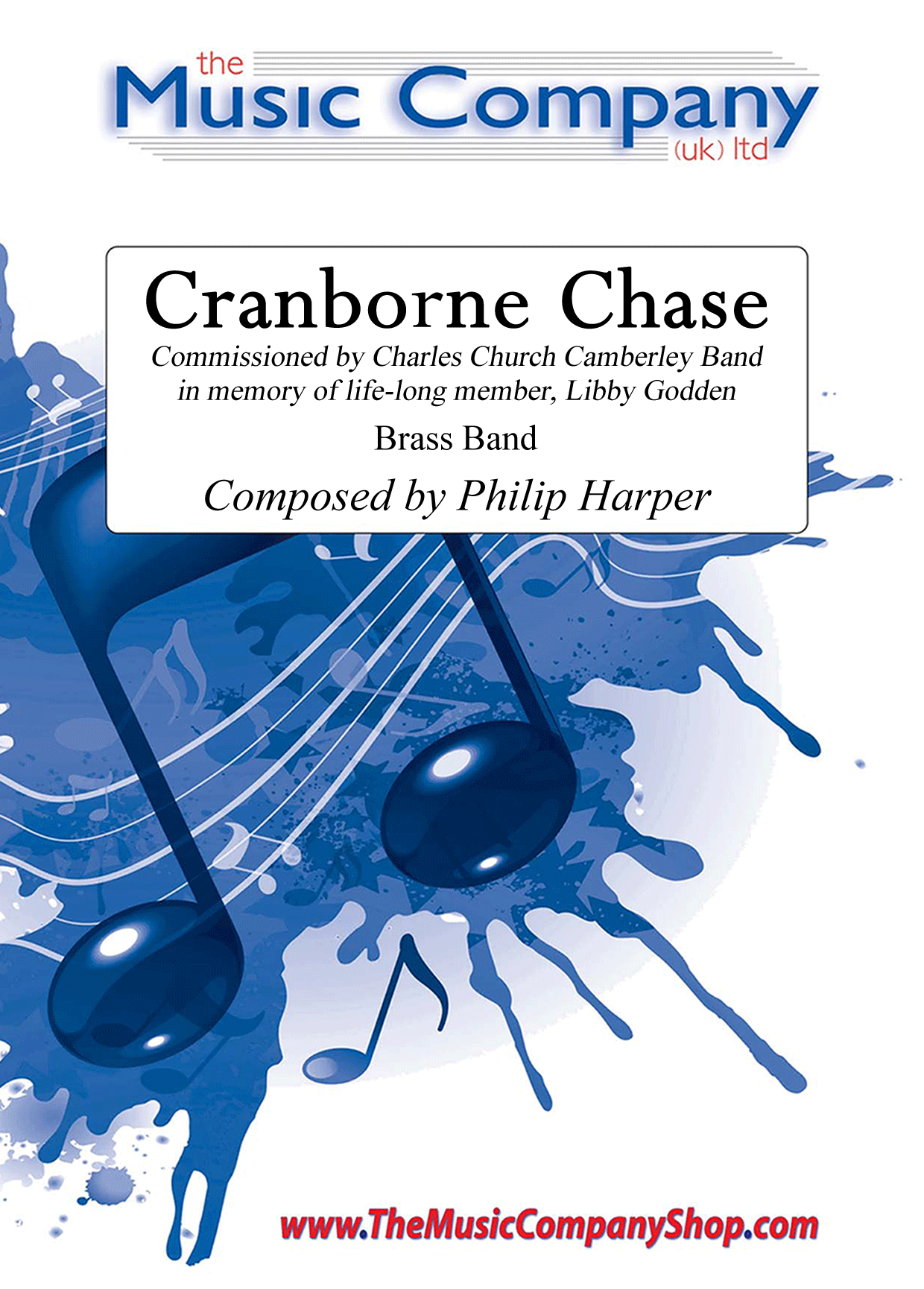
Cranborne Chase - Philip Harper
Cranborne Chase was commissioned by the Charles Church Camberley Band in 2011 in memory of solo horn player and life-long member Libby Godden.Libby joined the band in 1966 which marked the start of a long association, during which she progressed to the solo horn position, recruited four family members to play with the band, and had spells on the committee as publicity officer and chairman. Most recently she led the Training Ensemble in her role as Assistant Bandmaster. Libby continued to be active with the band despite a diagnosis of cancer, which finally claimed her life in February 2011.Programme notes from the composer, Philip Harper:The Music: As well as invoking the joyous spirit befitting Libby's approach to life, there are several musical ideas woven into the score. After a brief introduction, the main theme uses the musical letters of Libby's surname: G, O(A), D, D, E, N(G), whilst the harmonic progression here is based on that of the slow movement of Edward Gregson's Partita for Brass Band, one of Libby's favourite passages of music.To further imbue the piece with Libby's persona, the lyrical theme is first introduced as a traditional brass band quartet (two cornets, horn and euphonium), one of her favourite musical genres.After the first rehearsal of the piece the band members, with the composer's blessing, decided on the name Cranborne Chase, which is the name of a place in Dorset with which Libby Godden had a great affinity.Raising Funds for Cancer Research UK. The Music Company (UK) Ltd has been involved in charitable work for many years both nationally and internationally. Through publishing Cranborne Chase, The Music Company is extending its charitable support by helping to raise funds for the Cancer Research UK charity, in memory of Libby Godden (a band-friend since childhood of Clair Tomalin, Business Director of The Music Company (UK) Ltd).A donation will therefore be made by The Music Company (UK) Ltd for every purchased set of this piece. There is a hope that every band in the UK will have Cranborne Chase as part of their library and included in their concert programmes, enabling a significant amount of money to be raised for Cancer Research UK through the enjoyment of music.
In Stock: Estimated dispatch 3-5 working days
-
 £35.00
Ascend the Brightest Heaven...
DescriptionThe band's uniform badges feature a significant local landmark, a transmission tower officially known as The Arqiva Tower but known more colloquially to locals as 'Emley Moor mast'. The current elegantly tapered concrete sculpture, the tallest freestanding structure in the UK at 1084 feet, is the third mast on this site and was built between 1969 and 1971 after the catastrophic collapse of the previous structure.On 19 March 1969 a combination of extreme icing and strong winds caused the tubular mast to collapse across Jagger Lane and the chapel opposite - fortunately, despite the fact that the organist was in the chapel practising, nobody was injured. Several million people lost their BBC2 and ITV signals, until the Independent Television Authority managed to set up a temporary transmitter nearby!Just over two years later the new mast was operational, and despite initial opposition from some locals who feared another, potentially worse, collapse, Emley Moor Mast is now a popular local landmark and a grade II listed building. In 2015 the mast was illuminated with coloured lights at night to mark the 'Grand Depart' of the Tour de France coming to Yorkshire.You can listen and follow the score in the video below:
Estimated dispatch 7-14 working days
-
 £33.62
An Irish Blessing (Brass Band) Craig Stevens
VIEW SCORE PDF Written during the Covid lockdown in 2020, An Irish Blessing is a beautiful original tune from the pen of Craig Stevens set to the following words: May the road rise to meet you. May the wind be at your back. May the sun shine warm upon your face. Though the rain falls on your fields And the flowers grow no more, May the Lord keep you safe in His hands Until we meet again. Traditional Irish Blessing (paraphrased) The composer writes: 'The hope, that despite the uncertainty of the times, that we would meet again.' To view a follow-the-score video featuring Ratby Cooperative Band please visit www.youtube.com/watch?v=9B6F7STXH9I Sheet music available from: UK - www.brassband.co.uk USA - www.solidbrassmusic.com Difficulty Level: Fourth Section + Instrumentation: Soprano Cornet Eb Solo Cornet Bb Repiano Cornet Bb 2nd Cornet Bb 3rd Cornet Bb Flugel Horn Bb Solo Horn Eb 1st Horn Eb 2nd Horn Eb 1st Baritone Bb 2nd Baritone Bb 1st Trombone Bb 2nd Trombone Bb Bass Trombone Euphonium Bb Bass Eb Bass Bb Timpani Percussion 1-2
In Stock: Estimated dispatch 1-3 working days
-
 £37.35
Resilience (Brass Band) Andrew Wainwright
Resilience was composed by Andrew Wainwright for the River City Brass Band Composer Competition 2022, later being awarded first prize. The work celebrates the band's short but rich history, with a particular focus on the determination it has shown, like so many bands around the world, to continue its tradition of musical excellence despite the unprecedented challenges of the pandemic that led to an extended hiatus in music making. To view a video of River City Brass performing the work please visit www.youtube.com/watch?v=6y_MEm2eEeQ PDF download includes score and parts. Sheet music available from: UK - www.brassband.co.uk USA - www.solidbrassmusic.com Difficulty Level: 1st Section + Instrumentation: Soprano Cornet Eb Solo Cornet Bb Repiano Cornet Bb 2nd Cornet Bb 3rd Cornet Bb Flugel Horn Bb Solo Horn Eb 1st Horn Eb 2nd Horn Eb 1st Baritone Bb 2nd Baritone Bb 1st Trombone Bb 2nd Trombone Bb Bass Trombone Euphonium Bb Bass Eb Bass Bb Percussion 1-3
In Stock: Estimated dispatch 1-3 working days
-
 £33.62
Swan Theme from 'Swan Lake' (Brass Band) Tchaikovsky arr. Jack Lythaby
Tchaikovsky's Swan Lake is made up of folk tales from Germany and Russia, and tells the story of Odette, a princess turned into a swan by an evil sorcerer's curse. The ballet was premiered on 4th March 1877 by the Bolshoi Ballet company in the Bolshoi Theatre in Moscow, and despite its initial failure, has become one of the greatest ballets ever written. The Swan Theme depicts the magic and mystery of the lake, with the oboe (solo horn in this version) playing the famous melody, which returns in various guises throughout the ballet. Tchaikovsky's symphonic approach to ballet music was called "undanceable" by some critics after its premiere, but the score to Swan Lake has now become considered as the epitome of ballet music. Sheet music available from: UK - www.brassband.co.uk USA - www.solidbrassmusic.com Difficulty Level: 4th Section + Instrumentation: Soprano Cornet Eb Solo Cornet Bb Repiano Cornet Bb 2nd Cornet Bb 3rd Cornet Bb Flugel Horn Bb Solo Horn Eb 1st Horn Eb 2nd Horn Eb 1st Baritone Bb 2nd Baritone Bb 1st Trombone Bb 2nd Trombone Bb Bass Trombone Euphonium Bb Bass Eb Bass Bb Timpani Vibraphone
In Stock: Estimated dispatch 1-3 working days
-
 £69.95
Lift High The Cross - Jonathan Bates
DURATION: 12'00. DIFFICULTY: 2nd+. 'Lift High The Cross' was commissioned by the Armagh Brass Band Summer School in Northern Ireland to celebrate the 350th anniversary of the First Presbyterian Church in Armagh in 2023. The extended work utilises 2 hymn tunes; 'Lift High The Cross' and 'How Lovely Is Thy Dwelling Place' as it's core and - despite it's nature as either an extended concert work or test piece - aims to pay tribute to the warm and welcoming way in which the church and it's community has welcomed brass music of all genres across the years, notably through it's connection for over 25 years with the Foden's Band (UK).
In Stock: Estimated dispatch 1-3 working days
-
 £37.35
A Fugal Overture (Brass Band) Gustav Holst arr. Rob Bushnell
A Fugal Overture was written in 1922 by Gustav Holst. It was first performed at the Royal Opera House, Covent Garden on 14 May 1923 and was used as an opening work to Holst's one-act opera The Perfect Fool. It received its concert premiere on 11 October 1923 at one of Henry Wood's Queen's Hall Promenade Concerts. It is an early example of neoclassicism and was influenced by the counterpoint of J. S. Bach, despite its unconventional use of the fugal process. Holst began writing the piece in the summer of 1922, having hoped to develop it into a ballet. It is divided into three sections, the fugal subject with its distinct 3+3+2 pattern, a slower section with solos at the end, and a third section where the subject returns. Although reviews of the piece were mixed at the time of its premiere, the likes of Adrian Boult have said it was "an invigorating work that could effectively start any [...] concert". In more recent years, it has been compared to John Adam's A Short Ride in a Fast Machine. This arrangement is for the British-style brass band, with alternative parts for horns in F and bass-clef lower brass. A recording of the original composition can be found here: www.youtube.com/watch?v=a8xfwJyFq2E. Duration: Approx. 5.40 minutes Difficulty Level: 1st Section + PDF download includes parts and score. Sheet music available from www.brassband.co.uk Instrumentation: Soprano Cornet Eb Solo Cornet Bb Repiano Cornet Bb 2nd Cornet Bb 3rd Cornet Bb Flugel Horn Bb Solo Horn Eb 1st Horn Eb 2nd Horn Eb 1st Baritone Bb 2nd Baritone Bb 1st Trombone Bb 2nd Trombone Bb Bass Trombone Euphonium Bb Bass Eb Bass BbTimpani Percussion 1-2
In Stock: Estimated dispatch 1-3 working days
-
 £33.62
Metamorphosis on 'Finlandia' (Brass Band - Full Score Print) Andrew Wainwright
This major work was commissioned by Five Lakes Silver Band and its Musical Director Christopher Ward in February 2024, and is featured on the band's CD Resurget Cineribus. The music is based on the hymn tune by Katharina von Schlegel, Be Still, My Soul, found in Sibelius' famous tone poem Finlandia (Op. 26). While the only source material used in Metamorphosis on 'Finlandia' is the hymn itself as opposed to any of the developmental music found in the tone poem, it does also seek to depict the strife of the Finnish people against the censorship of the Russian Empire. It is therefore both rousing and turbulent at various times. Metamorphosis on 'Finlandia' commences with a quartet playing a full statement of the hymn in its simplest form, featuring a solo flugel. This leads into a sprightly 6/8 section where a fanfare-like figure proclaims the theme. The music in this section is at times unstable and off-kilter as references to the hymn come and go, often in a very chromatic or dissonant form - a reflection of the struggles that the Finnish people went through. Despite this, there is still a sense of optimism. A somewhat reflective slower section follows, featuring another full rendition of the hymn, with a number of solo voices taking up the tune. This is followed by several cadenzas - for cornet, trombone, Eb bass, and Bb bass, which represent different voices speaking out against the oppression of the Finnish people. This leads into an energetic final movement before a resounding proclamation of the hymn in its full glory. A return to the fanfare heard earlier in the work brings the piece to a glorious conclusion. To listen to a recording of Five Lakes Silver Band performing the work please visit www.youtube.com/watch?v=GeJJF6asD2k Duration: Approx. 13.15 minutes Difficulty Level: 1st Section + This product includes a print copy of the full score. PDF parts and score available here. Sheet music available here (UK) or https://satradecentral.org (USA) Instrumentation: Soprano Cornet Eb Solo Cornet Bb Repiano Cornet Bb 2nd Cornet Bb 3rd Cornet Bb Flugel Horn Bb Solo Horn Eb 1st Horn Eb 2nd Horn Eb 1st Baritone Bb 2nd Baritone Bb 1st Trombone Bb 2nd Trombone Bb Bass Trombone Euphonium Bb Bass Eb Bass Bb Timpani Percussion 1-3
In Stock: Estimated dispatch 1-3 working days
-
£67.24
Metamorphosis on 'Finlandia' (Brass Band) Andrew Wainwright
This major work was commissioned by Five Lakes Silver Band and its Musical Director Christopher Ward in February 2024, and is featured on the band's CD Resurget Cineribus. The music is based on the hymn tune by Katharina von Schlegel, Be Still, My Soul, found in Sibelius' famous tone poem Finlandia (Op. 26). While the only source material used in Metamorphosis on 'Finlandia' is the hymn itself as opposed to any of the developmental music found in the tone poem, it does also seek to depict the strife of the Finnish people against the censorship of the Russian Empire. It is therefore both rousing and turbulent at various times. Metamorphosis on 'Finlandia' commences with a quartet playing a full statement of the hymn in its simplest form, featuring a solo flugel. This leads into a sprightly 6/8 section where a fanfare-like figure proclaims the theme. The music in this section is at times unstable and off-kilter as references to the hymn come and go, often in a very chromatic or dissonant form - a reflection of the struggles that the Finnish people went through. Despite this, there is still a sense of optimism. A somewhat reflective slower section follows, featuring another full rendition of the hymn, with a number of solo voices taking up the tune. This is followed by several cadenzas - for cornet, trombone, Eb bass, and Bb bass, which represent different voices speaking out against the oppression of the Finnish people. This leads into an energetic final movement before a resounding proclamation of the hymn in its full glory. A return to the fanfare heard earlier in the work brings the piece to a glorious conclusion. To listen to a recording of Five Lakes Silver Band performing the work please visit www.youtube.com/watch?v=GeJJF6asD2k Duration: Approx. 13.15 minutes Difficulty Level: 1st Section + PDF download includes parts and score. Sheet music available here (UK) or https://satradecentral.org (USA) Instrumentation: Soprano Cornet Eb Solo Cornet Bb Repiano Cornet Bb 2nd Cornet Bb 3rd Cornet Bb Flugel Horn Bb Solo Horn Eb 1st Horn Eb 2nd Horn Eb 1st Baritone Bb 2nd Baritone Bb 1st Trombone Bb 2nd Trombone Bb Bass Trombone Euphonium Bb Bass Eb Bass Bb Timpani Percussion 1-3
In Stock: Estimated dispatch 1-3 working days
 Watch video