
Results
-
 £75.00
LEGEND OF KING ARTHUR, The (Brass Band Set) - Meechan, Peter
Score and Parts. 2014 National Championships Finals - Championship Section. King Arthur is the subject of many tales, stories, myths and legends - from his ascension to the throne by pulling the sword from the stone, his courageous battles with his fellow Knights of the Round Table, to his ultimately tragic love for Guinevere. The Legend of King Arthur is a musical portrayal of some of the most important moments in the legend. It is dedicated to Michael Bach and Brass Band B?rgermusik Luzern, who commissioned the work. Duration: 16:00
Estimated dispatch 7-14 working days
-
 £29.95
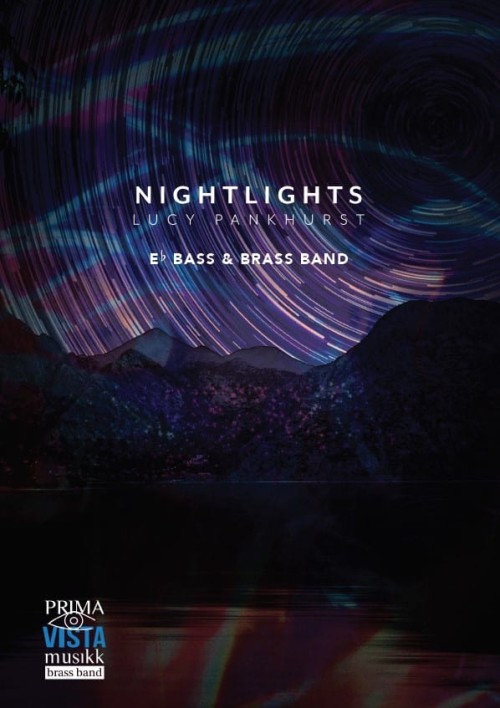
Nightlights (Eb Bass Solo with Brass Band - Score and Parts) - Pankhurst, Lucy
Nightlights was commissioned by Chris Jeans and Don Collins for Youth Brass 2000, to be used as part of their programme at the 2019 European Championships. Written during January 2019, Nightlights received its world premiere by Youth Brass 2000, conducted by Chris Jeans with Siobhan Bates as soloist, at the 2019 European Brass Band Championships in Montreux, Switzerland.Originally written as a Tenor Horn solo, this version for Tuba was arranged for and is dedicated to Dr Joanna Ross Hersey.Nightlights is intended to illustrate a winter's evening looking out across Lake Geneva from Montreux. Tiny lights appear beneath the mountains from faraway homes and vehicles, flickering in the distance and shimmering in the reflections on the water. Tiny, blinking nightlights against the inky blue of the clear sky. Thousands of stars shine above, blurring the boundaries between land, water, and the heavens into a sparkling ether. Transfixed, the bustle of sounds and lights from Montreux seems a lot further away than it is in reality. Eventually, each little light blinks out, one at a time, leaving the chill of the cold night air and an empty sky.Duration: 4.30
Estimated dispatch 7-14 working days
-
£95.00
Penlee (Brass Band - Score and Parts) - Dobson, Simon
2013 Finals of the National Brass Band Championships of Great Britain - 3rd SectioTo some, the tragic story of the Penlee lifeboat, Solomon Browne, would need no introduction, and to some the pain felt is still very much a reality. The composer, born just a few weeks before that fateful night on the 19th December 1981, has created this work as a musical homage to the bravery of the souls who lost their lives and has dedicated it to their memory.Penlee was commissioned by the Cornwall Youth Brass Band using funds bequeathed by Michael Pickett. The first performance was given by the Cornish Youth Brass Band, conducted by Ian Porthouse, at St. Michael's Church, Newquay, on 30th December 2008.Penlee has been voted into the Classic FM Hall of Fame 2011 at No.106. Not only is it the first time a brass work has been featured in the Hall of Fame, but it was also the highest new entry.The work has subsequently been recorded by the Leyland Band, conducted by Jason Katsikaris, on the CD entitled Penlee.Suitable for Advanced Youth/3rd Section Bands and aboveDuration: 13:30
Estimated dispatch 7-14 working days
-
 £17.99
Penlee (Brass Band - Score only) - Dobson, Simon
2013 Finals of the National Brass Band Championships of Great Britain - 3rd SectionTo some, the tragic story of the Penlee lifeboat, Solomon Browne, would need no introduction, and to some the pain felt is still very much a reality. The composer, born just a few weeks before that fateful night on the 19th December 1981, has created this work as a musical homage to the bravery of the souls who lost their lives and has dedicated it to their memory.Penlee was commissioned by the Cornwall Youth Brass Band using funds bequeathed by Michael Pickett. The first performance was given by the Cornish Youth Brass Band, conducted by Ian Porthouse, at St. Michael's Church, Newquay, on 30th December 2008.Penlee has been voted into the Classic FM Hall of Fame 2011 at No.106. Not only is it the first time a brass work has been featured in the Hall of Fame, but it was also the highest new entry.The work has subsequently been recorded by the Leyland Band, conducted by Jason Katsikaris, on the CD entitled Penlee.Suitable for Advanced Youth/3rd Section Bands and aboveDuration: 13:30
Estimated dispatch 7-14 working days
-
 £44.95
Reflections (Flugel and Tenor Horn Duet with Brass Band - Score and Parts) - Graham, Peter
Duet for Flugel and Tenor Horn or Two Bb Cornets from War of the Worlds SuiteEach movement of War of the Worlds is available separately allowing for a variety of "mini-suite" combinations eg: Movements 1,2 and 5 or 3,4 and 5 etc. For movements 1, 4 and 5 see the BB Concert Music tab. Complete suite also available.Reflections is the second movement of the suite War of the Worlds which was commissioned by the Senzoku Gakuen College of Music Saxophone Orchestra and first performed by them in the Maeda Hall, Japan on June 29 2012, the composer conducting. The music is dedicated to Professor Shin-ichi Iwamoto. The transcription for brass band was first performed by the Brighouse & Rastrick Band, conductor David King, in the Bridgewater Hall Manchester on September 8 2012.The suite takes inspiration from the 1953 film script adaptation of the famous HG Wells novel and key scenes from the film are set as individual movements: Reflections - here mankind contemplates a life forever changed as the invaders progress their colonisation of Planet Earth.
Estimated dispatch 7-14 working days
-
£99.95
ROCOCO VARIATIONS (Gregson) (Brass Band - Score and Parts) - Gregson, Edward
Rococo Variations was commissioned by the British Open Championships for their 2008 contest in Symphony Hall, Birmingham, and co-commissioned by the Norwegian Band Federation, for their National Championship in Bergen in 2009.The title of the work has been used before, of course, most notably by Tchaikovsky in his work for cello and orchestra. My set of variations follows the Tchaikovskian model in that it is based on a quasi-Baroque original theme, and has certain 'dance-like' characteristics in the variations, but beyond that all comparisons end.There are six variations: Toccata, Siciliana, Waltz, Moto Perpetuo, Lament, and Fugal Scherzo, followed by a triumphant re-statement of the theme. Throughout, there is considerable contrast in the music, with the fast variations being rather virtuoso in character, sometimes with constantly changing time patterns, whilst the two slow variations (Siciliana and Lament) are in turn lyrical and pensive in mood with prominent solos and duets for a number of instruments.Although the work overall is dedicated by my brother, each of the six variations pays tribute to a different composer whose contribution to the brass band repertoire during the second half of the twentieth century has been of great significance. To this end, all six composers have their own 'musical signature' embraced within the particular variation, a process which reaches its zenith, contrapuntally speaking, during the final variation and reprise of the theme.- Edward Gregson
Estimated dispatch 7-14 working days
-
£49.95
ROCOCO VARIATIONS (Gregson) (Brass Band - Score only) - Gregson, Edward
Rococo Variations was commissioned by the British Open Championships for their 2008 contest in Symphony Hall, Birmingham, and co-commissioned by the Norwegian Band Federation, for their National Championship in Bergen in 2009.The title of the work has been used before, of course, most notably by Tchaikovsky in his work for cello and orchestra. My set of variations follows the Tchaikovskian model in that it is based on a quasi-Baroque original theme, and has certain 'dance-like' characteristics in the variations, but beyond that all comparisons end.There are six variations: Toccata, Siciliana, Waltz, Moto Perpetuo, Lament, and Fugal Scherzo, followed by a triumphant re-statement of the theme. Throughout, there is considerable contrast in the music, with the fast variations being rather virtuoso in character, sometimes with constantly changing time patterns, whilst the two slow variations (Siciliana and Lament) are in turn lyrical and pensive in mood with prominent solos and duets for a number of instruments.Although the work overall is dedicated by my brother, each of the six variations pays tribute to a different composer whose contribution to the brass band repertoire during the second half of the twentieth century has been of great significance. To this end, all six composers have their own 'musical signature' embraced within the particular variation, a process which reaches its zenith, contrapuntally speaking, during the final variation and reprise of the theme.- Edward Gregson
Estimated dispatch 7-14 working days
-
£27.50
SALUT D'AMOUR (Bb Cornet Solo with Brass Band) - Snell, Howard
Dedicated to his wife, Elgar sold the copyright of Salut d'Amour to a publisher for just over ?2, who changed the title into French, thereby hoping to sell more copies. It did sell, at once, and has remained very popular ever since. Recorded on Polyphonic QPRL070D Solo. Duration: 3:12.
Estimated dispatch 7-14 working days
-
 £16.99
Sweet Sunset (Brass Band - Score only)
The sky creates a dazzling display of yellows, oranges, and reds, before turning a calm blue, then purple, and finally black. Such sunsets inspired Jan de Haan to write this piece for solo flugelhorn and brass band. It is dedicated to his daughter, Hermanda. 03:35
Estimated dispatch 7-14 working days
-
 £40.00
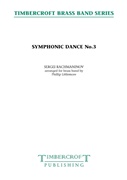
Symphonic Dance No.3 (Brass Band - Score and Parts) - Rachmaninoff, Sergei - Littlemore, Phillip
Completed in 1940, the set of?Symphonic Dances?was Sergei Rachmaninov's last composition. The work is fully representative of the composer's late style with its curious, shifting harmonies, the almost Prokofiev-like grotesquerie of the outer movements and the focus on individual instrumental tone colours throughout.?Rachmaninov composed the Symphonic Dances four years after his Third Symphony, mostly at the Honeyman Estate, 'Orchard Point', in Centerport, New York, overlooking Long Island Sound. The three-movement work's original name was Fantastic Dances, with movement titles of 'Noon', 'Twilight' and 'Midnight'. When the composer wrote to the conductor Eugene Ormandy in late August, he said that the piece was finished and needed only to be orchestrated, but the manuscript for the full score actually bears completion dates of September and October 1940. It was premiered by Ormandy and the Philadelphia Orchestra, to whom it is dedicated, on 3rd January, 1941. This arrangement is of the last dance and is a kind of struggle between the?Dies Iraetheme, representing Death, and a quotation from Rachmaninov's own?Vespers?(also known as the All-night Vigil, 1915), representing Resurrection. The Resurrection theme proves victorious in the end as the composer actually wrote the word 'Hallelujah' at the relevant place the score (one bar after Fig. 16 in this arrangement).?Duration: 3:45
Estimated dispatch 7-14 working days
 View Music