Results
-
 £74.99
Cornet Concerto No.1 - Jonathan Bates
My 'Cornet Concerto No.1' was composed for Lode Violet and Brass Band Willebroek in 2018 and features 2 movements, entitled 'Dystopia' and 'Utopia'. . The nature of the music in the opening section, 'Dystopia', is very jagged, disjointed and unsettling, as the soloist almost battles against the constant churning of the mechanical accompaniment, trying to persevere with it's own ideas and styles without being dragged into conforming to it's surroundings. The movement is based largely on the 3 note interval heard right at the outset of the piece (C, D & G#, a series of notes that lends itself so well to different modes, scales, harmonies and intervals) and this forms much of the rhythmic and harmonic structure of the opening section.Whilst this movement acts as a virtuoso feature to demonstrate the extended capabilities of both the soloist and instrument, I feel the accompanying ensemble plays an equal role in the narrative of 'dystopia', and features a number of demanding and prominent episodes for soloists within the accompanying band. A short and heavy coda concludes the movement, with a sense of real pain and sorrowfulness as the music fades away into darkness. . 'Utopia' opens in an instantly more hopeful nature, with the soloist introducing the first real 'theme' of the movement, taken up shortly by the accompaniment. Throughout this movement, there are a number of timbral and melodic references back to the darkness of 'dystopia', but transformed into a much more positive outlook and soundworld. There is a moment of quiet reflect (using the initial 3 note cell as a basis) before flying head first into a frenzied wild 'tarantella' like section, full of joy and energy which tests the dexterity and light-natured approach to virtuosity (much unlike the heavier material in the 1st movement) of the soloist. Primarily, the concept of this finale is fun - joy, happiness, and freedom from restraint, so the addition of a quirky 'tongue-in-cheek' habanera section offers a brief moment of respite from the craziness of the tarantella. To conclude the work, there is an extended cadenza for the soloist which is built on several motifs heard throughout the concerto, which leads the band into a dramatic and energetic final few bars.. Jonathan Bates. (2018). .
In Stock: Estimated dispatch 1-3 working days
-
 £4.99
£4.99First Things First - Let's Play (Elementary Course) Bb/Eb Edition
Let's Play (Elementary Course) provides an exciting and challenging early introduction to brass playing. Intentionally, using just the first 5 noes (C-G), the course allows and encourages the important early development of a brass player's most vital commodity, the lips!Includes link to downloadable resources including backing and demonstration tracks, online course assessment sheets and personalised course certificates.In this book you willlearn how to hold the instrument and how to breath properly!learn how to buzz your lips and how to use your tongue to start notesmeet lots of well known tunes, but using just 5 notes (C, D, E, F & G)learn many of the rhythm patterns possible in 4/4 timeimprove your listening skills as you play along with the downloadable tracks.
Estimated dispatch 7-14 working days
-
 £45.00
First Things First - Let's Play (Elementary Course) Bb/Eb Edition (Pack of 10)
Let's Play (Elementary Course) provides an exciting and challenging early introduction to brass playing. Intentionally, using just the first 5 noes (C-G), the course allows and encourages the important early development of a brass player's most vital commodity, the lips!Includes link to downloadable resources including backing and demonstration tracks, online course assessment sheets and personalised course certificates.In this book you willlearn how to hold the instrument and how to breath properly!learn how to buzz your lips and how to use your tongue to start notesmeet lots of well known tunes, but using just 5 notes (C, D, E, F & G)learn many of the rhythm patterns possible in 4/4 timeimprove your listening skills as you play along with the downloadable tracks.
Estimated dispatch 7-14 working days
-
 £38.95
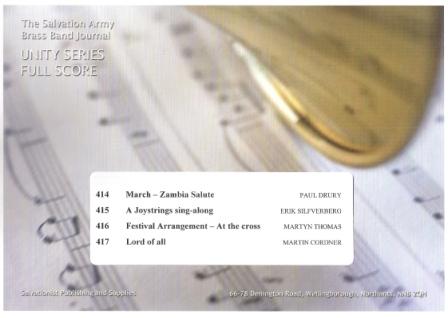
Unity Series Band Journal February 2014 Numbers 414-417
No.414 March - Zambia Salute (Paul Drury)In April 2009, a group from Chelmsford Citadel Corps visited Zambia. The purpose of the visit was to assist in the leadership of the Zambian Territorial Music School, held at Chikankata. This march was written to commemorate the event and received its premiere performance at the final festival. The melody featured is the chorus of the song, I know not why Dod's wondrous grace (S.A.S.B. 730).No.415 A Joystrings sing-along (Erik Silfverberg O.F.)This piece represents the first published work since the sudden Promotion to Glory of Bandmaster Erik Silfverberg O.F. The Joystrings made Salvation Army history about fifty years ago, introducing rock music on the Christian music scene. Many of their songs have become classics and have been used as thematic material in our brass music. Here is a selection of three of their songs, to be used either as a band piece or as accompaniment to a sing-along. The three songs are:- 'I want to sing it', 'It's an open secret' and 'Have faith in God'.No.416 Festival Arrangement - At the cross (Martyn Thomas)The well-known song, 'At the cross' (T.B. 580), is given a lively new setting by Martyn Thomas. The rock and swing treatment of this old melody should appeal to many!No.417 Lord of all (Martin Cordner)This piece was written for the 120th Anniversary of Balham corps (London Central Division) in 2011. In terms of a theme, the anniversary occasion prompted the primary thought that the piece should first be a praise-offering to God, acknowledging him for who he is. Therefore songs referenced in the piece are praide songs: 'Lord, reign in me', 'He is Lord', 'All hail the Lamb', along with a song of testimony, 'I'm a soldier bound for Glory' (T.B. 382),which speaks of the Christian hope in Heaven and challenges Salvationists to influence others by living out that hope. There is also a brief reference to the National Anthem of the Democratic Republic of Congo (4 bars before D)- man acknowledgement to the faithfulness of corps soldiers who in recent years have arrived from that country.
Estimated dispatch 7-14 working days
-
 £34.95
Lady of the Lake - Christopher Bond
A remote Carmarthenshire lake shrouded in Welsh legend has been named as one of the 1,000 must-see sights across the globe by an influential travel bible. Llyn y Fan Fach, 12km southeast of Llandovery in the Brecon Beacons, is the only spot in Wales to make the list, which was put together by Lonely Planet. "This isolated drop of blue, beneath a cirque of raw Welsh hills, is enchanting - and enchanted," Lonely Planet's 1,000 Ultimate Sights tells readers. The story goes that in the 13th Century, a farmer grazing cattle on the nearby slopes spotted the most beautiful woman he'd ever seen. She was a fairy maiden, who agreed to marry him on one proviso - he must not hit her more than twice. In time, the inevitable happened - three strikes, and the otherworldly wife disappeared back into the lake, taking her magic cows with her. This work, for flugel horn and brass band, is reflective in nature, portraying the dismay of the man in losing his wife for his own selfishness. The work was written for and premiered by Rob Nesbitt & City of Cardiff (Melingriffith) Band, at the 2019 Welsh Open Entertainment Contest in Porthcawl, Wales.
Estimated dispatch 10-14 working days
-
 £79.95
Lost Village of Imber, The - Christopher Bond
The village of Imber on Salisbury Plain had been inhabited for over one thousand years when it was evacuated in 1943 to make way for military training in the Second World War. At the time, with preparations for the Allied invasion of Europe underway, most villagers put up no resistance, despite being upset, with the belief that they'd return once the war had concluded. To this day, Imber and its surrounding land remain a military training ground. The villagers never returned, and just the shell of what was once a community remains. Structured in three movements, it is on this very real story that the work is based, setting out the series of events of 1943 in chronological order. The first movement, On Imber Downe, portrays a sense of jollity and cohesiveness - a community of individuals living and working together before news of the evacuation had broken. Sounds of the village are heard throughout, not least in a series of percussive effects - the anvil of the blacksmith; the cowbell of the cattle and the bells of the church. The second movement, The Church of St. Giles, begins mysteriously and this sonorous, atmospheric opening depicts Imber in its desolate state and the apprehension of residents as they learn they have to leave their homes. Amidst this is the Church, a symbol of hope for villagers who one day wish to return, portrayed with a sweeping melodic passage before the music returns to the apprehension of villagers facing eviction around their sadness at losing their rural way of life. In complete contrast, the third movement, Imemerie Aeternum, portrays the arrival of the military, complete with the sounds of the ammunition, firing and tanks - sounds which were all too familiar to those living in the surround areas. To close, the Church of St. Giles theme returns in a triumphant style, representing the idea that the church has always been, even to this day, a beacon of hope for the villagers and local community - both the centrepiece and pinnacle of a very real story. The work was commissioned by Bratton Silver Band in celebration of the band's 160th Anniversary, with funding from the Arts Council National Lottery Project Grants Fund and the Brass Bands England Norman Jones Trust Fund.
Estimated dispatch 10-14 working days
-
 £39.99
You Know my Name
ABOUT THIS PIECE: Bring the iconic energy of Casino Royale to your next programme with Adam D J Taylor's electrifying arrangement of "You Know My Name." Originally performed by Chris Cornell, this powerful theme blends hard rock elements with sweeping orchestration, embodying the grit and sophistication of the James Bond franchise. ENSEMBLE: Standard British Brass Band WHEN YOU BUY THIS PRODUCT, YOU GET: High-quality printed score and parts LEVEL: 2 LISTEN: DURATION: 3-minutes, 30 secondsEXAMPLE SCORE: Click here COPYRIGHT NOTICE: Due to copyright law, this item is only available in: UK AND EUROPE LEVEL GUIDE: Level 1- Accessible to all Level 2 - c. UK third section and higher Level 3 - c. UK second section and higher Level 4 - c. UK first section and higher Level 5 - c. UK championship section level
Estimated dispatch 5-7 working days
-
£105.00
King Arthur - Benjamin Britten
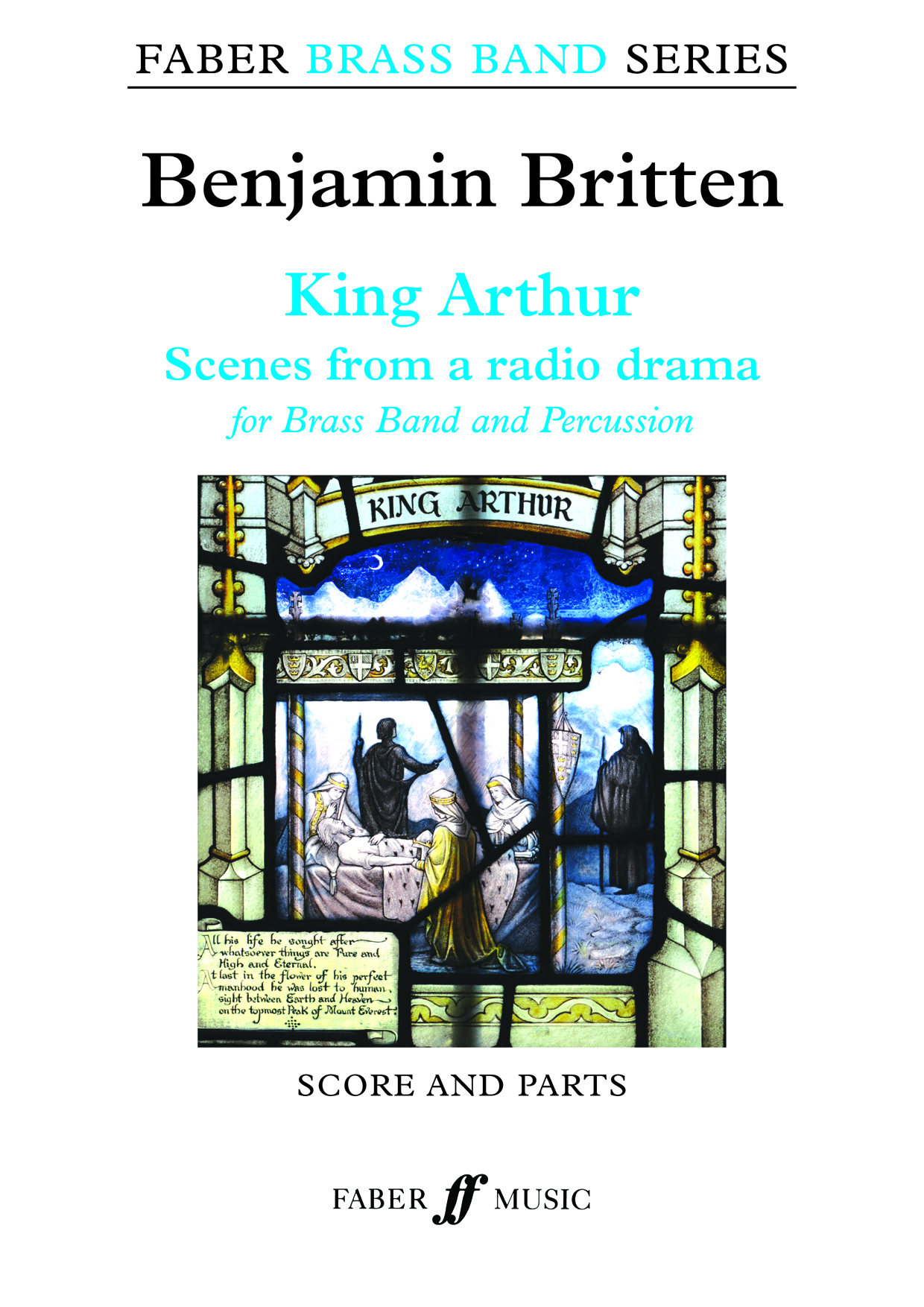
King Arthur (Scenes from a radio drama) was the first of 28 scores Benjamin Britten (1913-1976) composed for radio between 1937 and 1947. It was an ambitious dramatisation of King Arthur's life and times - part pageant, part play, part cantata - written by D.G. Bridson.This colourful suite incorporates the Introduction, a dramatic Wild Dance, some of the music underscoring the scenes for Galahad and The Holy Grail, and two vivid battle scenes, ending with The Final Battle and Apotheosis.
In Stock: Estimated dispatch 1-3 working days
-
 £30.00
Beneath The River Severn (Chris Cobon) - Brass Band Sheet Music Full Score and Parts - LM283
COMPOSER: Chris CobonBeneath The River SevernProgramme NotesBeneath The River Severn follows on, chronologically,from three pieces about steam engines;LMR600 Gordon, Tornado (LNER Peppercorn Class A160163),The Lady Armaghdale and also 'Moments in Brass' Sets 1+2Living 3 miles from the River Severn, the longest river in Great Britain,I regularly cross it on the way to conduct Highley Colliery Brass Band.Beneath The River Severn aims to capture not only the beauty of the river but also the dangerous undercurrents that lie under the calm surface.The length of the complete piece is 4 minutes 11 secondsMusical Traits:Attempting to avoid stereotype water music,I started with sketches based on quartal harmony but inverted (so 5ths)For example, the first run onEuphonium starts on concert pitch G, Hrns = D, Bari=A, 1st Hrn=E etc."A" represents the undercurrent,which has claimed many lives over the years.An 11-note salute to the greatest river piece,Smetana's Vltava, is worked into this sectionSuitable Section 4 Upwards
In Stock: Estimated dispatch 3-5 working days
-
£73.00
Stealing Apples - Fats Waller - Reid Gilje
"Stealing Apples" is an old swing-tune written by Fats Waller. Performances by Benny Goodman and his big band made the song very popular.In this arrangement for brass band, the mallet percussion is very essential. Mallet Percussion presents the melody from letter A and is also featured as soli-instruments from letter L to P. These parts can alternatively be played as vibraphone solo.Please be aware of the balance at letter A. Horn and Trombones must play piano but well articulated. Letter D must sound sparkling and fresh with articulated and powerful trombones and cornets (using straight-mute).Make shue that the 8th-notes are not played too dotted two bars before letter G. Almost even 8th-notes accentuated on the start of the slur is a good tip.Watch the balance at letter H. This part have to sound homogeniously.The soloistic Soprano Cornet at letter Q must be played in the style of Benny Goodan. The accompaniment must not be too powerful from letter R to S. Best of luck with the performance!
Estimated dispatch 7-14 working days