
Results
-
Eye Level - Jack Trombey - Len Jenkins
Eye Level was originally produced for the De Wolfe Music Library and selected by Thames Television for the theme tune to their Netherlands based detective series Van der Valk. Based on a German/Dutch nursery rhyme, which in turn takes its melody line from Mozart's Nozze di Figaro, Dutch composer Jan Stoeckart adapted it under the name Jack Trombey, and Simon Park arranged it for his own orchestra. In 1973 his single was top of the UK charts for 4 weeks and in the top 40 for 22 weeks. It gained the award of a platinum disc. Fully entitled 'Eye Level (Theme from the TV series Van der Valk)', the tune has also been used in various TV adverts for clients such as KLM Royal Dutch Airlines in the 70's and Oranjeboom lager in the 1980's. This new arrangement is straightforward and within the capabilities of most 4th section and village brass bands. The tune is instantly recognisable and ideally suited to fetes, concerts and programmes of light entertainment.
-
The Wombles Song - Mike Batt - Len Jenkins
The Wombles are fictional pointy-nosed, furry creatures that live in burrows, where they aim to help the environment by collecting and recycling rubbish in creative ways. They were created by author Elisabeth Beresford, and originally appeared in a series of children's novels from 1968 that featured the inhabitants of a burrow on Wimbledon Common in London, England.The characters gained a higher national profile in the UK in the mid-1970s as a result of a BBC commissioned children's television show, and a number of spin-off novelty songs also became hits in the British music charts. The Wombles pop group was the idea of British singer and composer Mike Batt who wrote the series' theme tune, and who went on to perform and produce a number of successful albums and singles with 'The Wombles'.This is a brass band arrangement of that well-known theme tune. Caution! This may provoke a sing-along.
-
Introduction & Allegro Spiritoso - Jean Baptiste Senaille - Len Jenkins
Introduction and Allegro Spiritoso appears in many forms within the music compendium, frequently as a piece demonstrating a solo string, woodwind or brass instrument with Piano or other accompaniment. It was originally composed by the baroque composer Jean Baptiste Senaille, and includes the fast 2/4 movement from one of his 50 or so violin sonatas. It is probably one of his most recognised pieces. This arrangement for a brass quintet with optional Glockenspiel is presented in two formats. One is for Brass Band instruments, the other for Orchestral Brass, both with appropriate Parts to match that genre.
-
Merry Christmas Polka - Sonny Burke - Len Jenkins
"Sonny" Burke was an American arranger, composer, Big Band leader and producer who during the 1940s and 1950s worked as an arranger for the Charlie Spivak and Jimmy Dorsey bands, among others. In 1955, along with Peggy Lee, he wrote the songs to Disney's Lady and the Tramp.Later he became musical director of Warner Bros. Records / Reprise Records and was responsible for many of Frank Sinatra's albums, and produced Sinatra's recording of "My Way". He was also the bandleader for recordings of leading singers such as Bing Crosby and The Andrews Sisters a highly successful close harmony singing group of the swing and boogie-woogie eras, and it was with them that Merry Christmas Polka became famous.
-
Codebreakers : Bletchley Park - Len Jenkins - Len Jenkins
Bletchley Park was the centre for Allied codebreaking in World War 2, responsible for decoding secret military codes used by enemy forces, in particular those related to the use of the 'Enigma' and other encoding machines. In the course of its endeavours it developed what was effectively the first electronic computer and brought to prominence the genius of Alan Turing when its wartime work was declassified and made public. The composer, Len Jenkins, still lives near Bletchley Park, went to school nearby, and attended training courses there when, after the war, it was used as a telecommunications training centre. This march is dedicated to the memory of all those who worked at Bletchley Park.
-
 £39.95
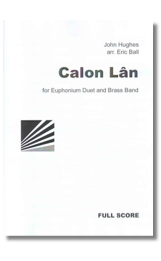
Calon Lan - Eric Ball
Eric Ball originally made this duet arrangement with piano accompaniment for inclusion in our album Czardas (order code 0078) and it was later transcribed for brass band by Eric Wilson (who was named after the composer!). The Welsh tune is handled in turn by the duettists, one embellishing while the other carries the melody. The accompaniment parts are not difficult making this delightful, somewhat nostalgic, piece ideal for bands of all abilities.
Estimated dispatch 7-9 working days
-
 £39.95
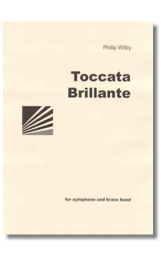
Toccata Brillante - Philip Wilby
Written for the composer's daughter this energetic work involves some four-mallet work and will be enjoyed by capable soloists and audiences alike.
Estimated dispatch 7-9 working days
-
 £49.95
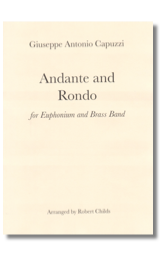
Andante and Rondo - and Robert Childs
Capuzzi was an Italian violinist and composer who worked in Venice in the 1780s. His Concerto for Double Bass is charming and sports simple lines, crisp rhythms, and elegance of form. As a result, it is a great favourite. An ideal addition to recital and exam programmes, the present version of the second and third movements is perfect for young players and professionals alike, and lls a substantial hole in the euphonium repertoire of eighteenth century classics.
Estimated dispatch 7-9 working days
-
 £42.00
Euphonium Music (Score only) - Brian Bowen
Written in 1978, the work is constructed in three movements and is virtually a concerto for euphonium and band. The first movement begins with an unaccompanied motto theme, which uses all twelve notes of the scale but with a tonal feel. The slow second movement is based on an original song melody by the composer - 'The Eyes of God' - and affords lyrical and richly expressive playing that is typically euphonium. Movement three follows without a break - a capricious movement which ends triumphantly. Now available in versions for piano, brass band, wind band, and orchestra, Euphonium Music can be seen as a major contribution to the literature for the instrument. Duration: 15 minutes An orchestral version is available on hire.
Estimated dispatch 7-9 working days
-
 £52.00
Euphonium Music (Parts only) - Brian Bowen
Written in 1978, the work is constructed in three movements and is virtually a concerto for euphonium and band. The first movement begins with an unaccompanied motto theme, which uses all twelve notes of the scale but with a tonal feel. The slow second movement is based on an original song melody by the composer - 'The Eyes of God' - and affords lyrical and richly expressive playing that is typically euphonium. Movement three follows without a break - a capricious movement which ends triumphantly. Now available in versions for piano, brass band, wind band, and orchestra, Euphonium Music can be seen as a major contribution to the literature for the instrument. Duration: 15 minutes An orchestral version is available on hire.
Estimated dispatch 7-9 working days