
Results
-
 £42.00
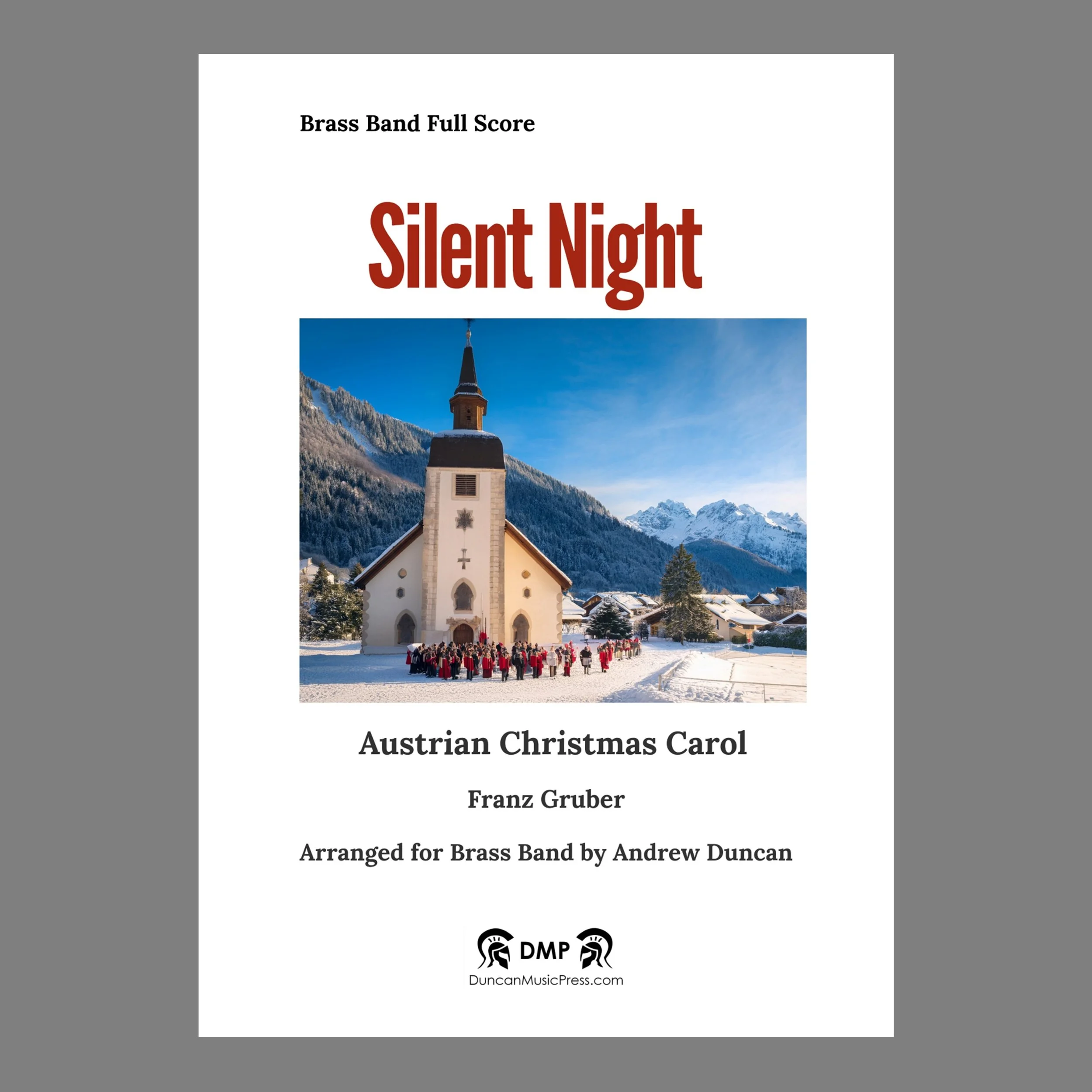
Silent Night. Franz Gruber arranged for brass band by Andrew Duncan
Silent Night is an Austrian Christmas Carol written by Franz Gruber, (1787-1863). Franz Gruber was an primary school teacher, organist and composer who lived in the village of Arndorf in Austria. Silent Night (Stille Nacht) has become one of the best loved Christmas Carols ever written. This arrangement for brass band imagines Christmas morning in a small Austrian village, such as Arndorf, with the sound of the local church bells ringing out along with the sound of a choir singing Silent Night accompanied by the local band.. The arrangement features the tubular bells playing a simple descending scale, which is also played by muted cornets (2nd and 3rd cornets). After 2 verses of the hymn the coda features a short trombone trio with a jazzy feel which leads into a final scale from the tubular bells and cornets bringing the piece to a peaceful close. To hear a sound file of Silent Night scroll down.
-
 £30.00
Ave Verum Corpus (WA Mozart arr. by Alex McGee) - Brass Band Sheet Music Full Score & Parts - LM579 - W. A. Mozart - Alex McGee
COMPOSER: W. A. MozartARRANGER: Alex McGeeThe wonderful Ave Verum Corpus arranged for brass band by Alex McGeeAve verum corpus("Hail, True Body"), (K.618), is amotetinD majorcomposed byWolfgang Amadeus Mozartin 1791. It is a setting of theLatinhymnof the same name. Mozart wrote it for Anton Stoll, a friend who was the church musician ofSt. StephaninBaden bei Wien. The motet was composed for the feast ofCorpus Christi; theautographis dated 17 June 1791. It is scored forSATBchoir,string instrumentsandorgan.LM579 - ISMN : 9790570005796
In Stock: Estimated dispatch 3-5 working days
-
 £37.06
Great is Thy Faithfulness (Brass Band) Runyan arr. Dan Forrest trs. Wainwright
This marvelous setting by Dan Forrest of the classic hymn Great is thy Faithfulness has quickly become a popular item for choirs around the world. This setting for brass band by English composer Andrew Wainwright was commissioned by the Melbourne Staff Band to commemorate Bandmaster Ken Waterworth's final year as Bandmaster before his retirement. It begins with quiet assurance, a beautiful combination of strength and gentleness which continues to build to a dramatic final statement of truth. For bands looking to combine with a choir, this setting is in the same key and format as the original choral version. To view a rolling score video of Melbourne Staff Band performing the piece please visit www.youtube.com/watch?v=bPtXdxaEPHc Duration: Approx. 5.30 minutes Difficulty Level: 3rd Section + PDF download includes parts and score. Sheet music available from www.brassband.co.uk (UK) or www.cimarronmusic.com (USA) Instrumentation: Soprano Cornet Eb Solo Cornet Bb Repiano Cornet Bb 2nd Cornet Bb 3rd Cornet Bb Flugel Horn Bb Solo Horn Eb 1st Horn Eb 2nd Horn Eb 1st Baritone Bb 2nd Baritone Bb 1st Trombone Bb 2nd Trombone Bb Bass Trombone Euphonium Bb Bass Eb Bass BbTimpani Percussion 1-2
In Stock: Estimated dispatch 1-3 working days
-
 £33.35
In the Bleak Midwinter (Brass Band) Holst arr. Mack Wilberg trs. Barrie Gott
A transcription for brass band of Mack Wilberg's popular setting of the much loved carol In the Bleak Midwinter, as sung by The King's Singers and The Choir of King's College, Cambridge at Carols from Kings in 2020. This is a reflective and beautiful arrangement of the classic Gustav Holst Christmas carol and remains faithful to the Wilberg choral setting. The arrangement underpins the well-loved melody with luscious, romantic harmonies, including moments of exquisite chromaticism. To view a rolling score video please visit www.youtube.com/watch?v=t2DbgNgezAQ PDF download includes score and parts. Sheet music available from: UK - www.brassband.co.uk USA - www.cimarronmusic.com Difficulty Level: 4th Section + Length: 5.10 minutes Instrumentation: Soprano Cornet Eb Solo Cornet Bb Repiano Cornet Bb 2nd Cornet Bb 3rd Cornet Bb Flugel Horn Bb Solo Horn Eb 1st Horn Eb 2nd Horn Eb 1st Baritone Bb 2nd Baritone Bb 1st Trombone Bb 2nd Trombone Bb Bass Trombone Euphonium Bb Bass Eb Bass Bb
In Stock: Estimated dispatch 1-3 working days
-
 £30.00
Bandamonium 2024 (Neil Lock) - Brass Band Sheet Music Full Score & Parts - LM541
COMPOSER: Neil LockThis march was submitted to the march composers' competition for "Bandamonium 3"in Hatherleigh, Devon in July 2024. The winning march was played by massed bands at the conclusion of the celebrations on Saturday 27th July 2024. Unfortunately, this march took second place in the competition, behind the march of Paul Pennicotte-Henrie, conductor of Okehampton Silver Band.The march can be played with or without the singing. (Even at the Whit Friday marches, begad!) I suggest that it should be introduced by 3-beat rolls.When played with singing, the "Bandamonium" lyrics (bars 10-13 and 56-57) are to be sung by all players, keeping to their own parts, with appropriate octave adjustment for their individual singing voices. Conductor and percussionists should sing with the main theme (Db and C at bars 10-13, F at 56-57). Listen to the 3rd cornet players!There is an additional part for Singers, in which the trio melody (bars 58 onwards) can be sung by Soprano and Tenor singers at a moderate choir standard. An octave-down option is also provided in the higher bars. This part can be given to "spare" singers within the band, or to singers external to the band if opportunity permits. The lyrics are:We are in Devon,We're in Hatherleigh,Whit Friday heaven,But we're marching free!Now it's past seven,Time to party,At BandamoniumIn Hatherleigh!LM541 - ISMN : 9790570005413
In Stock: Estimated dispatch 3-5 working days
-
£34.95
CHOOSE FREEDOM (Brass Band Set) - Kenneth Downie
Choose Freedom is largely derived from the composers' own setting of Richard Slater's words, 'Yes, there flows a wondrous river' for SATB choir which was published in The Salvation Army's Choral Festival Series under the title 'The mighty river'.After many allusions to the song, it is eventually stated in full in the trio section. Downie's effective use of varying harmonic colours, unusual instrumental voicings and modal harmonies stand out in this rhythmically diverse march. There are quite a few loud passages in the march so conductors should savour the quieter ones!
Estimated dispatch 7-14 working days
-
£24.95
YOU KNOW THAT WE LOVE YOU! (Trombone Feature with Brass Band Set) - Kenneth Downie
First published for SATB choir in 1983, the majestic feel of the melody gave the arranger the idea of featuring it for trombones, demonstrating the tender qualities of the section.
Estimated dispatch 7-14 working days
-
 £33.35
The Risen King (Brass Band) Getty & Townend arr. Andrew Wainwright
VIEW SCORE PDF This scintillating work will be an ideal opener to your band's concert programme. Written at the request of Bandmaster Christopher Ward and the Eastern Michigan Divisional Band of The Salvation Army (USA), it was premiered at the 2019 Autumn Praise Festival in Rochester, Michigan which featured the Eastern Michigan Divisional Band and Choir, and the Chicago Staff Band. The piece is based on the popular modern hymn by Keith and Kristin Getty and Stuart Townend, Come People of the Risen King. To view a video of the New York Staff Band performing the work please visit: https://www.youtube.com/watch?v=o1w7qY2dyvY&t=3s Sheet music available from: UK - www.brassband.co.uk USA - www.solidbrassmusic.com Difficulty Level: 2nd Section + Instrumentation: Soprano Cornet Eb Solo Cornet Bb Repiano Cornet Bb 2nd Cornet Bb 3rd Cornet Bb Flugel Horn Bb Solo Horn Eb 1st Horn Eb 2nd Horn Eb 1st Baritone Bb 2nd Baritone Bb 1st Trombone Bb 2nd Trombone Bb Bass Trombone Euphonium Bb Bass Eb Bass Bb Timpani Percussion 1-3
In Stock: Estimated dispatch 1-3 working days
-
 £73.00
Midwinter (Brass Band with Optional Choir - Score and Parts) - Vilhelmsen, Ingebjorg
This arrangement for full band can be performed both with and without choir. Midwinter is a Christmas song about how the holiday can be a highlight even in the darkest winters. The piece was originally written for brass quartet and choir, for Oslofjord Brass and Vivo Vokal's Christmas concert in 2019.If the piece is performed together with a choir, the dynamics of the band must be balanced with regard to the size of the choir, possibly using sound amplification if necessary.Choir Parts (SATB) available separately.Duration: 4.00
Estimated dispatch 7-14 working days
-
 £24.00
We Wish You a Merry Christmas (Choir with Brass Band - Score and Parts) - Wilkinson, Keith M.
This traditional carol is arranged for band and chorus with optional bell choir. It was designed - and has been used effectively in this way - as a short encore to a Christmas concert. It is possible to invite the audience to join the final chorus (letter C).The publisher permits the user to copy as many Choir and Bell Choir parts as necessary.
Estimated dispatch 7-14 working days
 View Music