
Results
-
 £29.95
Christ the Lord (Brass Band - Score and Parts) - Venables, Marcus
This festival prelude was written for the North York Temple Band to open the 2011 'Glory of Easter' concert. The piece is based on the Welsh tune of Llanfair (T.B. 271), associated with the words 'Christ the Lord is risen today'. The music is meant to be a celebration and awakening of our spirits to rejoice in the awesome wonder that is the Easter story; Christ thre Lord came to die for the worlds sins, but has risen, today!
Estimated dispatch 7-14 working days
-
£14.95
Christ the Lord (Brass Band - Score only) - Venables, Marcus
This festival prelude was written for the North York Temple Band to open the 2011 'Glory of Easter' concert. The piece is based on the Welsh tune of Llanfair (T.B. 271), associated with the words 'Christ the Lord is risen today'. The music is meant to be a celebration and awakening of our spirits to rejoice in the awesome wonder that is the Easter story; Christ thre Lord came to die for the worlds sins, but has risen, today!
Estimated dispatch 7-14 working days
-
 £32.50
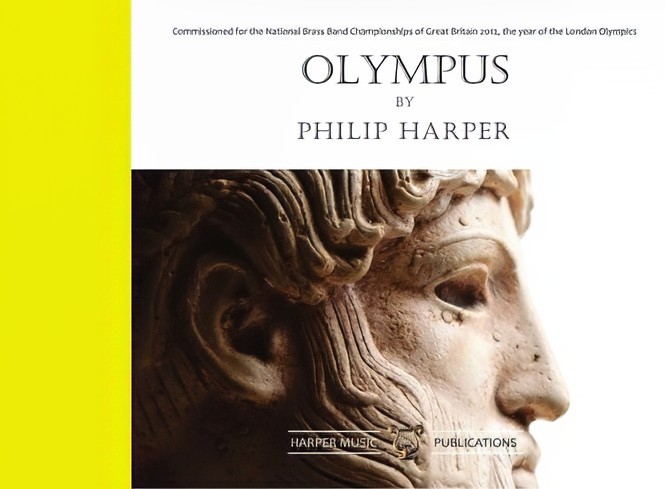
Olympus (Brass Band - Score only) - Harper, Philip
Selected as the test-piece for the 3rd Section Regional contests of the National Brass Band Championships 2012The music begins with a depiction of the exciting Opening Ceremony where noisy fanfares and sudden swells add to the cosmopolitan flag-waving clamour. Without a break the music leads to The Chariot Race, a fast compound-time gallop with thundering hooves in the basses and percussion, and a heroic melody introduced by the tenor horns. Chariot racing was the main equestrian event in the Ancient Greek Games, which were founded in memory of King Oenomaus. In the Greek legend he suffered defeat in a chariot race to his son-in-law and Zeus' grandson, Pelops, but much of the music is bitter-sweet to symbolise the fact that Pelops had to cheat to win - drawing parallels with some of the issues still facing modern-day athletics.A slow, mystical passage follows, describing The Temple of Zeus at Olympia. The statue of Zeus, who was honoured throughout the Ancient Games' history, was housed inside the temple and was one of the Seven Wonders of the Ancient World. The music depicts this period of the dawn of one of mankind's most ancient civilisations and there is a series of solo passages above a drone.The next section is called The Olympic Flame and a broad and lyrical anthem-like melody develops slowly in the euphoniums, which gradually ascends until the horns can take it over before passing upwards again to the cornets (Higher). The music bursts into bright life at the lighting of the flame and the regular rhythmic pattern which has been established goes through an accelerando (Faster).The final section is called The Olympic Truce and aims to capture the cooperative spirit of the ancient practice of ending wars for the duration of the games. The anthem-like melody makes an affirmatory return (Stronger) and the work ends as it began - with a blaze of colour and a real sense of optimism and global celebration.Citius, Altius, Fortius (Faster, Higher, Stonger)Duration: 11:30
Estimated dispatch 7-14 working days
-
£74.99
Olympus (Brass Band - Score and Parts) - Harper, Philip
Selected as the test-piece for the 3rd Section Regional contests of the National Brass Band Championships 2012The music begins with a depiction of the exciting Opening Ceremony where noisy fanfares and sudden swells add to the cosmopolitan flag-waving clamour. Without a break the music leads to The Chariot Race, a fast compound-time gallop with thundering hooves in the basses and percussion, and a heroic melody introduced by the tenor horns. Chariot racing was the main equestrian event in the Ancient Greek Games, which were founded in memory of King Oenomaus. In the Greek legend he suffered defeat in a chariot race to his son-in-law and Zeus' grandson, Pelops, but much of the music is bitter-sweet to symbolise the fact that Pelops had to cheat to win - drawing parallels with some of the issues still facing modern-day athletics.A slow, mystical passage follows, describing The Temple of Zeus at Olympia. The statue of Zeus, who was honoured throughout the Ancient Games' history, was housed inside the temple and was one of the Seven Wonders of the Ancient World. The music depicts this period of the dawn of one of mankind's most ancient civilisations and there is a series of solo passages above a drone.The next section is called The Olympic Flame and a broad and lyrical anthem-like melody develops slowly in the euphoniums, which gradually ascends until the horns can take it over before passing upwards again to the cornets (Higher). The music bursts into bright life at the lighting of the flame and the regular rhythmic pattern which has been established goes through an accelerando (Faster).The final section is called The Olympic Truce and aims to capture the cooperative spirit of the ancient practice of ending wars for the duration of the games. The anthem-like melody makes an affirmatory return (Stronger) and the work ends as it began - with a blaze of colour and a real sense of optimism and global celebration.Citius, Altius, Fortius (Faster, Higher, Stonger)Duration: 11:30
Estimated dispatch 7-14 working days
-
£44.95
Symphony Of Thanksgiving (Brass Band - Score and Parts) - Goffin, Dean
Specially written for the Diamond Jubilee Celebration of The International Staff band in 1951 concluding with 'Praise my soul, the King of Heaven' and a phrase of 'Give to Jesus glory'.
Estimated dispatch 7-14 working days
-
£22.50
Symphony Of Thanksgiving (Brass Band - Score only) - Goffin, Dean
Specially written for the Diamond Jubilee Celebration of The International Staff band in 1951 concluding with 'Praise my soul, the King of Heaven' and a phrase of 'Give to Jesus glory'.
Estimated dispatch 7-14 working days
-
 £59.99
The Earl of Oxford's March (Brass Band - Score and Parts) - Byrd, William
The Battell was written during the late 14th Century when England was in a mood of national celebration after victory over the Spanish and French Armadas. The movement which Byrd called Marche Before The Battell became known as The Earl of Oxford's Marchand it appears with that title in an early manuscript copy of the Fitzwilliam Virginal Book. Written while Byrd was at the height of his powers, it still stirs the soul to this day. A perfect opener for your concert performances.Duration: 4:45
Estimated dispatch 7-14 working days
-
 £59.95
A Caledonian Suite (Brass Band - Score and Parts) - Orr, Buxton
Commissioned by BBC Scotland for the Radio Brass Band Contest "Fanfare 1980"In the spirit of the occasion of the commission and in celebration of the composers Scottish boyhood, is was the intention to invoke the feeling of authentic melodies rather than to use any. The composer has used fragments of characteristic scales, rhythms and melodic patterns, rarely complete melodies, and and has concentrated on varied treatment and juxtaposition rather than direct presentation.Duration: 12.30
Estimated dispatch 7-14 working days
-
£44.95
The Call Of The Righteous (Brass Band - Score and Parts) - Condon, Leslie
The classic Leslie Condon 'Tone Poem', originally written for Tottenham (now Enfield) Citadel Band in the mid 1960's. Based on the old gospel tune 'When the roll is called up yonder', this music became a blueprint of style copied by countless others since. Also featured on Celebration by Croydon Citadel Band.
Estimated dispatch 7-14 working days
-
£22.50
The Call Of The Righteous (Brass Band - Score only) - Condon, Leslie
The classic Leslie Condon 'Tone Poem', originally written for Tottenham (now Enfield) Citadel Band in the mid 1960's. Based on the old gospel tune 'When the roll is called up yonder', this music became a blueprint of style copied by countless others since. Also featured on Celebration by Croydon Citadel Band.
Estimated dispatch 7-14 working days
 View Music