
Results
-
 £34.95
Of Wind & Weeping - Christopher Bond
The relationship between Achilles and Patroclus is a key element of the myths associated with the Trojan war.. Its exact nature has been a subject of dispute in both the classical period and modern times. In the lliad, the two heroes have a deep and meaningful friendship. Achilles is tender towards Patroclus, while he is callous and arrogant towards others. Of Wind & Weeping (2015) is a flugel solo, with the soloist representing Greek warrior Achilles and the pain he faces following the death of Patroclus. For a brief moment, Achilles' character shifts from a strong and unbreakable warrior to an emotional and vulnerable character. The solo should be played with expression and feeling, a character who is mourning a loved one with mixed feelings of sadness, shock and vengeance. The work was written in early 2015 for flugel soloist David James and Tongwynlais Temperance Band, with whom he is a member.
Estimated dispatch 10-14 working days
-
 £19.99
Dear Friends
ABOUT THIS PIECE: Introduce a heartfelt and reflective moment to your next programme with this beautiful arrangement of Dear Friends, originally performed by Freddie Mercury and Queen. Written by Mercury and featured on their 1974 album Sheer Heart Attack, this gentle ballad stands out for its simplicity and emotional sincerity, offering a tender message of gratitude and friendship. This arrangement, crafted for a sextet with band accompaniment, preserves the intimacy of the original. It provides a brief, but soulful showcase for smaller ensemble playing within the band, supported by a sensitive muted accompaniment (this piece can also be played as a simple sextet without the band accompaniment). ENSEMBLE: Sextet (recommended cornet, horn, baritone, trombone, euphonium and Eb bass) with Band accompaniment WHEN YOU BUY THIS PRODUCT, YOU GET: High-quality printed score and parts LEVEL: 1 LISTEN: Click here DURATION: 1-minute 10 secondsEXAMPLE SCORE: Click here LEVEL GUIDE: Level 1- Accessible to all Level 2 - c. UK third section and higher Level 3 - c. UK second section and higher Level 4 - c. UK first section and higher Level 5 - c. UK championship section level
Estimated dispatch 5-7 working days
-
£100.00
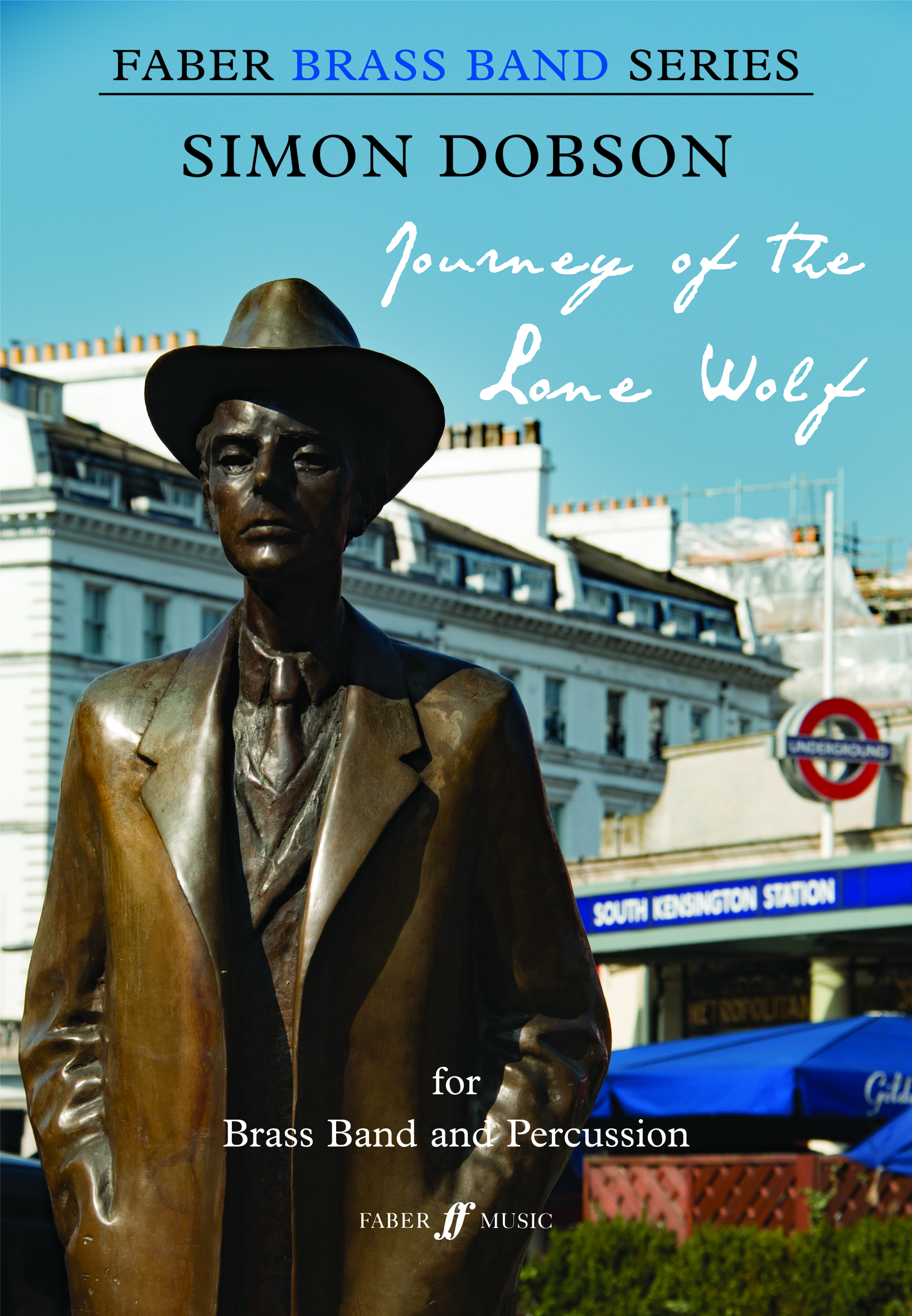
Journey of the Lone Wolf (score & parts) - Simon Dobson
Journey of the Lone Wolf tells the story of the hungarian composer Bla Bartk. It was commissioned by Dr. Nicholas Childs for Black Dyke Band, who gave the first performance on Sunday 26 January 2014 at the Bridgewater Hall, Manchester as part of the Royal Northern College of Music Festival of Brass.The composer's programme notes for each movement: 1. Capturing the Peasants' SongAfter the upheaval of moving to Budapest the young Bla Bartk meets Zoltn Kodly and the pair embark on summertime adventures throughout the Hungarian countryside to collect and catalogue the astonishing variety (both harmonically and rhythmically) of gypsy and folk music heard in the Balkans. The arrival of WW1 plunges Bartk's beloved Hungary into chaos.2. Night MusicBartk was at times a cold man, aloof and lonely. The odd moments of tenderness he showed are portrayed here in a series of evocative solos. His brief but intense affairs speak of a love he could only long for. Jazz is my night music and here there are hints of what Bartk may have heard in the USA later in his life.3. Flight and FightHaving been forced by the world's evils to leave his homeland of Hungary for America, Bartk, the anti-fascist, felt isolated and angry. In this movement we hear his longing for a simpler time of gypsy folk dances as well as his maturity and depth as a composer finally exploring deeper colours and darker themes. Duration: 15 minutes.Level: Championship
In Stock: Estimated dispatch 1-3 working days
-
£70.00
A Tallis Anthem - Geert Jan Kroon
A Tallis Anthem is based on If Ye Love Me by Thomas Tallis (1505-1585). He was one of the first who set English words to the Rites of the Church of England. If Ye Love Me is a classic example of the new English anthems: mainly homophonic, but with brief moments of imitation. The opening is a triumphant version of the first homophonic phrases of the song, interrupted by a calm melody build with material from a motive from the original. The anthem is played by a quartet placed in front of the band or of stage for efect. This is followed by a more modern anthem leading to a triumphant finale.
-
£110.00
The Final Frontier - Geert Jan Kroon
In The Final Frontier, the composer explores different associations with the universe. Inspired by Stephen Hawking's (1942-2018) book Brief Answers to the Big Questions, the piece describes the wonders and dangers of the universe, the big questions about the smallest elements, and the possibility of space travel. The work consists of four movements. The first movement, 'Energy and Space', is the exposition of both main materials. With energy and space, a universe can be created. The second movement, 'The Great Unknown', is a fast section in which the materials are further explored and depicts the dangers of the universe, like supernovae and black holes. The third movement, 'The Big Questions', is a slow movement with different soloists and music of a reflective nature. Imagine how in the tiniest elements, whole dimensions could be rolled up. Also, a Dutch pioneer in cosmology is hidden in the notes. The fourth movement, 'The Final Frontier', is a big build-up to a majestic finale, portraying the excitement of space travel. The Final Frontier was the set test piece of the 3rd section at the Dutch National Brass Band Championships.
-
 £34.95
How To Catch A Killer... - Jonathan Bates
DURATION: 5 minutes. DIFFICULTY: Championship. 'How To Catch A Killer.' was composed as the energetic finale to Carlton Main Frickley Colliery Band's 2nd placed 'Murder in the Night' set at the 2018 Brass In Concert Championships. The piece is built upon a quite complex motif in the tuned percussion, exploring an almost sci-fi-esque soundworld as the identity of the killer is figured out. After the identity of the killer is revealed, there is a brief chase scene before the work draws to a dramatic and fiery conclusion. .
In Stock: Estimated dispatch 1-3 working days
-
 £74.99
Cornet Concerto No.1 - Jonathan Bates
My 'Cornet Concerto No.1' was composed for Lode Violet and Brass Band Willebroek in 2018 and features 2 movements, entitled 'Dystopia' and 'Utopia'. . The nature of the music in the opening section, 'Dystopia', is very jagged, disjointed and unsettling, as the soloist almost battles against the constant churning of the mechanical accompaniment, trying to persevere with it's own ideas and styles without being dragged into conforming to it's surroundings. The movement is based largely on the 3 note interval heard right at the outset of the piece (C, D & G#, a series of notes that lends itself so well to different modes, scales, harmonies and intervals) and this forms much of the rhythmic and harmonic structure of the opening section.Whilst this movement acts as a virtuoso feature to demonstrate the extended capabilities of both the soloist and instrument, I feel the accompanying ensemble plays an equal role in the narrative of 'dystopia', and features a number of demanding and prominent episodes for soloists within the accompanying band. A short and heavy coda concludes the movement, with a sense of real pain and sorrowfulness as the music fades away into darkness. . 'Utopia' opens in an instantly more hopeful nature, with the soloist introducing the first real 'theme' of the movement, taken up shortly by the accompaniment. Throughout this movement, there are a number of timbral and melodic references back to the darkness of 'dystopia', but transformed into a much more positive outlook and soundworld. There is a moment of quiet reflect (using the initial 3 note cell as a basis) before flying head first into a frenzied wild 'tarantella' like section, full of joy and energy which tests the dexterity and light-natured approach to virtuosity (much unlike the heavier material in the 1st movement) of the soloist. Primarily, the concept of this finale is fun - joy, happiness, and freedom from restraint, so the addition of a quirky 'tongue-in-cheek' habanera section offers a brief moment of respite from the craziness of the tarantella. To conclude the work, there is an extended cadenza for the soloist which is built on several motifs heard throughout the concerto, which leads the band into a dramatic and energetic final few bars.. Jonathan Bates. (2018). .
In Stock: Estimated dispatch 1-3 working days
-
 £30.00
Concerto for Two Trumpets & Brass Band - Bb or Eb Duet & Brass Band Sheet Music Full Score & Parts- LM601
COMPOSER: Antonio VivaldiTRANSCRIBED : Daniel S. AugustineThe great duet from Vivaldi is now available for two players with brass band accompanimentThe soloists can be two Eb soprano cornets, 2 Bb Cornets or one of each.A chance to let your soloists shine with authentic backing transcribed from Vivaldi original score.Definitely one for your next concert.Concerto for Two Trumpets in C Major, double concerto for trumpets and strings byAntonio Vivaldi, one of the few solo works of the early 1700s to feature brass instruments. It is the only such piece by Vivaldi.The rarity of Vivaldi'sConcerto for Two Trumpetsstems from the difficulties inherent in the Baroque trumpet. At the time, trumpets were natural, or valveless. The instrument's range was quite restricted, and much depended on the performer's lip control, as with the modern bugle.As with the great majority of Vivaldi's concertos, this one begins with a quick and sparkling movement to catch the attention of the audience and to showcase the bright tones of the solo trumpets. This is followed by a languid and very brief second movement, with fanfare-like passages from the soloists overlaying sustained string tones. For the final movement, Vivaldi returned to brilliant mode with quick energy and intricate passages for the soloists.
In Stock: Estimated dispatch 3-5 working days
-
 £25.00
Eloise (Paul Ryan arr. David Beal) (The Damned - Barry Ryan) - Brass Band Sheet Music Full Score & Parts - LM368
COMPOSER: Paul RyanARRANGER: David BealISMN : 9790570003686UK SALES ONLYPDF DOWNLOAD - NOT AVAILABLE DUE TO COPYRIGHTSuperb Opener or closer for your next Concert!A great brass band title suitable for most bandsPROGRAMME NOTESBarry Ryan - 1968"Eloise" is a song first released in 1968 on theMGMlabel.It was sung byBarry Ryan, and written by histwinbrotherPaul Ryan.Running for over five minutes, it features strongorchestration,melodramaticvocals, and a brief slowinterlude.It sold three million copies worldwide,and reached No. 2 in theUK Singles Chartas published byRecord Retailer,but hit No. 1 in theNMEandMelody Makercharts.It topped the chart in 17 countries,including Italy,the Netherlandsand Australia.The single was released as "Barry Ryan with the Majority".The Majority were a pop band, who for a period, were the backing band for Ryanand who, after renaming to Majority One, had some success in Europe.Ryan also released an Italian-language version of the song,"Eloise (Versione Italiana)", in 1968.After not being able to cope with the success of some of his hits as a duo with Barry,Paul decided to take a step away from the limelight and to concentrate on songwriting."Eloise" was the second song he wrote and was influenced byRichard Harris'arrangement of "MacArthur Park"after listening to a rough mix of it at a party at Harris' house.After listening to it, Paul locked himself away and wrote "Eloise" in three days.The Damned - 1986In January 1986, the non-album single "Eloise",a cover version of the 1968 hit byBarry Ryan,was a No.3 chart success in the UK,the band's highest chart placing to date.LM368 - ISMN : ISMN : 9790570003686
In Stock: Estimated dispatch 3-5 working days
-
 £65.00
Second Suite in F - Brass Band Sheet Music Full Score & Parts - LM602 - Gustav Holst
COMPOSER: Gustav HolstTRANSCRIBED : Daniel S. AugustineA brand transcription from Holst's manuscript score for brass band.A very authentic version from the original for Military Band.Can be used as a testpiece in your next own choice contestSuitable for Section 3 bands upwardsSecond Suite in FOp. 28, No. 2 (1922)1. MarchThe "March" of the Second Suite begins with a simple five note motif between the low and high instruments of the band. The first folk tune is heard in the form of a traditional British brass band march using the morris-dance tune "Glorishears". After a brief climax, the second strain begins with a euphonium solo playing the second folk tune in the suite "Swansea Town". The theme is repeated by the full band before the trio. For the trio, Holst modulates to the unconventional subdominant minor of Bb minor and changes the time signature to 6/8, thereby changing the meter. Usually one would modulate to subdominant major in traditional march form. While Sousa, reputably the "king of marches", would sometimes change time signatures for the trio (most notably in "El Capitan"), it was not commonplace. The third theme, called "Claudy Banks",[2] is heard in a low woodwind soli, as is standard march orchestration. Then the first two tunes are repeated da capo.2. Song without Words "I'll Love My Love"Holst places the fourth folk song, "I'll Love My Love" in stark contrast to the first movement. The movement begins with a chord and moves into a solo over a flowing accompaniment. The solo is then repeated, forming an arc of intensity. The climax of the piece is a fermata, followed by a cornet pick-up into the final measures of the piece.3. Song of the BlacksmithAgain, Holst contrasts the slow second movement to the rather upbeat third movement which features the folk song "A Blacksmith Courted Me". There are many time signature changes (4/4 to 3/4) making the movement increasingly difficult because the accompaniment has a pick up on the up-beats of each measure. The band joins in on the melody around the body of the piece and are accompanied with the sound of a blacksmith forging metal with an anvil called for in the score. The final major chord has a glorious, heavenly sound, which opens way to the final movement.This chord works so effectively perhaps because it is unexpected.4. Fantasia on the "Dargason"This movement is not based on any folk songs, but rather has two tunes from Playford's Dancing Master of 1651. The finale of the suite opens with a solo based on the folk tune "Dargason", a 16th-century English dance tune included in the first edition of The Dancing Master. The fantasia continues through several variations encompassing the full capabilities of the band. The final folk tune, "Greensleeves", is cleverly woven into the fantasia by the use of hemiolas, with Dargason being in 6/8 and Greensleeves being in 3/4. At the climax of the movement, the two competing themes are placed in competing sections.As the movement dies down, a duet forms a call back to the beginning of the suite with the competition of low and high registers.The name 'dargason' may perhaps come from an Irish legend that tells of a monster resembling a large bear (although much of the description of the creature has been lost over time), the Dargason tormented the Irish countryside. During the Irish uprising of the late 18th century, the dargason is supposed to have attacked a British camp killing many soldiers. This tale aside, 'dargason' is more likely derived from an Old English word for dwarf or fairy, and the tune has been considered English (or Welsh) since at least the 16th century. It is also known as 'Sedony' (or Sedany) or 'Welsh Sedony'.
In Stock: Estimated dispatch 3-5 working days
 View Music
