
Results
-
 £5.00
£5.00O Mio Babbino Caro (Trombone or Horn Solo and Piano Accompaniment)
This famous aria is from the opera Gianni Schicchi. Lauretta, daughter of Gianni Schicchi, has fallen in love with Rinuccio but there are huge tensions between their two families which threaten to keep the young couple apart. The rather discordant music which opens portrays these tensions before giving way to Lauretta's tender appeal to her father to allow her to marry the man she loves. A brass band arrangement of this aria was prepared at the request of Brett Baker to be performed with Brass Band Of The Western Reserve, musical director Dr Keith M Wilkinson, during his visit in May, 2011. This piano accompaniment version will make this beautiful music accessible to more soloists.Parts included for Trombone BC, Trombone TC, Eb Horn, F Horn and Piano Accompaniment
Estimated dispatch 7-14 working days
-
 £29.50
Brass Monkey's Selection I
This selection introduced your learning band to a March and a Waltz. There is also a spooky item and an arrangement of the well-known and loved "Grandfather's Clock". PENNINE MARCH GOOLE-Y-GHOST WAKEFIELD WALTZ GRANDFATHER'S CLOCK
Estimated dispatch 7-14 working days
-
 £15.00
In the Hall of the Mountain King - Grieg
Performance Notes from Andrew Duncan:This arrangement is fairly difficult for inexperienced players and is without doubt one of the most difficult in the Flexi-Collection Popular Classics Series. But, as it is such a popular piece there is normally a great incentive from the players to learn the piece, despite the difficulties.The accelerando and gradual increases in tempo which are integral to this piece are in themselves very important musical ideas for new players to grasp, and these will be better understood as a result of playing and learning this arrangement.Other features found in this arrangement which may be new to some inexperienced players are the use of tin mutes in the 1st Cornet/Trumpet part, and the falling chromatic notes (accidentals) found in the melody line. Also, the wide range of dynamics, pp - ff , may be new to some players.I have deliberately not suggested any specific metronome markings as this is very much up to the conductor and is dependant on the players' abilities. However, as the arrangement becomes more familiar, the tempo could no doubt be speeded up adding to the excitement of future performances.The Flexi-Collection ApproachFlexible scoring tailored to your needs - A perfect solution for expanding the repertoire of training and junior brass bands. The Flexi-Collection currently offers two series - Popular Classics and World Tour. Based on four-part harmony, these collections provide groups with the advantage of complete flexibility when they may not be balanced. If players or instruments are missing, the show can still go on!The Flexi-Collection - Popular Classics Series, encapsulates all that is great about the wonderful range of musical styles produced by Holst, Elgar, Handel, Verdi, Tchaikovsky, Grieg, Bizet and Parry.The thoughtful scoring and arranging by Andrew Duncan now means that groups of all abilities have access to a truly flexible set of music for their needs. With world parts, rudimentary theory, terminology translations and large format typesetting, The Flexi-Collection ticks all the boxes when it comes to bringing interesting music to the training and junior band/brass group environment.Available individually or as part of the money-saving Flexi-Collection Popular ClassicsAlbum.Scored for Brass Band and supplied with additional Easy Bb, Easy Eb and world parts - The Flexi-Collection offers flexibility in every sense of the word.
In Stock: Estimated dispatch 3-5 working days
-
 £34.50
The Wanderer - Hymn Tune Arrangement
ABOUT THIS PIECE: Written for the Haydock Band in memory of their late president, Stan Gardner, this is a beautifully simple take on the hymn tune: Stella. The title comes from the words of often sung to this hymn, written by John Lingard: 'Pray for the wanderer, pray for me'. Before the whole hymn is heard, the band play a repeated melody that evokes feelings of movement. There is an interplay between new and old melody, before a rousing rendition of the hymn by forte band. The arrangement concludes with the opening melody disappearing into the distance - a musical representation of the arranger's sentiments written at the top of the score: 'May God bless your onward journey, dear friend'. ENSEMBLE: Standard British Brass Band WHEN YOU BUY THIS PRODUCT, YOU GET: High-quality printed score and parts LEVEL: 1 LISTEN: DURATION: 5-minutesEXAMPLE SCORE: Click here LEVEL GUIDE: Level 1- Accessible to all Level 2 - c. UK third section and higher Level 3 - c. UK second section and higher Level 4 - c. UK first section and higher Level 5 - c. UK championship section level
Estimated dispatch 5-7 working days
-
 £34.99
I'll be there for you (theme from Friends)
Recommended for - Suitable for all bands An arrangement for brass band by Andrew Duncan of I'll Be There For You' the celebrated theme tune by The Rembrandt's for the ever-popular TV Sitcom, Friends. Includes Score & Parts
-
 £42.00
Partita for Band (Postcards from Home) (Score only) - Philip Wilby
The sound and culture of brass bands was part of Philip Wilby's childhood, and this short Partita seeks to commemorate his childish memories in the musical terms of today's currency. Although the music makes technical demands on the players the piece is, nevertheless designed to involve rather than impress its audiences. There are four movements: 'Towers and Chimneys' which is both heraldic and mysterious; 'Churches: Lord of the Dance' is an arrangement of the famous shaker melody made popular in Martin Shaw's hymn of Jesus' life and history; 'Pastorale: Sunday Afternoon recalls those long and languorous days before television, and 'Coronation Day Parade' - a community celebration with a brass band at its centre. Duration: 12:00
Estimated dispatch 7-9 working days
-
 £52.00
Partita for Band (Postcards from Home) (Parts only) - Philip WIlby
The sound and culture of brass bands was part of Philip Wilby's childhood, and this short Partita seeks to commemorate his childish memories in the musical terms of today's currency. Although the music makes technical demands on the players the piece is, nevertheless designed to involve rather than impress its audiences. There are four movements: 'Towers and Chimneys' which is both heraldic and mysterious; 'Churches: Lord of the Dance' is an arrangement of the famous shaker melody made popular in Martin Shaw's hymn of Jesus' life and history; 'Pastorale: Sunday Afternoon recalls those long and langorous days before television, and 'Coronation Day Parade' - a community celebration with a brass band at its centre. Duration: 12:00
Estimated dispatch 7-9 working days
-
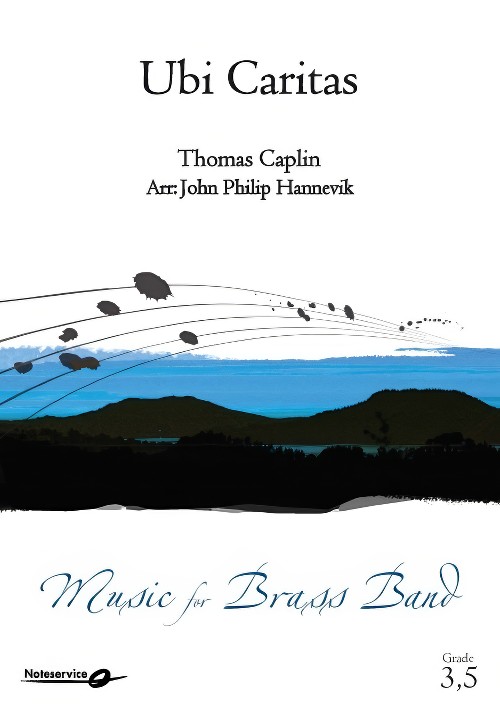 £73.00
Ubi Caritas (Brass Band - Score and Parts) - Caplin, Thomas - Hannevik, John Philip
Thomas Caplin is a Swedish professor of choral conducting. He works at the Inland Norway University of Applied Sciences in Hamar. He composed this beautiful opus for choir based on the ancient text Ubi caritas.The text is often used during Maundy Thursday, describing Jesus washing the feet of his disciples: Where charity and love are, there God isIn this arrangement, a smaller group of players are soloists. The arrangement will work well if the group can be placed on a gallery or at the back of the concert hall.Duration: 5.00
Estimated dispatch 7-14 working days
-
 £24.95
The Pilgrim's Prayer (Brass Band - Score and Parts) - Rouse, Sydney - Ball, Eric
Introduction - This could hardly be more simple. Inexperienced players may have some little difficulty in intonation, especially as they are starting 'cold', but a useful lesson can be learned in this connection when rehearsing these two bars. Section A - The music is hymn tune-like in character, but it should not become stilted. Close intonation is still a point to study, especially in view of the chromatic nature of some of the harmony. Section B - Aim to secure just balance in the accompanying parts, especially in the second phrase, where the 1st comets may be inclined to treat their moving part as an independent melody rather than part of the 'colour' background. Section C -This is a reprise of the first theme, with a different arrangement. The same comments apply, however. Section D - Here the music becomes more song-like in style, and provides an interesting contrast. The scoring, too, is more varied, and there are a number of points that call for attention. Note that the 1st and 2nd comets and 2nd trombone work as a team throughout; see that the pulsating, syncopated background adds to the movement of the music without giving a jerky effect; the new entries in the fourth and twelfth bars are to be made quite smoothly; and do not allow the texture of the music, especially in the last eight bars of the section, to overshadow the simplicity of the main tune. Section E - Here the first subject appears again. In the arrangement the colour contrasts are quite clear-cut. In order to secure true balance in the fifth and sixth bars, it may be necessary to adjust the amount of tone given by the bass trombone, as this part is not doubled as are the other parts. Section F -This section forms a simple but expressive coda.
Estimated dispatch 7-14 working days
-
£12.50
The Pilgrim's Prayer (Brass Band - Score only) - Rouse, Sydney - Ball, Eric
Introduction - This could hardly be more simple. Inexperienced players may have some little difficulty in intonation, especially as they are starting 'cold', but a useful lesson can be learned in this connection when rehearsing these two bars. Section A - The music is hymn tune-like in character, but it should not become stilted. Close intonation is still a point to study, especially in view of the chromatic nature of some of the harmony. Section B - Aim to secure just balance in the accompanying parts, especially in the second phrase, where the 1st comets may be inclined to treat their moving part as an independent melody rather than part of the 'colour' background. Section C -This is a reprise of the first theme, with a different arrangement. The same comments apply, however. Section D - Here the music becomes more song-like in style, and provides an interesting contrast. The scoring, too, is more varied, and there are a number of points that call for attention. Note that the 1st and 2nd comets and 2nd trombone work as a team throughout; see that the pulsating, syncopated background adds to the movement of the music without giving a jerky effect; the new entries in the fourth and twelfth bars are to be made quite smoothly; and do not allow the texture of the music, especially in the last eight bars of the section, to overshadow the simplicity of the main tune. Section E - Here the first subject appears again. In the arrangement the colour contrasts are quite clear-cut. In order to secure true balance in the fifth and sixth bars, it may be necessary to adjust the amount of tone given by the bass trombone, as this part is not doubled as are the other parts. Section F -This section forms a simple but expressive coda.
Estimated dispatch 7-14 working days
 View Music