
Results
-
 £33.62
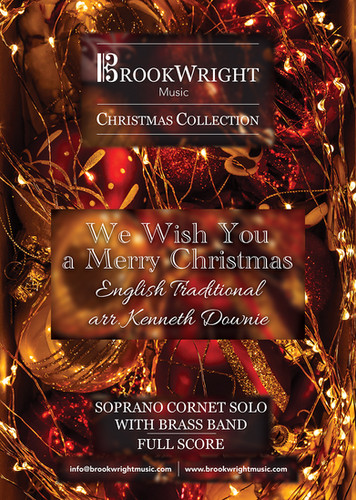
We Wish You a Merry Christmas (Soprano Cornet Solo with Band) arr.Kenneth Downie
This light-hearted soprano cornet feature offers a fresh and entertaining take on the well-known Christmas carol We Wish You a Merry Christmas. Thought to date back to 16th-century England, the carol reflects a tradition of festive singing outside the homes of the well-to-do - often accompanied by requests for treats such as figgy pudding, a forerunner of today's Christmas pudding. Kenneth Downie's arrangement embraces the jovial spirit of the original, pairing nimble soprano cornet writing with bright, colourful scoring for brass band. The famous refrain, 'And we won't go until we've got some', sets the tone: cheerful, a touch cheeky, and full of seasonal good humour. To view a rolling score video of the work featuring Gary Fountain, please visit www.youtube.com/watch?v=3WCW9oBw-mY A version of this solo is available as part of the Sounds of the Season series, with both piano accompaniment and MP3 orchestral backing track, available here. Difficulty Level: 3rd Section + PDF download includes parts and score. Sheet music available at www.brassband.co.uk (UK) or https://satradecentral.org (USA) Instrumentation: Soprano Cornet Soloist Eb Solo Cornet Bb Repiano Cornet Bb 2nd Cornet Bb 3rd Cornet Bb Flugel Horn Bb Solo Horn Eb 1st Horn Eb 2nd Horn Eb 1st Baritone Bb 2nd Baritone Bb 1st Trombone Bb 2nd Trombone Bb Bass Trombone Euphonium Bb Bass Eb Bass Bb Percussion 1-4
In Stock: Estimated dispatch 1-3 working days
-
 £33.62
With the heart (Brass Band) Andrew Batterham
With the heart is a fanfare full of energy and celebration. The title references a quote from the book The Little Prince by Antoine de Saint-Exupery: "it is only with the heart that one can see rightly, what is essential is invisible to the eye". This aesthetic links the passion of music to the giving ethos of the Rotary organisation, whose District 9800 commissioned the work for their 2024 District Conference. With the Heart was premiered by the Victorian Youth State Brass Band directed by Phillipa Edwards in Bendigo in April 2024. To listen to a performance by Victorian State Youth Brass Band please click here. Duration: Approx. 3.15 minutes Difficulty Level: 4th Section + PDF download includes parts and score. Sheet music available from www.brassband.co.uk Instrumentation: Soprano Cornet Eb Solo Cornet Bb Repiano Cornet Bb 2nd Cornet Bb 3rd Cornet Bb Flugel Horn Bb Solo Horn Eb 1st Horn Eb 2nd Horn Eb 1st Baritone Bb 2nd Baritone Bb 1st Trombone Bb 2nd Trombone Bb Bass Trombone Euphonium Bb Bass Eb Bass Bb Percussion 1-3
In Stock: Estimated dispatch 1-3 working days
-
 £37.35
World War III (Brass Band) Joe Galuszka
This descriptive work for brass band by Joe Galuszka depicts the horrors of war. War is all around us. Every day, another life is lost. Myanmar, Sudan, Ethiopia, Ukraine, Colombia, Afghanistan, Somalia, Syria and Yemen. As time goes on, more and more countries are brought to the end of what is a diplomatic struggle - in where war seems to be the only option. 'War! Terror! Panic! captures the tumultuous and relentless nature of war. With driving rhythms, aggressive brass fanfares, and thundering percussion, the listener is immersed in the chaos of battle. Dissonance and clashing harmonies depict the discord that pervades war and takes us on a journey through the terror and panic that comes with the brutality of conflict. Remembrance (For Those That We Have Lost) provides a poignant and reflective interlude, allowing the audience to contemplate the human cost of war. Mournful melodies and expressive solos for trombone, euphonium and glockenspiel, convey the depth of sorrow and loss, serving as a powerful reminder of the toll war takes on individuals and communities. The final movement, Hymn for Peace and Hope is a testament to the enduring human spirit and the yearning for harmony - dissonance and conflict gradually give way to consonance and resolution. We celebrate the human capacity for unity and the triumph of peace over strife, as we imagine a world at piece. To listen to an audio demo of the work please visit https://on.soundcloud.com/Udt1AWRThgwuWnQv5 Duration: Approx. 5.00 mins Difficulty Level: 2nd Section + PDF download includes parts and score. Sheet music available from www.brassband.co.uk (UK) or https://satradecentral.org (USA) Instrumentation: Soprano Cornet Eb Solo Cornet Bb Repiano Cornet Bb 2nd Cornet Bb 3rd Cornet Bb Flugel Horn Bb Solo Horn Eb 1st Horn Eb 2nd Horn Eb 1st Baritone Bb 2nd Baritone Bb 1st Trombone Bb 2nd Trombone Bb Bass Trombone Euphonium Bb Bass Eb Bass Bb Timpani Percussion 1-3
In Stock: Estimated dispatch 1-3 working days
-
 £33.62
You're Always There (Brass Band) Lee Fisher arr. Andrew Wainwright
One of BrookWright's most popular titles, this piece is based on an original song by Lee Fisher which was written for Britain's Got Talent star Charlie Green. Originally arranged as a tenor horn solo with brass band, it is now available here as a standalone work for band. To view a follow-the-score video please visit www.youtube.com/watch?v=suzzgdxU_xU PDF download includes score and parts. Sheet music available from: UK - www.brassband.co.uk USA - https://satradecentral.org Difficulty Level: 4th Section + Length: 3.45 minutes Instrumentation: Soprano Cornet Eb Solo Cornet Bb Repiano Cornet Bb 2nd Cornet Bb 3rd Cornet Bb Flugel Horn Bb Solo Horn Eb 1st Horn Eb 2nd Horn Eb 1st Baritone Bb 2nd Baritone Bb 1st Trombone Bb 2nd Trombone Bb Bass Trombone Euphonium Bb Bass Eb Bass Bb Timpani Percussion 1-2
In Stock: Estimated dispatch 1-3 working days
-
 £89.95
Revelation (Score and Parts)
Symphony for Double Brass on a theme of Purcell 1995 marked the tercentenary of Purcell's death, and my new score Revelation has been written as a tribute to his music and the ornate and confident spirit of his age. There are five major sections: 1 Prologue 2 Variations on a ground bass I 3 Fugue 4 Variations on a ground bass II 5 Epilogue and Resurrection The score uses many features of the Baroque Concerto Grosso, and arranges players in two equal groups from which soloists emerge to play in a variety ofvirtuoso ensembles. It quotes freely from Purcell's own piece Three Parts on a Ground in which he has composed a brilliant sequence of variations over a repeating six-note bass figure. This original motif can be heard most clearly beneath the duet for Cornet 5 and Soprano at the beginning of the 2nd section. There is, of course, a religious dimension to Revelation as the title suggests, and the score is prefaced by lines by the 17th century poet John Donne. His Holy Sonnet paraphrases the Book of Revelation in which the dead are raised at the sounds of the last trumpet. Donne's trumpets are themselves placed stereophonically ". . . At the round Earth's imagined corners" and it is this feature that today's players represent as they move around the performing area. Their final apocalyptic fanfares can be heard at the close of the score, as Purcell's music re-enters in a lasting tribute to England's first composer of genius. Philip Wilby September 1995 At the round Earth imagined corners, blow your trumpets, angels, and arise, arise from death, you numberless infinities Of souls, and to your scattered bodies go. All whom the flood did, and fire shall o 'erthrow All whom war, dearth, age, agues, tyrannies, Despair, law, chance hath slain, and you whose eyes Shall Behold God, and never taste death woe. John Donne after Revelation Ch. 11 v.15
Estimated dispatch 7-14 working days
-
 £44.95
Revelation (Score Only)
Symphony for Double Brass on a theme of Purcell 1995 marked the tercentenary of Purcell's death, and my new score Revelation has been written as a tribute to his music and the ornate and confident spirit of his age. There are five major sections: 1 Prologue 2 Variations on a ground bass I 3 Fugue 4 Variations on a ground bass II 5 Epilogue and Resurrection The score uses many features of the Baroque Concerto Grosso, and arranges players in two equal groups from which soloists emerge to play in a variety ofvirtuoso ensembles. It quotes freely from Purcell's own piece Three Parts on a Ground in which he has composed a brilliant sequence of variations over a repeating six-note bass figure. This original motif can be heard most clearly beneath the duet for Cornet 5 and Soprano at the beginning of the 2nd section. There is, of course, a religious dimension to Revelation as the title suggests, and the score is prefaced by lines by the 17th century poet John Donne. His Holy Sonnet paraphrases the Book of Revelation in which the dead are raised at the sounds of the last trumpet. Donne's trumpets are themselves placed stereophonically ". . . At the round Earth's imagined corners" and it is this feature that today's players represent as they move around the performing area. Their final apocalyptic fanfares can be heard at the close of the score, as Purcell's music re-enters in a lasting tribute to England's first composer of genius. Philip Wilby September 1995 At the round Earth imagined corners, blow your trumpets, angels, and arise, arise from death, you numberless infinities Of souls, and to your scattered bodies go. All whom the flood did, and fire shall o 'erthrow All whom war, dearth, age, agues, tyrannies, Despair, law, chance hath slain, and you whose eyes Shall Behold God, and never taste death woe. John Donne after Revelation Ch. 11 v.15
Estimated dispatch 7-14 working days
-
 £19.99
Dear Friends
ABOUT THIS PIECE: Introduce a heartfelt and reflective moment to your next programme with this beautiful arrangement of Dear Friends, originally performed by Freddie Mercury and Queen. Written by Mercury and featured on their 1974 album Sheer Heart Attack, this gentle ballad stands out for its simplicity and emotional sincerity, offering a tender message of gratitude and friendship. This arrangement, crafted for a sextet with band accompaniment, preserves the intimacy of the original. It provides a brief, but soulful showcase for smaller ensemble playing within the band, supported by a sensitive muted accompaniment (this piece can also be played as a simple sextet without the band accompaniment). ENSEMBLE: Sextet (recommended cornet, horn, baritone, trombone, euphonium and Eb bass) with Band accompaniment WHEN YOU BUY THIS PRODUCT, YOU GET: High-quality printed score and parts LEVEL: 1 LISTEN: Click here DURATION: 1-minute 10 secondsEXAMPLE SCORE: Click here LEVEL GUIDE: Level 1- Accessible to all Level 2 - c. UK third section and higher Level 3 - c. UK second section and higher Level 4 - c. UK first section and higher Level 5 - c. UK championship section level
Estimated dispatch 5-7 working days
-
 £32.00
The Cistercians
DescriptionThe Cistercianswas written during December 2003 and January 2004 as an entry for Morecambe Band's Centenary New Music Competition, which it went on to win. The first two performances were at the final of this competition, part of the band's 100th Anniversary Concert at The Dome in Morecambe on 9 July 2004.The music was inspired by visits to three of Britain's great Cistercian Abbeys; Valle Crucis, Fountains and Rievaulx. The Cistercian Order was founded at Citeaux in France in the 11th Century and was based on the principles of austerity, humility and piety. Cistercian Abbeys were deliberately sited in remote, difficult areas. Despite this many of them, especially Rievaulx, became immense centres of commerce and power, with ever more complex administration and hierarchies.In a way the music reflects this; all the material in the piece is derived from two simple motifs played by flugel and solo horn in the opening bars and becomes more complex and further removed from the original material as the piece develops. After a tranquil opening section a fugal chorale develops over a medieval-style "tenor" - a stretched out version of one of the original motifs. A burst of semiquavers leads into a faster, folk-dance type section - our medieval abbey has become a bustling trade centre - before rhythmic quaver pulses in the horns and cornets accompany powerful chords in the low brass; this is another "tenor" derived from the opening motifs. A short development section, including the folk dance "hocketing" round the band and a slightly disjointed 10/8 section leads to a restatement of the fugal chorale from the beginning before a frenetic coda brings the work to a triumphant conclusion.Performance Notes:Percussion instruments required are Bass Drum, Suspended Crash Cymbal, Glockenspiel, 2 x Tom-toms, Snare Drum, Tambourine, Tam-Tam, 2 x Timpani (G-C, C-F), Triangle, Wood Block. All cornets will require metal stratight mutes and all except soprano require cup mutes. All trombones require cup and metal straight mutes.You can follow a preview of the score in the video below.
Estimated dispatch 7-14 working days
-
£30.00
The Djebels
A rousing opening section with impressive countermelodies lead to a middle section in the relative major. Here, the tune is put into the bass parts with some interjections from the upper parts. The final section is a stately chorale reminiscent of Elgar at his finest! Straightforward phrasing and relatively straightforward parts make this accessible to the majority of bands.
-
 £14.94
Finale from Symphony No.3 (Organ Symphony) (Brass Band) Additional Parts
Saint-Saens' magnificent Finale from Symphony No.3 (widely known as the 'Organ Symphony') has here been arranged for brass band with optional organ by Kevin Norbury. It was recorded by The International Staff Band on its CD Manuscripts, although this version has been revised in places. Saint-Saens decided to add the organ and piano to his 3rd symphony as a pragmatic orchestration innovation. The composition of this symphony was probably started in 1885 and a first draft was completed in Prague in 1886. Saint-Saens later recalled its eventful genesis: 'The Symphony in C was three-quarters sketched out when I found it impossible to write the finale. I did not know how to resolve this situation, until one night I suddenly woke up and, in a sort of hallucination, I heard the whole finale, which I hastily wrote down in outline, knowing that if I went back to sleep without having put anything on paper, I would have forgotten it all the next day.' The symphony was first performed under the composer's direction at Saint James's Hall in London on May 19, 1886. This arrangement by Kevin Norbury can both function as a stand-alone brass band piece, and be performed with an organ by omitting the notes found in square brackets in the parts and score. To view a rolling score video please visit www.youtube.com/watch?v=OlUd_FppBY8 PDF download includes additional parts as listed below. Full set including score available here. Sheet music available from: UK - www.brassband.co.uk USA - https://satradecentral.org Difficulty Level: 1st Section + Length: 8.30 mins. Alternative Parts included in this download: Solo Horn F 1st Horn F 2nd Horn F 1st Baritone B.C. 2nd Baritone B.C. 1st Trombone B.C. 2nd Trombone B.C. Euphonium B.C. Tuba 1 B.C. (Bass Eb equivalent) Tuba 2 B.C. (Bass Bb equivalent)
In Stock: Estimated dispatch 1-3 working days