
Results
-
 £54.95
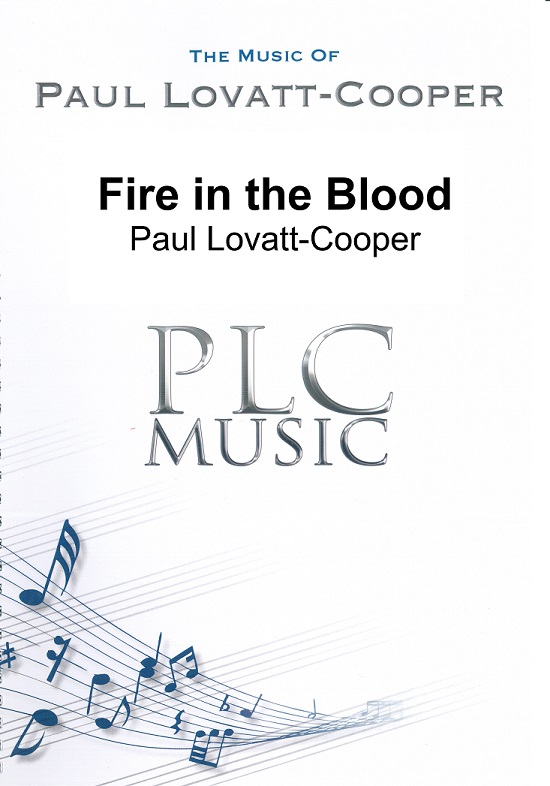
Fire in the Blood (Brass Band - Score and Parts)
Fire in the Blood was commissioned by Dr Stephen Cobb for the 120th anniversary of the International Staff Band of the Salvation Army. The piece was composed for the celebration concert where the ISB were joined by several other staff bands from around the world to perform independently to a sell-out capacity crowd at Britain's most famous concert hall The Royal Albert Hall. Fire in the Blood received its world premier at the 'ISB 120' concert at the Royal Albert Hall on June 4th 2011.With this piece I wanted to acknowledge music that had an impact on me through my Salvation Army upbringing. When thinking of a title for this piece I had no hesitation than to reflect and re-word the Salvation Army's motto under their famous crest 'Blood and Fire'.When composing Fire in the Blood I wanted to use three songs of worship that have been prevalent in the Salvation Army's services over a number of years. Opening with Richard Phillips' setting of Psalm 95, 'Sing for Joy', the music is vibrant and full of energy, I wanted to capture the spirit of the well known words of Scripture. The music then moves into a more reflective section that includes Howard Davies' emotive song melody 'Lord, you know that we love you' and Laurie Klein's worship song 'I love you Lord'.A re-statement of the opening Psalm setting follows and this, in turn, leads into a dramatic and powerful finale that combines two pivotal statements drawn from the slower, reflective section: I love you lord, and I lift my voice to worship you, O my soul rejoice and Lord, you know that we love you with a final flourish from Psalm 95: Come let us sing joy to the Lord!Paul Lovatt-Cooper
Estimated dispatch 7-14 working days
-
 £24.95
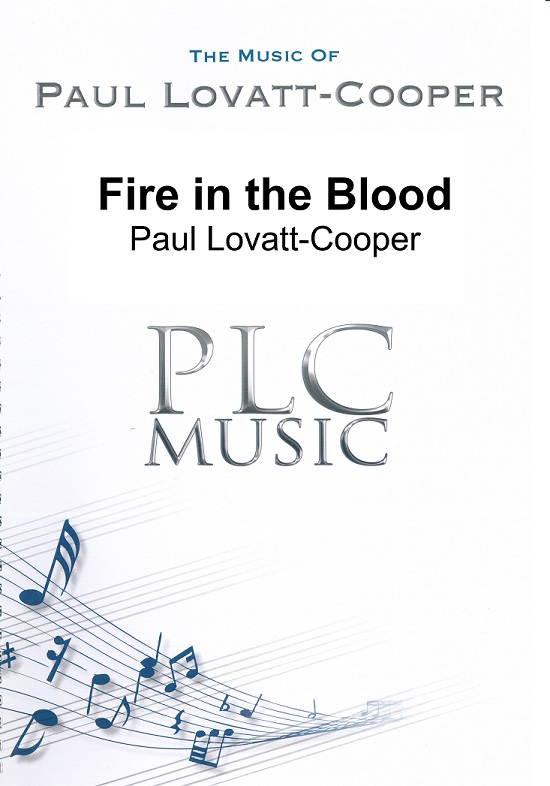
Fire in the Blood (Brass Band - Score only)
Fire in the Blood was commissioned by Dr Stephen Cobb for the 120th anniversary of the International Staff Band of the Salvation Army. The piece was composed for the celebration concert where the ISB were joined by several other staff bands from around the world to perform independently to a sell-out capacity crowd at Britain's most famous concert hall The Royal Albert Hall. Fire in the Blood received its world premier at the 'ISB 120' concert at the Royal Albert Hall on June 4th 2011.With this piece I wanted to acknowledge music that had an impact on me through my Salvation Army upbringing. When thinking of a title for this piece I had no hesitation than to reflect and re-word the Salvation Army's motto under their famous crest 'Blood and Fire'.When composing Fire in the Blood I wanted to use three songs of worship that have been prevalent in the Salvation Army's services over a number of years. Opening with Richard Phillips' setting of Psalm 95, 'Sing for Joy', the music is vibrant and full of energy, I wanted to capture the spirit of the well known words of Scripture. The music then moves into a more reflective section that includes Howard Davies' emotive song melody 'Lord, you know that we love you' and Laurie Klein's worship song 'I love you Lord'.A re-statement of the opening Psalm setting follows and this, in turn, leads into a dramatic and powerful finale that combines two pivotal statements drawn from the slower, reflective section: I love you lord, and I lift my voice to worship you, O my soul rejoice and Lord, you know that we love you with a final flourish from Psalm 95: Come let us sing joy to the Lord!Paul Lovatt-Cooper
Estimated dispatch 7-14 working days
-
 £29.51
Cu Chulainn (Brass Band) Daniel Hall
VIEW SCORE PDF Cu Chulainn is a dramatic concert opener written for Filton Concert Brass by English composer Daniel Hall, based on the myth of its titular Gaelic warrior. The piece opens with a dark choral-like melody, which fluoresces into a grand climax. To view a video of Filton Concert Brass performing the work please visit: www.youtube.com/watch?v=VIyJKx62Kjo Sheet music available from: UK - www.brassband.co.uk USA - www.solidbrassmusic.com Difficulty Level: Second Section + Instrumentation: Soprano Cornet Eb Solo Cornet Bb Repiano Cornet Bb 2nd Cornet Bb 3rd Cornet Bb Flugel Horn Bb Solo Horn Eb 1st Horn Eb 2nd Horn Eb 1st Baritone Bb 2nd Baritone Bb 1st Trombone Bb 2nd Trombone Bb Bass Trombone Euphonium Bb Bass Eb Bass Bb Timpani Percussion 1-2
In Stock: Estimated dispatch 1-3 working days
-
 £33.20
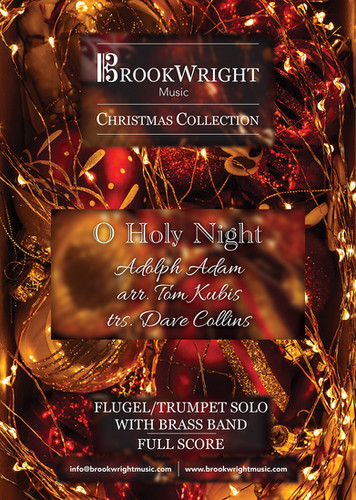
O Holy Night (Flugel/Trumpet Solo with Band) arr. Tom Kubis trs. Dave Collins
This stunning arrangement of O Holy Night, showcases the lyrical and expressive potential of the Flugel Horn or Trumpet, arranged by acclaimed jazz composer Tom Kubis and transcribed by Dave Collins. Originally made famous by the legendary Wayne Bergeron with the Tom Kubis Big Band, this arrangement has since become a favourite among brass soloists worldwide. It received its concert premiere with the North York Temple Band (Canada) under Bandmaster Glenn Barlow, featuring the virtuosic talents of Marcus and Harrington Venables. The piece was later recorded by the International Staff Band, conducted by Dr. Stephen Cobb, on their 2016 album Celebrate the Season. The featured soloist on that recording was the world-renowned Philip Cobb. This arrangement offers flexible performance options - it can be presented as a solo feature or as a duet for Flugel Horn and Soprano Cornet (cued into the parts), making it ideal for both concert settings and festive performances. To view a video of Philip Cobb performing the solo with the International Staff Band, please visit www.youtube.com/watch?v=1x_hjZyDjrA&list=RD1x_hjZyDjrA&start_radio=1 Duration: approx. 3.45 minutes Difficulty Level: 3rd Section + PDF download includes parts and score. Sheet music available at www.brassband.co.uk (UK) or https://satradecentral.org (USA) Instrumentation: Flugel Horn/Trumpet Soloist Bb Soprano Cornet Eb Solo Cornet Bb Repiano Cornet Bb 2nd Cornet Bb 3rd Cornet Bb Flugel Horn Bb Solo Horn Eb 1st Horn Eb 2nd Horn Eb 1st Baritone Bb 2nd Baritone Bb 1st Trombone Bb 2nd Trombone Bb Bass Trombone Euphonium Bb Bass Eb Bass Bb Bass Drum Percussion 1-3
In Stock: Estimated dispatch 1-3 working days
-
 £66.00
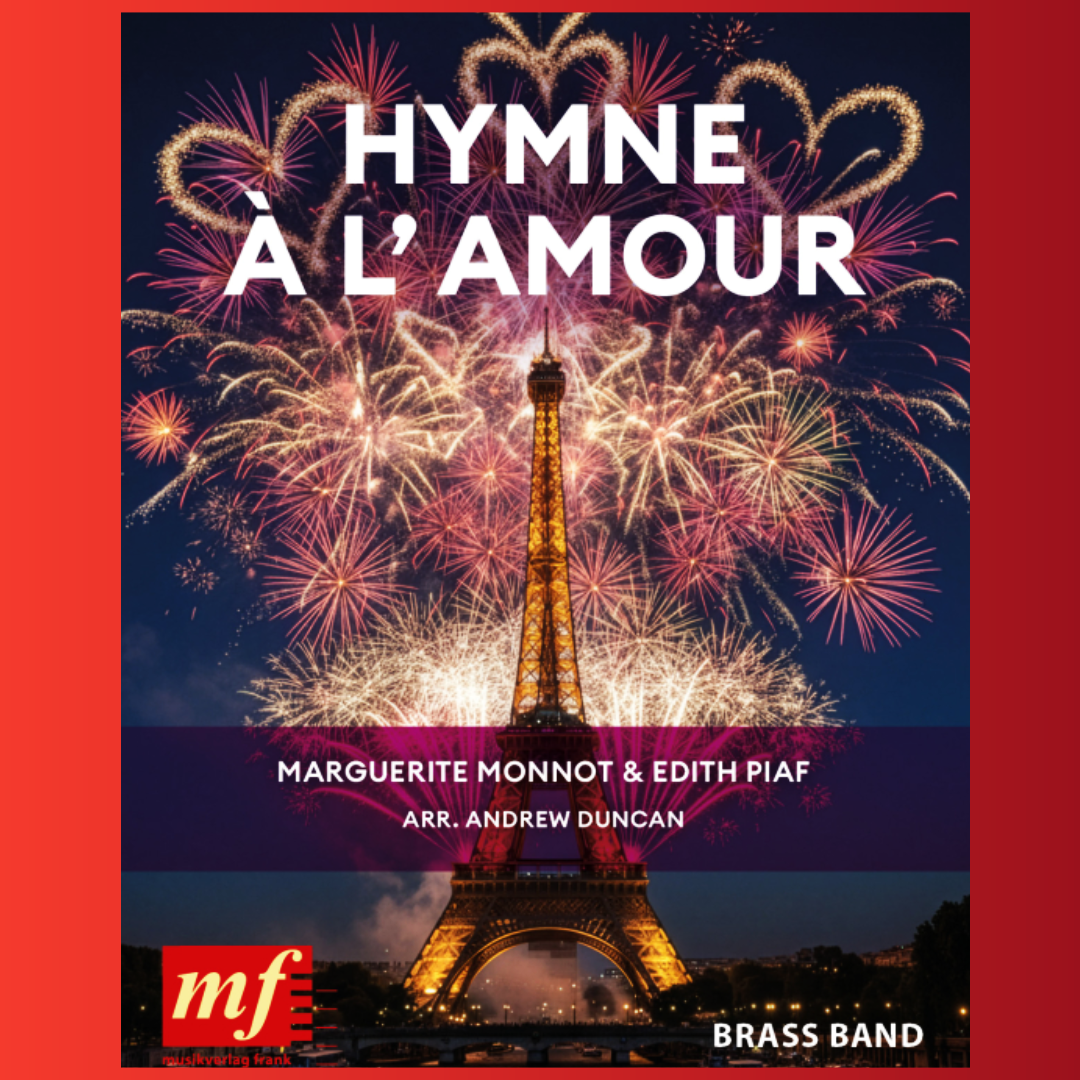
Hymne A L' Amour for Brass Band
Title: Hymne A L'Amour Composers: Marguerite Monnot & Edith Piaf Arranger: Andrew Duncan Instrumentation: Brass Band Publisher: Musikverlag Frank Description An arrangement of the beautiful French song Hymne A L'Amour arranged for brass band by Andrew Duncan This arrangement was originally sung by Edith Piaf then Josh Groban and more recently by Celine Dion in a memorable performance on the Eiffel Tower at the 2024 Paris Olympics. The Cooperation Band conducted by Katrina Marzella played this arrangement at Brass in Concert 2025 as the finale of their winning performance and was an audience favourite. It has been much shared on social media and can also be streamed on World Of Brass Play. The arrangement for brass band can be played with and without a marimba. There are alternate parts to the marimba within the band. Versions for Concert Band and Fanfare Band also available. IN STOCK
-
 £95.00
Concertante (Piano Solo with Brass Band - Score and Parts)
This work was written in 1966, when I was a student at the Royal Academy of Music in London. It was the first major work to be written for this combination. The Concertante is unashamedly romantic in idiom and is cast in three movements: Prelude, Nocturne and Rondo.The Prelude is in sonata form with a contracted recapitulation. There are two main themes, the first announced after the opening flourish on piano. The second theme is lyrical in character and the interplay between these two themes forms the main focus of the movement.The pensive Nocturne opens with an introduction from the band which contains hints of the two main ideas to follow. The solo piano announces the main theme, which has a slightly 'blues' character in its flattened third and seventh notes of the scale. The band enters with the chorale theme already heard in the introduction. Eventually the first theme returns, this time from piano and band and building to a powerful climax before subsiding to a peaceful ending.The Rondo is full of energetic rhythms and changing time patterns. The main theme is 'giocoso' in character and in the first episode there is more than a hint of the tune 'Onward Christian Soldiers' in what amounts to a good humoured parody. Before the final coda there is a long piano cadenza underlying the virtuoso element of the work.The work had a number of public performances leading up to a memorable one in the Royal Albert Hall in 1989 as part of the Gala Concert that used to be held after the National Brass Band Championship in the Royal Albert Hall. That year, the 'centre band' in the massed bands concert were the GUS Band (then known for sponsorship reasons as 'Rigid Containers Group Band'!) conducted by my great friend and champion, Bramwell Tovey, with myself as the soloist.- Edward GregsonDuration: 18.00
Estimated dispatch 7-14 working days
-
 £35.00
Postcard to Grimethorpe (Brass Band - Score and Parts)
I composed the original version of Postcard to Grimethorpe in 1993 at the request of Elgar Howarth, for a concert at the Queen Elizabeth Hall, London, given by the Grimethorpe Colliery Band. This was at a time when after the Grimethorpe Colliery pit closed the future of the band was in severe jeopardy. The concert was given in aid of the band, both through publicity and funding.Then in late 2022 Jack Stamp, the American composer, conductor and educator, and at that time international composer-in-association with Grimethorpe, contacted me to say that he had discovered my short piece in the band library, and asked if I might extend it for a recording he was sponsoring for the band - the repertoire to consist entirely of music specially composed for Grimethorpe.I agreed and decided to extend the piece by using the miner's hymn Gresford, as a symbolic gesture of protest at the many thousands of miners in the UK who were made redundant from their jobs. After an angular (quasi-atonal) first section, the hymn enters, softly at first, but with each phrase it becomes more powerful and insistent, ending with the final phrase triumphantly accompanied by melodic percussion (replacing the drums and cymbals of the earlier phrases, as if the band were then on the march). However, this short work ends softly and gently, as if anger has been replaced by quiet resolution and determination, looking to the future with confidence.- Edward GregsonDuration: 3.00
Estimated dispatch 7-14 working days
-
 £36.89
El Camino A Belen - Trumpet Solo with Brass Band (Nick Simmons-Smith)
VIEW SCORE PDF This trumpet solo was written by Nick Simmons-Smith at the request of Dallas Brass Band for a Christmas concert featuring Elmer Churampi, international trumpet soloist. The solo features three Christmas songs: i. Mi Burrito Sabanero voy camino de Belen (With my donkey of the Savannah, I'm going to Bethlehem) ii. Noche de paz (Silent night) iii. Campana Sobre Campana (Bell above bells, O bells of Bethlehem) These songs are all very popular in Central and South America - including Peru, where Elmer Churampi is originally from. Each tune has been given a different Latin treatment producing a fast-slow-fast festive concert solo. The solo is not long, but each movement could be played individually. To view a video of Elmer Churampi performing the solo with Dallas Brass Band, please visit: www.youtube.com/watch?v=cpQCFXReEJg PDF download includes score and full set of parts. Sheet music available from: UK - www.brassband.co.uk USA - www.solidbrassmusic.com Instrumentation: Trumpet Soloist Bb Soprano Cornet Eb Solo Cornet Bb Repiano Cornet Bb 2nd Cornet Bb 3rd Cornet Bb Flugel Horn Bb Solo Horn Eb 1st Horn Eb 2nd Horn Eb 1st Baritone Bb 2nd Baritone Bb 1st Trombone Bb 2nd Trombone Bb Bass Trombone Euphonium Bb Bass Eb Bass Bb Percussion 1-3
In Stock: Estimated dispatch 1-3 working days
-
 £47.96
Euryanthe Overture (Brass Band) von Weber arr. Barrie Gott
This expert arrangement for brass band by Barrie Gott of Carl Maria von Weber's popular overture, 'Euryanthe' will be a terrific addition to concert programmes.'Euryanthe' is acknowledged as one of Weber's most important operas and is based on the 13th-century French romance L'Histoire du tres-noble et chevalereux prince Gerard, comte de Nevers et la tres-virtueuse et tres chaste princesse Euriant de Savoye, sa mye.Only the overture, an outstanding example of the early German Romantic style (heralding Richard Wagner), is regularly played today.This transcription for brass band attempts to realise the orchestral score as closely as possible. There are many technical challenges that will provide opportunities for the expert level of player and ensemble. It will be and exciting addition to a concert programme. To view a follow-the-score video of the work please visit https://www.youtube.com/watch?v=wMePX1rVigk PDF download includes score and parts. Sheet music available from: UK - www.brassband.co.uk USA - www.solidbrassmusic.com Difficulty Level: 1st Section + Instrumentation: Soprano Cornet Eb Solo Cornet Bb Repiano Cornet Bb 2nd Cornet Bb 3rd Cornet Bb Flugel Horn Bb Solo Horn Eb 1st Horn Eb 2nd Horn Eb 1st Baritone Bb 2nd Baritone Bb 1st Trombone Bb 2nd Trombone Bb Bass Trombone Euphonium Bb Bass Eb Bass Bb Timpani
In Stock: Estimated dispatch 1-3 working days
-
 £27.00
Edward Gregson: Birthday Prelude for Brass Band
DescriptionThis short work for brass band was written in 1982 for a concert to celebrate the 80th birthday of Harry Mortimer, one of the great figures in the world of brass bands. Not surprisingly, it references the well-known song Happy Birthday, in a breezy, up-tempo, short concert prelude.The premiere was given at the Free Trade Hall in Manchester by the Fodens Band, conducted by Howard Snell.In 2014 the composer revised it for a trip to the North American Brass Band Championships, where it was performed, also as an 80th birthday tribute, this time to the composer's brother Bram; it was subsequently dedicated to both Harry Mortimer and Bram Gregson.For more information on Edward Gregson's music please visit the composer's website: www.edwardgregson.com
Estimated dispatch 7-14 working days