
Results
-
 £29.92
Fanfare from La Peri(Brass Band) Dukas arr. Rob Bushnell
La Peri is a one-act ballet by the French composer Paul Dukas, best known for The Sorcerer's Apprentice (L'apprenti sorcier) as in the 1940 Disney film Fantasia. Dukas was commissioned to write La Peri by the Ballets Russes, producing a Poeme danse en un tableau ('dance poem in one scene') in 1911; this become his last published work. With Natalia Trouhanova due to play the Peri and Vaslav Nijinsky to play Iskender (the name of Alexander the Great in Persian, who is scouting around Iran in search of the Flower of Immortality), the production was ultimately cancelled because Serge Diaghilev feel Trouhanova was not a skilled enough dancer to be partnered to Nijinsky. Trouhanova later hired Ivan Clustine to choreograph the music, with the ballet premiering at the Theatre du Chatelet in Paris on 22 April 1912.The brilliant fanfare that precedes the ballet is often performed separately and is the arrangement available here. Arranged for British-style brass band, it has optional percussion parts as well as alternative parts for horns in F and bass-clef lower brass. The piece has been lowered by a tone compared to the original. A recording of the original composition can be found here: www.youtube.com/watch?v=7EDekMos1ok. Duration: Approx. 2 minutes Difficulty Level: 2nd Section + Duration: 4 or 5 minutes (depending on tempo and without any cuts) PDF download includes parts and score. Sheet music available at www.brassband.co.uk (UK) or www.cimarronmusic.com (USA) Instrumentation: Soprano Cornet Eb Solo Cornet Bb Repiano Cornet Bb 2nd Cornet Bb 3rd Cornet Bb Flugel Horn Bb Solo Horn Eb 1st Horn Eb 2nd Horn Eb 1st Baritone Bb 2nd Baritone Bb 1st Trombone Bb 2nd Trombone Bb Bass Trombone Euphonium Bb Bass Eb Bass Bb Timpani Percussion 1 - Snare Drum Percussion 2 - Bass Drum & Cymbal
In Stock: Estimated dispatch 1-3 working days
-
 £25.00
The Garland Waltz (Tchaikovsky arr. Dan Price)
The Garland Waltz comes from 'The Sleeping Beauty', the second of three ballets by Pyotr Tchaikovsky. Sleeping Beauty's theme is simplistic and focuses on the conflicting forces of good and evil through the characters the Lilac Fairy (good) and Carabosse (evil). The ballet's premiere in 1890 received more favourable accolades than 'Swan Lake' but Tchaikovsky never witnessed the work's true success outside of Russia as he died in 1893. By 1903, 'The Sleeping Beauty' was the second most popular ballet in the repertoire of the Imperial Ballet, having been performed 200 times in only 10 years. The waltz and other music from the ballet has been used extensively in film and television, most notably in Disney's animated version of 'Sleeping Beauty' and the recently released 'Maleficent'. Here, Dan Price faithfully transcribes Tchaikovsky's original score for Brass Band. Duration : 00:04:45 Grade : 3.5 / 4
Estimated dispatch 5-7 working days
-
 £64.95
Suite from Adam Zero - Arthur Bliss - Robert Childs
Following his ballet Checkmate, Bliss composed another score for the, by then, Sadler's Wells Ballet, Miracle in the Gorbals, which was choreographed by Robert Helpmann, to a scenario by Michael Benthall. Premiered in 1944, the ballet made a considerable impact...
Estimated dispatch 5-7 working days
-
 £25.00
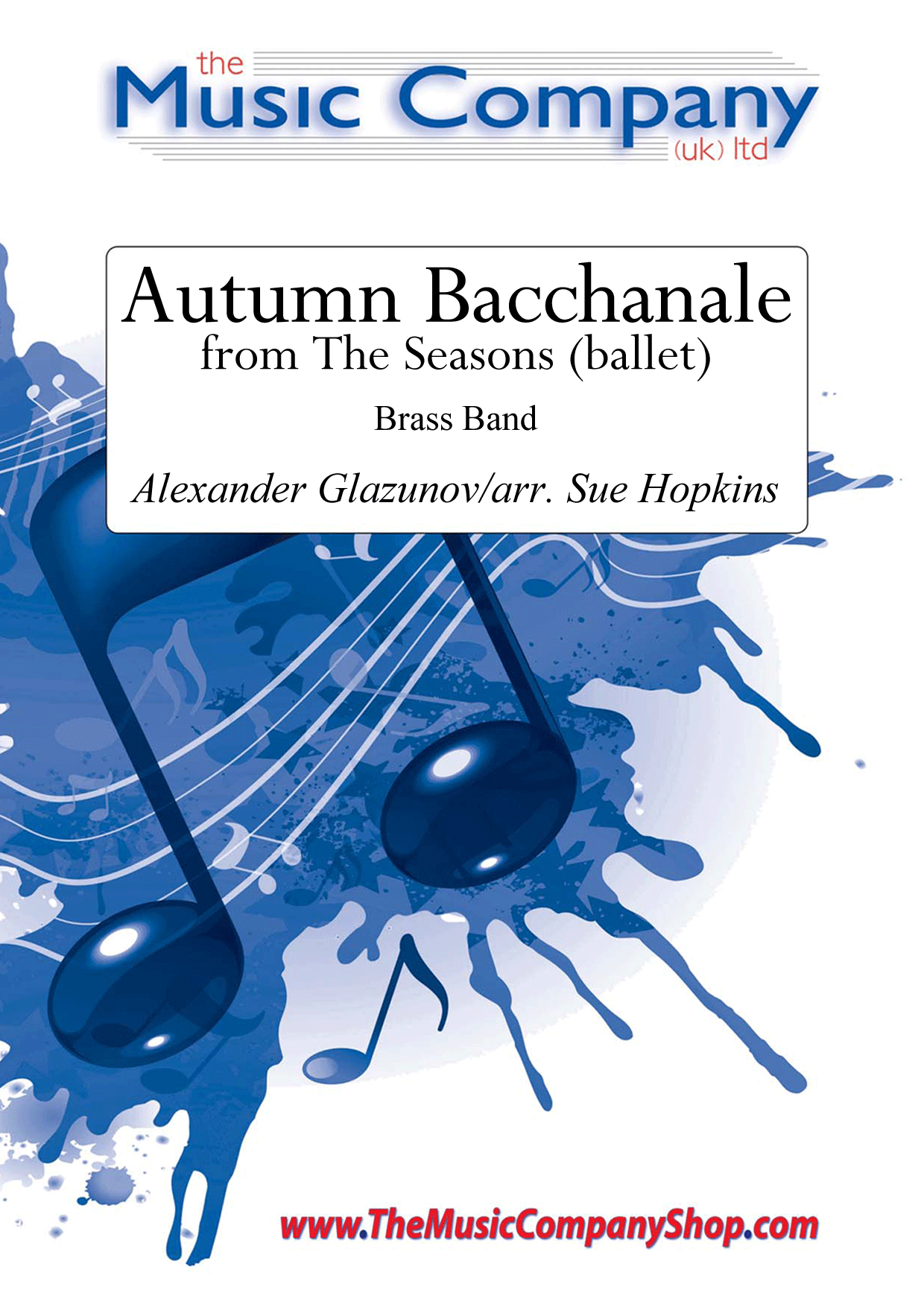
Autumn Bacchanale (from The Seasons) - Alexander Glazunov
A lively, joyous item, ideal as a light interlude in any concert and especially appropriate for late season/Christmas themed events with its jaunty, positive sounds. Sue Hopkins has shown great creativity in crafting this arrangement of Glazunov's 'Autumn' movement, a bacchanale from his ballet The Seasons, hence its fondly referenced title of Autumn Bacchanale.Alexander Glazunov (1865 - 1936) was a Russian composer, music teacher and conductor. He was a child prodigy and was taught privately byRimsky-Korsakov, who said Glazunov's musical progress did not increase day by day but hour by hour. He began composing at age eleven and wrote his first symphony at age 16 in 1881 and it was premiered one year later.His ballet The Seasonswas first performed by the Imperial Ballet in St Petersburg on 20 February 1900 and was choreographed by Marius Petipa.It was written in one act and four scenes, and this piece represents the moment when all The Seasons take part in a glorious dance while leaves from autumn trees rain upon their merriment.
In Stock: Estimated dispatch 3-5 working days
-
 £44.99
Sweeney Todd (Brass Band - Score and Parts)
Malcolm Arnolds ballet, Sweeney Todd, was first staged in 1959 by The Royal Ballet Company with choreography by John Cranko. The music was later adapted as a concert work and it is from this version that this brass band arrangement, by Phillip Littlemore, is made. The original concert suite lasts some 20 minutes, but this version has been shortened to a more manageable eight minutes. The first performance of this arrangement was given on the 22nd October 2006 at the Malcolm Arnold Festival, Derngate, Northampton by the Rushden Windmill Band conducted by Richard Graves. Suitable for Advanced Youth/3rd Section Bands and above. Duration 8:00
Estimated dispatch 7-14 working days
-
 £57.00
Conspirators Overture
Composer: Andrew Duncan Conspirators Overture was written for Katrina Marzella-Wheeler and the Cooperation Band for their winning programme played at the 2025 Brass in Concert competition at the Glass House in Gateshead in England. The piece describes a meeting in a caf in Paris in 1912 between three very influential Russians. The composer Igor Stravinsky, the dancer Vaslav Nijinsk and the impresario Sergei Diaghilev. Together they conspired about how Stravinsky's new Ballet, Le Sacre du Printemps (The rite of Spring) was going to disrupt what was then a very conservative, classical music scene in Paris. Stravinsky's music would forever change the way harmonies and rhythms are used in classical and jazz music. Starvinsky's full name is Igor Fyodorovich Stravinsky. The piece uses the morse code rhythm for IFS, which is Stravinsky's initials as a pulsating 11/8 rhythm which is the foundation of the overture. The opening notes from the Rite of Spring, played by a solo bassoon, are also quoted in the piece in a jazz waltz setting and in a short fugue towards the end of the piece. Suitable for Championship or First Section Bands.
-
 £99.95
Malcolm Arnold Variations (Score and Parts)
MALCOLM ARNOLD VARIATIONS was commissioned by Philip Biggs and Richard Franklin for the 20th All England Masters International Brass Band Championship held in the Corn Exchange, Cambridge on 25 May 2008. The work is dedicated to Anthony Day, long time carer of Sir Malcolm Arnold in his final years. I first met Malcolm and Anthony in 1990 and remained in constant touch until Malcolm's passing in 2006. Anthony, of course, remains a friend and plays his own role subliminally in this piece. The work is not based on any of Malcolm Arnold's own themes, rather it is a portrait of him (and by association Anthony Day) through my eyes and as a result of my friendship with both parties over some 18 years. If there is any theme as such it is the personalities of the players, the protagonist and his carer placed together by my own efforts coloured and influenced by aspects of Arnold's style and technique without recourse to direct quotation but through allusion and parody. It is of course designed as a brass band test piece but in my eyes is first and foremost a musical challenge. The pyrotechnical elements are there but always secondary to the musical thrust of the work's structure. I have long beforehand submerged myself in Malcolm Arnold's music and ultimately delivered this tribute. Music Directors will be advised to acquaint themselves with the composer's personal music, particularly the film scores, symphonies, concertos and ballets: the solutions towards a successful interpretation of my piece are all in there - and YES, I want, and sanction, this piece to be interpreted, and therein lies the challenge for those of you 'up front'! The challenge for players is that of virtuosity, ensemble and careful attention to where they are individually in relation to their colleagues - a question of balance, taste and insight. With regard to tempi, as is my usual custom, I have indicated all metronome marks with the prefix circa. I would suggest that the fast music is played at these tempos but that the more rubato moments can be allowed some freedom in expression and fluidity of line. With regard to the type of mutes to be employed - this decision I leave to the discretion of players and conductors. Structurally the work is cast as an Introduction, 20 Variations and a Finale. Some variations are self contained, others run into each other as sequences in the same tempo. In other variations, segments are repeated and developed. I could describe the overall concept as a miniature ballet or a condensed film score - there is much drama and character and the repeated elements assist this in driving the action forward. I have deliberately avoided the more extremely dark qualities of Malcolm's own music in this, my celebration of this master-composer, as I have always viewed (and evidenced by my previous Masters scores Tristan Encounters and Chivalry) that the Cambridge contest is a 'sunshine- affair' and firmly believe that Malcolm Arnold would have had it no other way too!
Estimated dispatch 7-14 working days
-
 £49.95
Malcolm Arnold Variations (Score Only)
MALCOLM ARNOLD VARIATIONS was commissioned by Philip Biggs and Richard Franklin for the 20th All England Masters International Brass Band Championship held in the Corn Exchange, Cambridge on 25 May 2008. The work is dedicated to Anthony Day, long time carer of Sir Malcolm Arnold in his final years. I first met Malcolm and Anthony in 1990 and remained in constant touch until Malcolm's passing in 2006. Anthony, of course, remains a friend and plays his own role subliminally in this piece. The work is not based on any of Malcolm Arnold's own themes, rather it is a portrait of him (and by association Anthony Day) through my eyes and as a result of my friendship with both parties over some 18 years. If there is any theme as such it is the personalities of the players, the protagonist and his carer placed together by my own efforts coloured and influenced by aspects of Arnold's style and technique without recourse to direct quotation but through allusion and parody. It is of course designed as a brass band test piece but in my eyes is first and foremost a musical challenge. The pyrotechnical elements are there but always secondary to the musical thrust of the work's structure. I have long beforehand submerged myself in Malcolm Arnold's music and ultimately delivered this tribute. Music Directors will be advised to acquaint themselves with the composer's personal music, particularly the film scores, symphonies, concertos and ballets: the solutions towards a successful interpretation of my piece are all in there - and YES, I want, and sanction, this piece to be interpreted, and therein lies the challenge for those of you 'up front'! The challenge for players is that of virtuosity, ensemble and careful attention to where they are individually in relation to their colleagues - a question of balance, taste and insight. With regard to tempi, as is my usual custom, I have indicated all metronome marks with the prefix circa. I would suggest that the fast music is played at these tempos but that the more rubato moments can be allowed some freedom in expression and fluidity of line. With regard to the type of mutes to be employed - this decision I leave to the discretion of players and conductors. Structurally the work is cast as an Introduction, 20 Variations and a Finale. Some variations are self contained, others run into each other as sequences in the same tempo. In other variations, segments are repeated and developed. I could describe the overall concept as a miniature ballet or a condensed film score - there is much drama and character and the repeated elements assist this in driving the action forward. I have deliberately avoided the more extremely dark qualities of Malcolm's own music in this, my celebration of this master-composer, as I have always viewed (and evidenced by my previous Masters scores Tristan Encounters and Chivalry) that the Cambridge contest is a 'sunshine- affair' and firmly believe that Malcolm Arnold would have had it no other way too!
Estimated dispatch 7-14 working days
-
 £35.00
Swan Lake (Finale). Tchaikovsky.
Recommended - Championship & 1st Section The Finale from Swan lake is the turbulent and dramatic conclusion to Tchaikovsky's celebrated ballet so as a 'finisher' this music is as exciting as it gets! The music begins at whirlwind speed before giving way to the famous tender love theme, which is skilfully developed before the music builds to a thrilling and exciting conclusion. This arrangement won the prize for the best new arrangement at 'Spennymore' in 1996, played by the Fodens Band. Includes score & Parts
-
 £92.00
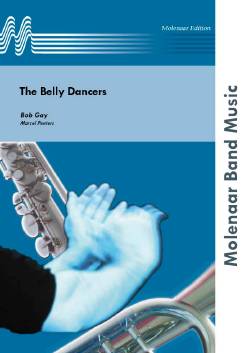
The Belly Dancers - Bob Gay/Marcel Peeters
Since several years the famous Flemish composer and arranger Marcel Peeters collaborates with his friend Bog Gay to write rather light-hearted compositions for symphonic band. In this extremely colourful oriental ballet the composers introduce the listeners into mysterious and exotic places where attractive young ladies dance voluptuously. A fascinating composition with quite some humoristic characteristics and a sparkling orchestration.
Estimated dispatch 10-14 working days
 View Music