
Results
-
 £14.95
Funk Engine (Score Only)
'Funk Engine' was commissioned by Brass Bands England for the 2016 National Youth Brass Band Championships of Great Britain. What Ryan says about the piece:"When I was commissioned to write a piece for the Championships I decided that I wanted to create something a bit different to standard brass band repertoire. I decided that the best way to do this was to go a bit out of my comfort zone and explore some styles of music that I have yet to experiment with. I have always been a great lover of jazz, funk and big band music and the sounds associated with them. In 'Funk Engine' I have tried to capture some of these sounds, however I am a brass-bander at heart and as such I've tried to create a fusion of styles that hopefully combines the best of brass band and jazz into one piece.'Funk Engine' runs continuously, but is divided into three broad sections - fast, slow, fast. The opening is in driving big band style, which segues into a smoother lyrical section; the pace then picks up into a jazz inspired scherzo. After a delicate transition from the basses and trombones the euphonium plays a soaring scale - bringing us into the central movement - which begins with a series of languid solos before descending into a darker interlude. A flugel solo lightens the mood and the music gains momentum leading into a brief cornet chorale before a euphonium solo leads into a percussive climactic passage for full band. As this section winds down to settle on an open fifth, the Hi-hat and Bass section punctuate the texture with the first notes of the final section."The final section of the piece is in similar big band style to the opening and develops material from the first two movements. The percussion feature heavily at this stage and the tension builds towards a final statement, with the piece concluding with a bang!"
Estimated dispatch 7-14 working days
-
 £79.99
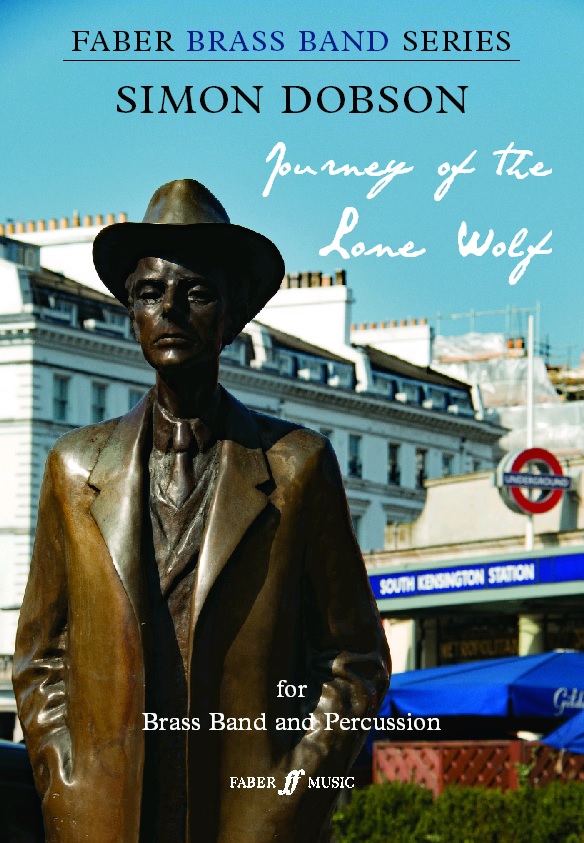
Journey of the Lone Wolf (Score and Parts)
Championship Section Finals Test Piece for National Brass Band Championships of Great Britain 2016Journey of the Lone Wolf tells the story of the hungarian composer Bla Bartk. It was commissioned by Dr. Nicholas Childs for Black Dyke Band, who gave the first performance on Sunday 26 January 2014 at the Bridgewater Hall, Manchester as part of the Royal Northern College of Music Festival of Brass.The composer's programme notes for each movement:1. Capturing the Peasants' SongAfter the upheaval of moving to Budapest the young Bla Bartk meets Zoltn Kodly and the pair embark on summertime adventures throughout the Hungarian countryside to collect and catalogue the astonishing variety (both harmonically and rhythmically) of gypsy and folk music heard in the Balkans. The arrival of WW1 plunges Bartk's beloved Hungary into chaos.2. Night MusicBartk was at times a cold man, aloof and lonely. The odd moments of tenderness he showed are portrayed here in a series of evocative solos. His brief but intense affairs speak of a love he could only long for. Jazz is my night music and here there are hints of what Bartk may have heard in the USA later in his life.3. Flight and FightHaving been forced by the world's evils to leave his homeland of Hungary for America, Bartk, the anti-fascist, felt isolated and angry. In this movement we hear his longing for a simpler time of gypsy folk dances as well as his maturity and depth as a composer finally exploring deeper colours and darker themes.
Estimated dispatch 7-14 working days
-
 £40.00
Lionheart (Score and Parts)
Lionheart was commissioned by the British Federation of Brass Bands for the 2007 European Brass Band Championships held at the Symphony Hall, Birmingham, and first performed at the Gala Concert by the European Youth Brass Band. It is a triumphant concert opener of about four minutes duration playable by second, first and championship bands.
Estimated dispatch 7-14 working days
-
£37.95
Oceans (Score Only)
Commissioned by the West of England Bandmen's Festival, with valuable support from South West Arts, for first performance at the Sixtieth Anniversary Festival at Bugle, Cornwall, 1984
Estimated dispatch 7-14 working days
-
 £27.50
Rise of the Phoenix Score Only)
As the title suggests, the phoenix was a fabulous mythical bird, who every morning at dawn, sang a song so enchanting that even the sun God, Apollo, would stop and listen. The bird would live for a hundred years, and at the end of its life, would build a pyre, set it on fire and be consumed by the flames. After three days, the phoenix would be reborn from the ashes, to sing once more.This work was commissioned by Clifton and Lightcliffe Band and reflects the difficulties and rebirth of the band to make music once more.Suitable for second section bands and above.
Estimated dispatch 7-14 working days
-
 £94.95
Whitsun Wakes (Score and Parts)
Whitsun Wakes was commissioned by the BBC and first performed by Black Dyke Band, conducted by James Watson, in Manchester's Bridgewater Hall on 26th May, 1997 as part of the BBC's 'Music Live' Festival. It was subsequently selected as a test piece for the British Open Championship which was scheduled to be held on 6th September 1997 at Birmingham's Symphony Hall. Unfortunately this was the day of the funeral of Diana, Princess of Wales and so the British Open was postponed until 17th January, 1998. However the greatest irony is the fact that although this piece takes its inspiration from the Manchester area it was destined to be played at the first British Open Championship to take place outside Manchester.
Estimated dispatch 7-14 working days
-
 £44.95
Whitsun Wakes (Score Only)
Whitsun Wakes was commissioned by the BBC and first performed by Black Dyke Band, conducted by James Watson, in Manchester's Bridgewater Hall on 26th May, 1997 as part of the BBC's 'Music Live' Festival. It was subsequently selected as a test piece for the British Open Championship which was scheduled to be held on 6th September 1997 at Birmingham's Symphony Hall. Unfortunately this was the day of the funeral of Diana, Princess of Wales and so the British Open was postponed until 17th January, 1998. However the greatest irony is the fact that although this piece takes its inspiration from the Manchester area it was destined to be played at the first British Open Championship to take place outside Manchester.
Estimated dispatch 7-14 working days
-
 £189.95
'The New Christmas Collection' - Full Set March Card Size
The new Christmas Collection carol books contain all the traditional Christmas Carols, with some new 'pop' music arrangements included to add more variety to your carolling this year.
* Note, these are not compatible with the New Christmas Praise books.
Full list of works in The Christmas Collection:-
• A child this day is born
Estimated dispatch 7-14 working days
• A Christmas lullaby
• A great and mighty wonder
• All I want for Christmas is you
• All my heart this night rejoices
• Angels, from the realms of Glory (Come and worship)
• Angels, from the realms of Glory (Iris)
• Angels we have heard on high
• A starry night
• As with gladness men of old
• Auld lang syne
• A virgin most pure
• Away in a manger (The manger scene)
• Away in a manger (Traditional)
• A winter’s tale
• Bethlehem
• Brightest and best (Spean)
• Brightest and best (Traditional)
• Calypso Carol
• Carol for the Nativity
• Carol of the bells
• Carol of the drum
• Child of Mary
• Christians Awake!
• Christ is born (Il est né)
• Christ was born on Christmas Day
• Come and join the celebration
• Come, children, come quickly
• Coventry Carol
• Deck the hall
• Ding dong! merrily on high
• Do you hear what I hear?
• Frosty the snowman
• Gabriel’s Message
• Gaudete
• Glory in the highest
• Glory in the highest Heaven
• God of God, the uncreated
• God rest you merry, gentlemen
• Good Christian men, rejoice
• Good King Wenceslas
• Go, tell it on the mountain!
• Happy Christmas (War is over)
• Hark the glad sound!
• Hark! the herald angels sing
• Have yourself a merry little Christmas
• Here we come a-wassailing
• How far is it to Bethlehem?
• Huron Carol
• Infant Holy
• In the bleak midwinter (Cranham)
• In the bleak midwinter (Darke)
• I saw mommy kissing Santa Claus
• I saw three ships come sailing in
• It came upon a midnight clear (Traditional)
• It came upon a midnight clear (Willis)
• It’s beginning to look a lot like Christmas
• It’s the most wonderful time of the year
• I wish it could be Christmas everyday
• I wonder as I wander
• Jesus, good above all other
• Jingle Bells
• Jingle bell rock
• Joy to the world!
• Last Christmas
• Let it snow!
• Little baby Jesus
• Little children, wake and listen
• Little Donkey
• Little Jesus, sweetly sleep
• Lo! he comes with clouds descending
• Long, long ago
• Love came down at Christmas
• Mary’s boy child
• Mary’s Child
• Masters in this hall
• Merry Christmas everyone
• Mistletoe and wine
• Noel
• O Christmas tree
• O come, all ye faithful
• O come, Immanuel
• O Heaven-sent King
• O holy night!
• O little town of Bethlehem (Christmas Carol)
• O little town of Bethlehem (Forest Green)
• O little town of Bethlehem (St Louis)
• Once in royal David’s city
• Past three o’clock
• Patapan
• Personent Hodie
• Praise ye the Lord
• Ring the bells
• Rise up, shepherd!
• Rockin’ around the Christmas tree
• Rudolph, the red-nosed reindeer
• Sans day carol
• Santa Claus is comin’ to town
• Saviour’s Day
• See, amid the winter’s snow
• Silent Night!
• Sleigh Ride
• Softly the night is sleeping
• So here it is, merry Christmas
• Stars are shining
• Still, still, still
• Stop the cavalry
• Sussex Carol
• Sweet chiming bells
• Sweet chiming Christmas bells
• The candle song
• The cherry tree carol
• The Christmas song
• The first Nowell
• The holly and the ivy
• The infant King
• The light has come
• The shepherds’ farewell
• The stable door
• The star in the east
• The twelve days of Christmas
• The virgin Mary had a baby boy
• They all were looking for a king
• Thou didst leave thy throne
• Three kings’ march
• Unto us a boy is born
• Walking in the air
• We gather round the manger-bed
• We three kings of Orient are
• We wish you a merry Christmas
• What child is this?
• When a child is born
• When Santa got stuck up the chimney
• Whence is that goodly fragrance flowing?
• When wise men came seeking
• While shepherds watched (Cranbrook)
• While shepherds watched (Handel)
• While shepherds watched (Winchester Old)
• White Christmas
• Who is he?
• Winter Wonderland
• Worldwide Christmas message
• Zither Carol
• A starry night
• Christmas Joy
• Christmas Praise
• Coventry Carol
• Infant Holy
• Mid-winter
• Rudolph, the red-nosed reindeer
• The everlasting light
• To celebrate his birth
• Yuletide Rag
-
 £77.00
General Series Brass Band Journal, Numbers 2254 - 2257, April 2025
2254: Be glorified today (Martin Cordner)Built around Bob Kilpatrick's song In my life, Lord, be glorified today (S.A.S.B. 593), this concert opener was composed for Cambridge Citadel Band (UK and Ireland Territory) at the request of Bandmaster Simon Fisher. The piece pays homage to the city.2255: Driven by mission (Stephen Bulla)Stephen Bulla wrote this piece to commemorate Willis Howell and his wife's retirement from active officership. Bulla references St. Denio (S.A.S.B. 37), Melita (T.B. 442), For your mission and Men of Harlech (T.B. 756), and the assembling of the tunes and all they represent reflects the masterful artistry that always marks Bulla's works.2256: The Lord's my shepherd (Paul Sharman)This arrangement brings together two settings of Psalm 23; the familiar hymn tune Crimond (T.B. 68) and the more recent melody by Stuart Townend (T.B. 863).2257: Cornet Solo - I love you, Lord (Ian Robinson)Laurie Klein's chorus I love you, Lord (S.A.S.B. 369) has been popular for many years with Salvation Army congregations around the world and this work combines unconventional harmonies with sparse scoring to feature the soloist.
Estimated dispatch 7-14 working days
-
 £55.00
Triumph Series Brass Band Journal, Numbers 1359 - 1362, March 2024
1359: Festival March - Coastal Celebration (Sam Creamer)Coastal Celebration was commissioned in 2019 by Nambour Salvation Army Band for the Corps' 125th anniversary celebrations. Nambour was the birthplace of The Salvation Army's work on the Beautiful Sunshine Coast in Queensland, Australia. Firring with this theme are subtle tributes to iconic Sunshine Coast landmarks, referenced with small phrases of popular secular melodies intertwined with the main tunes What a faithful God (S.A.S.B. 378) and All through the years (S.A.S.B. 826).1360: He's always been faithful (Craig Woodland)This meditative selection is an arrangement of the song by American singer and record producer Sara, Groves, He's always been faithful. The words express the joy and thankfulness in having a relationship with Jesus and knowing his presence in life. The melody and motifs of the traditional hymn, Great is thy faithfulness (S.A.S.B. 26), are heard throughout.1361: Christ's living water (Dean Jones)Christ's sacrificial love has been beautifully portrayed through the imagery of water in many songs, none more so that the skilfully crafted words we find in the chorus of I know a fount (S.A.S.B. 197), written by Oliver Cooke. To enhance the sentiments expressed, the pure sounds derived from Handel's Water Music fit perfectly in terms of music and imagery.1362: March - Fear Not! (Avelan Ntsiete)The Salvation Army continues to proclaim its music ministry in all corners of the world and, with this item under review, we introduce a new composer, originally from Congo Brazzaville, Central Africa. Avelan Ntsiete is currently a Bandsman at the Lilas Corps in Paris but has previously served in the Congo Brazzaville Territorial Band. This march, in traditional format, was written for an evangelistic campaign in Kindamba, where civil war has brought upheaval to the area and uncertainty for the local Salvationists. The composer was part of a small brass group which travelled for over 24 hours by truck and on foot to reach Kindamba and bring encouragement to the Salvationists within that community.
Estimated dispatch 7-14 working days