
Results
-
 £29.95
Hinemoa (Score Only)
Hinemoa, the beautiful daughter of Amukaria, a great Maori chief, had seen Tutanekai, a chief and brave warrior from the island of Mokoia, only once, during a tribal gathering; yet she knew she loved him dearly. Amukaria counselled his daughter to forget this man, whose flute-playing Hinemoa heard as it came, soft but clear, across the lake which separated them.At night she went to the shore and listened. The sound of the flute spoke to Hinemoa, giving her courage. When Tutanekai managed to get a message to Hinemoa, her mind was made up.On the next moonless night she entered the dark, cold waters of the lake, using empty gourds as floats. She was determined to swim the long distance to her lover. Tutanekai's flute-playing kept her going, until at last she reached the shores of Mokoia.Great was the joy when the lovers at last met, the rocks echoing Tutanekai's cry - 'HINEMOA'.
Estimated dispatch 7-14 working days
-
 £22.50
Petite Suite de Ballet (Score Only)
This composition consists of four 'miniatures', simple in construction, yet not without technical demands upon the players.The music is for a ballet which so far exists only in the imagination! Like most ballet, it has a touch of the fantastic, and must be interpreted with a light, deft touch.The first movement, Parade, brings many characteristics on to the stage, marching perkily, leggily, with almost puppet-like movements.In the next movement, Pas Seul (Solo Dance), one lone figure holds the stage, with a mixture of grace and sauciness. At the end he (or she) runs off with a snap of the fingers.The third movement is a Minuet. A chosen few, richly garbed, perform this stately, courtly dance, while the rest of the company look on at some ritual in which they are not allowed to join.The final Ensemble commencing with the return of the lone figure, gradually brings the whole company to the stage. Various groups come forward for a few moments, and then rejoin the general pattern of the dancing. Towards the end a stately procession is formed, but this finally breaks up in a sudden flurry of leaping and capering, and in a moment, as though at some magic call, the dances have disappeared, whilst the sonorous tones of the final bars of music follow them with a rather disapproving air.Our little fantasy in over.
Estimated dispatch 7-14 working days
-
 £5.00
Coffee in the Red Light - For Brass Band - Paul Saggers
Commissioned by Brass Band Schoonhoven for the 2025 Brass in Concert Championships.A curious traveller finds themself in Amsterdam's Red Light District, drawn in by the vibrantatmosphere. In a moment of spontaneity, they eat a hash cake, unaware of its strength. At first,they feel relaxed and joyful-everything seems amusing and carefree. As the effects intensify,their surroundings become strange and hypnotic, and time begins to lose meaning. Suddenly,anxiety takes hold. Their thoughts race, and they swing between panic and bursts of excitement, unsure of what's real.Delusions follow-familiar things twist into unfamiliar shapes, and their sense of reality slips away. They become isolated, lost in the crowd yet completely alone. Finally, frustration erupts into rage-at themself, at the experience, at the world around them. Coffee in the Red Light is a story of innocence, altered perception, and emotional descent-a cautionary tale wrapped in surreal adventure.
-
 £89.95
In Many Lands - The Adventures of Mary Seacole - Paul Saggers
In Many Lands - The Adventures of Mary Seacole was commissioned by The Royal Marines Band Service for The National Youth Brass Band of Great Britain. The first performance of the piece was on 16 April 2022 in Huddersfield Town Hall to celebrate the 70th anniversary of the NYBBGB. It was next performed in Birmingham Town Hall (on 28 April 2022) at a joint charity concert of the NYBBGB and The Band of Her Majesty's Royal Marines, Collingwood, for the European Brass Band Association Prelude Concert. The work is a musical account of the life of Mary Seacole who was a British-Jamaican nurse and businesswoman who set up the "British Hotel" behind the lines during the Crimean War. The work takes inspiration from Seacole's biography Wonderful Adventures of Mrs. Seacole in Many Lands. The work is divided into three movements:I Leave Kingston for Isthmus of PanamaIn 1851, Seacole travelled to Cruces to visit her brother. Shortly after her arrival, the town was struck by cholera, a disease which had reached Panama in 1849. Seacole was on hand to treat the first victim, who survived, which established Seacole's reputation and brought her a succession of patients as the infection spread. The rich paid, but she treated the poor for free. She avoided opium, preferring mustard rubs and poultices, the laxative calomel (mercuric chloride), sugars of lead, and rehydration with water boiled with cinnamon. While her preparations had moderate success, she faced little competition, the only other treatments coming from a "timid little dentist", who was an inexperienced doctor sent by the Panamanian government, and the Roman Catholic Church.The Predatory Tribes of BalaclavaSeacole was in London in 1854 when reports of the lack of necessities and breakdown of nursing care for soldiers in the Crimean War began to be made public. Despite her experience, her offers to serve as an army nurse were refused, and she attributed her rejection to racial prejudice. In 1855, with the help of a relative of her husband, she went to Crimea as a sutler, setting up the British Hotel to sell food, supplies, and medicines to the troops. After transferring most of her stores to the transport ship Albatross, with the remainder following on the Nonpareil, she set out on the four-day voyage to the British bridgehead into Crimea at Balaclava. Lacking proper building materials, Seacole gathered abandoned metal and wood in her spare moments, with a view to using the debris to build her hotel. The hotel was completed in July 1855 at a total cost of �800. Seacole's hotel was constantly targeted by thieves, she lost many resources and livestock.NYBBGB YOUTUBE PERFORMANCEhttps://www.youtube.com/watch?v=aCGzYWiKsqY
-
 £48.30
Suite Music (Brass Band) Rob Wiffin
A tuneful and reasonably easy suite, comprising Fanfare, Lullaby and All at Sixes and Sevens. There are some asymmetric rhythmic challenges in the last movement as implied in its title, but otherwise this suite is not particularly difficult and sets out to be attractive throughout. The Fanfare is vibrant and energetic while Lullaby is very lyrical and occasionally punctuated by harmonic piquancy. All at Sixes and Sevens plays games between 3/4 and 6/8 with some sevens thrown in for good measure.Duration: Approx. 8.42 minutesDifficulty Level: MediumThis PDF download includes the full score and parts.Sheet music available at www.brassband.co.uk (UK) or https://satradecentral.org (USA)
In Stock: Estimated dispatch 1-3 working days
-
 £33.43
Principio (Brass Band) Rob Wiffin
Principio is a vivacious concert opener. The word 'Principio' means start or beginning in both Spanish and Italian and this piece sets out to be just that - an energetic concert opener. Most of the melodic material is derived from the main theme which starts and ends the piece with its slightly lopsided rhythm. The piece is mostly conventional in language though with a touch of crunch here and there. I recently revised it, but originally composed it quite a few years ago and, at the time, showed it to Philip Sparke during the course of some composition lessons with him. Perhaps this is a good point at which to say on behalf of myself and many others - 'Thanks for all that red pen Philip'!Duration: Approx. 3.40 minutesDifficulty Level: MediumThis PDF download includes the full score and parts.Sheet music available at www.brassband.co.uk (UK) or https://satradecentral.org (USA)
In Stock: Estimated dispatch 1-3 working days
-
 £33.43
La Chica sin nombre (Trombone Solo with Brass Band) Rob Wiffin
A vibrant, rhythmic solo for trombone and band.La Chica sin Nombre was written in March 2020 at the request of Brett Baker. He wanted something in Latin style so I chose to go for a Mambo-type dance piece. In obtaining the right percussion sound I would always ask for Conga drums and Mambo Bell/Timbales rather than drum kit. The piece needs to be played with an appropriate feel for Latin music.It should sound light and easy to play but has a few tricky moments - especially the cadenza-like sections from F to H. The virtuosic section at letter G can be cut if required.Duration: Approx. 4.20 minutesDifficulty Level: Band: Medium / Soloist: AdvancedThis PDF download includes the full score and parts.Sheet music available at www.brassband.co.uk (UK) or https://satradecentral.org (USA)
In Stock: Estimated dispatch 1-3 working days
-
 £37.15
Seaside Odyssey (Brass Band) Liz Lane
Seaside Odyssey is a celebration of the British seaside! The music represents a juxtaposition between natural and manmade elements; there are two main musical themes - the reflective sea (a wordless setting of John Masefield's Sea Fever) and a more lively 'seaside' theme, heard separately in different ways and later together. From childhood memories, sand, beach and cliffs to cafes, ice creams, fish and chips, buckets and spades, boating trips, beach huts, bandstands, piers, theatres, gardens, mini golf, arcades and more, Seaside Odyssey is a journey from dawn to dusk with the sea at the heart of the music.This work was commissioned by Grimethorpe Colliery Band for its seaside tour, August 2023, where it performed at Paignton, Lyme Regis, Weymouth, Shanklin and Herne Bay.Includes optional poems and words specially curated from poets associated with the seaside towns, which can be read before a performance.Duration: approx. 5 minutesThis PDF download includes parts and score.Sheet music available at www.brassband.co.uk (UK) or https://satradecentral.org (USA)Instrumentation:Eb Soprano CornetBb Solo CornetBb Repiano CornetBb Cornet 2Bb Cornet 3Bb FlugelhornEb Solo Tenor HornEb Tenor Horn 1Eb Tenor Horn 2Bb Baritone 1Bb Baritone 2Bb Trombone 1Bb Trombone 2Bass TromboneBb EuphoniumEb BassBb BassPercussion 1: timpani, triangle and optional 'arcade jackpot' effect (see score/part)Percussion 2: 3 suspended cymbals (2 ride, 1 crash) and hi-hatPercussion 3: snare, tom-toms and bass drumPercussion 4: glockenspiel
In Stock: Estimated dispatch 1-3 working days
-
 £29.72
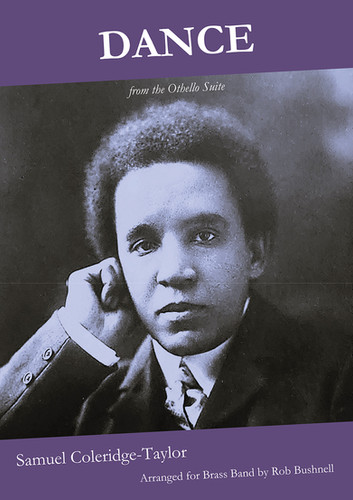
Dance from the Othello Suite (Brass Band) Coleridge-Taylor arr. Bushnell
Samuel Coleridge-Taylor is a British composer, who, from a young age, showed talent on the violin and entered the Royal College of Music, studying with Charles Villers Standford. His music become so popular that his Hiawatha trilogy was the second most performed choral piece (joint with Mendelssohn's Elijah, and only beaten by Handel's Messiah) with choral societies up and down the British Isles. In fact, Hiawatha was arranged by Charles Godfrey as a test-piece for the 1902 National Brass Band Championship of Great Britain, held at Crystal Palace.Commissioned by the theatre impresario Herbert Beerbohm, Coleridge-Taylor composed incidental music for His Majesty's Theatre London production of the Shakespeare play, Othello, in the West End, in 1909. In 1912, the play opened to the public, with a suite of five movements put together soon afterwards. The Dance, arranged here by Rob Bushnell, makes a great concert opener.This arrangement is for the British-style brass band, with alternative parts for horns in F and bass-clef lower brass.A recording of the original composition can be found at www.youtube.com/watch?v=OQeO_Ij9CV8Duration: approx. 2.30 minutesDifficulty Level: 3rd Section +PDF download includes parts and score.Sheet music available at www.brassband.co.uk (UK) or https://satradecentral.org (USA)Instrumentation:Soprano Cornet EbSolo Cornet BbRepiano Cornet Bb2nd Cornet Bb3rd Cornet BbFlugel Horn BbSolo Horn Eb1st Horn Eb2nd Horn Eb1st Baritone Bb2nd Baritone Bb1st Trombone Bb2nd Trombone BbBass TromboneEuphonium BbBass EbBass BbTimpaniPercussion - Triangle, Cymbal & Bass Drum
In Stock: Estimated dispatch 1-3 working days
-
 £33.43
E lucevan le stelle (Cornet/Euphonium Duet with Brass Band) Puccini arr.Bushnell
Tosca is an opera in three acts by the Italian composer Giacomo Puccini. The opera is set in June 1800 in Rome, and tells the story of the Kingdom of Naples and the threat to its control of Rome by Napoleon's invasion of Italy. Some of Puccini's best-known arias can be found in Tosca.The opera is based on Victorien Sardou's dramatic play of the same name (La Tosca). Puccini saw the play at least twice in 1889 and begged his publisher, Giulio Ricordi, to obtain the rights to turn it into an opera, which were secured in 1891 - although Puccini relinquished the rights to Alberto Franchetti before being recommissioned in 1895. Puccini wrote "I see in this Tosca the opera I need, with no overblown proportions, no elaborate spectacle, nor will it call for the usual excessive amount of music." It took four years to write, with Puccini arguing with his librettists (Luigi Illica and Giuseppe Giacosa) and his publisher. Although the first performance was delayed by a day due to the unrest in Rome at the time, the opera was premiered on 14 January 1900 at the Teatro Costanzi in Rome. The critics reviews were indifferent, but it was an immediate success with the public. The opera is through-composed, with the different musical elements weaved from piece to piece. Puccini used the Wagner's leitmotif concept to identity different parts of the opera.Taken from Act 3, E lucevan le stelle is sung by Cavaradossi, a painter, who has fallen for the singer Tosca. The corrupt Chief of Police, Baron Scarpia, longs for Tosca himself and, upon suspecting Cavaradossi of helping a political prisoner escape, he takes the opportunity to get rid of Cavaradossi and blackmail Tosca into being with him. The guards lead Cavaradossi to the roof of Castel Sant'Angelo, where he is told he has 1 hour to live before being executed. He asks to write a letter to Tosca, overcome by memories, he sings E lucevan le stelle (And the stars shone). It was selected by the tenor Wynne Evans as one of the most romantic songs for his top ten arias for Classic FM. He described it as "another tenor classic, both tragic and beautiful."This arrangement (for cornet and euphonium duet with brass band) includes alternative parts for horns in F and lower brass in bass clef.A recording of the original song can be found here: www.youtube.com/watch?v=EAqHQMX7GHY
In Stock: Estimated dispatch 1-3 working days
 Watch video