
Results
-
 £115.60
S.O.S. - Björn Ulvaeus - Bjørn Morten Kjærnes
When the publisher asked me to make an arrangement of an ABBA tune, S.O.S. was the first song I thought of. Its introduction and melody are well suited to play for Wind Band. Admittedly, the key had to be shifted to make it sound good for this instrumentation. To me, this is nostalgia, while for others, the Mamma Mia movie/show will be what they associate with this wonderful song. Apart from a few medleys, few of ABBA's songs are available to Wind Band. So, it was very fun to work on this classic.The arrangement is made quite simply to fit many sizes of Bands. Technically, it is also relatively simple both in range and rhythm. As you can see, there are many ways to adjust this arrangement to your own ensemble. Bring out melody lines and the bassline, and a lot is done. If needed, simplify to make it sound nice.Bjorn Morten Kjaernes
Estimated dispatch 5-14 working days
-
 £104.99
High Flyers - Andrew R. Mackereth
From the composer: High Flyers are regarded as people with promise and potential.They are winners. This is music for winners.The title, as well as being a play-on-words, implies the nature of the work. It is a bright, optimistic, and upbeat piece attempting to depict an exhilarating ride on flying carpet. The opening rising chords immediately suggest the gentle elevation of the carpets' ascent towards unknown heights, leading to a hint of a first theme in the horns at Fig. B. The first four notes provide the thematic material for the whole work: C F G A.A perpetual sense of movement is achieved through accented quaver chords punctuating the melodicmaterial of the first main theme. Fig. E sees the music of the opening bars fully realised, with flourishes from the euphonium and baritones representing swirling clouds, shooting stars, or passing birds in flight.The same subject is developed into a lyrical second theme with a new lush harmonic treatment, evocative of gliding over an expanse of sparse countryside.This section ends with a note of serenity but is shattered by the urgent insistence of the percussion rhythms.The third section introduces a new idea with a slightly distorted fanfare in the cornets and trombones. This figure suggests for the first time that there may be trouble ahead. In fact, there is no need to fear and the journey can continue without aggravation. This fanfare returns near the end to signal a final note of triumph.A new rhythmic variant of the cell motif emerges as the third theme now transformed by the addition of a triplet figure. The music steadily gains momentum before moving inexorably towards the climactic return of the music and tonality of the opening bars of the piece.
Estimated dispatch 5-14 working days
-
£54.99
Swingin' Kilts - John Blanken
John Blanken has created a swinging arrangement of the famous Scottish traditional tune Scotland the Brave. The usual version with bagpipes is the best known and there is a similarity in Swingin' Kilts owing to its long, drone-like tones in the accompaniment. The theme has been rhythmically adapted but it is still easily recognisable. Swingin' Kilts holds a challenge for every brass band. It makes demands in terms of timing and technique which give this work the bravura feel that will keep the audience as well as the musicians swinging in their seats.
Estimated dispatch 5-14 working days
-
 £52.50
Broadheath - Philip Sparke
Broadheath was commissioned by the Elgar International Brass Band Summer School for their 2024 course. The premiere took place in the Routh Hall at Bromsgrove School on Friday 26 July.It is in conventional march form, opening with a brief fanfare before the horns take up the main theme. This is then repeated by the full band before euphoniums and baritone announce the second subject. This builds to a stirring tutti passage utilising elements of the opening theme, which brings the opening section to a close.In honour of the summer school's tribute to Sir Edward Elgar (it is held in 'Elgar country'), the trio uses the opening melody of his 1st symphony as its main theme, decorating it with filigree work from the cornets. This is repeated on the full band and leads to a varied recapitulation of the opening material to bring the march full circle.
Estimated dispatch 5-14 working days
-
 £127.30
Sommernatt ved fjorden - Ketil Bjørnstad - Haakon Esplo
"By the Fjord" is written by the Norwegian composer Kjetil Bjornstad and is the most famous song from the musical work "Leve Patagonia" which was published in 1978. The work is written as a modern suite about the Oslo Bohemians Hans Jaeger and OdaLasson sitting in a pram on the fjord a summer night. Odas sister sees the couple on the sea from her window and tells us the story.Kjetil Bjornstad wrote "By the Fjord" in his house outside Tvedestrand early spring 1978. He was initially notfully satisfied and considered disposing it. The beautiful music has luckily made the song a classic in Norwegian music.To the conductorThis arrangement can be used with both vocal andinstrumental soloist. Its always a challenge toarrange songs with many verses that tells a story if it is to be played by an instrumental soloist instead of a singer. Because of that, please cut the repeats if it's performed without lyrics.Solo-parts included in the set: Vocal Flugelhorn Euphonium - Trombone
Estimated dispatch 5-14 working days
-
 £44.00
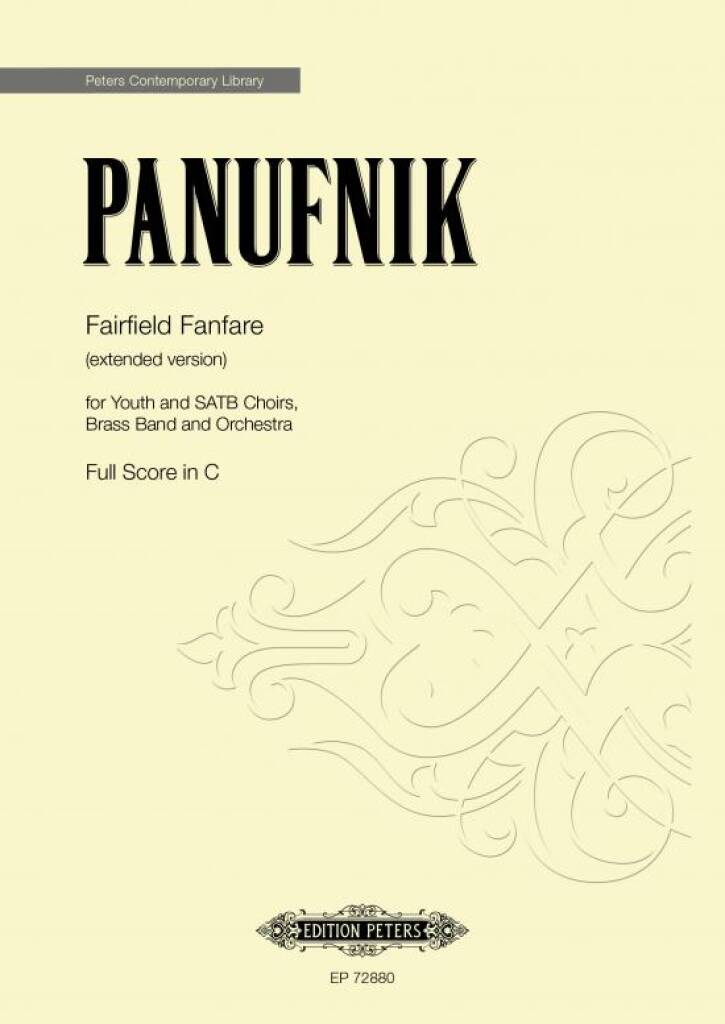
Fairfield Fanfare (expanded version) - Roxanna Panufnik
Fairfield Fanfare (expanded version) by Roxanna Panufnik is a 4-minute work for youth and mixed choirs, brass band and orchestra. Originally commissioned to celebrate the 50th anniversary of the Fairfield Halls, Croydon in 2012, the opening chords are based on all the alphabetic note names from FA-ir-F(#)-i-E-l-D, heralding a flourishing section of hustle and bustle that is the city of Croydon today.This expanded version includes brass band and choirs, with a setting of the text from Psalm 127. The expanded version was commissioned by the London Mozart Players, who premiered the piece on 30 June 2016 at Fairfield Halls, Croydon.This edition is the full score in C (EP 72880). It is available for sale as part of the Peters Contemporary Library. The performance material can be hired as well as a transposed full score, if preferred.
Estimated dispatch 5-14 working days
-
£54.99
First Jazz - André Waignein
First Jazz, a fine swinging piece, was written by Roland Kernen, who is the composer and arranger of a great deal of successful concert band music. It's a cheerful piece in ABA form for four-part variable instrumentation and additional percussion. It is very suitable for beginners who want to play light music and the swing style will appeal to the musicians as well as the audience.
Estimated dispatch 5-14 working days
-
£76.99
Jubilant Prelude - Toon Hagen - Dirk Annema
'Jubilant Prelude' is an orchestration of the 'Preludium over Psalm 150' originally composed for organ by Toon Hagen. Since 1998 Toon Hagen has been organ-player of the 'Grote or Sint Michaelskerk' in Zwolle (the Netherlands). He has written several 'contemporary' compositions for organ.'Jubilant Prelude' has a capricious character by the use of irregular measures and its many measure changes. The structure of the Prelude is that of a fugue and is based on motives from the psalm.After the first climax, which is both dynamic and harmonic, the theme in the Andante Jubiloso is clearly audible and it is alternated with erratic motifs. Tension increases until at last the psalm itself isheard in all its glory. The melody of the psalm sounds as a cantus firmus in tenor register, with motifs in ornamentation for saxophones, bugles and trumpets. The finale, like the prelude is capricious and vehement.The instrumentation for brassband was made by Dirk Annema. It is particularly colourful and has a surprising role for the percussion section.
Estimated dispatch 5-14 working days
-
 £89.99
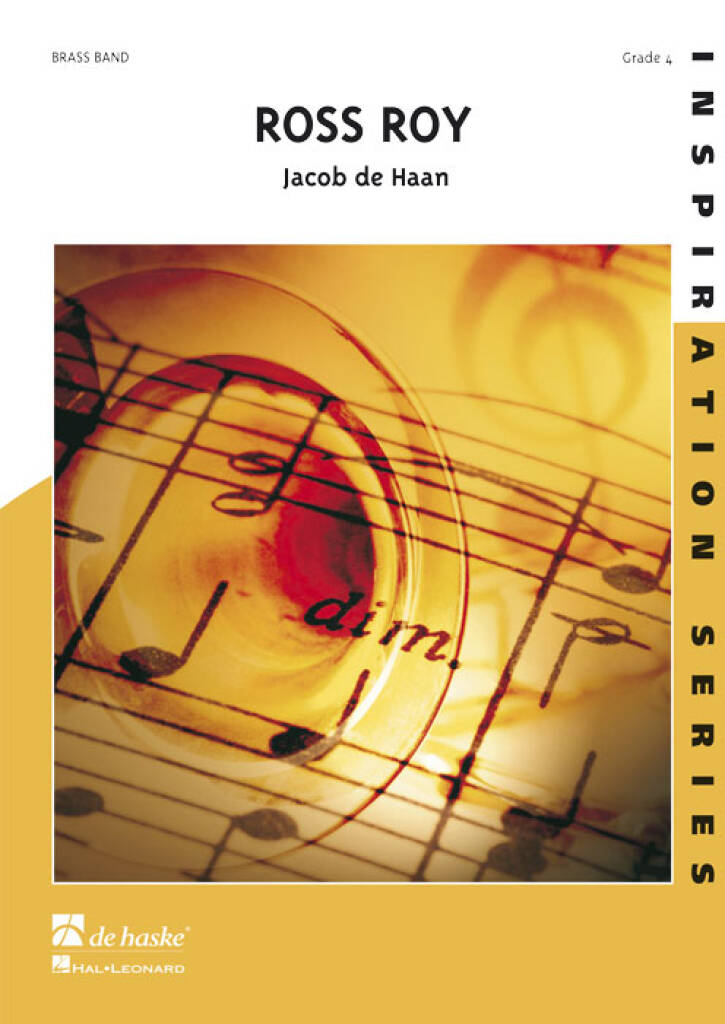
Ross Roy - Jacob de Haan
In this composition, Jacob de Haan sees the "Ross Roy" as a metaphor for the years spent at school (a monument in time), where one's personality is formed. So, the opening theme the artist calls the Ross Roy theme initially has monumental characteristics.The rhythmic motion, which strides along in the lower register and percussion at the beginning of the next section is typical of "Tempo di Marcia". This movement, accompanied by repetitions of sound, is a metaphor for the structure and discipline in school. This is the introduction to a march theme, symbolic of "passing through" the classes up to the final examinations.Then, the Ross Roy theme is dealt with again, now in aplayful, humorous variation. As if the composer is saying there should also be time for a smile in school. The same theme can be heard in major key and a slower tempo in the following section, expressing pride and self-confidence. This is also the introduction to the expressive middle section that represents love, friendship and understanding.We then return to the march theme in a slightly altered construction. The oriental sounds, constituting the modulation to the final theme, are symbols of the diversity of cultures in the school. The characteristic final theme first sounds solemn, but turns into a festive apotheosis. It is no coincidence that the final cadence is reminiscent of the close to a traditional overture, for the school years can be considered the "overture" to the rest of one's life.
Estimated dispatch 5-14 working days
-
 £114.99
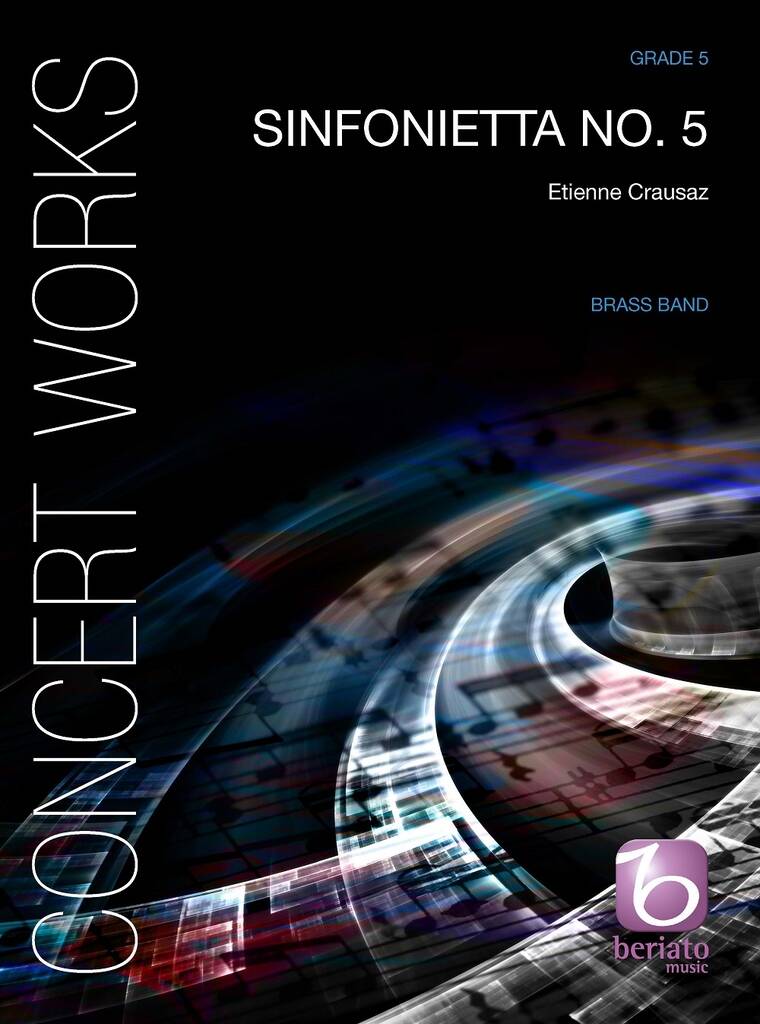
Sinfonietta No. 5 - Etienne Crausaz
This work continues the explorations made in previous numbers, and is particularly close to the Sinfonietta No. 3 in terms of difficulty and form. It is based on various short motifs presented in the first few minutes of the work, which are developed and treated symphonically. The music alternates between moments of great vitality and exuberance, and sombre or dramatic passages. While it is not programmatic, it remains highly descriptive. Sinfonietta No. 5 was commissioned by the Valais, Bern, Jura, Geneva, Solothurn and Innerschweiz cantonal associations for the 2024 cantonal celebrations to serve as the compulsory work in the 1st Brass Band category.
Estimated dispatch 5-14 working days
 View Music