
Results
-
 £3.95
£3.95On the Face Too! (Part C: Horn in F)
On the Face Too! is to the secondary school brass teacher as On the Face! is to the primary: namely a collection of pieces for intermediate brass ensemble in various jazz and popular styles, aiming to give a ready supply of material for concerts and assemblies, which nevertheless still allows for the developing technique of the young players to whom it is addressed.Generally speaking, the technical difficulty of the material here goes no further than grade 4 or 5 (even the first trumpet part never goes higher than a written G), though some pieces will offer considerable rhythmic challenges.
Estimated dispatch 7-14 working days
-
 £3.95
£3.95On the Face Too! (Part C: Trombone/Euphonium BC)
On the Face Too! is to the secondary school brass teacher as On the Face! is to the primary: namely a collection of pieces for intermediate brass ensemble in various jazz and popular styles, aiming to give a ready supply of material for concerts and assemblies, which nevertheless still allows for the developing technique of the young players to whom it is addressed.Generally speaking, the technical difficulty of the material here goes no further than grade 4 or 5 (even the first trumpet part never goes higher than a written G), though some pieces will offer considerable rhythmic challenges.
Estimated dispatch 7-14 working days
-
 £3.95
£3.95On the Face Too! (Part C: Trombone/Euphonium TC)
On the Face Too! is to the secondary school brass teacher as On the Face! is to the primary: namely a collection of pieces for intermediate brass ensemble in various jazz and popular styles, aiming to give a ready supply of material for concerts and assemblies, which nevertheless still allows for the developing technique of the young players to whom it is addressed.Generally speaking, the technical difficulty of the material here goes no further than grade 4 or 5 (even the first trumpet part never goes higher than a written G), though some pieces will offer considerable rhythmic challenges.
Estimated dispatch 7-14 working days
-
 £3.95
£3.95On the Face Too! (Part D: Bass in Eb)
On the Face Too! is to the secondary school brass teacher as On the Face! is to the primary: namely a collection of pieces for intermediate brass ensemble in various jazz and popular styles, aiming to give a ready supply of material for concerts and assemblies, which nevertheless still allows for the developing technique of the young players to whom it is addressed.Generally speaking, the technical difficulty of the material here goes no further than grade 4 or 5 (even the first trumpet part never goes higher than a written G), though some pieces will offer considerable rhythmic challenges.
Estimated dispatch 7-14 working days
-
 £3.95
£3.95On the Face Too! (Part D: Trombone BC)
On the Face Too! is to the secondary school brass teacher as On the Face! is to the primary: namely a collection of pieces for intermediate brass ensemble in various jazz and popular styles, aiming to give a ready supply of material for concerts and assemblies, which nevertheless still allows for the developing technique of the young players to whom it is addressed.Generally speaking, the technical difficulty of the material here goes no further than grade 4 or 5 (even the first trumpet part never goes higher than a written G), though some pieces will offer considerable rhythmic challenges.
Estimated dispatch 7-14 working days
-
 £3.95
£3.95On the Face Too! (Part D: Trombone TC)
On the Face Too! is to the secondary school brass teacher as On the Face! is to the primary: namely a collection of pieces for intermediate brass ensemble in various jazz and popular styles, aiming to give a ready supply of material for concerts and assemblies, which nevertheless still allows for the developing technique of the young players to whom it is addressed.Generally speaking, the technical difficulty of the material here goes no further than grade 4 or 5 (even the first trumpet part never goes higher than a written G), though some pieces will offer considerable rhythmic challenges.
Estimated dispatch 7-14 working days
-
 £3.95
£3.95On the Face Too! (Part D: Tuba BC)
On the Face Too! is to the secondary school brass teacher as On the Face! is to the primary: namely a collection of pieces for intermediate brass ensemble in various jazz and popular styles, aiming to give a ready supply of material for concerts and assemblies, which nevertheless still allows for the developing technique of the young players to whom it is addressed.Generally speaking, the technical difficulty of the material here goes no further than grade 4 or 5 (even the first trumpet part never goes higher than a written G), though some pieces will offer considerable rhythmic challenges.
Estimated dispatch 7-14 working days
-
 £3.95
£3.95On the Face Too! (Percussion)
On the Face Too! is to the secondary school brass teacher as On the Face! is to the primary: namely a collection of pieces for intermediate brass ensemble in various jazz and popular styles, aiming to give a ready supply of material for concerts and assemblies, which nevertheless still allows for the developing technique of the young players to whom it is addressed.Generally speaking, the technical difficulty of the material here goes no further than grade 4 or 5 (even the first trumpet part never goes higher than a written G), though some pieces will offer considerable rhythmic challenges.
Estimated dispatch 7-14 working days
-
 £50.00
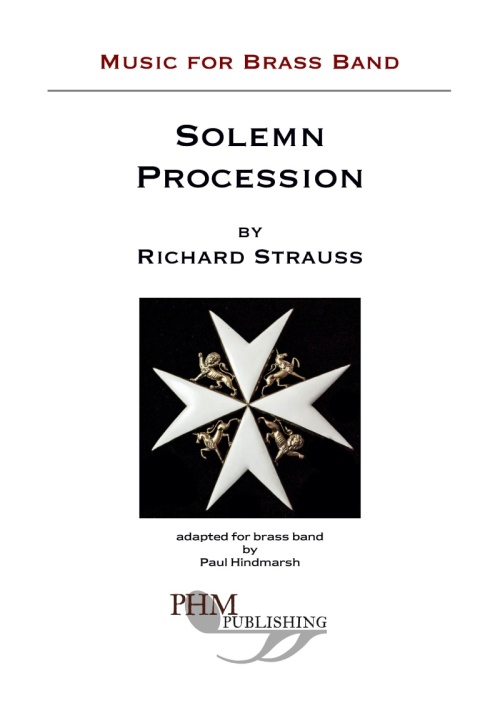
Solemn Procession (Brass Band - Score and Parts)
Richard Strauss (1864 - 1949) was a famous conductor and composer when he wrote Feierlicher Einzug der Ritter des Johanniter-Ordens (Solemn Entrance of the Knights of the Order of Saint John) in 1909. One of only a handful of his works written exclusively for winds, Strauss composed Feierlicher Einzug for the investiture ceremonies of the Order of St. John, a Christian military order that was founded in Jerusalem in 1023 to care for poor, sick, or injured pilgrims journeying to the Holy Land.Strauss scored Feierlicher Einzug (TrV 224) for a large ensemble of fifteen trumpets, four horns, four trombones, two tubas and timpani. He saw enough potential in its stately character and majestic conclusion to produce a version for symphony orchestra with organ and it has been arranged for a variety of brass ensembles with or without organ since then.This version for British style brass band was adapted from the original in 1990 by Paul Hindmarsh for the exclusive use of Besses o' th' Barn Band, of which he was then the musical director. Now that the music of Richard Strauss published in his lifetime is in the public domain, Solemn Procession, as it has been rendered in English, can be enjoyed by all brass bands and their audiences.- Paul HindmarshDuration: 6.00
Estimated dispatch 7-14 working days
-
 £44.95
Judd: Scottish Folk Variants - Euphonium Solo
Here is music that provides a soloist with melody and bravura, as it did when premiered by Derick Kane at ISB120 for which it was commissioned. Hence, there are a number of traditional Scottish melodies that form the basis for these variants. Perhaps you will recognise, in sequence: 'The dashing white sergeant', 'My bonnie lies over the ocean', 'Skye boat song', 'Bonnie Dundee'.
Estimated dispatch 7-14 working days