
Results
-
 £95.00
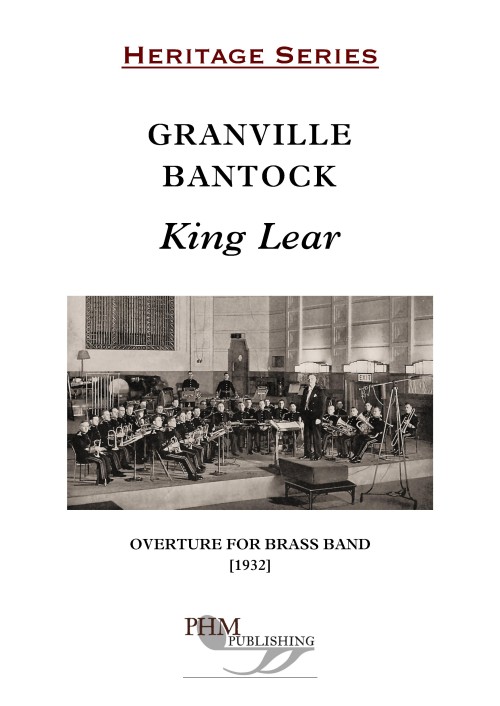
King Lear (Brass Band - Score and Parts) - Bantock, Granville - Hindmarsh, Paul
Sir Granville Bantock (1868 - 1946) composed the second of his five major brass band work for Callender's Cableworks Band, completing the commission on 30 November 1932. Based in the Thames-side district of Belvedere near Erith, the band was active between 1898 and 1961. The works band of the Callender Cable & Construction Co. Ltd, it was at the peak of its popularity during the 1930s and was a frequent broadcaster on the radio. The band employed an in-house arranger and played saxophones in its lighter material. King Lear was one of the band's major commissions and was not published in Bantock's lifetime. The manuscript score and parts were thought to be lost for decades, but were found in the library of the Haydock Band (Lancashire), which had inherited part of Callender's library of manuscripts material and bespoke arrangements after it has been transferred to nearby Prescott Cables Band after Callender's Cable Works closed.King Lear is a substantial work, in essence a dramatic tone poem in the romantic Tchaikovskian manner, presenting a series of character portraits of the foolish old king and his three daughters, Goneril, Regan and Cordelia. The music is dramatic and lyrical by turns, with the most generous lyrical episode revealing perhaps the warm-hearted Cordelia. An expansive melody that flows from this is brought back towards the end as the main climax of the work.In 2001, Bantock's score was recorded by the University of Salford Brass Band, conducted by Dr. Roy Newsome. The original is serviceable, but in comparison with the orchestral version he made in 1936 (part of which was recorded on a Paxton 78 rpm) and later brass band scores, performing editions of which were prepared by others, it lacks colour and range typical of Bantock's orchestral work. Above all it lacks percussion, which can be heard on the recorded extract. With the kind permission of the Bantock Estate, I have prepared a performing edition for publication that incorporates percussion, derived from the orchestral recording and added editorially in similar manner elsewhere. I have revoiced some of the low- lying instrumental parts to present the material in more comfortable ranges. Editorial interventions more elaborate than revoicing the original text have been identified as cue notes.- Paul HindmarshDuration: 15.00
Estimated dispatch 7-14 working days
-
 £44.95
Princethorpe Variations (Brass Band - Score and Parts) - Downie, Kenneth
Colourful harmony, rhythmic flair and melodic invention are the hallmarks of this excellent set of variations by Kenneth Downie, based on the well known church tune, Princethorpe.This major work demonstrates the well-known characteristics of the composer: colourful harmony, rhythmic flair and melodic invention, all encapsulated in scoring which is engulfing both to players and listeners alike. Following a presentation of the theme there are five variations culminating in what can be described as either a finale or coda.Theme. The composer shows his originality in the harmonic sense of this introduction. Perhaps it could be suggested that over-indulgence of rubato may be a temptation to be avoided.Sections A to F. Relentless rhythmic drive is of paramount importance in this first variation. Conscientious observance of dynamics is of course an essential requirement in conveying the exciting quality of the music; there are moments of sudden contrast of which all will need to be aware. Moving between the time-signatures of 5/4 and 6/4 these sections are built from strong easily-identifiable fragments of the theme. These is a significant increase in temp at letter F which will further the exciting impact of the music.Sections G & H. In a pastorale style this short, gentle variation affords a contrast in style between the previous and succeeding ones. The gentle undulating character of the melodic lines is governed by the Allegretto grazioso directive.Sections I to M. Commencing two bars before letter I the music is now exuberant and the tempo and style is that of a march in compound time. In this exhilarating movement there are moments of contrast and indeed of delicacy which are a foil to the more energetic moments. Rhythmic control will be essential to maintain a consistent tempo. As elsewhere in the work, the percussion section will contribute much to the success of the performance there are bars where this section alone is heard and there are important entries for glockenspiel.Sections N & O. With emotional content this Adagio variation has the first two notes of the melody as its melodic impetus. Apart from just over two bars at O (where there is an interpolatory phrase from Cornets and Trombones), the melodic line is entrusted to the plaintive sounds of the horn section. Cornets and Trombones provide a change of tone colour at the beginning of section O. Under a poco rall, this very expressive variation is concluded; there is an important link supplied by Eb Bass.Sections P & Q. A lively march-tempo is launched immediately and these sections are in the nature of an introduction to the final variations. There is a quickening of pace at Q which assists the generation of excitement which should be an essential part of the performance. Solo Cornets introduce a melodic line at Q which anticipates the compound time of the following section.Sections R & S. The Solo Cornet theme of the previous section is now a contrapuntal line accompanying the theme tune. With an elongation of the notes in the melody, the conductor will need to call on the sustaining powers of the band and at no time should the interesting accompanying lines be allowed to detract from the sonorous presentation of the basic theme.Sections T, U & V. Following a poco rit, the finale begins at letter T with the directive, molto vivace. There is much detail to be rehearsed, not least being the dynamic contrasts which are encountered. As throughout the work, the listener should have no difficulty in identifying the thematic sources of the composer's music.
Estimated dispatch 7-14 working days
-
 £89.99
Ross Roy (Brass Band - Score and Parts) - De Haan, Jacob
In this composition, Jacob de Haan sees the "Ross Roy" as a metaphor for the years spent at school (a monument in time), where one's personality is formed. So, the opening theme the artist calls the Ross Roy theme initially has monumental characteristics.The rhythmic motion, which strides along in the lower register and percussion at the beginning of the next section is typical of "Tempo di Marcia". This movement, accompanied by repetitions of sound, is a metaphor for the structure and discipline in school. This is the introduction to a march theme, symbolic of "passing through" the classes up to the final examinations.Then, the Ross Roy theme is dealt with again, now in a playful, humorous variation. As if the composer is saying there should also be time for a smile in school. The same theme can be heard in major key and a slower tempo in the following section, expressing pride and self-confidence. This is also the introduction to the expressive middle section that represents love, friendship and understanding.We then return to the march theme in a slightly altered construction. The oriental sounds, constituting the modulation to the final theme, are symbols of the diversity of cultures in the school. The characteristic final theme first sounds solemn, but turns into a festive apotheosis. It is no coincidence that the final cadence is reminiscent of the close to a traditional overture, for the school years can be considered the "overture" to the rest of one's life.Duration: 9:20
Estimated dispatch 7-14 working days
-
 £64.95
Dance Spirit (Brass Band - Score and Parts) - Wiffin, Rob
Dance Spirit is a three movement suite of dances comprising Stomping Dance, Waltz Interlude and Duende linked by solo dancer cadenzas. It started life as the wind band piece Spirit of the Dance. In it I attempted to capture some of the elements of this most fundamental of human activities, the urge to move our bodies to the rhythm of the music. In re-working it for brass band I extended the duration of the Waltz Interlude and increased the technical level in some areas with the intention of making it a suitable test piece.Stomping Dance - The suite starts with perhaps the most basic dance feeling, the desire to stomp our feet to the music, unrefined, no knowledge of steps needed. The heavy stomp is not always present in the music here, and sometimes you can sense the dancers trying something a little more refined, but it is always lurking in the background, ready to draw us back to the elemental rhythm of the beat.Waltz Interlude - Of course, dance does not always have to have heat, it can be elegant and restrained, emphasising fluidity of line and movement. In the waltz it is occasionally suspended by the held poses before the motion starts again. Unlike the outer movements, the Waltz Interlude is cool, danced in moonlight rather than under the sun. The two dancers sometimes move as one and at other times the man provides a frame for the more intricate arabesques of his partner.Duende - During my time living in Spain I went to watch some flamenco dancing. I was expecting the normal tourist cliches but the dancers were serious students of Flamenco Nuevo y Viejo (new and old). They performed with passion to some pounding asymmetric rhythms and their performance was the inspiration for Duende. Duende as a term is hard to define. It is a spirit of performance - that moment when you are right in the middle of the creative spirit of the music. It is about soul and a heightened state of emotion. Federico Garcia Lorca wrote: I have heard an old maestro of the guitar say, The duende is not in the throat; the duende climbs up inside you, from the soles of the feet. Meaning this: it is not a question of ability, but of true, living style, of blood, of the most ancient culture, of spontaneous creation.- Rob WiffinDuration: 13.45
Estimated dispatch 7-14 working days
-
 £183.99
Perihelion: Closer to the Sun (Brass Band - Score and Parts) - Sparke, Philip
Perihelion was commissioned by the Cory Band as their own-choice piece for the 2013 European Brass Band Championships, held in Oslo, Norway. Winning the set piece section of the contest and coming second to Eikanger-Bjorsvik Musikklag with their own choice selection, Cory went on to become European Champions for the fifth time. Cory MD Philip Harper had asked for a 'Concerto for Band' to fully exploit his outstanding band of virtuosi, and composer Philip Sparke created a one-movement work with contiguous sections, first featuring horns and flugel, then trombones followed by cornets and a slower central section for percussion and baritones, euphonium and basses. The piece is abstract in nature, without a specific programme, and the title merely reflects the fact that the piece was begun on January 2nd 2013, the day of Earth's perihelion - the point in its orbit when it is closest to the sun. It could also be argued that the piece weaves between moments of brilliant optimism and dark shadow, both of which can be the result of bright sunshine.Duration: 19:15
Estimated dispatch 7-14 working days
-
 £42.95
You Are the Sunshine of My Life (Flugel/Trombone Sextet with Brass Band - Score and Parts) - Wonder, Stevie - Richards, Goff
A brilliant feature for 3 flugel horns and/or cornets and 3 trombones.Although originally conceived to feature a sextet consisting of three Flugel Horns and three Trombones, with Brass Band, it may, of course, use cornets instead of Flugel Horns or, indeed, a mixture of the two.As it is envisaged that Solo Cornet players may be involved in the sextet, a Repiano Cornet part has been omitted so that the remaining cornet players can be dispersed among the parts to achieve the best balance.Recorded on Polyphonic QPRL229D Ovation!
Estimated dispatch 7-14 working days
-
 £110.99
The Four Noble Truths (Brass Band - Score and Parts) - Sparke, Philip
The Four Noble Truths are the most basic expression of the teaching of Buddha and therefore still form the guidelines for Buddhists to this day. The four truths are Dukkha, which describes times of major stress in our lives - birth, ageing, desire and death; Samudaya which describes those parts of our life that induce stress, feeling, craving, desire; Nirodha which tells us how to eliminate those aspects of our lives which induce stress and Magga which describes the eight disciplines which can help us eliminate the origins of stress from our lives. It can be seen from these over-simplified definitions, that the Four Noble Truths fall into two pairs, the first two describing the origins of stress and the second two describing how we can reduce stress. To reflect this, the four movements of this work are also combined into two pairs - two quick movements and two slow movements. A fascinating work from this great English composer.Duration: 14:00
Estimated dispatch 7-14 working days
-
£154.99
Spiriti (Brass Band - Score and Parts)
A Bach chorale stands at the centre of this work (F?r deinen Thron tret? ich hiermit).Anton Bruckner was one of Johann Sebastian Bach's great admirers. His work is full of the spirit of that musical genius. For Thomas Doss, it was Bruckner's spirit that always seemed to be with him while working on Spiriti. Bruckner's spirit is captured in this composition by a quote from the chorale of his Fifth Symphony at the end of the piece.The introduction, written in the style of a funeral march, already displays the first fragments of the chorale. Like splinters they are strewn throughout the first Allegro, combining and recombining in turbulent, powerful tutti passages. As the music becomes more rambunctious, the Bach-like fragments begin to swirl around each other, only to be scattered once more.The middle-section is of a more pensive nature. The Religioso character gives the audience time to reflect. The music is meditative and the quarter-note (or crotchet) elements mimic a soul that is yearning and crying out.The third part of the piece finally leads, by way of minimalist elements and the fragments mentioned earlier, to a magnificent presentation of the Bach chorale. As the church bells ring out, one can almost hear the great masters presiding at the organ. 17:00
Estimated dispatch 7-14 working days
-
£24.95
Lloyd (Brass Band - Score and Parts) - Howard, Cuthbert - Coles, Bramwell
The first presentation of the theme can be used for the purpose of accompanying congregational singing. At Section A the second presentation of the tune appears in the key of the dominant, the melody being given throughout to Solo Horn, with First Horn, First Trombone, Soprano and Flugel reinforcing the melody in the various phrases. Incidentally, see that the players do not break these phrases; it should be possible to take the four bars in one breath quite easily. Take due care of the light and shade which should be delicately applied. In the last bar the music gathers strength as we pass back into the original key for the last verse; pay particular attention to the part allotted to Second Baritone and Euphonium which needs to be slightly stressed. For the last appearance of the tune at Section B the full Band is used, apart from the third phrase which is given solo by Solo Comet with a light accompaniment above a bass pedal. Notice the rit. operating from the end of the eleventh bar and also the short swell effect on the fourth beat of the fourteenth bar.
Estimated dispatch 7-14 working days
-
 £50.00
Solemn Procession (Brass Band - Score and Parts) - Strauss, Richard - Hindmarsh, Paul
Richard Strauss (1864 - 1949) was a famous conductor and composer when he wrote Feierlicher Einzug der Ritter des Johanniter-Ordens (Solemn Entrance of the Knights of the Order of Saint John) in 1909. One of only a handful of his works written exclusively for winds, Strauss composed Feierlicher Einzug for the investiture ceremonies of the Order of St. John, a Christian military order that was founded in Jerusalem in 1023 to care for poor, sick, or injured pilgrims journeying to the Holy Land.Strauss scored Feierlicher Einzug (TrV 224) for a large ensemble of fifteen trumpets, four horns, four trombones, two tubas and timpani. He saw enough potential in its stately character and majestic conclusion to produce a version for symphony orchestra with organ and it has been arranged for a variety of brass ensembles with or without organ since then.This version for British style brass band was adapted from the original in 1990 by Paul Hindmarsh for the exclusive use of Besses o' th' Barn Band, of which he was then the musical director. Now that the music of Richard Strauss published in his lifetime is in the public domain, Solemn Procession, as it has been rendered in English, can be enjoyed by all brass bands and their audiences.- Paul HindmarshDuration: 6.00
Estimated dispatch 7-14 working days
 View Music