
Results
-
 £40.00
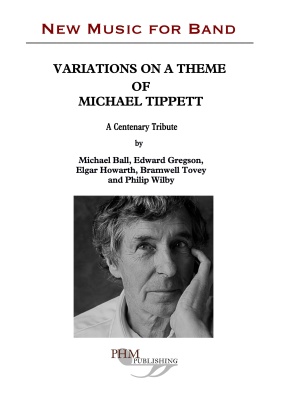
Variations on a Theme of Michael Tippett (Brass Band - Score only)
A Centenary Tribute by Michael Ball, Edward Gregson, Elgar Howarth, Bramwell Tovey and Philip WilbyThis unique 'pice d'occasion' arose out of a telephone conversation in 2004 with Alan Wycherley, who was the soprano cornet player of the Foden's Richardson Band at the time. He indicated that the band would like to include an original birthday tribute for Edward Gregson (60) and Elgar Howarth (70) in its concert at the 2005 RNCM Festival of Brass in Manchester. I have been Artistic Director of Manchester's Festival of Brass since it was established in 1990 as a BBC Radio 3 series, As the centenary of the birth of Sir Michael Tippett fell on 5 January 2005, I devised this collective work as a way of embracing all three anniversaries in a novel way.The idea of joint compositions is not a new one in the classical music world. In the 1860s, Verdi was joined by a number of his contemporaries in a Requiem Mass for Rossini. In this country there have been a number of orchestral examples over the past fifty years, but never before for the brass band. Although Tippett composed only one work for brass band, Festal Brass with Blues, his orchestral works and operas are full of idiomatic brass writing. The theme I chose for this celebration is one of Tippet's most memorable miniatures featuring wind and brass. In the opera Midsummer Marriage it marks the entry of the Ancients. It is also included in the orchestral Suite in D (1948), for the Birthday of Prince Charles.I invited five of the leading contemporary voices in brass band music to add their own creative perspectives to the little Tippett theme, with it's characteristic rhythms, embellishments and modality - the Lydian mode. Each contribution was designed to fit into a tonal and formal template to give the whole work a flow and continuity. In Danse des Amis, Bramwell Tovey has composed a jazzy, humorous variation. Inspiration came from Tippett's love of jazz and, more personally, from the characteristically syncopated gait of the distinguished music critic John Amis, who Tovey once observed leaving a performance of Tippett's opera King Priam before the end. Incidentally, that performance was conducted by Elgar Howarth.We hear Edward Gregson in lyrical mode. His Midsummer Song is redolent of the sound world of Tippett's opera A Midsummer Marriage and it ends with a brief reference to a favourite of Gregson's, Tippett's Concerto for Orchestra. Michael Ball provides a brief moment of light, airy activity bringing to mind perhaps Tippett's love of Shakespearian fantasy, especially The Tempest. Elgar Howarth juxtaposes a slowed down version of the processional theme with distant recollections of fanfares from King Priam. Philip Wilby has rounded the tribute off with a spectacular fugue. During its inexorable progress Wilby ingeniously introduces the two other birthday references - the three-note musical signature that Elgar Howarth includes in much of his music and the characteristic theme which begins Edward Gregson's substantial work for brass an organ The Trumpets of the Angels. An elaborated reprise of Tippett's little theme is followed by a dynamic coda.- Paul HindmarshDuration: 13.00
Estimated dispatch 7-14 working days
-
 £74.95
Eden (Score and Parts)
This work was commissioned by the Brass Band Heritage Trust as the test piece for the final of the 2005 Besson National Brass Band Championship, held at the Royal Albert Hall, London.The score is prefaced by the final lines from Milton's epic poem Paradise Lost (completed in 1663), in which Adam and Eve, expelled from Paradise, make their uncertain way into the outside world:"...The world was all before them, where to chooseTheir place of rest, and providence their guide:They hand in hand with wandering steps and slow,Through Eden took their solitary way."My work is in three linked sections. In the first, the characters of Adam, Eve and the serpent guarding the Tree of Knowledge are respectively represented by solo euphonium, cornet and trombone. The music opens in an idyllic and tranquil mood and leads into a duet between euphonium and cornet. Throughout this passage the prevailing mood darkens, though the soloists seem to remain oblivious to the increasingly fraught atmosphere. A whip-crack announces the malevolent appearance of the solo trombone who proceeds to engage the solo cornet in a sinister dialogue.The second section interprets the Eden story as a modern metaphor for the havoc mankind has inflicted upon the world, exploiting and abusing its resources in the pursuit of wealth. Though certainly intended here as a comment on the present-day, it is by no means a new idea: Milton himself had an almost prescient awareness of it in Book I of his poem, where men, led on by Mammon:"...Ransacked the centre and with impious handsRifled the bowels of their mother earthFor treasures better hid. Soon had his crewOpened into the hill a spacious woundAnd digged out ribs of gold."So this section is fast and violent, at times almost manic in its destructive energy. At length a furious climax subsides and a tolling bell ushers in the third and final section.This final part is slow, beginning with an intense lament featuring solos for tenor-horn, flgel-horn and repiano cornet and joined later by solo baritone, soprano cornet, Eb-bass and Bb-bass.At one stage in the planning of the work it seemed likely that the music would end here - in despair. Then, mid-way through writing it, I visited the extraordinary Eden Project in Cornwall. Here, in a disused quarry - a huge man-made wound in the earth - immense biomes, containing an abundance of plant species from every region of the globe, together with an inspirational education programme, perhaps offer a small ray of hope for the future. This is the image behind the work's conclusion and the optimism it aims to express is real enough, though it is hard-won and challenged to the last.John Pickard 2005
Estimated dispatch 7-14 working days
-
 £29.50
Eden (Score Only)
This work was commissioned by the Brass Band Heritage Trust as the test piece for the final of the 2005 Besson National Brass Band Championship, held at the Royal Albert Hall, London.The score is prefaced by the final lines from Milton's epic poem Paradise Lost (completed in 1663), in which Adam and Eve, expelled from Paradise, make their uncertain way into the outside world:"...The world was all before them, where to chooseTheir place of rest, and providence their guide:They hand in hand with wandering steps and slow,Through Eden took their solitary way."My work is in three linked sections. In the first, the characters of Adam, Eve and the serpent guarding the Tree of Knowledge are respectively represented by solo euphonium, cornet and trombone. The music opens in an idyllic and tranquil mood and leads into a duet between euphonium and cornet. Throughout this passage the prevailing mood darkens, though the soloists seem to remain oblivious to the increasingly fraught atmosphere. A whip-crack announces the malevolent appearance of the solo trombone who proceeds to engage the solo cornet in a sinister dialogue.The second section interprets the Eden story as a modern metaphor for the havoc mankind has inflicted upon the world, exploiting and abusing its resources in the pursuit of wealth. Though certainly intended here as a comment on the present-day, it is by no means a new idea: Milton himself had an almost prescient awareness of it in Book I of his poem, where men, led on by Mammon:"...Ransacked the centre and with impious handsRifled the bowels of their mother earthFor treasures better hid. Soon had his crewOpened into the hill a spacious woundAnd digged out ribs of gold."So this section is fast and violent, at times almost manic in its destructive energy. At length a furious climax subsides and a tolling bell ushers in the third and final section.This final part is slow, beginning with an intense lament featuring solos for tenor-horn, flgel-horn and repiano cornet and joined later by solo baritone, soprano cornet, Eb-bass and Bb-bass.At one stage in the planning of the work it seemed likely that the music would end here - in despair. Then, mid-way through writing it, I visited the extraordinary Eden Project in Cornwall. Here, in a disused quarry - a huge man-made wound in the earth - immense biomes, containing an abundance of plant species from every region of the globe, together with an inspirational education programme, perhaps offer a small ray of hope for the future. This is the image behind the work's conclusion and the optimism it aims to express is real enough, though it is hard-won and challenged to the last.John Pickard 2005
Estimated dispatch 7-14 working days
-
 £34.00
Meditation: It is Well With My Soul
ABOUT THIS PIECE: Cantatio are pleased to release this hymn meditation on the much-loved hymn by Adam D J Taylor. Commissioned by the world famous Wingates Band, this arrangement became a centrepiece of the band's online presence during the COVID pandemic. Story time... Horatio Spafford was a successful attorney and real estate investor who lost a fortune in the great Chicago fire of 1871. Around the same time, his beloved four-year-old son died of scarlet fever. Thinking a vacation would do his family some good, he sent his wife and four daughters on a ship to England, planning to join them after he finished some pressing business at home. However, while crossing the Atlantic Ocean, the ship was involved in a terrible collision and sunk. More than 200 people lost their lives, including all four of Horatio Spafford's precious daughters. His wife, Anna, survived the tragedy. Upon arriving in England, she sent a telegram to her husband that began: "Saved alone. What shall I do?" Horatio immediately set sail for England. At one point during his voyage, the captain of the ship, aware of the tragedy that had struck the Spafford family, summoned Horatio to tell him that they were now passing over the spot where the shipwreck had occurred. As Horatio thought about his daughters, words of comfort and hope filled his heart and mind. He wrote them down, and they have since become a well-beloved hymn: When peace like a river, attendeth my way, When sorrows like sea billows roll-- Whatever my lot, thou hast taught me to say It is well, it is well with my soul. ENSEMBLE: Standard British Brass Band WHEN YOU BUY THIS PRODUCT, YOU GET: High-quality printed score and parts LEVEL: 2 - 3 LISTEN: DURATION: c. 7-minutes, 30-seconds EXAMPLE SCORE: Click here LEVEL GUIDE: Level 1- Accessible to all Level 2 - c. UK third section and higher Level 3 - c. UK second section and higher Level 4 - c. UK first section and higher Level 5 - c. UK championship section level
Estimated dispatch 5-7 working days
-
 £79.95
Amundsen - Jonathan Bates
DURATION: 14'00". DIFFICULTY: 1st+. 'Amundsen' was commissioned by rskog Brass, Norway for their winning performance at the 2020 Norwegian National Championships held at the Grieghallen in Bergen. In December 1911, Norwegian Roald Amundsen gained global fame by becoming the first explorer to lead a team to the geographic South Pole. Amundsen and 4 other members of his team arrived 5 weeks ahead of a rival team from the UK led by Robert Falcon Scott, all of which perished on their attempted return from the pole. Initially when Amundsen's team set out in 1910, they were under the impression that they would be making the far shorter journey to the arctic drift to attempt to reach the North Pole, but Amundsen had received news that American explorers Peary and Cook had beaten them to this goal, and so Amundsen's focus changed southward. 'Fram, Forward' - 'Fram' (translating to English as "forward") was the name of the ship Amundsen used for this particular polar expedition. Amundsen had only informed 2 people of his real intentions of conquering the South Pole when the ship first left port in Kristiansand before heading south to the Portuguese island of Madeira in the Atlantic Ocean. After weeks at sea - causing the uninformed members of the crew to raise a number of questions and produce a general feel of uncertainty and low spirits - it was here that Amundsen announced his true plans to the rest of his crew. They were asked whether they wished to continue with their expedition, to which all - some begrudgingly - agreed to sail on to the South Pole, through the great Ice Barrier before docking in the Bay of Whales on the Ross Ice Shelf. 'Ross Ice Shelf' - Upon Amundsen's arrival in the Bay of Whales, the team were greeted by the sight of the enormous ice plateau's and glaciers, towering into the Antarctic sky. In 1907, Ernest Shackleton had attempted - and failed - to reach the South Pole, but his route and mapping was by now well documented. Scott and the UK team were to follow this route, whereas Amundsen and his men forged their own way to the pole through unchartered territory and deadly terrain littered with deep crevasses and canyons. The music here though, is a picture of tranquility. The eerie silence of total emptiness with only the heavy snow falling around Amundsen as Fram and the Bay of Whales disappears into the distance, faced by the maginute of the expedition ahead. 'Advance to Polheim' - The first new challenge Amundsen discovered on this route was a rough, sharp and extremely steep glacier (which was later named the Axel heiberg Glacier after the Norwegian monarch who funded much of the expedition), which would take his team up from sea level to an altitude of over 9,000ft in just 20 miles, with most of this over just 7 miles. Once scaled, only the vast Antarctic Plateau stood between Amundsen and the pole. Here the race began, with only one aim - victory for himself, his team, and for the whole of Norway. .
In Stock: Estimated dispatch 1-3 working days
-
 £45.00
God Put a Smile Upon Your Face
ABOUT THIS PIECE: 'God Put a Smile Upon Your Face' was written by all members of the band Coldplay for their second studio album 'A Rush of Blood to the Head'. Coldplay vocalist Chris Martin said: "The song came out of playing live and wanting to have something with a bit more bounce". The chart was originally released in 2003 to critical acclaim. In 2007 Mark Ronson covered the song on his album 'Version' - it is this version this arrangement is based upon. The following arrangement was devised as a concert opener - written as such to allow different sections of the band to make their way to the stage one at a time. The suggested stage entry directions for this arrangement are: Percussion > Basses > Trombones > Horns & Baritones > Cornets & Euphonium. Kit and percussion parts are written as a guide - please feel free to add and subtract as the MD sees fit. DUE TO COPYRIGHT LAW THIS WORK IS NOT AVAILABLE IN AUSTRALIA OR NEW ZEALAND ENSEMBLE: Standard British Brass Band WHEN YOU BUY THIS PRODUCT, YOU GET: High-quality printed score and parts LEVEL: 2 LISTEN: Click here DURATION: 3-mins 30 secondEXAMPLE SCORE: Click here LEVEL GUIDE: Level 1- Accessible to all Level 2 - c. UK third section and higher Level 3 - c. UK second section and higher Level 4 - c. UK first section and higher Level 5 - c. UK championship section level
Estimated dispatch 5-7 working days
-
£83.00
A Bournemouth Suite - Benjamin Tubb
Bournemouth Suite was written by Benjamin Tubb in 2005, when the composer was just 17 years of age. After spending many school holiday weeks with his grandparents in the coastal town of Bournmouth, it was obvious that these experiences would make a great basis for a composition.This testpiece is split into three separate movements: Balloon Ride, The Pier at Night and The BIC. Each movement has its own unique character, although there are ideas shared by all three throughout, one of which is the opening syncopation.Balloon RideThe First movement, Balloon Ride, describes a journey on "The Bournemouth Eye", a tethered hot air balloon that takes you up 500 feet. It's located in the middle of the town centre, which enables you to see surrounding countryside for up to 20 miles! The movement begins rather ominously as the balloon raises from the ground which leads into a more lively section caharacteresed by the repeating quavers in the lower brass and woodblock. The movement ends in much the same way as it started - signalling the return to terra firma.The Pier At NightDuring the summer there are several large firework displays in the town centre. The second movement, The Pier At Night descirbes an evening spent on the beach in deckchairs watching the montage of colours in the night-time sky. With demanding solos for horn and cornet, as well as exposed playing spread throughout the band, this slow movement will really test a band's expressive and lyrical playing.The 'BIC'The Bournemouth INternational Centre, also known as "The BIC" is one of Bournemouth's most visited attractions, and regularly hosts shows such as 'Riverdance' and pantomimes. Inside is a world of entertainment and the centre itself is just a stone's throw from both "The Bournemouth Eye" and the Pier. The 3rd movement has been written to describe the buzz of activity surrounding the BIC, and the entire works ends with the same syncopated motif from the beginning.A Bournemouth Suite was set as the 'set-test' at the Pontins Brass Band Championships 2009.
Estimated dispatch 7-14 working days
-
 £49.95
Bestowal of a Century - Christopher Bond
Bestowal of a Century (2014) was commissioned by Lowenna Taylor, and funded through her Harry Mortimer Trust award which she was presented with at the 2013 British Open Championship following the completion of her studies at the Royal Welsh College of Music in Cardiff. The 15-minute work received its world premiere at the Cornwall Youth Brass Band Christmas concert in 2014 with solosit, Lowenna, working alongside the band under the baton of Les Neish. The 'Bestowal' refers to the presentation of the Royal Trophy by the then Prince of Wales to the famous West of England Bandsman's Festival in Bugle in 1913. Over the years it has been won by some of the greatest names in brass banding, including Black Dyke and Munn & Feltons - although more recently it has become a wonderful open festival that includes sections for local bands as well as visitors from all over the banding globe. 2014 marked the one-hundredth anniversary of the presentation of the trophy, which is the only brass band trophy to have the official seal of royal patronage. The work, in three distinct sections, opens in a mysterious way, building progressively with interjections from the horn. The composer notes its as though one can imagine different part of the trophy being put together, piece by piece, until the trophy is complete and a climax is reached. Following this, a playful theme is presented which is developed throughout the first section and interacting between soloist and band. The second movement, in complete contrast, is a lyrical melody; heart-wrenching throughout, and sits well both as part of the concerto and also as a stand-alone solo item. The third movement is light-hearted and virtuosic, demonstrating the technical capabilities of the instrument with fast and virtuosic playing, and a cadenza towards the end of the work.
Estimated dispatch 10-14 working days
-
 £30.00
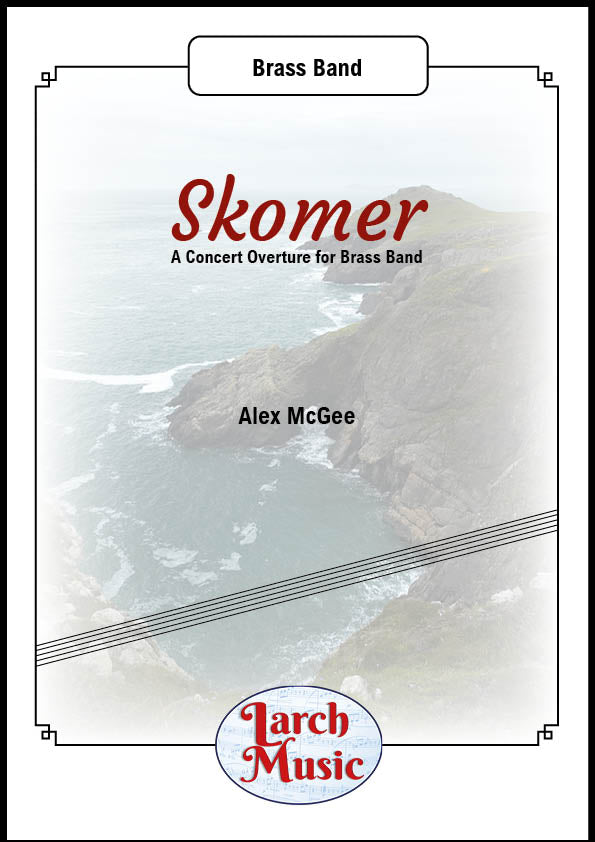
Skomer - Brass Band Full Score & Parts - LM294
COMPOSER: Alex McGeeSkomer Island, situated off the Pembrokeshire coast is a haven for a wide variety of marine life, notably sea birds.Puffins, gannets and shearwaters congregate in vast numbers over the cliffs while on land the Skomer Vole is unique to the island.At sea, porpoise, grey seals and dolphins abound, often putting on spectacular displays for visitors lucky enough to see them at play.This work tries to encapsulate some of the ebullience that the wildlife displays. As the work begins picture yourself as a bird, perhaps one of the kestrels that nest there hovering over the teeming mass of sea birds below, seeing puffins bobbing along, gannets diving for fish and gulls soaring on the breeze.Next, with a change of time signature, we dive below the surface, swimming along side playful seals and dolphins before leaping from the water full of the joys of life.However, the music takes us to a more brutal reality, the plight of such island idylls across the world. The music encourages you to reflect on the fragility of nature, and on the damage we are doing to these precious environments.Following this reflection, we are once again uplifted, with the composer taking inspiration from natures ability to overcome all we have thrown in her way and survive.Note to the conductor re percussionThe glockenspiel part is optional and can be played in place of the vibraphone where one is unavailable.The timpanist will require four drums for the performance and adequate time is given for changes throughout.Suitable for Most Bands - Duration 4'.00" (Approx.)
In Stock: Estimated dispatch 3-5 working days
-
 £48.00
Concerto for Euphonium - Kenneth Downie
An accessible and enjoyable showpiece for soloists of all ages. The concerto's three movements are in a tuneful, melodic style and bravura passages are mixed with others designed to exploit the singing qualities of the instrument. The first movement is a vigorous allegro in which the short, pithy motifs of the opening theme contrast with the broad sweep of the second subject. A short cadenza-like passage yields to a high-spirited episode before a reprise of the opening ends the movement quietly. The second movement opens with a warm, romantic melody which is soon taken up by the soloist. A short animated section gives way to the earlier tutti theme, this time with passionate decoration from the soloist before the music gently unwinds in a tranquil coda. The finale has a bouncy, festive feel. After the first subject runs its course there is a brief journey through a more contrapuntal style, before a spirited presto moves into a compound episode before returning to the opening idea. A jubilant coda brings the work to a conclusion.
Estimated dispatch 7-9 working days
