
Results
-
£74.99
Brilliant Beatles - Peter Kleine Schaars
There have been many arrangements of Beatles' songs for various kinds of ensembles, so rather than just producing a further medley of Beatles' hits, Peter Kleine Schaars has added a new twist to them with this excellent new work. All You Need Is Love and With a Little Help from my Friends pass by in a swing march, Michelle sounds like a newly composed ballad and When I'm Sixty Four is played in Dixie swing style. A Hard Day's Night is transformed into a funk theme with a samba interlude, Let It Be into a slowmarch, and Ob-La-Di, Ob-La-Da in a rock beat. Experience The Beatles as you have never heard them before.
Estimated dispatch 5-14 working days
-
 £104.99
Scottish Dances - Peter Martin - Menno Haantjes
Scottish Dances is based on three Scottish traditionals: Cock of the North, The Bonnie Bank's O'Loch Lomond and Marie's Wedding. I. Cock of the North's name is used for multiple things or events. For example for a locomotive to a famous, it seems, delicious liqueur, and rallies to snowboard competitions. Furthermore is "Cock O' the North " a nickname of a famous Duke. (The 4th Duke of Gordon). In this composition Cock of the North (a Jig) is a traditional Scottish bagpipe tune, regularly played on tattoos by Pipe Bands. Not infrequently the drummers sing the text. Auntie Mary, had a canary, Up the leg of her trousers While she was sleeping Iwas peeping Up the leg of her trousers. II. " The Bonnie Bank's O'Loch Lomond " is about a sad story that took place during an revolt against the British. In 1745 Bonnie Prince Charlie had to retreat. Two of his men were captured. One was convicted and executed, while the other was released. The spirit of the executed soldier would arrive in Scotland via the 'low road' (underworld) before his companion, who had still a long way to go. You'll take the high road And I'll take the low road And I'll be in Scotland afore ye But me and my true love will never meet again On the Bonnie Bonnie Banks of Loch Lomond III. In a Scottish wedding, after the official ceremonies, there is often danced. This is called a ceilidh. For this we use traditional Scottish music such as "Marie's Wedding '. Mid dance we go back to the church, where a lovely song in honor of the couple sounds. Marie's Wedding has been recorded by Van Morrison (among many others). Step we gaely, on we go, heel for heel and toe for toe Arm and arm and on we go, all for Marie's wedding
Estimated dispatch 5-14 working days
-
 £74.99
Kingdom of Dragons - Philip Harper
The 'Kingdom of Dragons' is Gwent in South Wales, known in ancient times as the Kingdom of Gwent, and more recently home to the Newport Gwent Dragons Rugby Union team. This piece was commissioned by the Gwent Music Service with additionalfunding from Ty Cerdd - Music Centre Wales to celebrate the 50th anniversary in 2010 of the formation of the Gwent Youth Brass Band. Although the music is continuous, it is divided into four distinct sections, each one representing one of theunitary authorities which make up the County of Gwent. I. Monmouthshire, which has a large number of ancient castlesII. Blaenau Gwent, an historic area of iron and coal miningIII. Torfaen, where Pontypool Park is a notablelandmarkIV. Newport, the largest city in the region. The music begins with a two-bar fanfare, which sets out all the thematic material of the piece. The mood of pageantry that follows describes some of the ancient castles inMonmouthshire, with rolling tenor drums and fanfaring cornets. After a majestic climax the music subsides and quite literally descends into the coal mines of Blaenau Gwent. The percussion provides effects that suggest industrial machineryclanking into life, and the music accelerates to become a perilous white-knuckle ride on the underground railroad. There is a brief respite as a miner's work-song is introduced and, after a protracted build-up, this is restated at fortissimo beforethe music comes crashing to an inglorious close, much like the UK's mining industry itself. The middle sonorities of the band portray the tranquillity of Pontypool Park, a place of great natural beauty. Brief cadenzas for cornet and euphoniumlead to a full band reprise of the pastoral mood. At the end of this section we find ourselves at the top of the park's 'Folly Tower' from which the distant castle turrets of Monmouthshire are visible. Pontypool RFC was one of eleven clubs inthe first Welsh league in 1881 and a brief but bruising musical portrayal of the formidable Pontypool front-row, the 'Viet Gwent' leads into the work's final section. This portrays Newport, a symbol for progress and optimism for the future, idealsshared by the Gwent Youth Band itself. The music is a vigorous fugue which advances through various keys and episodes before the final triumphant augmented entry which brings the work to a magnificent conclusion. NOTES ONPERFORMANCEPercussion requirements: (3 players) Timpani, 2 Tenor Drums, 2 Tom toms, Snare Drum (sticks and brushes required), Bass Drum, Clash Cymbals, Suspended Cymbal, Hi-hat, Sizzle Cymbal, Tambourine, Metal block with metalbeater (eg hammer), Rattle (eg football rattle), Glockenspiel, Xylophone
Estimated dispatch 5-14 working days
-
 £119.99
Delta Energy - Jan Bosveld
The assignment to write a test piece for the National Brass Band Championships ended up also being a 'test piece' for myself as a composer. Although being quite familiar with the Brass Band phenomenon, as a composer I still have the feeling ofbeing an outsider. Delta Energy turned out to be a non-program composition. The Brass Band as orchestra form is depicted musically in this piece. All the specific characteristics are portrayed in varying settings. Solo passages for Euphonium,Flugelhorn and Cornet alternating with extensive tutti-passages and of course technical highlights form the ingredients for this work written in rhapsodic form. The title "Delta Energy" is derived from a project of the N.V. NederlandseGasunie in Groningen which also contributed in making this composition possible.
Estimated dispatch 5-14 working days
-
 £74.99
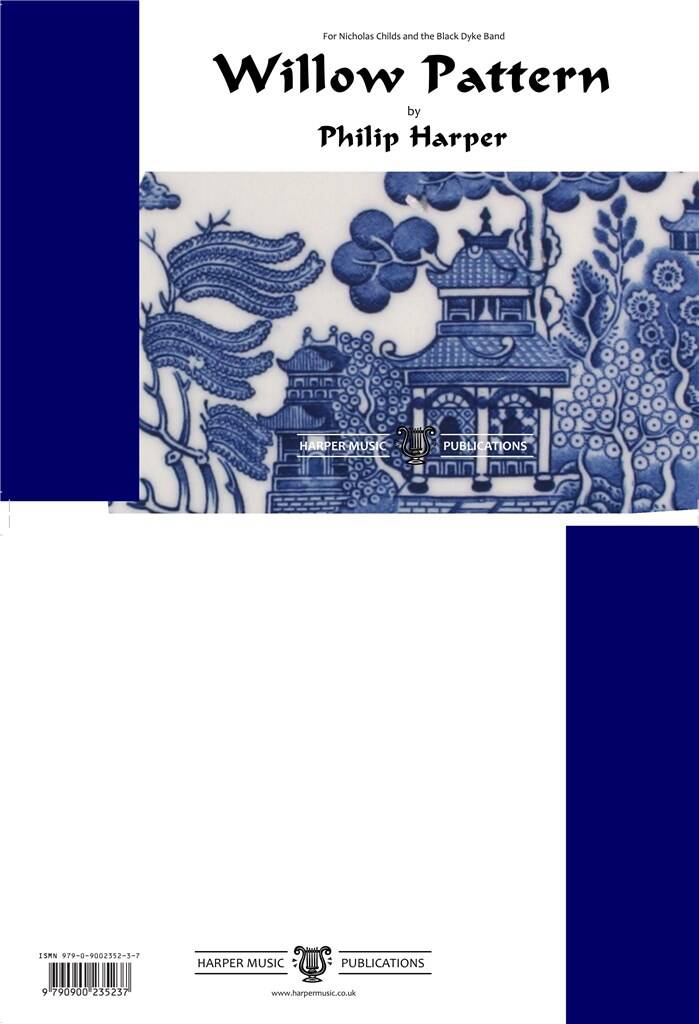
Willow Pattern - Philip Harper
Composed in 2009 for Nicholas Childs and the Black Dyke BandThis piece tells the Willow Pattern legend through music. Several leitmotifs are used both for the different characters and also for some of the important emotions in the tale. Additionally, Knoon-se's part is mainly played by the flugel horn, Changby the euphonium, the Mandarin by the Eb Bass and the Duke Ta-jin by the trombone. The Willow Pattern LegendOnce, in ancient China, there lived a wealthy and powerful Mandarin who had a beautiful daughter, Knoon-se. She had fallen in love with Chang, a humble accountant, which angered her father who imprisoned her in the Pavilion by the river with only theexotic birds for company. She learnt that the Mandarin planned to marry her to the pompous Duke Ta-jin and that the wedding would take place on the day the blossom fell from the willow tree, so she sent Chang a message: "Gather thy blossom, ere it bestolen". The Duke arrived by sea amid great fanfare when the tree was heavy with bud, and nights of magnificent banquets followed. After one such occasion when the Mandarin slept, Chang crept over the crooked fence and tiptoed into the Pavilion to rescueKnoon-se, but as they escaped the alarm was raised. They fled over the bridge with the Mandarin close on their heels brandishing his whip.They managed to escape by boat to a secluded island where they lived happily for a time. Meanwhile, the Mandarin learned of their refuge and, intent on revenge, he ordered his soldiers to kill them. As Knoon-se and Chang slept at night, the men setfire to the pagoda in which they lived and the lovers perished in the flames. However, the Gods, moved by the lovers' plight, transformed their souls into two turtle-doves which rose from the charred remains, soaring above the Earth, symbolising eternal happiness. Willow Pattern is dedicated to the memory of Jean Harper who passed away as I was completing the piece and who was a great collector of porcelain and china-ware. NOTES ON PERFORMANCEMute Requirements:Metal mutes soprano cornet, repiano cornet, 2nd cornets, 3rd cornets (6 in total) Cup mutes all cornets and trombones (10 + 3) Harmon mutes soprano cornet, solo cornets, repiano cornet (6) Percussion Requirements:There are two parts for percussion on the score. The minimum requirements are as follows: 2 players - Timpani, 2 Large tom toms, 2 Wood Blocks, Triangle, Sleigh Bells, Whip, Clash Cymbals, Suspended Cymbal, Hi-hat, Glockenspiel, Xylophone, Tam tam (or susp. cym.) For performances with extra resources, and to achieve closer authenticity, the full requirements are as follows: 3 players - Timpani, 3 Taiko Drums played with thick wooden sticks (or Large tom toms), 2 Wood Blocks, Triangle, Chinese Bells (or Sleigh Bells), Whip, Clash Cymbals, Chinese Cymbals (small clash cymbals approx 12"), Suspended Cymbal, Glockenspiel,Xylophone, Tam tam
Estimated dispatch 5-14 working days
-
 £105.00
Danceries. Set II - Kenneth Hesketh
Danceries Set II, arranged for brass band, was first commission by Keith Allen for the Birmingham Symphonic Winds. This second set of Danceries continues the format, established in the popular Danceries (Set I), of using tunesand dances from Playford s Dancing Master (17th century) to form the basis of an extended dancesuite. In this set, the melodies have become more abstracted and project only a distant echo of their original forms. As before, eachmovement is self-contained, colourful and direct, with its own distinct mood.The outer movements Jennie s Bawbee and Peascod s Galliarda share driving percussion with a military air. Tom Tinker s Toye and Heart sEase(movements two and three) are both settings of original melodies. All movements are more extended than in the first set, with a freer use and approach to the material; melodies now occur in various keys and are supported by agreater variety of harmonic colouring. The result is a richer, even more exhilarating set of dances.Brass Band Grade 5
Estimated dispatch 5-14 working days
-
 £90.30
Festival of Spirituals - Patrick Millstone
This Gospel Festival includes a.o. Sometimes I feel like a motherless child and Oh Peter, go ring-a dem bells. A skilfully set up and varied medley which will please all audiences.
Estimated dispatch 5-14 working days
-
 £54.99
Sound the Bells of Christmas - James Curnow
Three festive carols are skillfully combined into a terrific showcase for holiday programming. The familiar strains of these "bell" songs will make a superb concert opening for your holiday needs. Includes: Westminster Chimes, The Merry Bells All Ring, I Heard the Bells on Christmas Day and Ukrainian Bell Carol.
Estimated dispatch 5-14 working days
-
 £17.50
The Mansions of Glory (Score Only)
"A young, talented and tender-hearted actress was passing along the street of a large city. Seeing a pale, sick girl lying upon a couch just within the half-open door of a beautiful dwelling, she entered, with the thought that by her vivacity and pleasant conversation she might cheer the young invalid. The sick girl was a devoted Christian, and her words, her patience, her submission and heaven-lit countenance so demonstrated the spirit of her religion that the actress was led to give some earnest thought to the claims of Christianity, and was thoroughly converted and became a true follower of Christ. She told her father, the leader of a theatre troupe, of her conversion and of her desire to abandon the stage, stating that she could not live a consistent Christian life and follow the life of an actress. Her father was astonished beyond measure and told his daughter that their living would be lost to them and their business ruined if she persisted in her resolution.Loving her father dearly, she was shaken somewhat in her purpose and partially consented to fill the published engagement to be met in a few days. She was the star of the troupe, and a general favourite. Every preparation was made for the play in which she was to appear. The evening came and the father rejoiced that he had won back his daughter and that their living was not to be lost. The hour arrived; a large audience had assembled. The curtain rose and the young actress stepped forward firmly, amid the applause of the multitude. But an unwonted light beamed from her beautiful face. Amid the breathless silence of the audience, she repeated: 'My Jesus, I love thee, I know thou art mine,For thee all the pleasures of sin I resign;My gracious Redeemer, my Saviour art thou,If ever I loved thee, my Jesus, 'tis now.' This was all. Through Christ she had conquered and, leaving the audience in tears, she retired from the stage, never to appear upon it again. Through her influence her father was converted, and through their united evangelistic labours many were led to God." 1. My Jesus, I love thee, I know thou art mine,For thee all the pleasures of sin I resign;My gracious Redeemer, my Saviour art thou,If ever I loved thee, my Jesus, 'tis now.2. I love thee because thou hast first lovd me,And purchased my pardon on Calvary's tree;I love thee for wearing the thorns on thy brow,If ever I loved thee, my Jesus, 'tis now.3. I will love thee in life, I will love thee in death, And praise thee as long as thou lendest me breath; And say, when the death-dew lies cold on my brow; If ever I loved thee, my Jesus, 'tis now.4. In mansions of Glory and endless delight,I'll ever adore thee and dwell in thy sight; I'll sing with the glittering crown on my brow: If ever I loved thee, my Jesus, 'tis now. William Ralph Featherstone
Estimated dispatch 7-14 working days
-
 £33.62
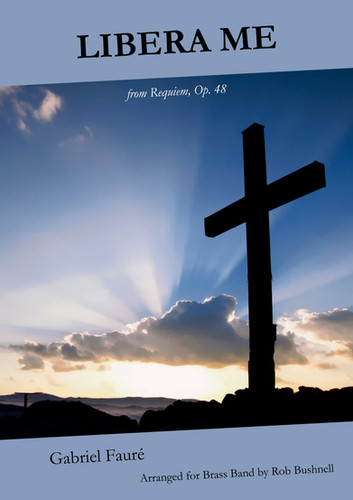
Libera Me from 'Requiem' (Brass Band) Faure arr. Rob Bushnell
Composed between 1887 and 1890, Gabriel Faure's Requiem is not only one of his best-known works but one of the most popular piece of choral music in the Classical repertoire, coming 23rd in the Classic FM's Hall of Fame 2024. Believed to be a tribute to his father (who died in 1885), Faure himself said "My Requiem wasn't written for anything - for pleasure, if I may call it that!" It started life as a five-movement work but was later expanded to be the final seven-movement work we know today. The first version (which Faure called "un petit Requiem") was first performed on 16 January 1888, with Faure conducting, a second version premiered on 21 January 1893 before the final version (reworked for full orchestra) was played on 12 July 1900; the Requiem was performed at the composer's own funeral in 1924.The Libera Me, or Deliver Me, was actually written in 1877 and is the sixth part of the Requiem.Faure once said of the work, "Everything I managed to entertain by way of religious illusion I put into my Requiem, which moreover is dominated from beginning to end by a very human feeling of faith in eternal rest." Upon interview, he also said, "It has been said that my Requiem does not express the fear of death and someone has called it a lullaby of death. But it is thus that I see death: as a happy deliverance, an aspiration towards happiness above, rather than as a painful experience. The music of Gounod has been criticised for its inclination towards human tenderness. But his nature predisposed him to feel this way: religious emotion took this form inside him. Is it not necessary to accept the artist's nature? As to my Requiem, perhaps I have also instinctively sought to escape from what is thought right and proper, after all the years of accompanying burial services on the organ! I know it all by heart. I wanted to write something different."This arrangement is for the British-style brass band, with alternative parts for horns in F and bass-clef lower brass. The tenor solo is featured on the euphonium. A recording of the original composition can be found here: www.youtube.com/watch?v=fXwFNoBHCf0 Duration: 4.20 minutes approx. Difficulty Level: 4th Section + PDF download includes parts and score. Sheet music available from www.brassband.co.uk Instrumentation: Soprano Cornet Eb Solo Cornet Bb Repiano Cornet Bb 2nd Cornet Bb 3rd Cornet Bb Flugel Horn Bb Solo Horn Eb 1st Horn Eb 2nd Horn Eb 1st Baritone Bb 2nd Baritone Bb 1st Trombone Bb 2nd Trombone Bb Bass Trombone Euphonium Bb Bass Eb Bass BbTimpani
In Stock: Estimated dispatch 1-3 working days
 View Music