
Results
-
 £60.99
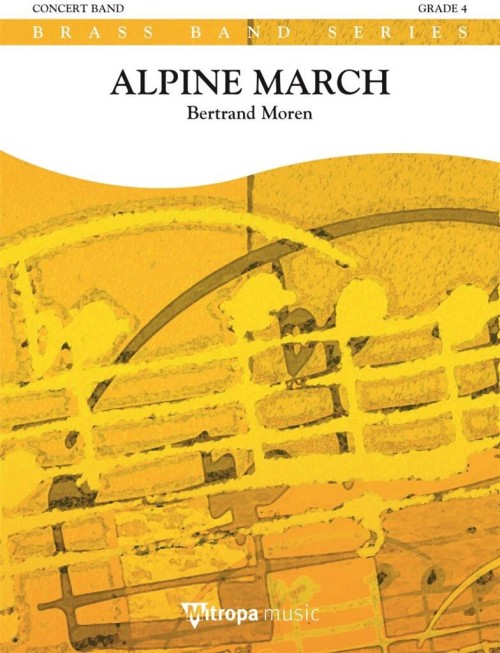
Alpine March (Brass Band - Score and Parts) - Moren, Bertrand
Bertrand Moren composed Alpine March for the Hochwaliser Musikfest in Blatten, Switzerland in 2004.The march opens in a festive 6/8 time with lots of dynamic contrast and characteristic 6/8 rhythms. The Trio-section however is written in 2/4 time and is very lyrical. With a da capo this march, written by the winner of last year's European Brass Band Composition Contest, is brought to a thrilling close.Duration: 5.15
Estimated dispatch 7-14 working days
-
 £82.95
The Flowers of the Forest (Brass Band - Score and Parts) - Bennett, Richard Rodney - Hindmarsh, Paul
In a preface to the score, the composer explains that 'the folk song The Flowers of the Forest is believed to date from 1513, the time if the battle of Flodden, in the course of which the archers of the Forest (a part of Scotland) were killed almost to a man'. Bennett had already used the same tune in his Six Scottish Folksongs (1972) for soprano, tenor and piano, and it is the arrangement he made then that forms the starting-point for the brass-band piece. A slow introduction (Poco Adagio) presents the folk song theme three times in succession - on solo cornet, on solo cornets and tenor horns, and on muted ripieno cornets in close harmony - after which the work unfolds through five sections and a coda. Although played without a break, each of these five sections has its own identity, developing elements of the tune somewhat in the manner of variations, but with each arising from and evolving into the next. The first of these sections (Con moto, tranquillo) is marked by an abrupt shift of tonality, and makes much of the slow rises and falls characteristic of the tune itself. The tempo gradually increases, to arrive at a scherzando section (Vivo) which includes the first appearance of the theme in its inverted form. A waltz-like trio is followed by a brief return of the scherzando, leading directly to a second, more extended, scherzo (con brio) based on a lilting figure no longer directly related to the theme. As this fades, a single side drum introduces an element of more overtly martial tension (Alla Marcia) and Bennett says that, from this point on, he was thinking of Debussy's tribute to the memory of an unknown soldier (in the second movement of En Blanc et noir, for two pianos). Bennett's march gradually gathers momentum, eventually culminating in a short-lived elegiac climax (Maestoso) before the music returns full-circle to the subdued melancholy of the opening. The work ends with a haunting pianissimo statement of the original tune.
Estimated dispatch 7-14 working days
-
£44.95
The Flowers of the Forest (Brass Band - Score only) - Bennett, Richard Rodney - Hindmarsh, Paul
In a preface to the score, the composer explains that 'the folk song The Flowers of the Forest is believed to date from 1513, the time if the battle of Flodden, in the course of which the archers of the Forest (a part of Scotland) were killed almost to a man'. Bennett had already used the same tune in his Six Scottish Folksongs (1972) for soprano, tenor and piano, and it is the arrangement he made then that forms the starting-point for the brass-band piece. A slow introduction (Poco Adagio) presents the folk song theme three times in succession - on solo cornet, on solo cornets and tenor horns, and on muted ripieno cornets in close harmony - after which the work unfolds through five sections and a coda. Although played without a break, each of these five sections has its own identity, developing elements of the tune somewhat in the manner of variations, but with each arising from and evolving into the next. The first of these sections (Con moto, tranquillo) is marked by an abrupt shift of tonality, and makes much of the slow rises and falls characteristic of the tune itself. The tempo gradually increases, to arrive at a scherzando section (Vivo) which includes the first appearance of the theme in its inverted form. A waltz-like trio is followed by a brief return of the scherzando, leading directly to a second, more extended, scherzo (con brio) based on a lilting figure no longer directly related to the theme. As this fades, a single side drum introduces an element of more overtly martial tension (Alla Marcia) and Bennett says that, from this point on, he was thinking of Debussy's tribute to the memory of an unknown soldier (in the second movement of En Blanc et noir, for two pianos). Bennett's march gradually gathers momentum, eventually culminating in a short-lived elegiac climax (Maestoso) before the music returns full-circle to the subdued melancholy of the opening. The work ends with a haunting pianissimo statement of the original tune.
Estimated dispatch 7-14 working days
-
 £75.00
Iceni Autumn (Brass Band - Score and Parts) - Barry, Darrol
The piece is in four movements; SPQR, Cockley Cley, Boudicca - Battles and Requiem and Venta Icenorum.S.P.Q.R. is an initialism of a Latin noun phrase, Senatus Populusque Romanus ("The Senate and the Roman People"). This movement attempts to portray the mood in England under Roman occupation and contains important themes developed throughout the suite.Cockley Cley is a reconstruction of the type of village occupied by the Iceni. For many years it was a popular tourist attraction in Norfolk.Boudicca (also known as Boadicea) was the wife of King Prasutagus of the Iceni, a British tribe that lived in East Anglia during the time of the Roman Emperor Nero. When Prasutagus, an ally of the Romans died, the local Roman government officials decided that they would seize her wealth and lands for themselves. When Boudicca protested, saying she was a Roman ally who was being treated no better than a slave, the Roman soldiers fogged her and raped her daughters. Boudicca called her tribe to arms and revolted against their Roman oppressors; this saw the complete devastation of Colchester, St Albans and London. In the final battle the Romans slaughtered about 80,000 Britons including women, children and old men, repaying atrocities in kind. Boudicca and her two daughters poisoned themselves rather than be captured and taken to Rome as prisoners of war.Venta Icenorum was the capital of the Iceni Tribe, who inhabited the flatlands and marshes of Norfolk and earned immortality for their revolt against Roman rule under their queen Boudicca in the winter of 61 AD. This triumphant march brings various themes together and ends with a final reference.
Estimated dispatch 7-14 working days
-
 £30.00
Iceni Autumn (Brass Band - Score only) - Barry, Darrol
The piece is in four movements; SPQR, Cockley Cley, Boudicca - Battles and Requiem and Venta Icenorum.S.P.Q.R. is an initialism of a Latin noun phrase, Senatus Populusque Romanus ("The Senate and the Roman People"). This movement attempts to portray the mood in England under Roman occupation and contains important themes developed throughout the suite.Cockley Cley is a reconstruction of the type of village occupied by the Iceni. For many years it was a popular tourist attraction in Norfolk.Boudicca (also known as Boadicea) was the wife of King Prasutagus of the Iceni, a British tribe that lived in East Anglia during the time of the Roman Emperor Nero. When Prasutagus, an ally of the Romans died, the local Roman government officials decided that they would seize her wealth and lands for themselves. When Boudicca protested, saying she was a Roman ally who was being treated no better than a slave, the Roman soldiers fogged her and raped her daughters. Boudicca called her tribe to arms and revolted against their Roman oppressors; this saw the complete devastation of Colchester, St Albans and London. In the final battle the Romans slaughtered about 80,000 Britons including women, children and old men, repaying atrocities in kind. Boudicca and her two daughters poisoned themselves rather than be captured and taken to Rome as prisoners of war.Venta Icenorum was the capital of the Iceni Tribe, who inhabited the flatlands and marshes of Norfolk and earned immortality for their revolt against Roman rule under their queen Boudicca in the winter of 61 AD. This triumphant march brings various themes together and ends with a final reference.
Estimated dispatch 7-14 working days
-
£29.95
Cairo Red Shield (Brass Band - Score and Parts) - Raikes, Albert Stanley
During World War Two, Salvation Army servicemen serving in Cairo formed a 'Red Shield Club', of which one of the elements was a band. Albert Stanley Raikes (more often known affectionately by his middle name, Stan) was for some time in charge of this band and wrote this march in memory of this wartime combination and the enthusiasts who were, at one time or another, members of it.
Estimated dispatch 7-14 working days
-
£14.95
Cairo Red Shield (Brass Band - Score only) - Raikes, Albert Stanley
During World War Two, Salvation Army servicemen serving in Cairo formed a 'Red Shield Club', of which one of the elements was a band. Albert Stanley Raikes (more often known affectionately by his middle name, Stan) was for some time in charge of this band and wrote this march in memory of this wartime combination and the enthusiasts who were, at one time or another, members of it.
Estimated dispatch 7-14 working days
-
 £60.99
Consolation (Brass Band - Score and Parts)
Wer nur den lieben Gott l?sst walten was composed by Georg Neumark in about 1641 and was subtitled 'Trostlied' literally meaning consolation song. Songbooks at the time showed the popularity of this song and it is still well-known today partly due to Johann Sebastian Bach's use of the melody for one of his own chorals. In Jan de Haan's arrangement the choral is heard twice, once, alternating with the original motif from the introduction and a second time, without interruption, reflecting the composer's original intention - a song of consolation. 03:10
Estimated dispatch 7-14 working days
-
£99.95
ROCOCO VARIATIONS (Gregson) (Brass Band - Score and Parts) - Gregson, Edward
Rococo Variations was commissioned by the British Open Championships for their 2008 contest in Symphony Hall, Birmingham, and co-commissioned by the Norwegian Band Federation, for their National Championship in Bergen in 2009.The title of the work has been used before, of course, most notably by Tchaikovsky in his work for cello and orchestra. My set of variations follows the Tchaikovskian model in that it is based on a quasi-Baroque original theme, and has certain 'dance-like' characteristics in the variations, but beyond that all comparisons end.There are six variations: Toccata, Siciliana, Waltz, Moto Perpetuo, Lament, and Fugal Scherzo, followed by a triumphant re-statement of the theme. Throughout, there is considerable contrast in the music, with the fast variations being rather virtuoso in character, sometimes with constantly changing time patterns, whilst the two slow variations (Siciliana and Lament) are in turn lyrical and pensive in mood with prominent solos and duets for a number of instruments.Although the work overall is dedicated by my brother, each of the six variations pays tribute to a different composer whose contribution to the brass band repertoire during the second half of the twentieth century has been of great significance. To this end, all six composers have their own 'musical signature' embraced within the particular variation, a process which reaches its zenith, contrapuntally speaking, during the final variation and reprise of the theme.- Edward Gregson
Estimated dispatch 7-14 working days
-
£49.95
ROCOCO VARIATIONS (Gregson) (Brass Band - Score only) - Gregson, Edward
Rococo Variations was commissioned by the British Open Championships for their 2008 contest in Symphony Hall, Birmingham, and co-commissioned by the Norwegian Band Federation, for their National Championship in Bergen in 2009.The title of the work has been used before, of course, most notably by Tchaikovsky in his work for cello and orchestra. My set of variations follows the Tchaikovskian model in that it is based on a quasi-Baroque original theme, and has certain 'dance-like' characteristics in the variations, but beyond that all comparisons end.There are six variations: Toccata, Siciliana, Waltz, Moto Perpetuo, Lament, and Fugal Scherzo, followed by a triumphant re-statement of the theme. Throughout, there is considerable contrast in the music, with the fast variations being rather virtuoso in character, sometimes with constantly changing time patterns, whilst the two slow variations (Siciliana and Lament) are in turn lyrical and pensive in mood with prominent solos and duets for a number of instruments.Although the work overall is dedicated by my brother, each of the six variations pays tribute to a different composer whose contribution to the brass band repertoire during the second half of the twentieth century has been of great significance. To this end, all six composers have their own 'musical signature' embraced within the particular variation, a process which reaches its zenith, contrapuntally speaking, during the final variation and reprise of the theme.- Edward Gregson
Estimated dispatch 7-14 working days
 View Music