
Results
-
 £39.95
Rhapsody on a Theme by Purcell - Contest Edition (Brass Band - Score only)
Contest VersionIn his relatively short lifetime, Henry Purcell (1659 -1695) achieved stellar musical success and was known and admired internationally by his contemporaries. He is justifiably considered one of England's greatest composers.I thought long and hard before using this magnificent theme as the basis for a band piece because I think that Benjamin Britten has said just about everything possible regarding it in his The Young Person's Guide to the Orchestra. Bearing this in mind, I tentatively set about working on this composition. Once started though, the job became fun because the theme still yielded possibilities - even after Britten!The piece is basically a set of linked variations, much like Rachmaninov's great Rhapsody on theme by Paginini. The music starts slowly and makes much use of crisply dotted rhythms - a Purcellian characteristic. The theme is heard twice before the music changes into a jaunty duple time variation based on the opening motif of Purcell's theme. After this, the mood changes to a waltz-like variation in which clear references to the original theme can be heard. The slow movement follows, and is based on rising and descending scalic figures. This variation is an 'A-B-A' movement with two similar passages framing a more vigorous middle section which features antiphonal fanfare-like figures. Without any preamble, the last variation launches itself - a rumbustious dance which has a distinctive feel to it.The theme eventually reappears as a counter-melody to this dance music before a final triumphant treatment of the melody featuring a somewhat athletic bass line. The music accelerates at the Coda and disappears in a 'puff of smoke'.- Kevin Norbury
Estimated dispatch 7-14 working days
-
 £84.95
A Day in the Life of a Knight (Brass Band - Score and Parts)
Here we have a most descriptive piece of writing - a story through music. A fantastic 1st section test piece and championship concert work:The opening scene would depict standing on the battlements of a castle hearing the thundering hoofs of our brave Knight's horse miles in the distance. His arrival is expected, and his reputation is known across many lands. Today, he is to joust amongst mere mortal knights and compete for the hand of the fair (and local) Princess.He vanquishes all competitors and wins the day. The scene moves to evening and court where reception and dance is to be held for our winning knight. Both Knight and Princess become centre of attention during the dance. Their eyes only for each other.At last, the Knight has a chance to be a lone with his Princess as they steal away from the celebrations to a star lit rampart above the castle gardens, where the Knight declares his ever-lasting love and pledges his life and of honour to her. He asks her hand, meanwhile monks pray in the below chapel hoping for union. She say's yes. It is announced in court, then blown from the battlements.Day breaks; he is brought word of evil doings back in his own land. He leaves word to the Princess that he will be back soon to take her hand. The trouble back home was a rouse to get him away from the Princes so one of the vanquished, a dark knight in yesterdays joust, has summoned a dragon to kidnap the princess for his own.As the truth of the deception reaches our Knight he quickly returns to face the varlet that has taken his Lady. This time tis no joust, but a fight to the death with the dark knight and dragon. Our champion proves his best once again and wins the day and the hand of his Princess forever!- Phil LawrenceSuitable for 1st Section Bands and aboveDuration: 11.15
Estimated dispatch 7-14 working days
-
 £82.95
Occasion (Brass Band - Score and Parts)
Occasion was published especially for the National Youth Brass Band Championship of Great Britain, held at the Royal Albert Hall, London, on 4th October, 1986.Occasion for Brass Band is in four movements: Fanfare, Festivities, Elegy and Dance. The opening Fanfare was originally written as a Wedding Fanfare for Paul and Hazel Patterson in 1981, while the Elegy and Dance were commissioned as a test-piece for the first Westsound/Ayrshire Invitation Contest in 1982 for the leading bands in Scotland. Festivities was therefore written last, to complete the work and give it its essentially 'festive' character. Except for the Elegy, which is contemplative, the music throughout is extrovert and joyful. The opeing Fanfare may be performed separately - of the Fanfare may be ledt out entirely, making the work a three movement Suite.Duration: 11 minutes
Estimated dispatch 7-14 working days
-
£37.95
Occasion (Brass Band - Score Only)
Occasion was published especially for the National Youth Brass Band Championship of Great Britain, held at the Royal Albert Hall, London, on 4th October, 1986.Occasion for Brass Band is in four movements: Fanfare, Festivities, Elegy and Dance. The opening Fanfare was originally written as a Wedding Fanfare for Paul and Hazel Patterson in 1981, while the Elegy and Dance were commissioned as a test-piece for the first Westsound/Ayrshire Invitation Contest in 1982 for the leading bands in Scotland. Festivities was therefore written last, to complete the work and give it its essentially 'festive' character. Except for the Elegy, which is contemplative, the music throughout is extrovert and joyful. The opeing Fanfare may be performed separately - of the Fanfare may be ledt out entirely, making the work a three movement Suite.Duration: 11 minutes
Estimated dispatch 7-14 working days
-
 £59.95
Bonnie Northumbria - Brass Band - LM786
COMPOSER: Laurie JohnstonProgramme NotesNorthumberland, or Northumbria as it is also known, is the most northern county in England and has magnificent and stunning landscapes just waiting to be explored. Filled with mystical castles, atmospheric ruins and historical sites and edged by spectacular coastal scenery, there is something wonderful to see at every turn. The Devils Causeway passes through Northumbria and reaches Berwick upon Tweed at the coast. Walkers and cyclists can also take the Coast and Castles Cycle Route or the North Sea Trail which journey through some of the most beautiful scenery along the way.The Blaydon Races is aGeordiefolk songwritten in the 19th century byGeordie Ridley, in a style deriving frommusic hall. It is regarded by many as the unofficialanthemofTynesideand is frequentlysungby supporters ofNewcastle United Football ClubandNewcastle Falconsrugby club.Blaydonis a small town inGateshead, situated about 4 miles (6.4km) fromNewcastle upon Tyne, inNorth East England. The race used to take place on the Stella Haugh 1 mile (1.6km) west of Blaydon.Stella South Power Station(demolished in 1995) was built on the site of the track in the early 1950s, after the races had stopped taking place in 1916.Water of Tyne (sometimes rendered as The Waters of Tyne) is a folk song (Roud number1364) from the north-east of England. The song is sung by a girl or woman lamenting the fact that her paramour is on the opposite bank of theRiver Tyne. Sleeve notes to Michael Hunt's recording of Tyneside songs states that "the ferry is believed to be that atHaughton Castleon theNorth Tyne". Alternatively the "rough river" in the last line may indicate a point further downstream, possiblyTynemouth.The song was collected byJohn Bellin 1810 and published two years later inRhymes of Northern Bards.The Keel Row is a traditional Tyneside folk song evoking the life and work of thekeelmenofNewcastle upon Tyne. A closely related song was first published in aScottishcollection of the 1770s, but may be considerably older, and it is unclear whether the tune is Scottish or English in origin.The opening lines of the song set it inSandgate, that part of the quayside overlooking the River Tyne to the east of the city centre where the keelmen lived and which is still overlooked by theKeelmen's Hospital.Versions of the song appear in both England and Scotland, with Scottish versions referring tothe Canongaterather than Sandgate. The earliest printing was in the 1770s inEdinburghin A Collection of Favourite Scots Tunes, edited by Charles Maclean, though the tune was also found in several late eighteenth-century English manuscript collections. As the term "keel" was used both sides of the border, it has not been determined which version was the original, althoughFrank Kidsonsurmised that like many other songs collected by Maclean it may originally have been aJacobiteair from the time of the1745 rebellion. Some versions of the song make reference to a "blue bonnet[...] with a snowy rose upon it", a clear attempt to evoke Jacobite symbolism, whether dating from 1745 or not.Kidson, however, also noted that he had found the tune of The Keel Row associated with an early dance called "The Yorkshire Lad" as early as 1748.By the 19th century the tune was well associated with the River Tyne; a few years before the 1850s the keelmen had met yearly to celebrate the founding of the Keelmen's Hospital, perambulating the town to the accompaniment of bands playing The Keel Row.Dance To Thy Daddyis a traditional Englishfolksong, originating inNorth East England. An early source for the lyrics, Joseph Robson's "Songs of the bards of the Tyne", published 1849, can be found on the Farne archive. In Farne's notes to the song, it is stated that these lyrics were written by William Watson around 1826.
In Stock: Estimated dispatch 3-5 working days
-
 £29.88
Fanfare from La Peri(Brass Band) Dukas arr. Rob Bushnell
La Peri is a one-act ballet by the French composer Paul Dukas, best known for The Sorcerer's Apprentice (L'apprenti sorcier) as in the 1940 Disney film Fantasia. Dukas was commissioned to write La Peri by the Ballets Russes, producing a Poeme danse en un tableau ('dance poem in one scene') in 1911; this become his last published work. With Natalia Trouhanova due to play the Peri and Vaslav Nijinsky to play Iskender (the name of Alexander the Great in Persian, who is scouting around Iran in search of the Flower of Immortality), the production was ultimately cancelled because Serge Diaghilev feel Trouhanova was not a skilled enough dancer to be partnered to Nijinsky. Trouhanova later hired Ivan Clustine to choreograph the music, with the ballet premiering at the Theatre du Chatelet in Paris on 22 April 1912.The brilliant fanfare that precedes the ballet is often performed separately and is the arrangement available here. Arranged for British-style brass band, it has optional percussion parts as well as alternative parts for horns in F and bass-clef lower brass. The piece has been lowered by a tone compared to the original. A recording of the original composition can be found here: www.youtube.com/watch?v=7EDekMos1ok. Duration: Approx. 2 minutes Difficulty Level: 2nd Section + Duration: 4 or 5 minutes (depending on tempo and without any cuts) PDF download includes parts and score. Sheet music available at www.brassband.co.uk (UK) or https://satradecentral.org (USA) Instrumentation: Soprano Cornet Eb Solo Cornet Bb Repiano Cornet Bb 2nd Cornet Bb 3rd Cornet Bb Flugel Horn Bb Solo Horn Eb 1st Horn Eb 2nd Horn Eb 1st Baritone Bb 2nd Baritone Bb 1st Trombone Bb 2nd Trombone Bb Bass Trombone Euphonium Bb Bass Eb Bass Bb Timpani Percussion 1 - Snare Drum Percussion 2 - Bass Drum & Cymbal
In Stock: Estimated dispatch 1-3 working days
-
£125.00
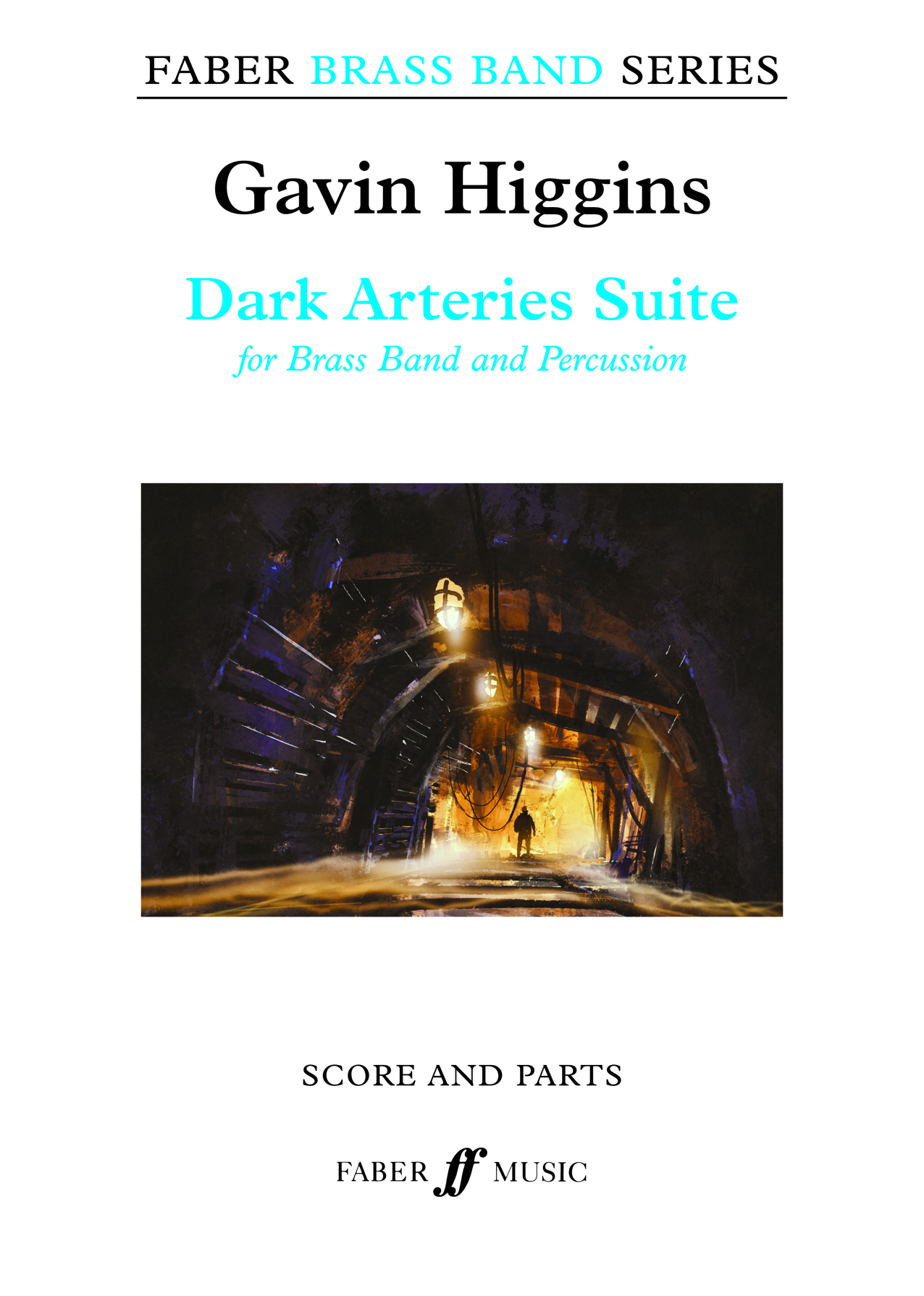
Dark Arteries Suite - Gavin Higgins
Dark Arteries was commissioned by Rambert Dance Company and first performed in May 2015 with the Tredegar Town Band sharing the stage with Rambert dancers. Dark Arteries is a personal and at times highly wrought response to the Miners Strike and its aftermath. It is in three movements, the first and last are expansive, with widely contrasting sound worlds, from dark, brooding melodies and the haunting sounds of solo flugel horn to wild syncopations on cornets, suggestive of an imposing, but often bleak mining landscape.In 2016 Higgins re-worked Dark Arteries into a virtuoso concert suite, which captures the essence of the work in three connected movements.Dark Arteries Suite was premiered by the National Youth Brass Band of Great Britain, conducted by Bramwell Tovey at the Barbican Centre, London, 22 April 2017.
In Stock: Estimated dispatch 1-3 working days
-
£72.00
Funky Hedde - Torstein Aagaard-Nilsen
A good friend of mine, trombonist and professor Jesper Juul Windahl commissioned me a trombone quartet. I then wrote Four Nordic Folk Pops. The last of the four is a Norwegian tune called Havard Hedde in a funky version.Then I made a brass quintet version for Lofoten Brass Quintet for a their Australia tour. The trombonist in the quintet asked me for a brass band version to be used in an entertainment contest (SIDDIS Brass). Havard Hedde did not succeed in getting married, but I think this version wil make him dance again.Torstein Aagaard-Nilsen
Estimated dispatch 7-14 working days
-
 £54.95
Cornish Pastiche (Brass Band - Score and Parts) - Wiffin, Rob
A three movement suite depicting aspects of Cornish life and culture.The first movement, Sea Shanties, uses two contrasting call-and-response melodies. The second of these is playful in nature and appears in a number of guises, some more discordant than others, reflecting the crew's use of the shanty to let the captain know what they thought of him! Having passed by, the ship disappears into the sea mist. Laments were traditionally reserved for occasions of the death of a member of the clan. In forming the melody for Celtic Lament I had in mind the type of sorrowful song that would suite the elegiac nature of such an occasion.The last movement of the suite attempts to catch the spirit of the Furry Dance, the ancient dance that heralds the coming of spring. It resembles a farandole but is probably better described as an unashamed romp.My intention was to make Cornish Pastiche readily accessible to both players and listeners. The language is unashamedly tonal but is treated with some harmonic twists to add occasional piquancy. The technical demands on the players are meant to be moderate but conductors and players are asked to observe the different layers, especially in the Basse Dance, and not overload the texture with over-zealous weight on the melodic line.- Rob WiffinDuration: 11.15
Estimated dispatch 7-14 working days
-
 £89.95
Four Etudes (Brass Band - Score and Parts) - Gregson, Edward
This work was written during August and September 2016. In it, I wanted primarily to explore the elements of timbre, rhythm, texture and colour. The first three tudes (or studies) are based on a set of piano pieces I composed in 1982, whilst the last, the longest of the set, was composed specially. My reference point was the Four tudes for orchestra of 1928 by Stravinsky, a work I have always admired, and of which the first three also happen to be based on a set of earlier pieces, in his case for string quartet, with the last being a re-arrangement of a work for pianola. I have also borrowed the titles he gave to the individual studies as they seemed to fit the mood of my pieces.However, the exception is the final study, where instead of the exuberant mood of his colourful portrayal of Madrid, mine was influenced by the terrible human tragedy that was unfolding in Aleppo at the time I was writing it, and thus reflects the violence and barbarism of those events; yet towards the end it does offer a glimmer of hope for humanity with a return to the Canticle (Song) of the first study, and concludes quietly with the chords and bells that began the work. The titles of the tudes are Canticle, Dance, Excentrique, and Aleppo. Like Stravinsky's, the set is relatively short, lasting around 8 minutes.The Four tudes were commissioned by Black Dyke Band and were written specially for the recording marking the conclusion of my year as Composer-in-Residence. The concert premiere will be given by Black Dyke Band, conducted by the composer, at the RNCM Festival of Brass in January 2017.- Edward GregsonDuration: 8.00
Estimated dispatch 7-14 working days
 View Music