
Results
-
 £74.99
Kingdom of Dragons - Philip Harper
The 'Kingdom of Dragons' is Gwent in South Wales, known in ancient times as the Kingdom of Gwent, and more recently home to the Newport Gwent Dragons Rugby Union team. This piece was commissioned by the Gwent Music Service with additionalfunding from Ty Cerdd - Music Centre Wales to celebrate the 50th anniversary in 2010 of the formation of the Gwent Youth Brass Band. Although the music is continuous, it is divided into four distinct sections, each one representing one of theunitary authorities which make up the County of Gwent. I. Monmouthshire, which has a large number of ancient castlesII. Blaenau Gwent, an historic area of iron and coal miningIII. Torfaen, where Pontypool Park is a notablelandmarkIV. Newport, the largest city in the region. The music begins with a two-bar fanfare, which sets out all the thematic material of the piece. The mood of pageantry that follows describes some of the ancient castles inMonmouthshire, with rolling tenor drums and fanfaring cornets. After a majestic climax the music subsides and quite literally descends into the coal mines of Blaenau Gwent. The percussion provides effects that suggest industrial machineryclanking into life, and the music accelerates to become a perilous white-knuckle ride on the underground railroad. There is a brief respite as a miner's work-song is introduced and, after a protracted build-up, this is restated at fortissimo beforethe music comes crashing to an inglorious close, much like the UK's mining industry itself. The middle sonorities of the band portray the tranquillity of Pontypool Park, a place of great natural beauty. Brief cadenzas for cornet and euphoniumlead to a full band reprise of the pastoral mood. At the end of this section we find ourselves at the top of the park's 'Folly Tower' from which the distant castle turrets of Monmouthshire are visible. Pontypool RFC was one of eleven clubs inthe first Welsh league in 1881 and a brief but bruising musical portrayal of the formidable Pontypool front-row, the 'Viet Gwent' leads into the work's final section. This portrays Newport, a symbol for progress and optimism for the future, idealsshared by the Gwent Youth Band itself. The music is a vigorous fugue which advances through various keys and episodes before the final triumphant augmented entry which brings the work to a magnificent conclusion. NOTES ONPERFORMANCEPercussion requirements: (3 players) Timpani, 2 Tenor Drums, 2 Tom toms, Snare Drum (sticks and brushes required), Bass Drum, Clash Cymbals, Suspended Cymbal, Hi-hat, Sizzle Cymbal, Tambourine, Metal block with metalbeater (eg hammer), Rattle (eg football rattle), Glockenspiel, Xylophone
Estimated dispatch 5-14 working days
-
 £74.99
Olympus - Philip Harper
Selected as the test-piece for the 3rd Section Regional contests of the National Brass Band Championships 2012The music begins with a depiction of the exciting Opening Ceremony where noisy fanfares and sudden swells add to the cosmopolitan flag-waving clamour. Without a break the music leads to The Chariot Race, a fast compound-time gallop withthundering hooves in the basses and percussion, and a heroic melody introduced by the tenor horns. Chariot racing was the main equestrian event in the Ancient Greek Games, which were founded in memory of King Oenomaus. In the Greek legend he suffereddefeat in a chariot race to his son-in-law and Zeus' grandson, Pelops, but much of the music is bitter-sweet to symbolise the fact that Pelops had to cheat to win drawing parallels with some of the issues still facing modern-day athletics. A slow, mystical passage follows, describing The Temple of Zeus at Olympia. The statue of Zeus, who was honoured throughout the Ancient Games' history, was housed inside the temple and was one of the Seven Wonders of the Ancient World. Themusic depicts this period of the dawn of one of mankind's most ancient civilisations and there is a series of solo passages above a drone. The next section is called The Olympic Flame and a broad and lyrical anthem-like melody develops slowly in the euphoniums, which gradually ascends until the horns can take it over before passing upwards again to the cornets (Higher). The musicbursts into bright life at the lighting of the flame and the regular rhythmic pattern which has been established goes through an accelerando (Faster). The final section is called The Olympic Truce and aims to capture the cooperative spirit of the ancient practice of ending wars for the duration of the games. The anthem-like melody makes an affirmatory return (Stronger) and the work ends asit began with a blaze of colour and a real sense of optimism and global celebration. "Citius, Altius, Fortius" (Faster, Higher, Stonger)NOTES ON PERFORMANCEPercussion requirements: 1 to 3 players (3 Timpani, Snare Drum, Tenor Drum, Cymbals, Glockenspiel, Triangle)
Estimated dispatch 5-14 working days
-
 £50.00
Harry Potter/Prisoner of Azkaban - John Williams
A spectacular medley of six themes from the John Williams score, arranged by Philip Harper for Brass Band. The third in the series of multi award-winning scores for this remarkable trilogy of films. The pack contains the parts forup to 46 instruments, including parts and substitutions for instruments of alternative tuning.
Estimated dispatch 5-14 working days
-
 £45.00
Dreamtime
Commissioned by Philip Harper for the Cory Bands 2013 tour to Australia, Dreamtime draws inspiration from Australian Aboriginal mythology. The Dreamtime is a sacred era in which the Aborigines believe ancestral totemic (symbolic) spirits created the world. The work is heavily percussive, including narration and a pseudo-didgeridoo, created with multi-phonics in euphoniums and tubas. The work can still be performed without multi-phonics, narration and reduced percussion. Duration: 00:07:30 (with narration) Grade: 5 Listen:
Estimated dispatch 5-7 working days
-
 £34.95
Elixir of Youth - Christopher Bond
Elixir of Youth (2013) was written for the 2013 Brass for Heroes charity event where it was premiered on 19th October 2013 at St Paul's Hall in Huddersfield under the baton of Philip Harper. The title of the work reflects the nature of the band that was put together for that premiere performance; an all-star youth band comprising a selection of the country's young brass banding talent, with the term Elixir referring here to the everlasting talent seen in young brass players throughout the United Kingdom's brass bands and bands' and teachers abilities to keep producing such high quality musicians for the banding movement.The work, structured in three sections, is a showcase for band with a heroic opening where fanfare-like gestures in the cornets and trombones juxtapose rapid euphonium and baritone runs, alongside sweeping horns and percussion effects. As the piece progresses, a grove is introduced - just in the tubas at first, accompanied by a hi-hat - before spreading through the band, definitely stuff to tap your toes to! The middle, slower section of the work sees both flugel and cornet solos, with additional inputs from the euphonium and solo horn before a climax and return to the tempo and music of the opening section. A rousing close concludes the work where all of the work's themes are interweaved to create a sense of power, unity and grandeur; an Elixir of Youth.
Estimated dispatch 10-14 working days
-
£55.00
De-Lovely: Cole Porter Medley (Score & Parts) - Cole Porter
The musical De-Lovely, celebrated the songs of Cole Porter and these songs have now been skilfully crafted into this show-stopping medley for brass band by Philip Harper. With melodies that include the delightful Let's Do It (Let's Fall In Love) and the suave Begin the Beguine, this concert piece is full of swing, swagger, and the heart-warming nostalgia of these evergreen favourites.Brass Band Grade 4: Advanced Youth and 3rd SectionDuration: 8 minutes
In Stock: Estimated dispatch 1-3 working days
-
£50.00
Harry Potter and The Prisoner of Azkaban (Score & Parts) - John Williams
Harry Potter and the Prisoner of Azkaban is the third book in the Harry Potter series by author J. K. Rowling. The book was published in 1999 and the film, based on the book, was released in 2004. This is Philip Harper's brass arrangement of a selection of the music from the film. Brass Band Grade 4: Advanced Youth and 3rd Section Duration: 4 minutes
In Stock: Estimated dispatch 1-3 working days
-
 £44.95
THREE JAZZ PIECES - Harper arr. Peter Graham
Three Jazz Pieces
Published Closed for Holidays. Est dispatch 13th Nov
-
 £30.00
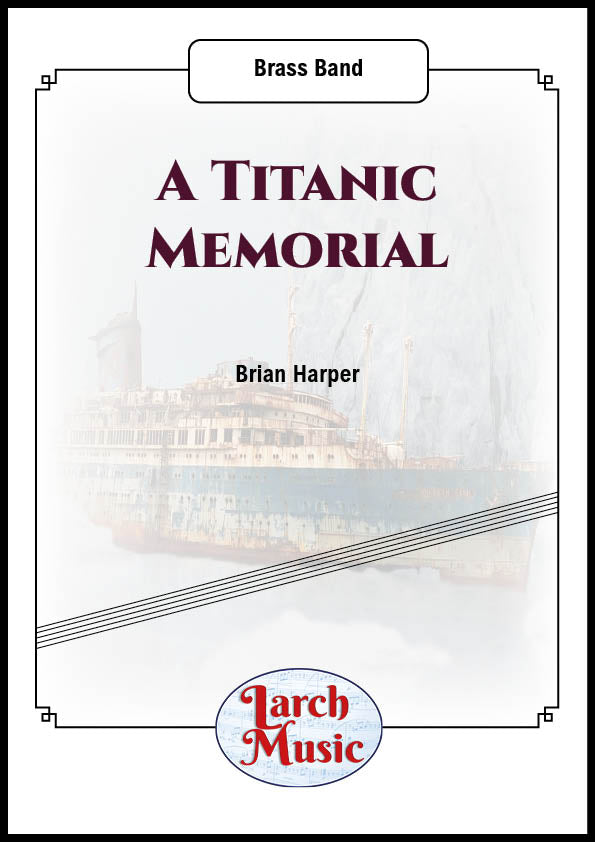
A Titanic Memorial - Brass Band Sheet Music Full Score & Parts - LM393
COMPOSER: Brian HarperRMSTitanicwas a British passengerliner, operated by theWhite Star Line, thatsank in the North Atlantic Oceanon 15 April 1912 after striking anicebergduring her maiden voyage fromSouthampton, England toNew York City, United States.Of theestimated 2,224 passengers and crewaboard, more than 1,500 died, making itthe deadliest sinking of a single shipup to that time.It remains the deadliest peacetime sinking of anocean linerorcruise ship.The disaster drew public attention, provided foundational material for thedisaster filmgenre, and has inspired many artistic works.LM393 - ISMN : 9790570003938
In Stock: Estimated dispatch 3-5 working days
-
 £50.00
Dragon Dances
DescriptionDragon Dances was commissioned by Owen Farr, who is also the work's dedicatee, gave the first performance with the Cornwall Youth Band conducted by Richard Evans on 5 April 2010 and has recorded it on his solo CD "A New Dawn" accompanied by the Cory Band conducted by Philip Harper.Being a Welsh composer, writing music for a Welsh soloist, I was naturally keen to reflect this in the music, and I drew inspiration from two particularly Welsh concepts - "hiraeth" and "hwyl". "Hiraeth" is a word that has no direct translation into English, but an approximation would be 'yearning for home'. Like the other celtic nations, Wales has a widespread diaspora of people who left to seek new lives out in the empire and "hiraeth" is a way of summing up the homesickness felt by these exiles, some of whom return each year for a special ceremony at the Royal National Eisteddfod. "Hwyl" is an even more complicated word, variously meaning ecstatic joy, fervour, equable temperament and even the characteristic sing-song oration style of the great Welsh Methodist preachers.I have attempted to make the music reflect both of these, with the melancholy first part of the work inspired by the hymns and solo songs for which Wales is famous, and the second part having a much more dance-like, joyful quality.Performance Notes:2 solo cornets, 2nd and 3rd cornets require cup mutes. 2 solo cornets require harmon mutes with tubes removed (marked 'TR' in the score).1st horn and 1st baritone require straight mutes, preferably fibre. 1st trombone requires a straight mute, 2nd and bass require cup mutes.Percussion instruments required are vibraphone, glockenspiel, timpani, snare drum, suspended cymbal and tam tamWatch/Listen to the score below:
Estimated dispatch 7-14 working days
 Listen to MP3
 View Music
