
Results
-
 £60.99
The Call of the Shepherd - Edvard Grieg - John Brakstad
A warm, romantic "pastorale", very suitable as calm interlude in your program. John Brastad, band master of the Bergen Salvation Army Band ((Norway) made the arrangement for brass band. Een warme, romantische 'pastorale', zeer geschikt als rustpunt in uw programma. John Brakstad, bandmaster van de Bergen Salvation Army Band ((Noorwegen)maakte het arrangement voor brassband.
Estimated dispatch 5-14 working days
-
 £106.99
Manhattan - Philip Sparke
Manhattan was commissioned by the United States Army Band for their solo cornet player Woodrow English and first performed by them in Carnegie Hall, New York, in November 2003. The two-movement work demonstrates both the lyrical and technical abilities of this outstanding player. The 'theme' is a weekend in New York and the opening bluesy movement, Saturday Serenade, describes the city on a Saturday night. While writing the second movement, Sunday Scherzo, the composer pictured an early morning jog in Central Park. This vivaciously rhythmic second movement ends with an even quicker coda bringing the work to a brilliant close. Each movement can also be playedindividually when a shorter solo is required.
Estimated dispatch 5-14 working days
-
£104.99
Firestorm - Stephen Bulla
The inspiration for this piece, commissioned by the United States Army Band, came from the Gulf and its constant presentation to the world as a media event on television. The composer wanted to capture the colour and events of war as they were played out on the television screen. Composed as a single movement rhapsody, the work is framed by the riveting sounds of airborne bombing raids with brass and percussion combining to create a gripping sense of tension.
Estimated dispatch 5-14 working days
-
 £34.95
Chalk Farm No.2 (Brass Band - Score and Parts) - Gregson, Edward
Like so many of the best composers for brass band - Eric Ball, Wilfred Heaton, Elgar Howarth and Robert Simpson - Edward Gregson's youthful talents came to the fore in the Salvation Army. In 1975 Gregson was commissioned by the Chalk Farm Band of the Salvation Army to write a march for the centenary of the birth of the band's most long-serving bandmaster Alfred W Punchard, who conducted the band from 1894 to 1944. In 1909 the Salvation Army published a march called Chalk Farm featuring the old Army chorus 'March on, we shall win the day'.Gregson uses the same tune in his Chalk Farm No 2 march, but this is a symphonic march clearly to be played sitting down. He includes irregular bars of 5 and 7 beats as well as a tongue-in-cheek treatment of the tune, complete with bongos (in the march) and bi-tonality (in the trio). Chalk Farm No 2 imaginatively composed. Gregson's own main theme 'fits' the chorus as a counter-subject. The playful irreverence of the style has more in common with Wilfred Heaton's Praise or Glory, than the conventional Salvation Army March.Duration: 4.00
Estimated dispatch 7-14 working days
-
 £29.95
Emblem Of The Army (Brass Band - Score and Parts) - Gullidge, Arthur
This march was originally written in 1934 and published as 'The Hussar' in the composer's own Regal Band Journal. The march was re-published by The Salvation Army in 1967, with the addition of the tune 'Lift up the Army banner', under the new title of 'Emblem of the Army' and has remained a firm favourite ever since.
Estimated dispatch 7-14 working days
-
£14.95
Emblem Of The Army (Brass Band - Score only) - Gullidge, Arthur
This march was originally written in 1934 and published as 'The Hussar' in the composer's own Regal Band Journal. The march was re-published by The Salvation Army in 1967, with the addition of the tune 'Lift up the Army banner', under the new title of 'Emblem of the Army' and has remained a firm favourite ever since.
Estimated dispatch 7-14 working days
-
 £94.95
Machine (Brass Band - Score and Parts) - Dobson, Simon
Machine, was commissioned by the Salvation Army Trading Company for the National Youth Brass Band of Great Britain.The work speaks of the perils of the fast fashion industry, the part it plays in our current understanding of late-stage capitalism and it's complicity in the destruction wrought on our one home planet. It also seeks to portray the incredible efforts of the Salvation Army in their quest to slow the fast fashion industry and recycle clothing in the most innovative and progressive ways.The work is through composed and comprises five movements.Movement 1: The great Machine. The band is placed into 8 groups of three (expect tubas, in their normal position as a 4), who stand in specific places on the stage. This will create machine like antiphonal movement in the written music. The great Machine in question is the fast fashion industry, in all its chaos, seeming grandeur and relentless momentum.Movement 2: Mode phmre is fast, angular and quirky, a nod to the perilous speed and waste of the fast fashion industry (the movement title is the French for fast fashion).Movement 3: A planet to treasure (for DA) is a love letter to our home planet and its finite resources and as well as the beauty of the natural world, which unfortunately, we are destroying (hence the dedication to David Attenborough on his 100th year).Movement 4: The wheels keep turning, returns to the fast, angular, almost unstoppable grasp of capitalism and the damaging structures it promotes.Movement 5: Recycle, re-use, mirrors the opening (though without stage directions) in reference to the cyclic nature of fast fashion and the wonderful work that The Salvation Army do in trying to halt this system.
Estimated dispatch 7-14 working days
-
 £44.95
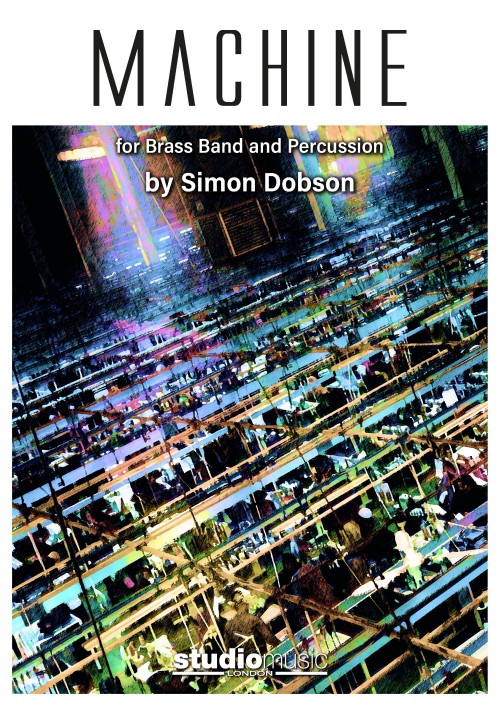
Machine (Brass Band - Score only) - Dobson, Simon
Machine, was commissioned by the Salvation Army Trading Company for the National Youth Brass Band of Great Britain.The work speaks of the perils of the fast fashion industry, the part it plays in our current understanding of late-stage capitalism and it's complicity in the destruction wrought on our one home planet. It also seeks to portray the incredible efforts of the Salvation Army in their quest to slow the fast fashion industry and recycle clothing in the most innovative and progressive ways.The work is through composed and comprises five movements.Movement 1: The great Machine. The band is placed into 8 groups of three (expect tubas, in their normal position as a 4), who stand in specific places on the stage. This will create machine like antiphonal movement in the written music. The great Machine in question is the fast fashion industry, in all its chaos, seeming grandeur and relentless momentum.Movement 2: Mode phmre is fast, angular and quirky, a nod to the perilous speed and waste of the fast fashion industry (the movement title is the French for fast fashion).Movement 3: A planet to treasure (for DA) is a love letter to our home planet and its finite resources and as well as the beauty of the natural world, which unfortunately, we are destroying (hence the dedication to David Attenborough on his 100th year).Movement 4: The wheels keep turning, returns to the fast, angular, almost unstoppable grasp of capitalism and the damaging structures it promotes.Movement 5: Recycle, re-use, mirrors the opening (though without stage directions) in reference to the cyclic nature of fast fashion and the wonderful work that The Salvation Army do in trying to halt this system.
Estimated dispatch 7-14 working days
-
£29.95
Wisbech Citadel (Brass Band - Score and Parts) - Gay, Albert
This homage to a Salvation Army corps in Cambridgeshire is Albert Gay's most popular Salvation Army composition although he wrote several other excellent marches like His Royal Banner and Western Valley. The bass solo quotes a vocal march dating from The Salvation Army's Musical Salvationist 1916; The Call to War.
Estimated dispatch 7-14 working days
-
£14.95
Wisbech Citadel (Brass Band - Score only) - Gay, Albert
This homage to a Salvation Army corps in Cambridgeshire is Albert Gay's most popular Salvation Army composition although he wrote several other excellent marches like His Royal Banner and Western Valley. The bass solo quotes a vocal march dating from The Salvation Army's Musical Salvationist 1916; The Call to War.
Estimated dispatch 7-14 working days
 View Music