
Results
-
 £29.95
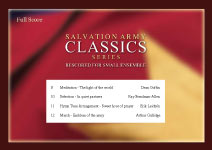
Salvation Army Classics 9-12 for Small Ensemble
Salvation Army Classics arranged for Smaller Ensembles Series 9 - 12Meditation - The Light of the WorldSelection - In Quiet PasturesHymn Tune Arrangement - Sweet Hour of PrayerMarch - Emblem of the Army This series features pieces that have been rescored for Unity Series (five-part) scoring.PART I 1st Cornet BbPART II 2nd Cornet Bb and 1st Horn EbPART III 2nd Horn Eb and Baritone or Trombone BbPART IV Euphonium BbPART V Bass Eb and Bass BbThese transcriptions have been carried out in such a way to facilitate the addition of any original parts that may be available.Where relevant, suggestions are made for a variation in tone colour (i.e. 2nd Cornet, Flugel, Baritone, Trombone) as well asthe occasional opportunity for rest.
Estimated dispatch 7-14 working days
-
 £214.95
Christmas Collection - Wind Band Set - March Card Size
The wind band set contains 30 parts in march card size only:Flute 1 x2Flute 2 x2Oboe x1Bassoon x1Clarinet 1 Bb x2Clarinet 2 Bb x2Soprano Saxophone Bb x1Alto Saxophone 1 Eb x1Alto Saxophone 2 Eb x1Tenor Saxophone Bb x1Baritone Saxophone Eb x1Horn 1 in F x1Horn 2 in F x1Solo & 1st Cornet Bb x22nd Cornet Bb x2Trombone 1 B.C. x1Trombone 2 B.C. x1Bass Trombone x1Euphonium B.C. x1Euphonium Bb T.C. x1Tuba B.C. x2String Bass x1Percussion x1
Estimated dispatch 7-14 working days
-
 £30.00
Roots - Lucy Pankhurst
Commissioned by Katrina Marzella in 2008, this modern 'duet' for Baritone and Euphonium soloists with brass band accompaniment has been inspired by 'nature and environment' as its primary muse. The music takes the listener through 7 stages of environmental atmosphere, in its combination of sounds and effects. It is a very uplifting work and with the back-story in mind (see programme notes below), it makes for an incredibly effective concert feature.Programme notes from the composer, Lucy Pankhurst:There are 7 main sections in the piece :RainGerminationGrowthTransionSunshineRainstormRestThe work begins with Rain, symbolised by the rainstick and 'rain sounds' in the brass , which allows the themes to germinate. The 'roots' of the music themselves, are firmly established in the tonic (root Eb) and 5ths in the low brass, from which the solo lines eventually grow, using triads and 5ths.During Growth, the solo baritone and euphonium begin with separate melodies which begin to twist around each other (much like tree roots), interlocking to produce harmonies and counterpoint, complimenting one another and firmly keeping the music in Eb major. Muted cornets and trombones continue to play overlapping semiquavers, reflecting the raindrops as they fall from the trees and leaves.A brief interlude, featuring brass sextet drives the music back to its Germination stage - here, named Transion, as it grows once more, evolving into something new. The Sunshine section is a dance. Moving rapidly through different keys, the warm sunlight catches on the dewy foliage, creating dazzling moments of clarity and beauty.However, the change in conditions also lead to brief moments of uncertainty, as the various creatures tentatively reappear from their shelter to bask as the earth is warmed. Birdsong can be heard in the solo lines as the entire band join in the celebrations.The jollity does not last long, however, as a Rainstorm, more violent than the last , ensues - stopping the dance in its tracks. The tam-tam and bass drum signify thunder, crashing into the music abruptly. However, the music still survives and re-emerges from the storm, delicately but securely establishing itself into a new key (C major), before softly concluding with the two soloists in rhythmic unison as the rain subsides and the world is at Rest.
In Stock: Estimated dispatch 3-5 working days
-
 £30.00
The Bare Necessities - Terry Gilkyson
A superb arrangement by Jon Bennett of this Disney favourite from The Jungle Book. It's been arranged here as a duet for two Eb Basses (or Eb/Bb Bass as an alternative) with brass band.Even just the concept of the scoring lends itself to being a piece with excellent entertainment value! When coupled with the expertise of the arranger's musicality, this is a feature which will definitely be well received by your band and audiences alike.
In Stock: Estimated dispatch 3-5 working days
-
 £49.95
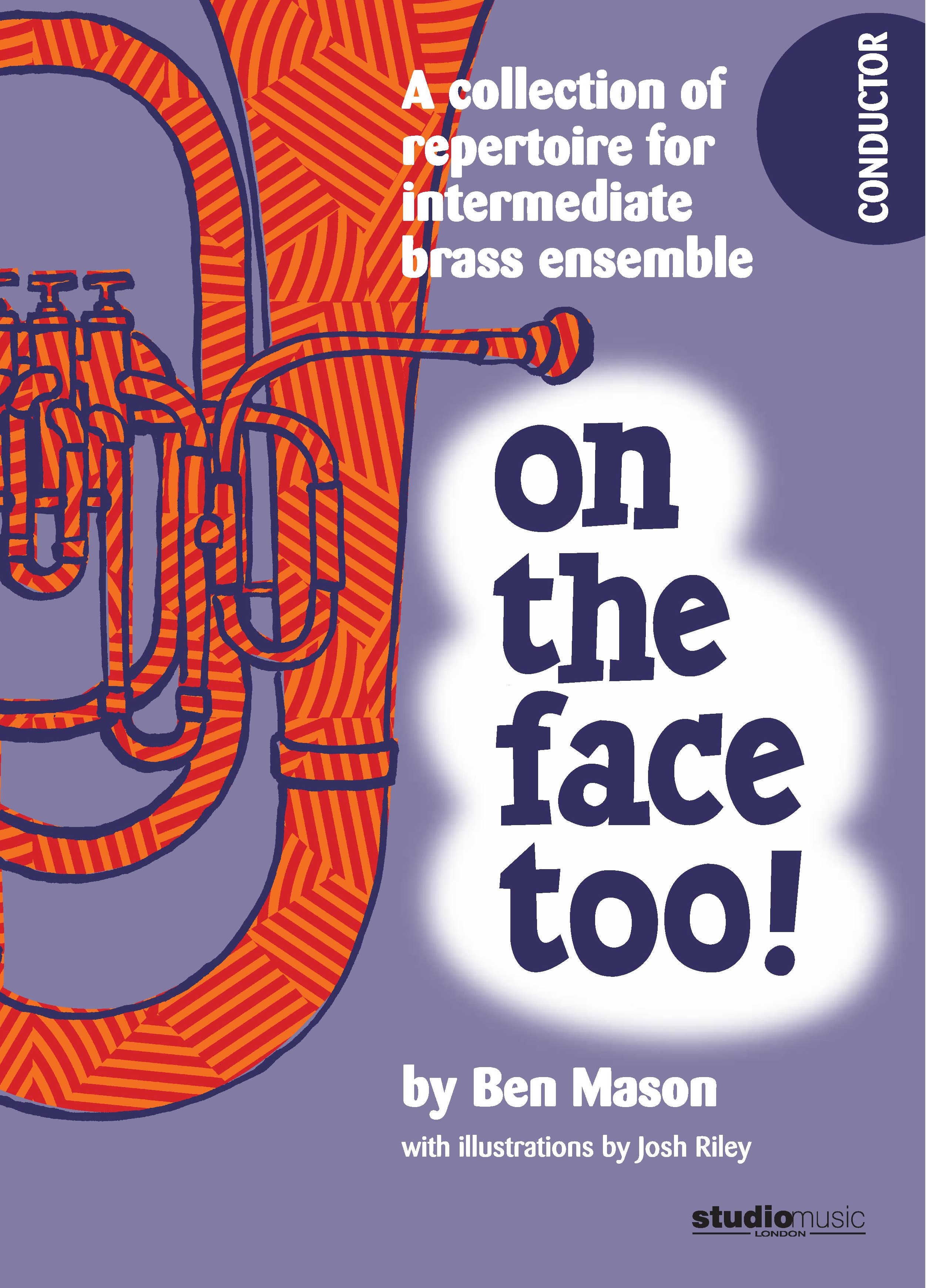
On the Face Too! (Value Set)
Value Set includes: a score and one of each part:Part A: Trumpet 1 in BbPart B: Trumpet 2 in BbPart C: Horn in EbPart C: Horn in FPart C: Trombone/Euphonium TCPart C: Trombone/Euphonium BCPart D: Trombone TCPart D: Trombone BCPart D: Bass in EbPart D: Tuba BDPercussionAdditional score and parts are also available individually.On the Face Too! is to the secondary school brass teacher as On the Face! is to the primary: namely a collection of pieces for intermediate brass ensemble in various jazz and popular styles, aiming to give a ready supply of material for concerts and assemblies, which nevertheless still allows for the developing technique of the young players to whom it is addressed.Generally speaking, the technical difficulty of the material here goes no further than grade 4 or 5 (even the first trumpet part never goes higher than a written G), though some pieces will offer considerable rhythmic challenges.
Estimated dispatch 7-14 working days
-
 £15.60
Two Go Around the World
Parts include for 2 Bb Instruments, Bb and Eb Instruments, Eb and Bb Instruments and 2 C Bass Clef Instruments.12 Easy Duets for various Brass Instruments includes: Bailero; John Peel; Men of Harlech; Santa Lucia; The Cuckoo; Danny Boy; Casatchok; The Flowers of the Forest; Banana Boat Song; The Chicken Reel; Pokarekare Ana; Waltzing Matilda.
Estimated dispatch 7-14 working days
-
 £99.00
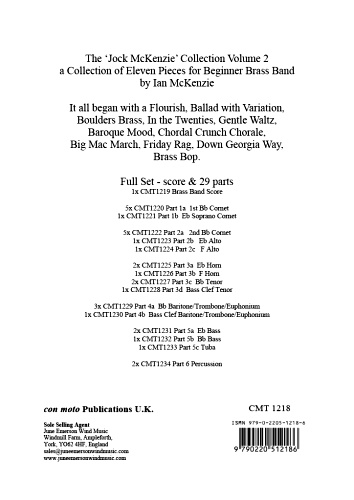
THE JOCK MCKENZIE COLLECTION Volume 2 for Brass Band (score & parts) - McKenzie, Jock
The score (CMT1219, which is ring bound on A4) shows parts 1 & 2 in Bb, part 3 in Eb and part 4 in bass clef concert pitch plus the percussion parts (drum kit & auxiliary). Each individual part book is printed on double sided B4 and presented with a colour cover. Indian Queens Junior Band plays 'Boulders Brass' on you tubeContents / Comments:
In Stock: Estimated dispatch 1-3 working days
-
 £19.95
Timepiece (Brass Quartet)
For brass quartet (2 Trumpets/Cornets, Horn Eb and Euphonium). Commissioned for the 1994 Swiss Quartet Championships. (Horn in F and Euphonium bass clef parts included).
Estimated dispatch 7-14 working days
-
 £37.95
Benvenuto Cellini (Brass Band - Score only)
Berliozs opera Benvenuto Cellini was first produced in Paris in 1838 but was withdrawn as a failure, and it was not until the production in Dresden in 1888 that it was finally acclaimed by the Germans as a triumph. Adapted from certain episodes recorded in the memoirs of Benvenuto Cellini, Tuscan sculptor and goldsmith, the story, laid in Rome during the mid-sixteenth century, is not strictly historical. The short opening Allegro, marked deciso con impeto, is conceived in the most brilliant Berlioz manner, utilising full instrumentation. In the Larghetto we meet at once the first of the opera themes " the Cardinals aria (from the last act) introduced in the bass, quasi pizzicato. A second melody leads to a resumption of the Allegro, the contrasting second subject in the tenor horns being an adaptation of Teresas aria (Act I). Towards the end the Cardinal theme is re-introduced by trombones, fortissimo against an energetic cornet and euphonium passage (senza stringendo " without hurry, says the score). After a unison passage storming skywards, there is a sudden, dramatic three-bar silent pause broken by Eb basses alone, again stating the Cardinal theme. A simple molto crescendo on the dominant, begun piano, leads to the long, resounding chord.
Estimated dispatch 7-14 working days
-
 £82.95
Benvenuto Cellini (Brass Band - Score and Parts)
Berliozs opera Benvenuto Cellini was first produced in Paris in 1838 but was withdrawn as a failure, and it was not until the production in Dresden in 1888 that it was finally acclaimed by the Germans as a triumph. Adapted from certain episodes recorded in the memoirs of Benvenuto Cellini, Tuscan sculptor and goldsmith, the story, laid in Rome during the mid-sixteenth century, is not strictly historical. The short opening Allegro, marked deciso con impeto, is conceived in the most brilliant Berlioz manner, utilising full instrumentation. In the Larghetto we meet at once the first of the opera themes " the Cardinals aria (from the last act) introduced in the bass, quasi pizzicato. A second melody leads to a resumption of the Allegro, the contrasting second subject in the tenor horns being an adaptation of Teresas aria (Act I). Towards the end the Cardinal theme is re-introduced by trombones, fortissimo against an energetic cornet and euphonium passage (senza stringendo " without hurry, says the score). After a unison passage storming skywards, there is a sudden, dramatic three-bar silent pause broken by Eb basses alone, again stating the Cardinal theme. A simple molto crescendo on the dominant, begun piano, leads to the long, resounding chord.
Estimated dispatch 7-14 working days