
Results
-
£35.00
Candlelight Carol (Euphonium Solo) - Rutter, J - Griffiths, D
John Rutter (b. 1945) has established a reputation as one of the most successful composers of modern-day carols, and the Candlelight Carol is one of the most popular. Written in 1984, this is a Nativity carol, and has been recorded by Glyn Williams on Cory Band's new Christmas CD release A Festival of Fanfares and Carols4th section +Duration 5 mins
In Stock: Estimated dispatch 1-3 working days
-
£33.00
Do They Know It's Christmas - Geldof, B - Broadbent, D
Do They Know It's Christmas? is a charity single released in 1984 by the supergroup Band Aid, organized by Bob Geldof and Midge Ure to raise funds for famine relief in Ethiopia.Featuring some of the biggest British and Irish artists of the time it become one of the best-selling singles in UK history.Beyond its chart success, Do They Know It's Christmas? remains a symbol of generosity and unity during the Christmas season. Perfect for any Christmas concert.
In Stock: Estimated dispatch 1-3 working days
-
 £32.00
Blaenwern (Brass Band - Score and Parts) - Rowlands, William - Wilkinson, Keith M.
This arrangement is dedicated to the memory of a much-loved friend and wonderful cornet player, Stephen Howard. Stephen played with the Clacton-on-Sea Band, conducted by his father Robert, and was a frequent guest with the G.U.S. Band directed by Dr. Keith M Wilkinson. Indeed, only a few weeks before his untimely death in 1984, Stephen had played principal cornet with the G.U.S. Band on a tour of Switzerland, performing outstandingly at each concert.The arrangement was first performed at Stephen's Memorial Service in October, 1984."Changed from glory into glory,Till in Heaven we take our place,Till we cast our crowns before Thee,Lost in wonder, love and praise." Charles Wesley
Estimated dispatch 7-14 working days
-
 £15.00
Symphony in Two Movements (Brass Band - Study Score) - Gregson, Edward
Selected as the Championship Section test piece for the National Brass Band Championships of Great Britain 2025This work was jointly commissioned by the National Youth Brass Band of Great Britain (NYBBGB) and the National Youth Brass Band of Wales (NYBBW), the latter with funding from T Cerdd (Music Centre Wales), to celebrate their 60th and 30th anniversaries respectively. The first performances were given at Cadogan Hall, London, in April 2012, by the NYBBGB, conducted by Bramwell Tovey; and at the Great Hall, Aberystwyth University, in July 2012, by the NYBBW, conducted by Nicholas Childs.When I was approached about a joint commission to write a new work to celebrate the anniversaries of these two outstanding youth bands I was delighted to accept, and decided to respond by writing a work apposite for the magnitude of these special occasions, namely a 'symphony for brass'.Through a long journey of writing music for brass band, which commenced with Connotations (1977), and continued with Dances and Arias (1984), Of Men and Mountains (1991), The Trumpets of the Angels (2000) and Rococo Variations (2008), I arrived at what I regard as the most important work of the cycle to date, combining as it does serious musical intent with considerable technical demands. It is perhaps my most abstract work for brass band, avoiding any programmatic content.The symphony lasts for some 19 minutes and is structured in two linked movements. The form is based on that used by Beethoven in his final piano sonata (Op.111), which is in two movements only: a compact sonata-form allegro, followed by a more expansive theme and four variations. Prokofiev also adopted this model in his 2nd Symphony of 1925.The opening Toccata of this Symphony is highly dramatic but compact, whilst still retaining the 'traditional' structural elements of exposition, development and recapitulation; indeed, it also has the 'traditional' element of a contrasting second subject - a gentle, lyrical modal melody first heard on solo cornets.In contrast, the longer and more substantial second movement Variations is built around a theme and four variations. The slowly unfolding chorale-like theme accumulates both added note harmony and increasing instrumentation, whilst the four variations which follow are by turn mercurial (fast, starting with all the instruments muted), march-like (menacing, with short rhythmic articulations underpinning an extended atonal melody), serene (a series of 'romances' for solo instruments alongside echoes of the chorale) with an emerging theme eventually bursting into a climax of passionate intent; whilst the final variation is a dynamic scherzo (concertante-like in its series of rapid-fire solos, duets, trios and quartets) with the music gradually incorporating elements of the main ideas from the first movement, thus acting as a recapitulation for the whole work. It reaches its peroration with a return to the very opening of the symphony, now in the 'home' tonality of F, and thus creating a truly symphonic dimension to the music.Most of the melodic material of the symphony is derived from the opening eleven-note 'row', which contains various intervallic sets, and although the work is not serially conceived it does use some typical quasi-serial procedures, such as canons, inversions, and retrogrades. The symphony uses somewhat limited percussion, in line with a 'classical' approach to the sound world of the brass band, alongside a use of multi-divisi instrumentation, whereby each player has an individual part rather than the traditional doubling within certain sections of the band.- Edward GregsonDuration: 19.00
Estimated dispatch 7-14 working days
-
 £90.00
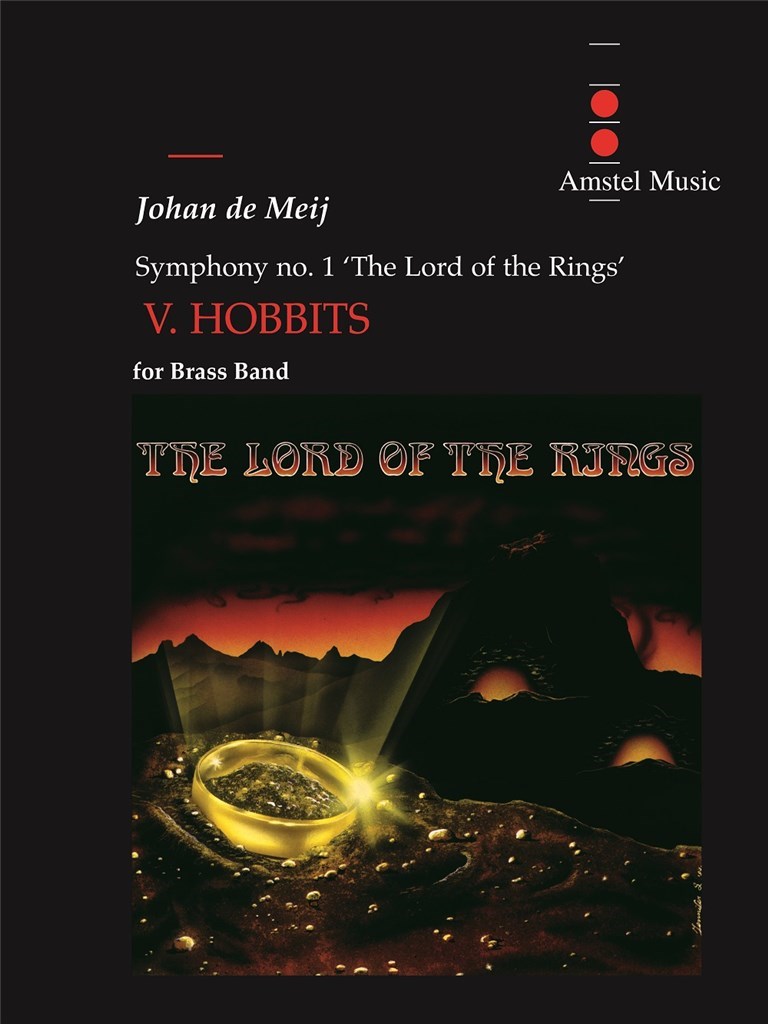
Hobbits (from Symphony No.1: The Lord of the Rings) (Brass Band - Score and Parts) - De Meij, Johan
Johan de Meij's first symphony The Lord of the Rings is based on the trilogy of that name by J.R.R. Tolkien. This book has fascinated many millions of readers since its publication in 1955. The symphony consists of five separate movements, each illustrating a personage or an important episode from the book. This transcription for brass band has been arranged by the composer. The symphony was written in the period between March 1984 and December 1987, and had its premiere in Brussels on 15th March 1988, performed by the The Royal Band ofthe Belgian Guides under the baton of Norbert Nozy. In 1989, the symphony The Lord of the Rings was awarded a first prize in the Sudler International Wind Band Composition Competition in Chicago, and a year later, the symphony was awarded a grant by the Dutch Composers Fund. In 2001, the orchestral version was premiered by the Rotterdam Philharmonic Orchestra and recorded by the London Symphony Orchestra. Duration: 9.00
Estimated dispatch 7-14 working days
-
 £90.00
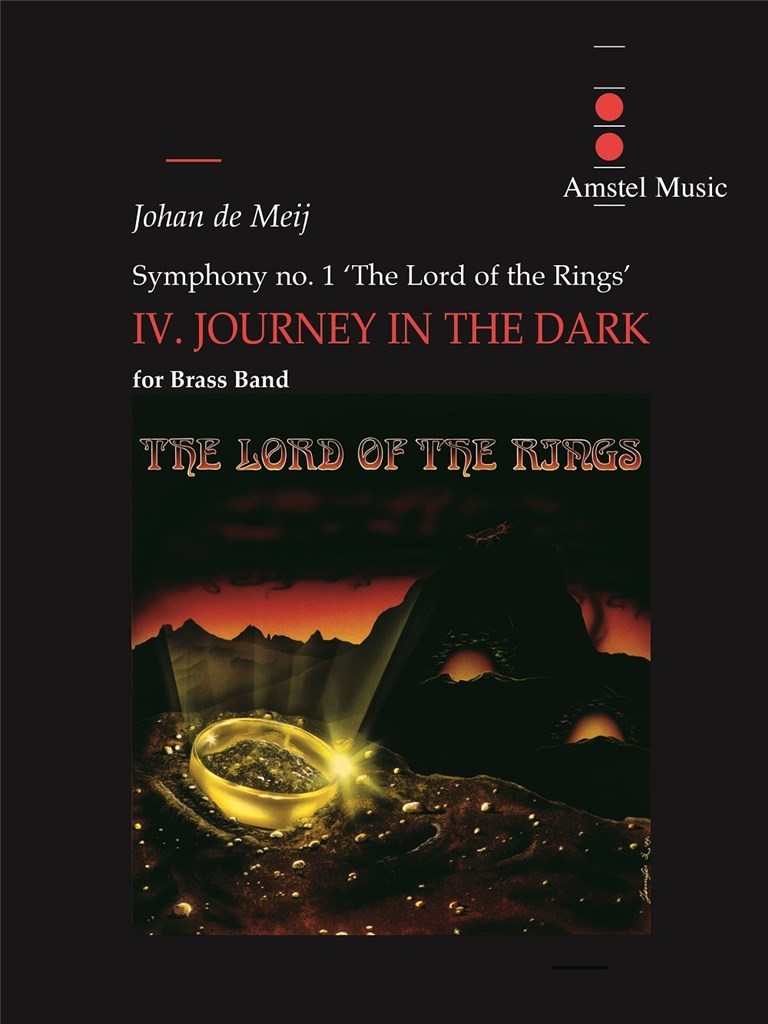
Journey in the Dark (from Symphony No.1: The Lord of the Rings) (Brass Band - Score and Parts) - De Meij, Johan
Johan de Meij's first symphony The Lord of the Rings is based on the trilogy of that name by J.R.R. Tolkien. This book has fascinated many millions of readers since its publication in 1955. The symphony consists of five separate movements, each illustrating a personage or an important episode from the book. This transcription for brass band has been arranged by the composer. The symphony was written in the period between March 1984 and December 1987, and had its premiere in Brussels on 15th March 1988, performed by the The Royal Band ofthe Belgian Guides under the baton of Norbert Nozy. In 1989, the symphony The Lord of the Rings was awarded a first prize in the Sudler International Wind Band Composition Competition in Chicago, and a year later, the symphony was awarded a grant by the Dutch Composers Fund. In 2001, the orchestral version was premiered by the Rotterdam Philharmonic Orchestra and recorded by the London Symphony Orchestra. Duration: 9.00
Estimated dispatch 7-14 working days
-
 £83.00
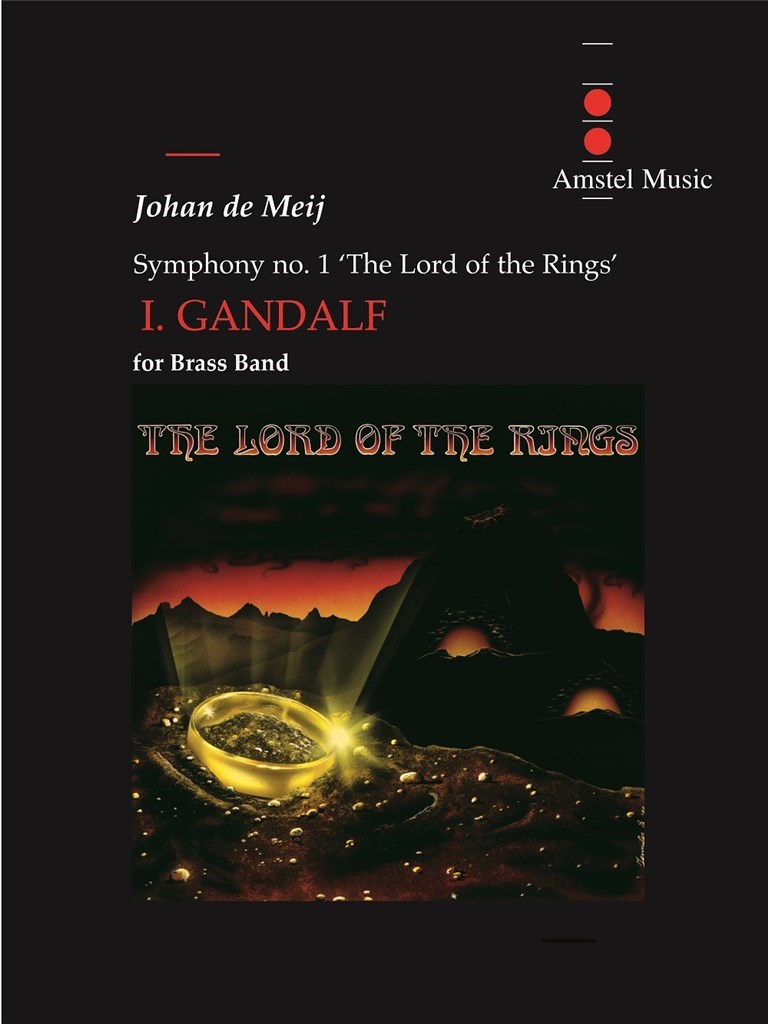
Gandalf (from Symphony No.1: The Lord of the Rings) (Brass Band - Score and Parts) - De Meij, Johan
Johan de Meij's first symphony The Lord of the Rings is based on the trilogy of that name by J.R.R. Tolkien. This book has fascinated many millions of readers since its publication in 1955. The symphony consists of five separate movements, each illustrating a personage or an important episode from the book. This transcription for brass band has been arranged by the composer. The symphony was written in the period between March 1984 and December 1987, and had its premiere in Brussels on 15th March 1988, performed by the The Royal Band ofthe Belgian Guides under the baton of Norbert Nozy. In 1989, the symphony The Lord of the Rings was awarded a first prize in the Sudler International Wind Band Composition Competition in Chicago, and a year later, the symphony was awarded a grant by the Dutch Composers Fund. In 2001, the orchestral version was premiered by the Rotterdam Philharmonic Orchestra and recorded by the London Symphony Orchestra. Duration: 6.30
Estimated dispatch 7-14 working days
-
 £59.70
Candlelight Carol (Brass Band - Score and Parts) - Rutter, John - Lorriman, Howard
Candlelight Carol" is a Christmas carol with music and lyrics by the English choral composer and conductor John Rutter. The carol was written in 1984, and was first recorded by Rutter's own group, the Cambridge Singers, on their 1987 album Christmas Night. It is now available for your brass band.
Estimated dispatch 7-14 working days
-
 £107.95
Symphony in Two Movements (Brass Band - Score and Parts) - Gregson, Edward
Selected as the Championship Section test piece for the National Brass Band Championships of Great Britain 2025This work was jointly commissioned by the National Youth Brass Band of Great Britain (NYBBGB) and the National Youth Brass Band of Wales (NYBBW), the latter with funding from T Cerdd (Music Centre Wales), to celebrate their 60th and 30th anniversaries respectively. The first performances were given at Cadogan Hall, London, in April 2012, by the NYBBGB, conducted by Bramwell Tovey; and at the Great Hall, Aberystwyth University, in July 2012, by the NYBBW, conducted by Nicholas Childs.When I was approached about a joint commission to write a new work to celebrate the anniversaries of these two outstanding youth bands I was delighted to accept, and decided to respond by writing a work apposite for the magnitude of these special occasions, namely a 'symphony for brass'.Through a long journey of writing music for brass band, which commenced with Connotations (1977), and continued with Dances and Arias (1984), Of Men and Mountains (1991), The Trumpets of the Angels (2000) and Rococo Variations (2008), I arrived at what I regard as the most important work of the cycle to date, combining as it does serious musical intent with considerable technical demands. It is perhaps my most abstract work for brass band, avoiding any programmatic content.The symphony lasts for some 19 minutes and is structured in two linked movements. The form is based on that used by Beethoven in his final piano sonata (Op.111), which is in two movements only: a compact sonata-form allegro, followed by a more expansive theme and four variations. Prokofiev also adopted this model in his 2nd Symphony of 1925.The opening Toccata of this Symphony is highly dramatic but compact, whilst still retaining the 'traditional' structural elements of exposition, development and recapitulation; indeed, it also has the 'traditional' element of a contrasting second subject - a gentle, lyrical modal melody first heard on solo cornets.In contrast, the longer and more substantial second movement Variations is built around a theme and four variations. The slowly unfolding chorale-like theme accumulates both added note harmony and increasing instrumentation, whilst the four variations which follow are by turn mercurial (fast, starting with all the instruments muted), march-like (menacing, with short rhythmic articulations underpinning an extended atonal melody), serene (a series of 'romances' for solo instruments alongside echoes of the chorale) with an emerging theme eventually bursting into a climax of passionate intent; whilst the final variation is a dynamic scherzo (concertante-like in its series of rapid-fire solos, duets, trios and quartets) with the music gradually incorporating elements of the main ideas from the first movement, thus acting as a recapitulation for the whole work. It reaches its peroration with a return to the very opening of the symphony, now in the 'home' tonality of F, and thus creating a truly symphonic dimension to the music.Most of the melodic material of the symphony is derived from the opening eleven-note 'row', which contains various intervallic sets, and although the work is not serially conceived it does use some typical quasi-serial procedures, such as canons, inversions, and retrogrades. The symphony uses somewhat limited percussion, in line with a 'classical' approach to the sound world of the brass band, alongside a use of multi-divisi instrumentation, whereby each player has an individual part rather than the traditional doubling within certain sections of the band.- Edward GregsonDuration: 19.00
Estimated dispatch 7-14 working days
-
 £57.95
Symphony in Two Movements (Brass Band - Score only) - Gregson, Edward
Selected as the Championship Section test piece for the National Brass Band Championships of Great Britain 2025This work was jointly commissioned by the National Youth Brass Band of Great Britain (NYBBGB) and the National Youth Brass Band of Wales (NYBBW), the latter with funding from T Cerdd (Music Centre Wales), to celebrate their 60th and 30th anniversaries respectively. The first performances were given at Cadogan Hall, London, in April 2012, by the NYBBGB, conducted by Bramwell Tovey; and at the Great Hall, Aberystwyth University, in July 2012, by the NYBBW, conducted by Nicholas Childs.When I was approached about a joint commission to write a new work to celebrate the anniversaries of these two outstanding youth bands I was delighted to accept, and decided to respond by writing a work apposite for the magnitude of these special occasions, namely a 'symphony for brass'.Through a long journey of writing music for brass band, which commenced with Connotations (1977), and continued with Dances and Arias (1984), Of Men and Mountains (1991), The Trumpets of the Angels (2000) and Rococo Variations (2008), I arrived at what I regard as the most important work of the cycle to date, combining as it does serious musical intent with considerable technical demands. It is perhaps my most abstract work for brass band, avoiding any programmatic content.The symphony lasts for some 19 minutes and is structured in two linked movements. The form is based on that used by Beethoven in his final piano sonata (Op.111), which is in two movements only: a compact sonata-form allegro, followed by a more expansive theme and four variations. Prokofiev also adopted this model in his 2nd Symphony of 1925.The opening Toccata of this Symphony is highly dramatic but compact, whilst still retaining the 'traditional' structural elements of exposition, development and recapitulation; indeed, it also has the 'traditional' element of a contrasting second subject - a gentle, lyrical modal melody first heard on solo cornets.In contrast, the longer and more substantial second movement Variations is built around a theme and four variations. The slowly unfolding chorale-like theme accumulates both added note harmony and increasing instrumentation, whilst the four variations which follow are by turn mercurial (fast, starting with all the instruments muted), march-like (menacing, with short rhythmic articulations underpinning an extended atonal melody), serene (a series of 'romances' for solo instruments alongside echoes of the chorale) with an emerging theme eventually bursting into a climax of passionate intent; whilst the final variation is a dynamic scherzo (concertante-like in its series of rapid-fire solos, duets, trios and quartets) with the music gradually incorporating elements of the main ideas from the first movement, thus acting as a recapitulation for the whole work. It reaches its peroration with a return to the very opening of the symphony, now in the 'home' tonality of F, and thus creating a truly symphonic dimension to the music.Most of the melodic material of the symphony is derived from the opening eleven-note 'row', which contains various intervallic sets, and although the work is not serially conceived it does use some typical quasi-serial procedures, such as canons, inversions, and retrogrades. The symphony uses somewhat limited percussion, in line with a 'classical' approach to the sound world of the brass band, alongside a use of multi-divisi instrumentation, whereby each player has an individual part rather than the traditional doubling within certain sections of the band.- Edward GregsonDuration: 19.00
Estimated dispatch 7-14 working days
 View Music