
Results
-
£35.00
Mood Indigo - Ellington, Duke - Harper, P
One of the Duke's most famous songs, this extremely subdued arrangement features a laid-back cornet solo, a whispering flugel solo, and then a big surprise for your audience in the middle. As played by Cory Band at Brass in Concert 2017.3rd section +Duration 3.30 minsListen to Cory Band on BIC 2017Courtesy of World of Brass
In Stock: Estimated dispatch 1-3 working days
-
£35.00
Somewhere - Bernstein, L. - Harper, P
One of the most famous numbers from Bernstein's West Side Story arranged as a show-stopping finale. Features either the trombone or optionally the flugel.2nd sectionDuration 3.30 minsListen to Cory Band on 'Summon the Heroes'Courtesy of World of Brass
In Stock: Estimated dispatch 1-3 working days
-
£40.00
And Death Shall Have No Dominion - Harper, P
Based on Dylan Thomas's famous poem, the music is also linked to John Lennon's assassination, beginning with five gunshots and alternating between turbulent and reflective music. Recorded by Glyn Williams with Cory.2nd section +Duration 5 minsListen to Glyn Williams with Cory Band on BIC 2017Courtesy of World of Brass
In Stock: Estimated dispatch 1-3 working days
-
 £164.99
Diamond Concerto (Euphonium Concerto No.3) (Euphonium Solo with Brass Band - Score and Parts) - Sparke, Philip
Diamond Concerto was commissioned by Musikverein Morschied from Germany - Dr. Eric Grandjean, conductor - for a special concert featuring Steven Mead as guest soloist. Together they gave the world premiere on 28th April 2012 in the town theatre of Idar-Oberstein. The commission is a highlight in the 30-year friendship between composer and soloist, which has included many mutual CD projects and concerts and, now, a concerto. Sparke had Steven Mead's special euphonium sound in his head throughout the composition process and made free use of the variety of styles which the world-renowned virtuoso has made his own during his highly successful solo career.The village of Morschied lies to the west of Frankfurt am Main in the area known as the German Road of Precious Stones, which is famous for its thriving gem industry. Because of this it was decided to give the commission a local connection by choosing the title, Diamond Concerto. Each of the three movements is named after a famous diamond:Earth Star is rather stern in mood, opening with a free fantasy for the soloist over a static chord from the band. This leads to an Allegro Moderato in minor mode where small motives are gradually repeated and developed by both band and soloist.Ocean Dream uses a varied quote from the composer's Music for Battle Creek, including a melting slow melody that was originally written with Steven Mead in mind.Blue Heart was written, at Steven Mead's suggestion, in bebop style and takes the form of a jazz waltz. The quasi-improvisatory central section features a call-and-response passage for the soloist and upper woodwinds.Duration: 16:45
Estimated dispatch 7-14 working days
-
 £80.00
The Unfortunate Traveller (Brass Band - Score and Parts) - Holst, Imogen - Hindmarsh, Paul
Imogen Holst (1907-1984) submitted The Unfortunate Traveller (1929) as her final work as a student portfolio at the Royal College of Music, where her composition teacher was Gordon Jacob. The title was taken from Thomas Nashe's famous 1594 picaresque novel of the same title. The Suite was first performed on 12 February 1933 at her Majesty's Theatre, Carlisle, by the St. Stephen's Band, with the composer conducting. Te concert was given in memory of Holst's uncle, Dr. H.A. Lediard. Holst had been impressed with the band's performance of his A Moorside Suite at the 1928 National Brass Band Championships (The Crystal Palace, South London) and was keen to work with them. Writing in Imogen Holst, a life in music, Christopher Grogan indicates that it was Gustav Holst's suggestion to include his daughter's work in the programme, quoting Imogen Holst's remarks made in interview to The Daily Mail as follows: "....it is the first time, so far as I know, that a woman has conducted a brass band at a public concert....It has been a delight to rehearse the St. Stephen's Band. It was their performance at the Crystal Palace Festival that inspired me to write this Suite, which I have dedicated to them."Imogen Holst accompanied her father to the Crystal Palace in 1928 to hear the performances of A Moorside Suite, and was so excited by the played and, audibly, by her father's music that she decided to write a brass band piece for her final examination. Te result was The Unfortunate Traveller (1929). However, it was not possible for her to present a brass band work for examination. She arranged it for string orchestra so that it could be played before she left the RCM in July 1930. Following the premiere of the original in 1933, the manuscripts did not resurface until 1969 Imogen found them among her late mother's effects. Although she requested score and parts be destroyed, they ended up in the possession of Manchester composer John Golland, who marked up the score presumably with the intention of creating a new performing edition. The original scoring reveals a lack of experience with what can be a tricky medium.With the agreement of the Holst Foundation, a revised edition, with additional percussion, was prepared in 2011 since when the work has been fortunate to travel round the world as a concert and contest piece. The original includes drums in the March only. The title was taken from Tomas Nashe's famous 1594 picaresque novel of the same title. Several Morris Dance tunes are introduced during the course of the four short movements, including Bonnie Green Garters, Shepherd's Hey, The Rose and The Wind Blaws Cauld. Quirky twists and turns of harmony and spirited rhythms that remind us how much Imogen Holst loved tradition English dance music.In September 2025, I made a performing edition of the composer's arrangement for string orchestra. The manuscript lacks the final movement, which I arranged in a similar style, ie. without extending the upper ranges. Making this edition raised some issues regarding the accuracy of my band version and some of the solutions I used to smooth out the voicing. I have used the composer's second thoughts to refine my performing edition and to correct a textual errors.- Paul HindmarshDuration: 10.00
Estimated dispatch 7-14 working days
-
£40.00
The Unfortunate Traveller (Brass Band - Score only) - Holst, Imogen - Hindmarsh, Paul
Imogen Holst (1907-1984) submitted The Unfortunate Traveller (1929) as her final work as a student portfolio at the Royal College of Music, where her composition teacher was Gordon Jacob. The title was taken from Thomas Nashe's famous 1594 picaresque novel of the same title. The Suite was first performed on 12 February 1933 at her Majesty's Theatre, Carlisle, by the St. Stephen's Band, with the composer conducting. Te concert was given in memory of Holst's uncle, Dr. H.A. Lediard. Holst had been impressed with the band's performance of his A Moorside Suite at the 1928 National Brass Band Championships (The Crystal Palace, South London) and was keen to work with them. Writing in Imogen Holst, a life in music, Christopher Grogan indicates that it was Gustav Holst's suggestion to include his daughter's work in the programme, quoting Imogen Holst's remarks made in interview to The Daily Mail as follows: "....it is the first time, so far as I know, that a woman has conducted a brass band at a public concert....It has been a delight to rehearse the St. Stephen's Band. It was their performance at the Crystal Palace Festival that inspired me to write this Suite, which I have dedicated to them."Imogen Holst accompanied her father to the Crystal Palace in 1928 to hear the performances of A Moorside Suite, and was so excited by the played and, audibly, by her father's music that she decided to write a brass band piece for her final examination. Te result was The Unfortunate Traveller (1929). However, it was not possible for her to present a brass band work for examination. She arranged it for string orchestra so that it could be played before she left the RCM in July 1930. Following the premiere of the original in 1933, the manuscripts did not resurface until 1969 Imogen found them among her late mother's effects. Although she requested score and parts be destroyed, they ended up in the possession of Manchester composer John Golland, who marked up the score presumably with the intention of creating a new performing edition. The original scoring reveals a lack of experience with what can be a tricky medium.With the agreement of the Holst Foundation, a revised edition, with additional percussion, was prepared in 2011 since when the work has been fortunate to travel round the world as a concert and contest piece. The original includes drums in the March only. The title was taken from Tomas Nashe's famous 1594 picaresque novel of the same title. Several Morris Dance tunes are introduced during the course of the four short movements, including Bonnie Green Garters, Shepherd's Hey, The Rose and The Wind Blaws Cauld. Quirky twists and turns of harmony and spirited rhythms that remind us how much Imogen Holst loved tradition English dance music.In September 2025, I made a performing edition of the composer's arrangement for string orchestra. The manuscript lacks the final movement, which I arranged in a similar style, ie. without extending the upper ranges. Making this edition raised some issues regarding the accuracy of my band version and some of the solutions I used to smooth out the voicing. I have used the composer's second thoughts to refine my performing edition and to correct a textual errors.- Paul HindmarshDuration: 10.00
Estimated dispatch 7-14 working days
-
 £54.50
Carnival of Venice (Bb Solo with Brass Band - Score and Parts) - Arban, Jean-Baptiste - Wilkinson, Keith M.
Bb Solo with Brass BandThe Carnival Of Venice is arguably everyone's favourite solo, especially the version by Arban (1820 - 1869), author of the famous brass-playing method book still in regular use today. Young soloists aspire to master the necessary techniques, accomplished soloists know that it is a "sure fire" winner with audiences and listeners love to be dazzled by a virtuoso display of variations on a theme they easily recognise.The theme is a traditional Italian song and has inspired variations for almost every possible instrument. Arban's famous variations were written in 1864. The arrangement remains faithful to the original while maintaining interest in the accompaniments by varying the orchestration. Although the arrangement is listed as featuring the euphonium as the solo instrument, it can also be used successfully as accompaniment for a cornet soloist.The arrangement has been recorded by Jeff Binns, euphonium, and St Louis Brass Band, musical director Keith M Wilkinson, on the CD Strike Up The Band and by Anthony Avitollo, euphonium, and Cuyahoga Valley Brass Band, musical director Keith M Wilkinson, on the CD Around The World.
Estimated dispatch 7-14 working days
-
 £74.95
Radio City (Trombone Solo with Brass Band - Score and Parts) - Graham, Peter
As youngsters growing up on the west coast of Scotland, my brother and I fell heir to an old valved radiogram which provided us with our first experiences of radio broadcasts. On the short wave signal, and through the static, we could pick up a whole range of programmes from across the Atlantic. I particularly recall the baseball games, the American accents of the announcers providing a window to a evocative world far removed from our small Ayrshire town. These memories form the basis of Radio City.The work is set in three movements, each introduced by a pastiche radio announcer narrative written by Philip Coutts. The first, City Noir, is a nod towards Raymond Chandler's eponymous private eye Philip Marlow and the dark cityscape of 1940s California.Movement two, Cafe Rouge, takes its title from the main restaurant in New York's famous Hotel Pennsylvania. Two of the most famous band leaders of the 1940s, trombonists Glenn Miller and Tommy Dorsey, broadcast live from the cafe on numerous occasions and the movement echoes with a collage of imagined sounds from the period.The finale, Two-Minute Mile, derives from an event dubbed in the USA as "the most exciting two minutes in sport", namely the Kentucky Derby. The virtuoso soloist figurations have their roots in Kentucky bluegrass fiddle music, with the galloping bluegrass clog-dancing rhythms providing the backdrop.- Peter Graham, Cheshire, January 2013
Estimated dispatch 7-14 working days
-
 £87.99
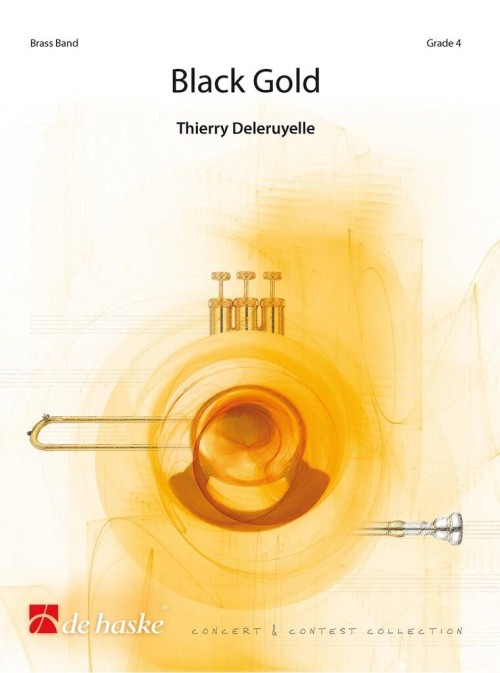
Black Gold (Brass Band - Score and Parts) - Deleruyelle, Thierry
Black Gold was commissioned by Musikverein 1891 "Harmonie" Saarwellingen e.V. (Germany) to mark its 130th anniversary.This composition pictures the history of the mining industry in the town of Saarwellingen and its surrounding region, where the life of the miners as well as their families revolved around coal, or black gold, for centuries on end. The piece is based on motifs from the famous song "Glck auf, Glck auf, der Steiger kommt..." ("Good luck, good luck, the mining foreman comes"), a veritable anthem for miners the world over.Duration: 11.45
Estimated dispatch 7-14 working days
-
 £50.00
I Want to Break Free (Brass Band - Score and Parts) - Deacon, John - Harper, Philip
Queen's 80s smash hit is known by all and has become an anthem against oppression around the world. The famous keyboard solo is taken by trombone.Suitable for 2nd Section Bands and aboveDuration: 3.30
Estimated dispatch 7-14 working days
 View Music