
Results
-
£44.50
In Memoriam - Arthur Sullivan - Neville Buxton
Written before teaming up with W.S. Gilbert, the first performance of "In Memoriam" was in 1866 at the Norwich Festival. Just before Sullivan started the composition, his father passed away. Sullivan turned his grief to the completion of this overture. It is also thought that the work was initially inspired by a poem of the same name by the Lord Tennyson Alfred. The overture enjoyed much success during Sullivan's lifetime, although sadly is seldom heard today. This arrangement of the work is the 2013 set test piece for the Butlins Mineworkers Open Brass Band Festival, 2nd section.
In Stock: Estimated dispatch 1-3 working days
-
 £37.50
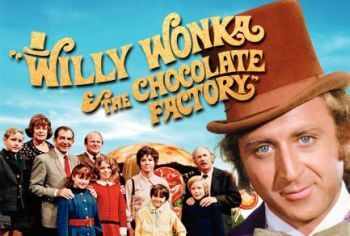
Willy Wonka (Selections From) - Leslie Bricusse & Anthony Newman - Gavin Somerset
Few people have not seen the 1971 film starring Gene Wilder as the eccentric chocolatier, offering tours of his chocolate factory to those lucky enough to find the hidden golden ticket. Whilst initialy a box office failure, the film went on to become a favourite in households across the world, years after its initial release. Now for the first time, your band can enjoy the music from the film in this selection that includes 'Golden Ticket', 'The Candy Man' and of course, the unforgettable 'Pure Imagination'. The music of Leslie Bricusse & Anthony Newley has been a hit for many years and continues to make TV and radio appearances. 'The Candy Man' was perhaps best known when covered by Sammy Davis Jr where it made it to number one in the USA. 'Pure Imagination' has been used countless times in adverts in the media and more recently, recorded by Jamie Callum for his album 'Momentum'. 'Pure Imagination' can also be performed as a stand-alone item. This is truly an all-time classic filled with a feast of musical variety that fits well into just about any concert. A must for all band libraries. To download the Solo Cornet part, please CLICK HERE . To download the Solo Horn part, please CLICK HERE . To download the Solo Euphonium part, please CLICK HERE . To download the playback audio to play along to, please RIGHT CLICK HERE & Save As .
In Stock: Estimated dispatch 1-3 working days
-
£24.50
The Farewell Symphony - Joseph Haydn - Neville Buxton
Composed in 1772, Haydn's Symphony No.45, better known as the "Farewell Symphony" due to the circumstances of which it was composed. Haydn's employer, Prince Nikolaus became so attracted to his Eszterhaza Castle, he spent longer and longer there each year. The court musicians were not allowed their families with them and became increasingly depressed. This symphony was composed in such a way, that during the last movement, one by one, each player blew out their candle, and crept of stage. The idea being that the prince would get the subtle hint. The next day, the court returned to Vienna! Arranged in the same way, players able to walk off one by one, a perfect ending to a concert, or first half.
In Stock: Estimated dispatch 1-3 working days
-
 £29.50
Pie Jesu (From Requiem) - John Rutter - Adam Rutter
John Rutter's music is known across the world for its simplicity and memorable melodies. The 'Pie Jesu' from his requiem is certainly no exception. First performed in Dallas, Texas in 1985, the 6 movements completed Rutter's setting of the Roman Catholic Mass. The third movement (the 'Pie Jesu') is typical of the composer, featuring a strong melody line with subtle accompaniments. Now arranged for Solo Cornet by Adam Rutter, this slow melody allows the soloist to shine in one of the finest and most famous settings of the work to date. A great addition to any concert & soloists repertoire.
In Stock: Estimated dispatch 1-3 working days
-
 £24.50
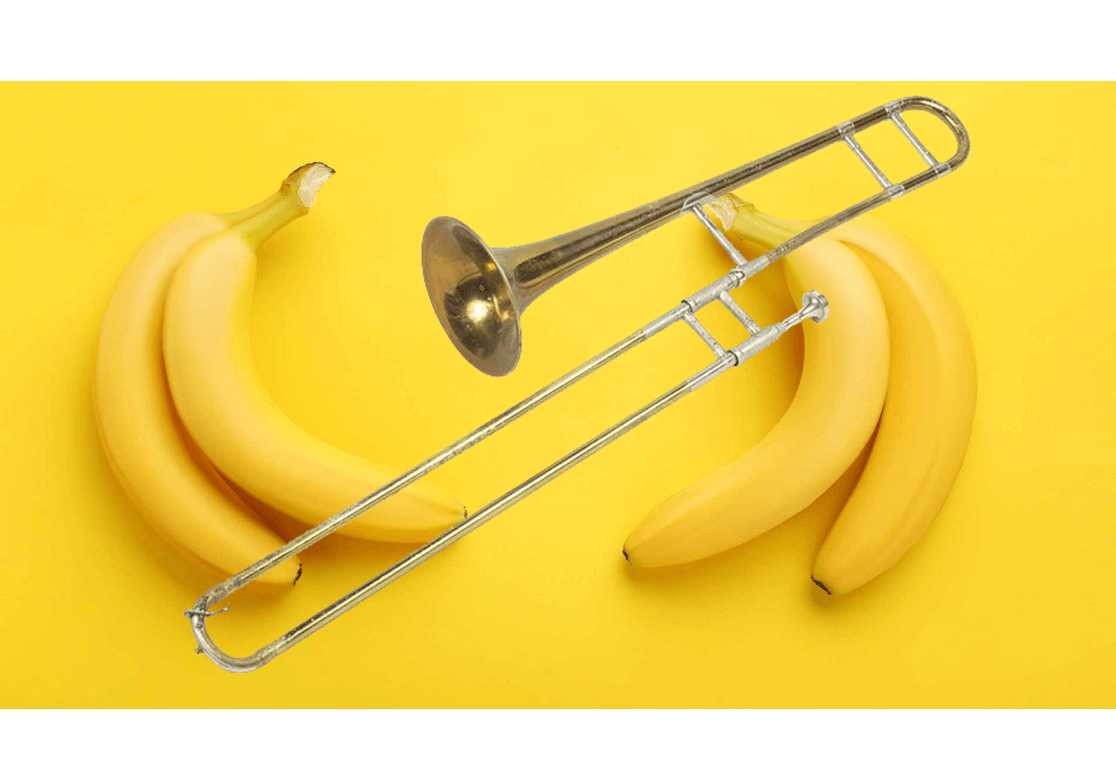
Yes, We Have No Bananas - Frank Silver & Irving Cohn - John Lee
This novelty song is known worldwide following multiple recordings by Billy Jones, Billy Murray, Arthur Hall, Irving Kaufman, and others. Benny Goodman and his Orchestra also recorded the work which has helped keep up the songs popularity since its initial release in 1923. Writer Frank Silver may have been influenced by an actual shortage of Gros Michel bananas in the early 20th century. Now arranged as a trombone solo, this arrangement has two parts; the first being accessible to most soloists with an optional continued section, which is more intricate for more advanced soloists to enjoy. A great audience pleaser and repertoire item.
In Stock: Estimated dispatch 1-3 working days
-
 £31.95
Adam Zero, Suite from (Brass Band - Score only) - Bliss, Arthur - Childs, Robert
Selected as the Section 2 test piece for the National Brass Band Championships of Great Britain 2025Following his ballet Checkmate, Bliss composed another score for the, by then, Sadler's Wells Ballet, Miracle in the Gorbals, which was choreographed by Robert Helpmann, to a scenario by Michael Benthall. Premired in 1944, the ballet made a considerable impact and was a box-office success. It was followed in turn by a further collaboration with Helpmann and Benthall, Adam Zero. This would serve Helpmann, in the eponymous role, as a vehicle in two respects: demonstrating his gifts as a dancer-actor and as a choreographer. First performed at the Royal Opera House, Covent Garden, on 8 April 1946, Adam Zero was conducted by Constant Lambert, the work's dedicatee. Bliss considered it 'his most varied and exciting ballet score'. Benthall provided a synopsis for the programme:There is a philosophy that life moves in an endless series of timeless cycles. As Nature passes through Spring, Summer, Autumn and Winter, so man is born, makes a success in his own particular sphere, loses his position to a younger generation, sees his world crumble before his eyes and only finds peace in death. This age-old story is told in terms of a Company creating a ballet and calling on the resources of the theatre to do so. Lighting, stage mechanism, dance conventions, musical forms and costumes and scenery of all periods are used to symbolize the world of 'Adam Zero'.Apart from Adam, as the Principal Dancer, other main roles included the Stage Director (representing Omnipotence), and Adam's Fates (Designer, Wardrobe Mistress, and Dresser). 'The Woman in this allegory', wrote Bliss, 'under the symbol of the Choreographer, was both the creator and destroyer of Adam: his first love, his wife, his mistress, and finally the figure of beneficent Death.' When the curtain rose, the 'audience saw the Covent Garden stage right back to the wall, completely empty except for the protagonists, 'the Company poised, still and expectant, as they await the birth of... Adam Zero.'Unfortunately, soon after the premire, Helpmann injured himself and had to withdraw from the remaining performances. Despite generally positive reviews, the ballet did not capture the imagination of audiences and, to Bliss's considerable disappointment, was not revived. Seventy years would elapse before its first major return to the stage, in 2016, performed by the ballet company of Stadttheater Bremerhaven with choreography by Sergei Vanaev.Bliss extracted a concert suite from the ballet, conducting its first performance with the City of Birmingham Symphony Orchestra on 28 October 1948. For his own suite, arranged for brass band in 2023, Dr Robert Childs chose three dances linked to the seasons, book-ending them with the ebullient 'Fanfare Overture' and 'Fanfare Coda'. After Adam has grown to manhood, his Fates clothe him in a costume synonymous with confident youth, appropriate for the virile, ardent 'Dance of Spring'. In the 'Approach of Autumn', Adam, now wearing a sombre costume, has grown older: his Fates have streaked grey in his hair and put lines on his face. But they had earlier raised Adam to the zenith of his power, and the 'Dance of Summer' depicts him in the prime of life, in music of sweeping grandeur. The 'Fanfare Coda' signals that the next cycle of life is about to begin.Duration: 10.30
Estimated dispatch 7-14 working days
-
£21.65
Adam Zero, Suite from (Brass Band - Study Score) - Bliss, Arthur - Childs, Robert
Selected as the Section 2 test piece for the National Brass Band Championships of Great Britain 2025Following his ballet Checkmate, Bliss composed another score for the, by then, Sadler's Wells Ballet, Miracle in the Gorbals, which was choreographed by Robert Helpmann, to a scenario by Michael Benthall. Premired in 1944, the ballet made a considerable impact and was a box-office success. It was followed in turn by a further collaboration with Helpmann and Benthall, Adam Zero. This would serve Helpmann, in the eponymous role, as a vehicle in two respects: demonstrating his gifts as a dancer-actor and as a choreographer. First performed at the Royal Opera House, Covent Garden, on 8 April 1946, Adam Zero was conducted by Constant Lambert, the work's dedicatee. Bliss considered it 'his most varied and exciting ballet score'. Benthall provided a synopsis for the programme:There is a philosophy that life moves in an endless series of timeless cycles. As Nature passes through Spring, Summer, Autumn and Winter, so man is born, makes a success in his own particular sphere, loses his position to a younger generation, sees his world crumble before his eyes and only finds peace in death. This age-old story is told in terms of a Company creating a ballet and calling on the resources of the theatre to do so. Lighting, stage mechanism, dance conventions, musical forms and costumes and scenery of all periods are used to symbolize the world of 'Adam Zero'.Apart from Adam, as the Principal Dancer, other main roles included the Stage Director (representing Omnipotence), and Adam's Fates (Designer, Wardrobe Mistress, and Dresser). 'The Woman in this allegory', wrote Bliss, 'under the symbol of the Choreographer, was both the creator and destroyer of Adam: his first love, his wife, his mistress, and finally the figure of beneficent Death.' When the curtain rose, the 'audience saw the Covent Garden stage right back to the wall, completely empty except for the protagonists, 'the Company poised, still and expectant, as they await the birth of... Adam Zero.'Unfortunately, soon after the premire, Helpmann injured himself and had to withdraw from the remaining performances. Despite generally positive reviews, the ballet did not capture the imagination of audiences and, to Bliss's considerable disappointment, was not revived. Seventy years would elapse before its first major return to the stage, in 2016, performed by the ballet company of Stadttheater Bremerhaven with choreography by Sergei Vanaev.Bliss extracted a concert suite from the ballet, conducting its first performance with the City of Birmingham Symphony Orchestra on 28 October 1948. For his own suite, arranged for brass band in 2023, Dr Robert Childs chose three dances linked to the seasons, book-ending them with the ebullient 'Fanfare Overture' and 'Fanfare Coda'. After Adam has grown to manhood, his Fates clothe him in a costume synonymous with confident youth, appropriate for the virile, ardent 'Dance of Spring'. In the 'Approach of Autumn', Adam, now wearing a sombre costume, has grown older: his Fates have streaked grey in his hair and put lines on his face. But they had earlier raised Adam to the zenith of his power, and the 'Dance of Summer' depicts him in the prime of life, in music of sweeping grandeur. The 'Fanfare Coda' signals that the next cycle of life is about to begin.Duration: 10.30
Estimated dispatch 7-14 working days
-
£74.95
Adam Zero, Suite from (Brass Band - Score and Parts) - Bliss, Arthur - Childs, Robert
Selected as the Section 2 test piece for the National Brass Band Championships of Great Britain 2025Following his ballet Checkmate, Bliss composed another score for the, by then, Sadler's Wells Ballet, Miracle in the Gorbals, which was choreographed by Robert Helpmann, to a scenario by Michael Benthall. Premired in 1944, the ballet made a considerable impact and was a box-office success. It was followed in turn by a further collaboration with Helpmann and Benthall, Adam Zero. This would serve Helpmann, in the eponymous role, as a vehicle in two respects: demonstrating his gifts as a dancer-actor and as a choreographer. First performed at the Royal Opera House, Covent Garden, on 8 April 1946, Adam Zero was conducted by Constant Lambert, the work's dedicatee. Bliss considered it 'his most varied and exciting ballet score'. Benthall provided a synopsis for the programme:There is a philosophy that life moves in an endless series of timeless cycles. As Nature passes through Spring, Summer, Autumn and Winter, so man is born, makes a success in his own particular sphere, loses his position to a younger generation, sees his world crumble before his eyes and only finds peace in death. This age-old story is told in terms of a Company creating a ballet and calling on the resources of the theatre to do so. Lighting, stage mechanism, dance conventions, musical forms and costumes and scenery of all periods are used to symbolize the world of 'Adam Zero'.Apart from Adam, as the Principal Dancer, other main roles included the Stage Director (representing Omnipotence), and Adam's Fates (Designer, Wardrobe Mistress, and Dresser). 'The Woman in this allegory', wrote Bliss, 'under the symbol of the Choreographer, was both the creator and destroyer of Adam: his first love, his wife, his mistress, and finally the figure of beneficent Death.' When the curtain rose, the 'audience saw the Covent Garden stage right back to the wall, completely empty except for the protagonists, 'the Company poised, still and expectant, as they await the birth of... Adam Zero.'Unfortunately, soon after the premire, Helpmann injured himself and had to withdraw from the remaining performances. Despite generally positive reviews, the ballet did not capture the imagination of audiences and, to Bliss's considerable disappointment, was not revived. Seventy years would elapse before its first major return to the stage, in 2016, performed by the ballet company of Stadttheater Bremerhaven with choreography by Sergei Vanaev.Bliss extracted a concert suite from the ballet, conducting its first performance with the City of Birmingham Symphony Orchestra on 28 October 1948. For his own suite, arranged for brass band in 2023, Dr Robert Childs chose three dances linked to the seasons, book-ending them with the ebullient 'Fanfare Overture' and 'Fanfare Coda'. After Adam has grown to manhood, his Fates clothe him in a costume synonymous with confident youth, appropriate for the virile, ardent 'Dance of Spring'. In the 'Approach of Autumn', Adam, now wearing a sombre costume, has grown older: his Fates have streaked grey in his hair and put lines on his face. But they had earlier raised Adam to the zenith of his power, and the 'Dance of Summer' depicts him in the prime of life, in music of sweeping grandeur. The 'Fanfare Coda' signals that the next cycle of life is about to begin.Duration: 10.30
Estimated dispatch 7-14 working days
-
 £45.00
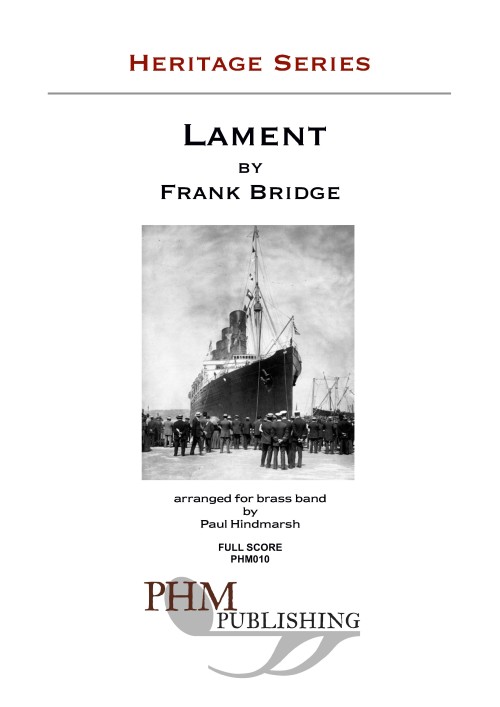
Lament (Brass Band - Score and Parts) - Bridge, Frank - Hindmarsh, Paul
The English composer Frank Bridge (1879 - 1941) did not take an active part in the First World War. However, he was devastated by the slaughter on the western and the eastern fronts, especially the loss of so many of his musicians friends and colleagues. Writing in 1963, his former pupil Benjamin Britten confessed that 'a lot of my feelings about the First World War which people seemed to see in the War Requiem came from Bridge. He had written a piano sonata in memory of a friend killed in France and though he didn't encourage me to take a stand for the sake of a stand, he did make me argue and argue and argue. His own pacifism was not aggressive, but typically gentle'.Bridge composed this Lament for string orchestra on 14 June 1915, in memory of Catherine Crompton, who drowned when the Cunard liner Lusitania was torpedoed by a German submarine on 7 May, 1915. According to figures researched by Liverpool historian Kevin Roach (www.lusitania.net), 1201 men, women and children lost their lives out of the 1962 people aboard. Ninety-four children died, including Catherine, her twin brother Paul and four other siblings. Paul Crompton, Snr. (44), a British businessman working in Philadelphia, his wife Gladys (40) and the family nanny were also drowned. How Bridge's dedication came about is uncertain. The music critic Edwin Evans, who knew Bridge well, has written that the Catherine was a young friend. It is also possible that he came across the family photograph which was published in many newspapers in the wake of the tragedy. By that time, Bridge was greatly distressed by the war as a whole. It seems perfectly in keeping with his pacifist leanings and the strength of his reaction, that this poignant and deeply touching 'war memorial' should mourn a child who he did not know, rather than one of the thousands of young men who fell in battle.Through the musical tears of this melancholy lullaby, Bridge may have regarded the death of young Catherine Crompton as symbolic of the loss of so many innocent lives in wartime. His response to this personal tragedy was characteristically spontaneous and utterly sincere. It is one of his most effective miniatures, poignant yet restrained in its lyrical beauty, with a compelling directness and simplicity of construction.This brass band transcription is pitched one tone lower than the original for string orchestra.- Paul HindmarshDuration: 5.00
Estimated dispatch 7-14 working days
-
 £59.95
John O'Gaunt (Overture) (Brass Band - Score and Parts) - Vinter, Gilbert
Concert Overture for Brass BandIn the year 1340 in the town of Ghent, a son was born to Edward III King of England and his Queen Phillipa. The boy, afterwards known as John O'Gaunt (Ghent) grew up to be a warrior and before he was 20 he was fighting in France beside his brother, the Black Prince. For many years he was occupied with the wars in France and Spain and was seldom in England. His first two marriages brought him great riches and position, but the love of his life was Catherine Swynford, who bore him four children. Whilst he was away , his Palace of Savoy was burnt to the ground by the mob during the Peasant's Revolt. Finally in 1394 he returned home and married Catherine, for whom he felt a strong affection since her first marriage in St. Clement Danes Church in the Strand, many years before. The Beaufort children were thus legitimised and from them sprang a long line of English Kings and Queens.Duration: 9:30Recorded on Polyphonic QPRL068D Triumphant Rhapsody
Estimated dispatch 7-14 working days
 View Music