
Results
-
 £32.00
Ye Banks and Braes (Trombone Solo with Brass Band - Score and Parts)
The origins of this melody are unknown but, set to the poem by Robert Burns, this has become one of the most popular Scottish songs.This arrangement was prepared at the request of Brett Baker for one of his many visits to perform as a soloist with Brass Band of the Western Reserve and its musical director Keith M Wilkinson. It has been recorded by Brett with BBWR on the CD Slides Rule!
Estimated dispatch 7-14 working days
-
 £44.83
Hero (Tenor Horn Solo with Brass Band) Fendall Hill
This piece was written as a full length virtuosic solo based on an earlier work called Humble Hero, which is also available from BrookWright Music. It is an extension of that work and still dedicated to Ken Bradley, designed to provide a reflection of his technical skills and a platform to emulate musicianship for which he was renowned. Ken Bradley (1962 - 2022) was one of Australia's best-known, well-loved, and talented brass musicians. The solo is also available from this website with piano accompaniment. To view a rolling score video of the work please visit https://www.youtube.com/watch?v=WIqS9xak_Es Duration: approx. 7.30 minutes Difficulty Level: 2nd Section + PDF download includes parts and score. Sheet music available at www.brassband.co.uk (UK) or https://satradecentral.org (USA) Instrumentation: Tenor Horn Soloist Eb Soprano Cornet Eb Solo Cornet Bb Repiano Cornet Bb 2nd Cornet Bb 3rd Cornet Bb Flugel Horn Bb 1st Horn Eb 2nd Horn Eb 1st Baritone Bb 2nd Baritone Bb 1st Trombone Bb 2nd Trombone Bb Bass Trombone Euphonium Bb Bass Eb Bass Bb Timpani Percussion 1-3
In Stock: Estimated dispatch 1-3 working days
-
 £29.88
March - His Royal Banner (Brass Band) Jonathan Mead
This upbeat, foot-tapping march by Welsh composer Jonathan Mead features the two well known Welsh tunes of Aberystwyth and God Bless The Prince of Wales. Aberystwyth is set as a big bold bass solo and careful attention will need to be paid to make sure that it sounds clean and together. God Bless The Prince of Wales first appears as a traditional hymn tune, before returning in a more vibrant, lively style, with florid scalic passages for the solo cornets and euphoniums. The march was written with St David's Day in mind, although will be an appropriate addition to concert programme throughout the year as either an opener or finisher. Difficulty Level: 3rd Section + Sheet music available from: UK - www.brassband.co.uk USA - www.solidbrassmusic.com Instrumentation: Soprano Cornet Eb Solo Cornet Bb Repiano Cornet Bb 2nd Cornet Bb 3rd Cornet Bb Flugel Horn Bb Solo Horn Eb 1st Horn Eb 2nd Horn Eb 1st Baritone Bb 2nd Baritone Bb 1st Trombone Bb 2nd Trombone Bb Bass Trombone Euphonium Bb Bass Eb Bass Bb Percussion Clash Cymbals Glockenspiel
In Stock: Estimated dispatch 1-3 working days
-
 £33.62
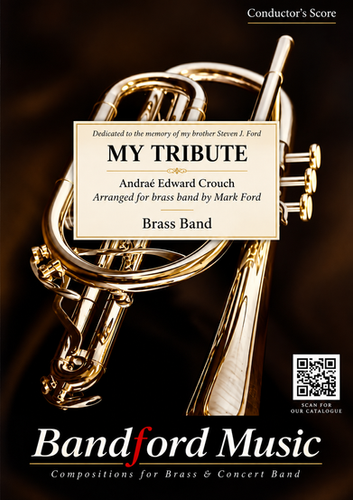
My Tribute (Euphonium Solo with Brass Band) Andrae Crouch arr. Mark Ford
My Tribute (To God Be The Glory) is a gospel song written by American gospel singer and songwriter Andrae Edward Crouch. He first recorded the song in 1972 on his album Keep on Singin'. The song is considered to be one of Crouch's most well-known songs. It is sometimes included in Christian children's song books. This arrangement for brass band from the pen of Mark Ford, features the euphonium as the soloist in a delightful setting sure to be popular with audiences. To view a performance video of the solo featuring Aaron Ford please visit https://youtu.be/6WGtAVgAsWc Duration: 1.30 minutes Difficulty Level: 3rd Section + This PDF download includes the full score and parts. Sheet music available at www.brassband.co.uk (UK) or https://satradecentral.org (USA) Instrumentation: Euphonium Soloist Bb Soprano Cornet Eb Solo Cornet Bb Repiano Cornet Bb 2nd Cornet Bb 3rd Cornet Bb Flugel Horn Bb Solo Horn Eb 1st Horn Eb 2nd Horn Eb 1st Baritone Bb 2nd Baritone Bb 1st Trombone Bb 2nd Trombone Bb Bass Trombone Euphonium Bb Bass Eb Bass Bb Drum Set Percussion
In Stock: Estimated dispatch 1-3 working days
-
 £29.88
Still, Still, Still (Horn Section Feature with Brass Band) arr. Stephen Tighe
Still, still, still is an Austrian Christmas carol and lullaby. The melody is a folk tune from the Salzburg area and the tune appeared for the first time in 1865 in a folksong collection. The words describe the peace of the infant Jesus and his mother as the baby is sung to sleep. They have changed slightly over the years, but the modern standard German version was established in the mid-19th century. This arrangement by Stephen Tighe features the flugelhorn and horn section with brass band. PDF download includes score and parts. Sheet music available from: UK - www.brassband.co.uk USA - www.solidbrassmusic.com Difficulty Level: 4th Section + Instrumentation: Soprano Cornet Eb Solo Cornet Bb Repiano Cornet Bb 2nd Cornet Bb 3rd Cornet Bb Flugel Horn Bb Solo Horn Eb 1st Horn Eb 2nd Horn Eb 1st Baritone Bb 2nd Baritone Bb 1st Trombone Bb 2nd Trombone Bb Bass Trombone Euphonium Bb Bass Eb Bass Bb Timpani Sleigh Bells Drum Kit Glockenspiel
In Stock: Estimated dispatch 1-3 working days
-
 £33.62
Sunset (Cornet Solo with Brass Band) David Robb
Sunset was written in June 2023 as a graduation present for the composer's son Callum and is dedicated to him. It portrays an older father (the composer) reminiscing about the love, respect and pride he has for his grown-up son and all that he has achieved and worked for. Sunset is lyrical and song-like in style. A soaring solo line is accompanied by a mainly homophonic background which should support, but never overpower the soloist. The tutti sections feature the melody accompanied by flowing scalic figures which portray the passing of time. The piece ends with an ad lib cadenza section where the soloist can really put their own mark on the music. To view a video of Dominic Longhurst and Victoria Brass performing the solo please visit www.youtube.com/watch?v=nzYwOvlqaYU PDF download includes score and parts. Sheet music available from: UK - www.brassband.co.uk USA - https://satradecentral.org Difficulty Level: 4th Section + Length: 4.10 minutes Instrumentation: Cornet Soloist Bb Soprano Cornet Eb Tutti Solo Cornet Bb Repiano Cornet Bb 2nd Cornet Bb 3rd Cornet Bb Flugel Horn Bb Solo Horn Eb 1st Horn Eb 2nd Horn Eb 1st Baritone Bb 2nd Baritone Bb 1st Trombone Bb 2nd Trombone Bb Bass Trombone Euphonium Bb Bass Eb Bass Bb Timpani Suspended Cymbal Glockenspiel
In Stock: Estimated dispatch 1-3 working days
-
£132.00
Music - Vocal- or Trumpet Solo with Opt. Choir - John Miles - Lars Erik Gudim
This famous song by English singer and composer John Miles was released for the first time in 1976 on his album "Rebel".The song is Miles' biggest hit to date, peaking the charts in England and several other European countries.This arrangement was performed on the Norwegian Military Tattoo 2016 by singer Knut Anders Sorum with The Staff Band of the Norwegian Armed Forces conducted by Lars Erik Gudim.
Estimated dispatch 7-14 working days
-
£29.95
BEFORE THE CROSS (Cornet Solo with Brass Band Set) - Edward Gregson
Written at the request of David Daws for his solo album The Sound of David Daws, this meditation for cornet and brass band uses the composer's own song Before the cross (originally published in The Musical Salvationist, April 1965), the first lines of which are Before the cross I stand in fear and wonder, and see that all my sirs on Thee are laid. The song was written at an early stage of the composer's career, just before commencing study at The Royal Academy of Music, London. After a brief introduction the melody is heard twice, first played by the soloist, then on Euphonium and Flugel Horn with the soloist adding ornate counterpoint before taking up the melody once again, this time leading to a quiet and reflective conclusion.
Estimated dispatch 7-14 working days
-
£29.95
TO WIN THE WORLD (Cornet and Trombone Double Trio with Brass Band Set) - Stephen Bulla
This double trio (three cornets and three trombones) was written for the National Capital Band of The Salvation Army in memory of Colonel William Maltby and is based on his own chorus, 'Keep on marching with a fighting faith'. Each solo part is of equal importance so six competent soloists will be required in order to make the piece sparkle!
Estimated dispatch 7-14 working days
-
 £29.95
Soliloquy II (Euphonium Solo with Brass Band - Score and Parts)
A few years ago, I wrote a Soliloquy based on a Salvation Army song by George Marshall called Soliloquy (In the Stillness), since published in the General Series. This solo follows up the form of that previous work, though it is quite different in emotional content, and was a commission during Covid lockdown from Euphonium player Micah Dominic Parsons.The main inspiration is the tune Cross of Jesus by John Stainer as well as a motif from some older Euphonium Studies from the Royal Military School of Music, Kneller Hall, that Micah had discovered. The tune is used in a chorale form and, after an introduction, the very first section is a reversal of the chorale that appears in the second half of the work. The Euphonium exclamations are all derived from the main tune and the study motif. The work begins in quite a dark reflective manner, representing those aspects of the song, without being too specific. The second half reflects the more positive characteristics and finds a triumphal nature in its conclusion. The soloist lines throughout have a very declamatory style and can have a freedom in performance.There is one new element in the coda, where the triplet motif (bars 87-89) is a direct quotation from Romans 8 - A brass celebration by Ray Steadman-Allen. RSA was a good friend, mentor and encourager to me. The glorious climax of Romans 8 is his presentation of the same tune (Cross of Jesus) used in this work. And so the piece ends with a final and personal reference to RSA!- Howard Evans
Estimated dispatch 7-14 working days
 Watch video