
Results
-
 £134.99
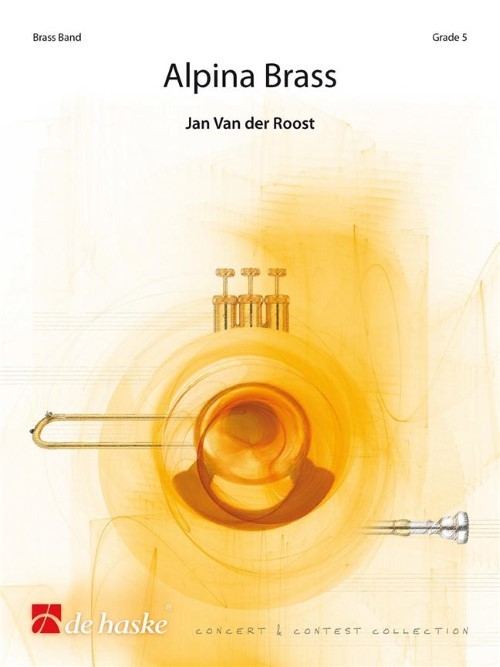
Alpina Brass (Brass Band - Score and Parts) - Van der Roost, Jan
Alpina Brass was the test piece for the first division of the Ftes Cantonales on 8 and 9 June 2019 in Naters, Switzerland. It consists of three movements, and features a variety of aspects, as is common for a competition work. However, as a whole, it has been written in such a way that it can perfectly serve as a concert work as well. It is a challenging piece for every section and offers colourful and melodic as well as spectacular rhythmic sequences and a most impressive ending!Duration: 11.00
Estimated dispatch 7-14 working days
-
 £79.99
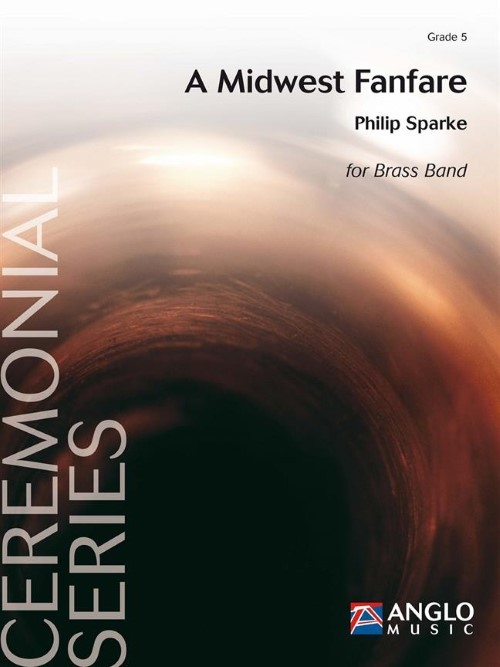
A Midwest Fanfare (Brass Band - Score and Parts) - Sparke, Philip
A Midwest Fanfare was commissioned by the Brass Band of Battle Creek and premiered by them during their appearance at the Midwest Clinic in Chicago on 20th December 2017 where this fanfare was the opening piece of the entire event. This piece is designed to be played with the cornets split into two teams either side of the band. It opens with the two groups answering each other antiphonally over a repeated figure in the lower band. A calmer central section introduces a euphonium solo which is then taken up by the whole ensemble. This leads back to a repeat of the opening fanfares over a rhythmic accompaniment and a short coda which brings the work to a close.Duration: 4.00
Estimated dispatch 7-14 working days
-
 £26.95
Flanders' Poppies (Brass Band - Score and Parts) - Wiffin, Rob
A setting of the well-known Great War poem In Flanders Fields, written during the First World War by Canadian physician Lieutenant Colonel John McCrae (1872-1918). I first set some of the words to music for the Royal British Legion Festival of Remembrance during my time in the RAF but returned to them in 2014, setting the whole poem to mark the centenary of the commencement of the Great War.- Rob WiffinDuration: 3.30
Estimated dispatch 7-14 working days
-
 £89.95
Trombone Concerto (Trombone Solo with Brass Band - Score and Parts) - Gregson, Edward
The Gregson Trombone Concerto was originally written in 1979 to a commission from Bedfordshire Education Service, for a new work for Michael Hext, winner of the first BBC Young Musician of the Year competition. This version for brass band was commissioned by Nicholas Childs, Music Director of the Black Dyke Band, specially for Brett Baker, the then principal trombone of the band. He has recorded it on the Doyen label with the Black Dyke Band.The work falls into three main sections, played without a break, but conforming to the traditional pattern of concerto structure. After a slow introduction, containing most of the motivic and rhythmic ideas used in the work, there follows the main fast section which is itself divided into three parts and concludes with a fierce climax (timpani and gong). The slow and rather intense middle section is linked to a cadenza for the soloist, at first unaccompanied but leading to accompanied references to earlier material. The final section is a scherzo which ends dramatically with a re-statement of the opening slow introduction. A brisk coda concludes the work. The interval of a fourth (and its augmented form) provides melodic and harmonic unity for the work, whilst the tonal juxtaposition between E minor and B flat major throughout the concerto is an important element of the structure.The writing for trombone is virtuosic, encompassing the whole range of the instrument, but it also exploits the rather beautiful lyrical sound of which this instrument is capable.
Estimated dispatch 7-14 working days
-
 £44.95
Trombone Concerto (Trombone Solo with Brass Band - Score only) - Gregson, Edward
The Gregson Trombone Concerto was originally written in 1979 to a commission from Bedfordshire Education Service, for a new work for Michael Hext, winner of the first BBC Young Musician of the Year competition. This version for brass band was commissioned by Nicholas Childs, Music Director of the Black Dyke Band, specially for Brett Baker, the then principal trombone of the band. He has recorded it on the Doyen label with the Black Dyke Band.The work falls into three main sections, played without a break, but conforming to the traditional pattern of concerto structure. After a slow introduction, containing most of the motivic and rhythmic ideas used in the work, there follows the main fast section which is itself divided into three parts and concludes with a fierce climax (timpani and gong). The slow and rather intense middle section is linked to a cadenza for the soloist, at first unaccompanied but leading to accompanied references to earlier material. The final section is a scherzo which ends dramatically with a re-statement of the opening slow introduction. A brisk coda concludes the work. The interval of a fourth (and its augmented form) provides melodic and harmonic unity for the work, whilst the tonal juxtaposition between E minor and B flat major throughout the concerto is an important element of the structure.The writing for trombone is virtuosic, encompassing the whole range of the instrument, but it also exploits the rather beautiful lyrical sound of which this instrument is capable.Duration: 16.00
Estimated dispatch 7-14 working days
-
 £45.00
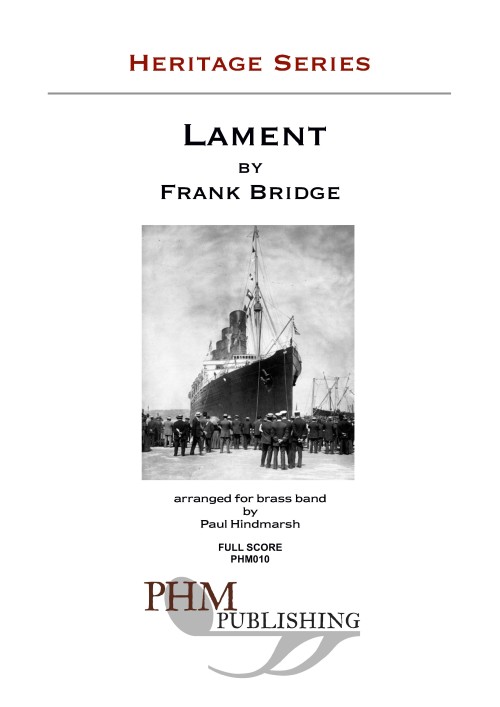
Lament (Brass Band - Score and Parts) - Bridge, Frank - Hindmarsh, Paul
The English composer Frank Bridge (1879 - 1941) did not take an active part in the First World War. However, he was devastated by the slaughter on the western and the eastern fronts, especially the loss of so many of his musicians friends and colleagues. Writing in 1963, his former pupil Benjamin Britten confessed that 'a lot of my feelings about the First World War which people seemed to see in the War Requiem came from Bridge. He had written a piano sonata in memory of a friend killed in France and though he didn't encourage me to take a stand for the sake of a stand, he did make me argue and argue and argue. His own pacifism was not aggressive, but typically gentle'.Bridge composed this Lament for string orchestra on 14 June 1915, in memory of Catherine Crompton, who drowned when the Cunard liner Lusitania was torpedoed by a German submarine on 7 May, 1915. According to figures researched by Liverpool historian Kevin Roach (www.lusitania.net), 1201 men, women and children lost their lives out of the 1962 people aboard. Ninety-four children died, including Catherine, her twin brother Paul and four other siblings. Paul Crompton, Snr. (44), a British businessman working in Philadelphia, his wife Gladys (40) and the family nanny were also drowned. How Bridge's dedication came about is uncertain. The music critic Edwin Evans, who knew Bridge well, has written that the Catherine was a young friend. It is also possible that he came across the family photograph which was published in many newspapers in the wake of the tragedy. By that time, Bridge was greatly distressed by the war as a whole. It seems perfectly in keeping with his pacifist leanings and the strength of his reaction, that this poignant and deeply touching 'war memorial' should mourn a child who he did not know, rather than one of the thousands of young men who fell in battle.Through the musical tears of this melancholy lullaby, Bridge may have regarded the death of young Catherine Crompton as symbolic of the loss of so many innocent lives in wartime. His response to this personal tragedy was characteristically spontaneous and utterly sincere. It is one of his most effective miniatures, poignant yet restrained in its lyrical beauty, with a compelling directness and simplicity of construction.This brass band transcription is pitched one tone lower than the original for string orchestra.- Paul HindmarshDuration: 5.00
Estimated dispatch 7-14 working days
-
 £107.95
Symphony in Two Movements (Brass Band - Score and Parts) - Gregson, Edward
Selected as the Championship Section test piece for the National Brass Band Championships of Great Britain 2025This work was jointly commissioned by the National Youth Brass Band of Great Britain (NYBBGB) and the National Youth Brass Band of Wales (NYBBW), the latter with funding from T Cerdd (Music Centre Wales), to celebrate their 60th and 30th anniversaries respectively. The first performances were given at Cadogan Hall, London, in April 2012, by the NYBBGB, conducted by Bramwell Tovey; and at the Great Hall, Aberystwyth University, in July 2012, by the NYBBW, conducted by Nicholas Childs.When I was approached about a joint commission to write a new work to celebrate the anniversaries of these two outstanding youth bands I was delighted to accept, and decided to respond by writing a work apposite for the magnitude of these special occasions, namely a 'symphony for brass'.Through a long journey of writing music for brass band, which commenced with Connotations (1977), and continued with Dances and Arias (1984), Of Men and Mountains (1991), The Trumpets of the Angels (2000) and Rococo Variations (2008), I arrived at what I regard as the most important work of the cycle to date, combining as it does serious musical intent with considerable technical demands. It is perhaps my most abstract work for brass band, avoiding any programmatic content.The symphony lasts for some 19 minutes and is structured in two linked movements. The form is based on that used by Beethoven in his final piano sonata (Op.111), which is in two movements only: a compact sonata-form allegro, followed by a more expansive theme and four variations. Prokofiev also adopted this model in his 2nd Symphony of 1925.The opening Toccata of this Symphony is highly dramatic but compact, whilst still retaining the 'traditional' structural elements of exposition, development and recapitulation; indeed, it also has the 'traditional' element of a contrasting second subject - a gentle, lyrical modal melody first heard on solo cornets.In contrast, the longer and more substantial second movement Variations is built around a theme and four variations. The slowly unfolding chorale-like theme accumulates both added note harmony and increasing instrumentation, whilst the four variations which follow are by turn mercurial (fast, starting with all the instruments muted), march-like (menacing, with short rhythmic articulations underpinning an extended atonal melody), serene (a series of 'romances' for solo instruments alongside echoes of the chorale) with an emerging theme eventually bursting into a climax of passionate intent; whilst the final variation is a dynamic scherzo (concertante-like in its series of rapid-fire solos, duets, trios and quartets) with the music gradually incorporating elements of the main ideas from the first movement, thus acting as a recapitulation for the whole work. It reaches its peroration with a return to the very opening of the symphony, now in the 'home' tonality of F, and thus creating a truly symphonic dimension to the music.Most of the melodic material of the symphony is derived from the opening eleven-note 'row', which contains various intervallic sets, and although the work is not serially conceived it does use some typical quasi-serial procedures, such as canons, inversions, and retrogrades. The symphony uses somewhat limited percussion, in line with a 'classical' approach to the sound world of the brass band, alongside a use of multi-divisi instrumentation, whereby each player has an individual part rather than the traditional doubling within certain sections of the band.- Edward GregsonDuration: 19.00
Estimated dispatch 7-14 working days
-
 £57.95
Symphony in Two Movements (Brass Band - Score only) - Gregson, Edward
Selected as the Championship Section test piece for the National Brass Band Championships of Great Britain 2025This work was jointly commissioned by the National Youth Brass Band of Great Britain (NYBBGB) and the National Youth Brass Band of Wales (NYBBW), the latter with funding from T Cerdd (Music Centre Wales), to celebrate their 60th and 30th anniversaries respectively. The first performances were given at Cadogan Hall, London, in April 2012, by the NYBBGB, conducted by Bramwell Tovey; and at the Great Hall, Aberystwyth University, in July 2012, by the NYBBW, conducted by Nicholas Childs.When I was approached about a joint commission to write a new work to celebrate the anniversaries of these two outstanding youth bands I was delighted to accept, and decided to respond by writing a work apposite for the magnitude of these special occasions, namely a 'symphony for brass'.Through a long journey of writing music for brass band, which commenced with Connotations (1977), and continued with Dances and Arias (1984), Of Men and Mountains (1991), The Trumpets of the Angels (2000) and Rococo Variations (2008), I arrived at what I regard as the most important work of the cycle to date, combining as it does serious musical intent with considerable technical demands. It is perhaps my most abstract work for brass band, avoiding any programmatic content.The symphony lasts for some 19 minutes and is structured in two linked movements. The form is based on that used by Beethoven in his final piano sonata (Op.111), which is in two movements only: a compact sonata-form allegro, followed by a more expansive theme and four variations. Prokofiev also adopted this model in his 2nd Symphony of 1925.The opening Toccata of this Symphony is highly dramatic but compact, whilst still retaining the 'traditional' structural elements of exposition, development and recapitulation; indeed, it also has the 'traditional' element of a contrasting second subject - a gentle, lyrical modal melody first heard on solo cornets.In contrast, the longer and more substantial second movement Variations is built around a theme and four variations. The slowly unfolding chorale-like theme accumulates both added note harmony and increasing instrumentation, whilst the four variations which follow are by turn mercurial (fast, starting with all the instruments muted), march-like (menacing, with short rhythmic articulations underpinning an extended atonal melody), serene (a series of 'romances' for solo instruments alongside echoes of the chorale) with an emerging theme eventually bursting into a climax of passionate intent; whilst the final variation is a dynamic scherzo (concertante-like in its series of rapid-fire solos, duets, trios and quartets) with the music gradually incorporating elements of the main ideas from the first movement, thus acting as a recapitulation for the whole work. It reaches its peroration with a return to the very opening of the symphony, now in the 'home' tonality of F, and thus creating a truly symphonic dimension to the music.Most of the melodic material of the symphony is derived from the opening eleven-note 'row', which contains various intervallic sets, and although the work is not serially conceived it does use some typical quasi-serial procedures, such as canons, inversions, and retrogrades. The symphony uses somewhat limited percussion, in line with a 'classical' approach to the sound world of the brass band, alongside a use of multi-divisi instrumentation, whereby each player has an individual part rather than the traditional doubling within certain sections of the band.- Edward GregsonDuration: 19.00
Estimated dispatch 7-14 working days
-
 £44.95
Atonement (Brass Band - Score and Parts) - Trigg, Roger
This work was written at the request of Bandmaster Ken Waterworth for the 2011 tour of the UK by the Melbourne Staff Band culminating in a performance given at the Royal Albert Hall during ISB120 Staff Bands in Concert.The opening reflects the history, vastness and majesty of the composer's Australian homeland and introduces a motif taken from the Tomlin/Reeves song, 'The wonderful cross' which is featured in its entirety later in the work. The whole in predominantly joyous and musically easy to digest with occasional references to 'Waltzing Matilda'!
Estimated dispatch 7-14 working days
-
£22.50
Atonement (Brass Band - Score only) - Trigg, Roger
This work was written at the request of Bandmaster Ken Waterworth for the 2011 tour of the UK by the Melbourne Staff Band culminating in a performance given at the Royal Albert Hall during ISB120 Staff Bands in Concert.The opening reflects the history, vastness and majesty of the composer's Australian homeland and introduces a motif taken from the Tomlin/Reeves song, 'The wonderful cross' which is featured in its entirety later in the work. The whole in predominantly joyous and musically easy to digest with occasional references to 'Waltzing Matilda'!
Estimated dispatch 7-14 working days
 View Music