
Results
-
 £17.50
Tribute Music (Brass Band - Score Only) - Downie, Kenneth
The composer writes: Having received delightful reports about Neil Ferguson from his colleagues in Granite City Brass, I thought it might be a good idea to incorporate the musical initials from his name, EFEG, in the opening idea of the music. I used this short idea as a motif during the piece. A recurring comment in the tributes referred to his dry sense of humour, and particularly his ability to deliver a one-liner when least expected. The music does therefore contain a few surprises and sudden changes of direction. I also thought that it might be in character for me to include a little "joke" of my own, which is there to be heard by the very careful listener! Such listeners would do well to remember that the Granite City Brass, the commissioning band, is based in Aberdeen. The idea of commemorating such a faithful member of the band with a piece of music led me to try and write a noble, upright theme, which might be remembered as a melody in the future. I hope that it is a fitting tribute.
Estimated dispatch 7-14 working days
-
 £34.95
Three Carols (Brass Band - Score and Parts) - Turrin, Joseph
Three Carols was commissioned by the New York Philharmonic as part of their Holiday Brass series and was premiered at Avery Fisher Hall by the New York Philharmonic Principal Brass and Canadian Brass. Originally for 10 players, soon after the premiere I decided to score the piece for brass band. The brass band version was first performed by the New York Staff Band.Through the years I have been intrigued by carious carols from different countries and the challenge of creating musical treatments that sound fresh and original. When commissioned to write these brass arrangements, I wanted to create contrasting movements that could be performed either as a set or individually and thought that three carols from different countries would allow the opportunity for that contrast. The featured carols are the traditional Polish carol Infant Holy, What child is this? with lyrics by William Dix and set to the English folk song Greensleeves and the lesser-known Catalonian carol Cold December flies away.- Joseph Turrin
Estimated dispatch 7-14 working days
-
 £35.00
Postcard to Grimethorpe (Brass Band - Score and Parts) - Gregson, Edward
I composed the original version of Postcard to Grimethorpe in 1993 at the request of Elgar Howarth, for a concert at the Queen Elizabeth Hall, London, given by the Grimethorpe Colliery Band. This was at a time when after the Grimethorpe Colliery pit closed the future of the band was in severe jeopardy. The concert was given in aid of the band, both through publicity and funding.Then in late 2022 Jack Stamp, the American composer, conductor and educator, and at that time international composer-in-association with Grimethorpe, contacted me to say that he had discovered my short piece in the band library, and asked if I might extend it for a recording he was sponsoring for the band - the repertoire to consist entirely of music specially composed for Grimethorpe.I agreed and decided to extend the piece by using the miner's hymn Gresford, as a symbolic gesture of protest at the many thousands of miners in the UK who were made redundant from their jobs. After an angular (quasi-atonal) first section, the hymn enters, softly at first, but with each phrase it becomes more powerful and insistent, ending with the final phrase triumphantly accompanied by melodic percussion (replacing the drums and cymbals of the earlier phrases, as if the band were then on the march). However, this short work ends softly and gently, as if anger has been replaced by quiet resolution and determination, looking to the future with confidence.- Edward GregsonDuration: 3.00
Estimated dispatch 7-14 working days
-
£12.00
Postcard to Grimethorpe (Brass Band - Score only) - Gregson, Edward
I composed the original version of Postcard to Grimethorpe in 1993 at the request of Elgar Howarth, for a concert at the Queen Elizabeth Hall, London, given by the Grimethorpe Colliery Band. This was at a time when after the Grimethorpe Colliery pit closed the future of the band was in severe jeopardy. The concert was given in aid of the band, both through publicity and funding.Then in late 2022 Jack Stamp, the American composer, conductor and educator, and at that time international composer-in-association with Grimethorpe, contacted me to say that he had discovered my short piece in the band library, and asked if I might extend it for a recording he was sponsoring for the band - the repertoire to consist entirely of music specially composed for Grimethorpe.I agreed and decided to extend the piece by using the miner's hymn Gresford, as a symbolic gesture of protest at the many thousands of miners in the UK who were made redundant from their jobs. After an angular (quasi-atonal) first section, the hymn enters, softly at first, but with each phrase it becomes more powerful and insistent, ending with the final phrase triumphantly accompanied by melodic percussion (replacing the drums and cymbals of the earlier phrases, as if the band were then on the march). However, this short work ends softly and gently, as if anger has been replaced by quiet resolution and determination, looking to the future with confidence.- Edward GregsonDuration: 3.00
Estimated dispatch 7-14 working days
-
 £34.95
March Of The Hours (Brass Band - Score and Parts) - Soderstrom, Emil
March of the Hours was first performed at Star Lake Music Camp in 1962 with the composer supplying an informative listening guide which was printed in the published score; "The phrases are of 12 crotchets each (three bars) signifying the 12 hours. Up to the trio, the music describes the headlong search for pleasure by the thoughtless. Abruptly, the trio brings 'I need thee every hour', but an episode employing the original theme pushes it aside until it reappears, this time against a background of chimes of the full hour (Westminster chimes). While the hour strikes 12, a paraphrase of the opening strains of 'When the trumpet of the Lord shall sound and time shall be no more' is heard. Here the music stops, to be followed by the trumpet sounding (cornets and trombones) and the rest of the band responds with 'When the roll is called up yonder' with a final 'I'll be there'."
Estimated dispatch 7-14 working days
-
£17.50
March Of The Hours (Brass Band - Score only) - Soderstrom, Emil
March of the Hours was first performed at Star Lake Music Camp in 1962 with the composer supplying an informative listening guide which was printed in the published score; "The phrases are of 12 crotchets each (three bars) signifying the 12 hours. Up to the trio, the music describes the headlong search for pleasure by the thoughtless. Abruptly, the trio brings 'I need thee every hour', but an episode employing the original theme pushes it aside until it reappears, this time against a background of chimes of the full hour (Westminster chimes). While the hour strikes 12, a paraphrase of the opening strains of 'When the trumpet of the Lord shall sound and time shall be no more' is heard. Here the music stops, to be followed by the trumpet sounding (cornets and trombones) and the rest of the band responds with 'When the roll is called up yonder' with a final 'I'll be there'."
Estimated dispatch 7-14 working days
-
 £74.99
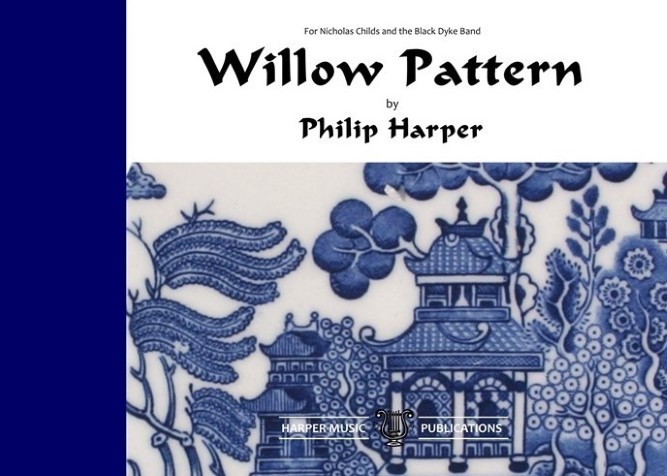
Willow Pattern (Brass Band - Score and Parts) - Harper, Philip
Composed in 2009 for Nicholas Childs and the Black Dyke BandThis piece tells the Willow Pattern legend through music. Several leitmotifs are used both for the different characters and also for some of the important emotions in the tale. Additionally, Knoon-se's part is mainly played by the flugel horn, Chang by the euphonium, the Mandarin by the Eb Bass and the Duke Ta-jin by the trombone.The Willow Pattern Legend:Once, in ancient China, there lived a wealthy and powerful Mandarin who had a beautiful daughter, Knoon-se. She had fallen in love with Chang, a humble accountant, which angered her father who imprisoned her in the Pavilion by the river with only the exotic birds for company. She learnt that the Mandarin planned to marry her to the pompous Duke Ta-jin and that the wedding would take place on the day the blossom fell from the willow tree, so she sent Chang a message: "Gather thy blossom, ere it be stolen". The Duke arrived by sea amid great fanfare when the tree was heavy with bud, and nights of magnificent banquets followed. After one such occasion when the Mandarin slept, Chang crept over the crooked fence and tiptoed into the Pavilion to rescue Knoon-se, but as they escaped the alarm was raised. They fled over the bridge with the Mandarin close on their heels brandishing his whip. They managed to escape by boat to a secluded island where they lived happily for a time. Meanwhile, the Mandarin learned of their refuge and, intent on revenge, he ordered his soldiers to kill them. As Knoon-se and Chang slept at night, the men set fire to the pagoda in which they lived and the lovers perished in the flames. However, the Gods, moved by the lovers' plight, transformed their souls into two turtle-doves which rose from the charred remains, soaring above the Earth, symbolising eternal happiness.Willow Pattern is dedicated to the memory of Jean Harper who passed away as I was completing the piece and who was a great collector of porcelain and china-ware.Duration: 12:00
Estimated dispatch 7-14 working days
-
 £55.00
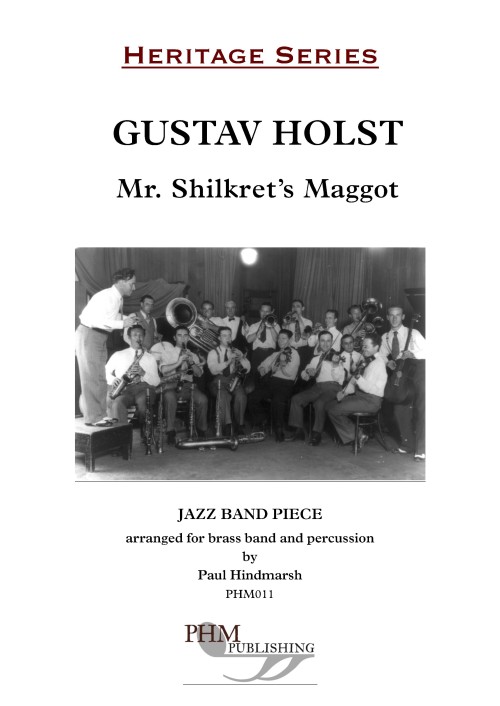
Mr Shilkret's Maggot (Brass Band - Score and Parts) - Holst, Gustav - Hindmarsh, Paul
This short piece was composed in 1932 during a visit Gustav Holst was making to the USA. He was invited by the band leader Nathaniel Shilkret to contribute to a series of piece for concert jazz band based on a folk song. Rather than using a traditional tune, Holst invented one of his own in folk song style and therefore the piece was not performed. Holst considered various titles for the piece including Mr. Shilkret's Dump, Folly and Maggot. On the manuscript he described it as a Jazz Band Piece. When the composer's daughter Imogen re-scored the piece for the English Chamber Orchestra to record under her direction in 1967, she changed decided to use the title Capriccio.Her re-orchestration involved removing the saxophone quartet, adding cor anglais and a second bassoon and changing cornet parts to trumpets. She retained the harp, extensive percussion, piano and celesta. My brass band version is based on the composer's manuscript, held at the British Library. It retains the composer's cornet parts, re-voices the woodwinds and strings, and places keyboards and harp onto glockenspiel, marimba, vibraphone and xylophone.I have selected the title Mr. Shilkret's Maggot for my scoring of Jazz Band Piece, which was first performed by The Cory Band, conducted by Philip Harper, at the Royal Northern College of Music Brass Band Festival, 29 January 2017.- Paul HindmarshDuration: 5.30
Estimated dispatch 7-14 working days
-
 £66.00
S.O.S. (Brass Band - Score and Parts) - Kjaernes, Bjorn Morten
When the publisher asked me to make an arrangement of an ABBA tune, S.O.S. was the first song I thought of. Its introduction and melody are well suited to play for band. Admittedly, the key had to be shifted to make it sound good for this instrumentation. To me, this is nostalgia, while for others, the Mamma Mia movie/show will be what they associate with this wonderful song. Apart from a few medleys, few of ABBA's songs are available for band. So, it was very fun to work on this classic.The arrangement is made quite simply to fit many sizes of bands. Technically, it is also relatively simple both in range and rhythm. As you can see, there are many ways to adjust this arrangement to your own ensemble. Bring out melody lines and the bassline, and a lot is done. If needed, simplify to make it sound nice.Get creative and have fun!- Bjorn Morten KjaernesDuration: 3.30
Estimated dispatch 7-14 working days
-
 £107.95
Cornet Concerto (Brass Band - Score and Parts) - Gregson, Edward
The Cornet Concerto was commissioned by Black Dyke Band for their principal cornet, Richard Marshall, and was premiered at the European Brass Band Festival's Gala Concert in Lille, France, on 30 April 2016 by the same performers, conducted by Nicholas Childs.It is challenging work, both musically and technically, and one that exploits the wide range of the instrument's capabilities. Lasting for some 17 minutes, it is in the usual three movements: Sonata, Intermezzo (subtitled 'Of More Distant Memories') and Rondo.The first movement presents four main ideas:Cadenzas (which recur throughout the movement, and indeed appear at the end of the work); a fast and rhythmically energetic motive; Bugle calls (echoing the ancestor of the cornet), and a lyrical and expressive melody, full of yearning. These four ideas are juxtaposed within the broad shape of a Sonata form structure, although here the word 'Sonata' is used in its original meaning of 'sounding together'.The second movement is music in search of a theme, which eventually comes at the end of the movement. In the middle section there are brief quotations, albeit mostly hidden, from three cornet solos written by the Swedish/American composer Erik Leidzen for the Salvation Army in the 1940s and 50s; these are solos I loved as a teenager, and my use of them is by way of tribute, not imitation - a sort of memory bank, just as the main theme of the movement, when it eventually comes, is reminiscent of the tune from my earlier work for brass band, 'Of Distant Memories'.The final Rondo, the shortest of the three movements, is a lively and 'fleet-of foot' Scherzo, its main theme full of cascading arpeggios, but with a contrasting lyrical second theme intertwined in the structure. There is much interplay between soloist and band in the development of the music, but eventually a brief reprise of the opening cadenzas leads to an exciting and climactic coda.Click here for the piano reduction
Estimated dispatch 7-14 working days
 View Music