
Results
-
 £40.00
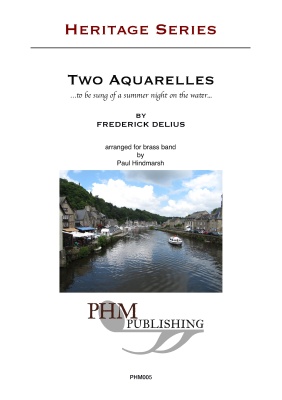
Two Aquarelles (Euphonium Feature with Brass Band - Score and Parts)
In the late spring of 1917, the Bradford born composer, Frederick Delius (1856 - 1934) composed two short part-songs at his home in Grez-sur-Loing. The river ran along the bottom of his garden and he called the two miniatures To be sung of a summer night on the water. The First World War was at its height, but one would never guess that from the languid and serene quality of these richly textured nocturnes. The songs were first heard in London on 28 June, sung by the Oriana Madrigal Society, conducted by Charles Kennedy Scott. In 1932 Delius's amanuensis, Eric Fenby, arranged them for string orchestra as Two Aquarelles. While I have taken Fenby's title, my arrangement is a note-for-note transcription of the choral original. It was prepared in early in 1993 for Besses o' th' Barn Band, of which I was Musical Director at the time. In the second song, the prominent tenor solo has been given to the solo euphonium, who should stand apart from the band in performance.- Paul HindmarshDuration: 5.00
Estimated dispatch 7-14 working days
-
 £29.95
Judd: Before The Cross
Written at the request of David Daws for his solo album The Sound of David Daws, this meditation for cornet and brass band uses the composer's own song Before the cross (The Musical Salvationist, April 1965), the first lines of which are "Before the cross I stand in fear and wonder, and see that all my sins on Thee are laid". The song was written at an early stage of the composer's career, just before commencing study at The Royal Academy of Music, London. After a brief introduction the melody is heard twice, first played by the soloist, then on euphonium and flugel horn with the soloist adding ornate counterpoint before taking up the melody once again, this time leading to a quiet and reflective conclusion.
Estimated dispatch 7-14 working days
-
 £89.95
Judd: Infinity
In the post-modern age in which we live, 'absolutes' are difficult for many to comprehend. Yet infinity, which means absolute, total, all-embracing, having no limits or boundaries in time, space, extent, or magnitude, has always been central to the Christian's concept of God.Through the ages, as human understanding has grown, particularly at a remarkable rate from the latter part of the twentienth century, Christianity has been continually challenged to interpret traditional beliefs in the light of new discoveries, but always within the reality of the infinite Being. In addition, scripture tells us that 'humanity was made in God's image'. Humankind is part of God's creation and as such, responsible for its upkeep. Such a commission has never been more relevant than in this present age. Psalm 8 creates a great picture of the majesty, eternal, infinte quality of God and yet reveals the desire of God to share in spirit with humankind. It recognises humankind as being, not a tool of the infinite, but as a creative contributing part of the ongoing movement and activity of the infinite.The music is deliberately melodic in context, creating a sense of unity with the infinite, in tandem with the varying expressions of individuality. It is not based on the Psalm but reflects some of the sentiments lying therein. The 'hymn-like' theme expresses the nature of the Divine using the Old Testament image of the infinite God coming to finite humankind, not in the 'wind', the 'earthquake', the 'fire', but in the 'still small voice' of quietness (1 Kings 19: 11-13). The ensuing musical development, in different styles and patterns, expresses this continual link between infinite and finite. Thus the conclusion, rather than being a symbol of might, power and magnificence, reflects the same sentiment as the opening.
Estimated dispatch 7-14 working days
-
 £29.95
Judd: Minneapolis IV
This march was the outcome of a request from Minneapolis IV Corps to write a march to celebrate its 60th anniversary. It is said that the composer received $25 for his efforts! At the time of its writing, Soderstrom had become a leading arranger for NBC Radio in Chicago and had mastered many contemporary American styles. His lush harmonies remind one of Gershwin, Porter, Berlin and Rodgers while even the scoring suggests an American big-band of the swing era! These and other novel touches make the march interesting to listen to, as well as to play, over 60 years on.
Estimated dispatch 7-14 working days
-
 £40.00
Blue-Sleeve Step (Score and Parts)
This is a big band style number which is modelled on Barrie Gott's brilliant Lightwalk. It begins with a walking bass before horns state the highly whistleable tune for the first time. The full band quickly joins and there is an extended solo break for cornet. A tiptoeing tuba solo precedes the final key change which propels the piece to its infectiously foot-tapping conclusion.
Estimated dispatch 7-14 working days
-
 £27.50
Perpetuum Mobile
A little concerto for orchestra... in this arrangement for band... this is a glass of freshly poured champagne every time the music changes direction. Irresistible!
Estimated dispatch 7-14 working days
-
 £35.00
Positively Pittsburgh (Score and Parts)
Composed for James Gourlay and the River City Brass Band, this piece has a driving energy in a quick compound time. There is a contrasting middle section, but valves will need to be well-oiled for this one -- exciting stuff!
Estimated dispatch 7-14 working days
-
 £18.00
Positively Pittsburgh (Score Only)
Composed for James Gourlay and the River City Brass Band, this piece has a driving energy in a quick compound time. There is a contrasting middle section, but valves will need to be well-oiled for this one ' exciting stuff!
Estimated dispatch 7-14 working days
-
 £89.95
Tuba Concerto (Score and Parts)
This work was commissioned by the Besses o' th' Barn Band with funds provided by the Arts Council of Great Britain. It was written for, and is dedicated to, John Fletcher, who gave the first performance in Middleton Civic Hall, near Manchester, on 24 April, 1976, with Besses o' th' Barn Band conducted by the composer. Another interesting feature about the premire was that it was recorded by BBC Television for an Omnibus programme with Andr Previn as presenter. The concerto exists in three versions: with brass band (1976), orchestra (1978) and wind band (1984).The concerto is in three movements, following the usual, quick-slow-quick pattern: Allegro deciso,Lento e mesto, Allegro giocoso. The first movement has a sonata form shell with two contrasting themes, the first one being rhythmic in character, the second lyrical. There is a reference made in passing to the Vaughan Williams Tuba Concerto, but this merges into the other material in the development section.The second movement begins with a chorale, but after the entry of the tuba it leads to a cantabile theme, softly unfolded by the soloist. The opening chorale passage returns, this time briefly on muted brass, and leads to a middle section which is more chromatic in style and soon builds to a powerful climax, where the opening cantabile theme triumphantly returns. The music subsides, returning to the opening chorale and ending peacefully.The finale is light and breezy in style, and is cast in rondo form. After a brief introduction the tuba announces the main rondo theme, which is dance-like and a little jaunty. There are two episodes: the first a broad sweeping tune, the second a slowish waltz and a little jazz-like. After a virtuoso cadenza reference is made to the very opening of the concerto before the work ends with a triumphal flourish.The Tuba Concerto has established itself as one of the main works in the solo tuba repertoire. It has been performed and broadcast in over 40 countries all over the world. There are currently six commercial recordings of the concerto in its various versions.resolution in C major, pointed by a simple but expansive melody towards which the piece has been heading, and ending in a blaze of joyful colour.
Estimated dispatch 7-14 working days
-
£40.00
Blue Sleeve Step - Harper, P
This is a big band style number which is modelled on Barrie Gott's brilliant Lightwalk. It begins with a walking bass before horns state the highly whistleable tune for the first time. The full band quickly joins and there is an extended solo break for cornet. A tiptoeing tuba solo precedes the final key change which propels the piece to its infectiously foot-tapping conclusion.2nd section +
In Stock: Estimated dispatch 1-3 working days
 View Music