
Results
-
 £119.95
Harrison's Dream (Brass Band - Score and Parts) - Graham, Peter
At 8.00pm on the 22nd of October 1707, the Association, flagship of the Royal Navy, struck rocks off the Scilly Isles with the loss of the entire crew. Throughout the rest of the evening the remaining three ships in the fleet suffered the same fate. Only 26 of the original 1,647 crew members survived. This disaster was a direct result of an inability to calculate longitude, the most pressing scientific problem of the time. It pushed the longitude question to the forefront of the national consciousness and precipitated the Longitude Act. Parliament funded a prize of �20,000 to anyone whose method or device would solve the dilemma.For carpenter and self-taught clockmaker John Harrison, this was the beginning of a 40 year obsession. To calculate longitude it is necessary to know the time aboard ship and at the home port or place of known longitude, at precisely the same moment. Harrison's dream was to build a clock so accurate that this calculation could be made, an audacious feat of engineering.This work reflects on aspects of this epic tale, brilliantly brought to life in Dava Sobel's book Longitude. Much of the music is mechanistic in tone and is constructed along precise mathematical and metrical lines. The heart of the work however is human - the attraction of the �20,000 prize is often cited as Harrison's motivation. However, the realisation that countless lives depended on a solution was one which haunted Harrison. The emotional core of the music reflects on this, and in particular the evening of 22ndOctober 1707.- Peter GrahamJuly 2000 Recorded on Polyphonic QPRL219D Master Brass (Volume Fifteen). Duration: 14'30"
Estimated dispatch 7-14 working days
-
£44.95
Harrison's Dream (Brass Band - Score only) - Graham, Peter
At 8.00pm on the 22nd of October 1707, the Association, flagship of the Royal Navy, struck rocks off the Scilly Isles with the loss of the entire crew. Throughout the rest of the evening the remaining three ships in the fleet suffered the same fate. Only 26 of the original 1,647 crew members survived. This disaster was a direct result of an inability to calculate longitude, the most pressing scientific problem of the time. It pushed the longitude question to the forefront of the national consciousness and precipitated the Longitude Act. Parliament funded a prize of �20,000 to anyone whose method or device would solve the dilemma.For carpenter and self-taught clockmaker John Harrison, this was the beginning of a 40 year obsession. To calculate longitude it is necessary to know the time aboard ship and at the home port or place of known longitude, at precisely the same moment. Harrison's dream was to build a clock so accurate that this calculation could be made, an audacious feat of engineering.This work reflects on aspects of this epic tale, brilliantly brought to life in Dava Sobel's book Longitude. Much of the music is mechanistic in tone and is constructed along precise mathematical and metrical lines. The heart of the work however is human - the attraction of the �20,000 prize is often cited as Harrison's motivation. However, the realisation that countless lives depended on a solution was one which haunted Harrison. The emotional core of the music reflects on this, and in particular the evening of 22ndOctober 1707.- Peter GrahamJuly 2000 Recorded on Polyphonic QPRL219D Master Brass (Volume Fifteen). Duration: 14'30"
Estimated dispatch 7-14 working days
-
 £55.00
New York (from East Coast Pictures) (Brass Band - Score and Parts) - Hess, Nigel - Littlemore, Phillip
For anyone who is familiar with this bizarre and wonderful city, this piece needs no explanation. New York is the third movement of East Coast Pictures, originally written for wind band, commissioned in 1985 by the British Youth Wind Orchestra with funds from National Westminster Bank plc. These three short 'pictures' were inspired by several visits by the composer to a small part of the USA's East Coast, an area that provides great extremes in the geography and the people. Suitable for Premier Youth/2nd Section Bands and above. Duration: 6.00
Estimated dispatch 7-14 working days
-
 £72.99
The Eagles in Concert (Brass Band - Score and Parts) - Sebregts, Ron
The Eagles In Concert features three Eagles hits: Peaceful Easy Feeling, Desperado and Hotel California arranged by Ron Sebregts for Brass Band.Duration: 6.45
Estimated dispatch 7-14 working days
-
 £69.99
A German Christmas (Deutsche Weihnachten) (Brass Band - Score and Parts) - Hadermann, Jan
Following a Christmas concert in German speaking Belgium, Jan Hadermann put together A German Christmas. Three well-known German Christmas carols O Tannenbaum, Alle Jahre Wieder and Susser die Glocken nie klingen have been transcribed in this Christmas medley. The romantic simplicity of the music makes it ideal for all bands.Duration: 5:45
Estimated dispatch 7-14 working days
-
 £72.99
A Tribute to Elvis (Brass Band - Score and Parts) - Oud, Thijs
Richard Strauss's Also Sprach Zarathustra is used in this great medley to introduce the King of Rock and Roll. Just imagine him walking onto the Las Vegas stage and then put your whole heart into performing three of his best known hits. An extra touch of entertainment can be added with members of your band singing the chorus to CC Rider. Everyone will love this tribute to the legendary performer.Duration: 10:30
Estimated dispatch 7-14 working days
-
 £76.99
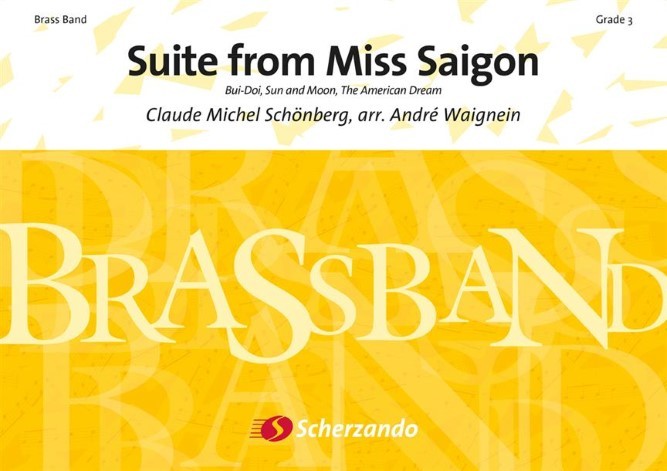
Suite from Miss Saigon (Brass Band - Score and Parts) - Schonberg, Claude-Michel - Waignein, Andre
The musical Miss Saigon was a massive hit in London, Broadway and throughout the world. Based on Puccini's opera, Madame Butterfly, this epic production centres on the romance between a strong-willed Vietnamese woman and an American soldier during the Vietnam War. The story tells of two young lovers torn apart by war yet still held together by a burning passion. This medley features three of the best songs from the musical and mixes desperate love with optimism and joy. Relive the hit show with this catchy medley.Duration: 10:30
Estimated dispatch 7-14 working days
-
 £60.99
Magic Slides (Trombone Trio with Brass Band - Score and Parts) - Laseroms, Wim
This playful novelty item for three trombones and band makes use of the trombone's most entertaining feature - the glissando. Makes an ideal light interlude in any concert or a great encore piece.Duration: 4:15
Estimated dispatch 7-14 working days
-
 £53.99
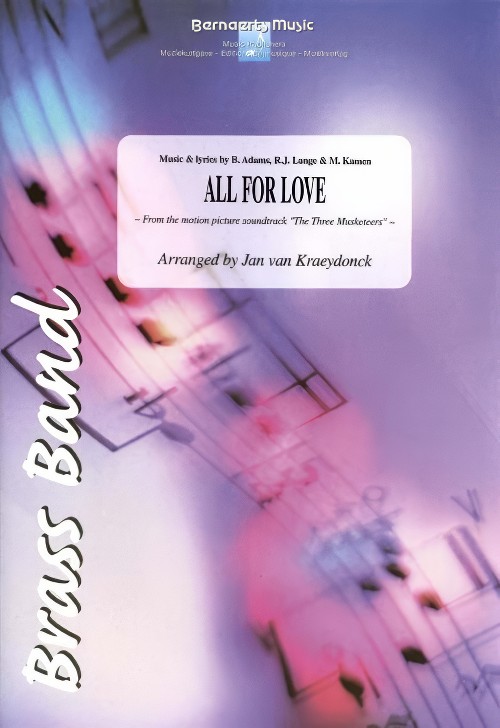
All for Love (Brass Band - Score and Parts) - Kraeydonck, Jan van
From the motion picture soundtrack The Three Musketeers and as performed by Bryan Adams, Rod Stewart and Sting. Duration: 3.45
Estimated dispatch 7-14 working days
-
 £104.99
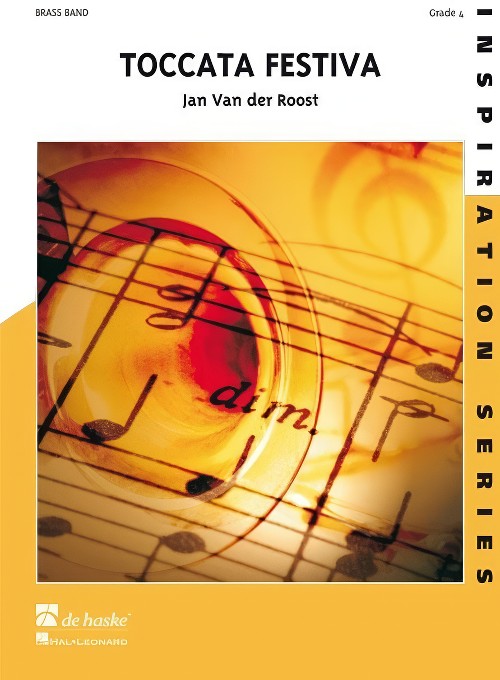
Toccata Festiva (Brass Band - Score and Parts) - Van der Roost, Jan
Toccata Festiva was commissioned in 1994 by the Dutch Brass Band Championships. The wind band version was made a year later by the composer himself. Historically speaking, the toccata is considered to be one of the first independent instrumental forms for keyboard instruments. Originally the toccata was typically more or less improvised, later this musical form was given a more regulated structure. Both elements are used in the Toccata Festiva: on the one hand the different themes are developed freely, on the other, the piece has an orderly structure. It is in a three part form (quick-slow-quick) and includes both strong rhythmical figures and broad melodic lines. Part of the composition is written in a more or less archaic tone idiom, referring to the period from which the toccata form originates (16th century).Duration: 13:30
Estimated dispatch 7-14 working days
 View Music