
Results
-
 £154.99
Audivi Media Nocte - Oliver Waespi
Audivi Media Nocte is based on the eponymous motet by Thomas Tallis from the 16th Century - a work that holds great fascination for Oliver Waespi.During the process of composition, various chord sequences and rhythmical structures emerged that led the work in the direction of a musical drama, with elements of a concerto grosso and solos for different soloists. An innovative, virtuoso and gripping work that can also take you far in competitions!
Estimated dispatch 5-14 working days
-
£84.99
Utopia - Jacob de Haan
Utopia is the name of a book written by the English author Thomas More and was published in 1516. The title is a word thought up by More himself, after the Greek language, meaning "Nowhereland" and leading to the invention of the words utopian scheme and utopian. Utopia pictured an ideal state on an island far from the inhabited world. This idea was the basis of the composition. It makes one think of Oregon in variety of themes and style. Utopia also exists of a combination of styles that breathe the atmosphere of film music. However, Utopia sounds less American. The slow and stirring middle part for example is closer to the European romanticism: the chord signals in the brasssection remind of Wagner's music.
Estimated dispatch 5-14 working days
-
 £154.99
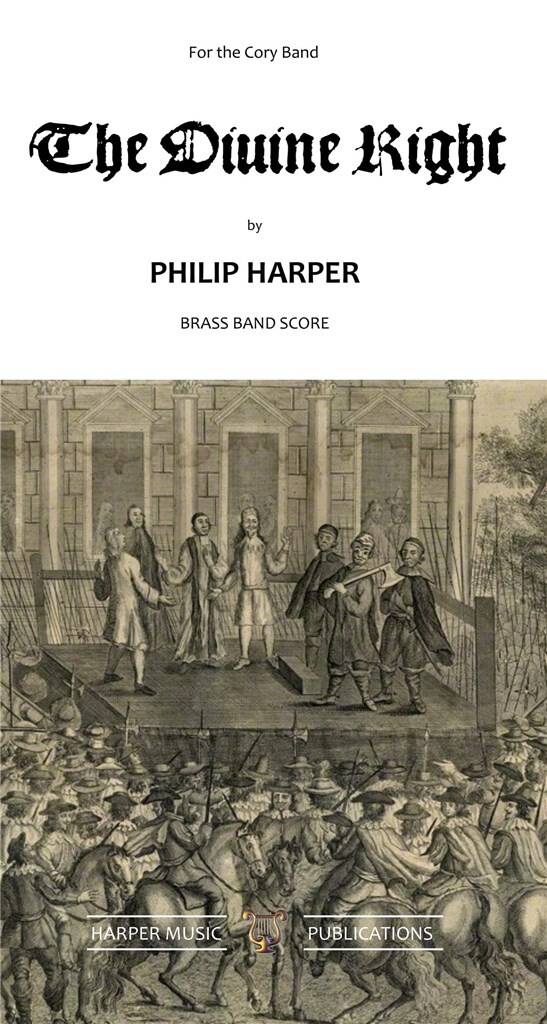
The Divine Right - Philip Harper
At the time of composing this piece, the Arab Spring was sweeping through the Middle East. It seemed that almost every week a new countrys people had risen up against the regimes and dictatorships which had prevailed for generations, leaving manynations at a defining crossroads in their history. There were so many possible ways ahead: so many hopes, yet so many uncertainties.My music is a depiction of these revolutionary times, and several musical themes are in turn presented, discussed, considered, fought over, altered, rejected or accepted. Most nations have had, or probably will have, their own Arab Spring, including my own, the United Kingdom. Events of 17th Century Britain provide the context for this piece, particularly those following the execution of the tyrant King Charles I on30 January 1649. The regicide was in part due to Charless steadfast belief in the Divine Right of Kings, and led to a tumultuous interregnum, where England stood at its own defining crossroads.The music begins turbulently, before King Charles appears and is led to the gallows outside Banqueting House in central London where he is brutally decapitated. From the assembled crowd rose, according to one observer, a moan as I never heard before and desire I may never hear again.The music descends to emptiness. The musical argument which follows is not strictly programmatic, but a number of musical themes are all thrown into the melting pot, representing ideas such as: religion; military force; reasoned Parliamentary debate; and the chattering,irrepressible voice of the people. Additionally, there are some quotations from the music of royalist composer Thomas Tomkins (1572-1656), who was often in tune with the feeling of the times. This defining episode in Englands history was brought to a close with the Restoration of the monarchy in 1660, and as the exiled King Charles II rode back into London the diarist John Evelyn wrote: Never was so joyful a day seen in this nation. I stood in the Strand and beheld it, and blessed God.At the end of the piece the bells ring out, and the musical appearance of the King has transformed from turbulent to triumphant. Philip Harper, 2013
Estimated dispatch 5-14 working days
-
 £60.99
Cornfield Rock - Jacob de Haan
Originally Cornfield Rock was written by Jacob de Haan as a version for male choir. It was based on a text by William Shakespeare on a melody of Thomas Morley (It was a lover and his lass). The original melody however was abandoned completely and in its place Jacob de Haan created a new one in rock style. The title refers to the text: That o're the green corne fields did passe.
Estimated dispatch 5-14 working days
-
 £69.99
Sunset Serenade - Thomas Doss
Sunset Serenade is a tribute by the composer to a music colleague, whose life was unexpectedly cut short. In spite of the sad circumstances of its creation, the music reflects overwhelmingly happy memories and thoughts of gratitude for timespent together and shared experiences. The overall peaceful nature of this composition symbolises a reconciliation with, and acceptance of, the transient nature of man.
Estimated dispatch 5-14 working days
-
 £38.95
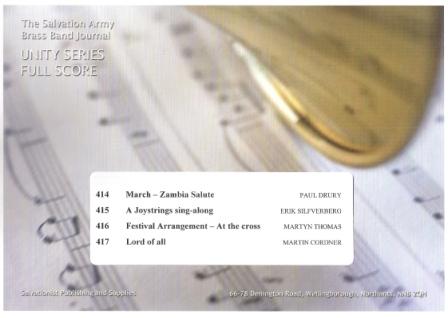
Unity Series Band Journal February 2014 Numbers 414-417
No.414 March - Zambia Salute (Paul Drury)In April 2009, a group from Chelmsford Citadel Corps visited Zambia. The purpose of the visit was to assist in the leadership of the Zambian Territorial Music School, held at Chikankata. This march was written to commemorate the event and received its premiere performance at the final festival. The melody featured is the chorus of the song, I know not why Dod's wondrous grace (S.A.S.B. 730).No.415 A Joystrings sing-along (Erik Silfverberg O.F.)This piece represents the first published work since the sudden Promotion to Glory of Bandmaster Erik Silfverberg O.F. The Joystrings made Salvation Army history about fifty years ago, introducing rock music on the Christian music scene. Many of their songs have become classics and have been used as thematic material in our brass music. Here is a selection of three of their songs, to be used either as a band piece or as accompaniment to a sing-along. The three songs are:- 'I want to sing it', 'It's an open secret' and 'Have faith in God'.No.416 Festival Arrangement - At the cross (Martyn Thomas)The well-known song, 'At the cross' (T.B. 580), is given a lively new setting by Martyn Thomas. The rock and swing treatment of this old melody should appeal to many!No.417 Lord of all (Martin Cordner)This piece was written for the 120th Anniversary of Balham corps (London Central Division) in 2011. In terms of a theme, the anniversary occasion prompted the primary thought that the piece should first be a praise-offering to God, acknowledging him for who he is. Therefore songs referenced in the piece are praide songs: 'Lord, reign in me', 'He is Lord', 'All hail the Lamb', along with a song of testimony, 'I'm a soldier bound for Glory' (T.B. 382),which speaks of the Christian hope in Heaven and challenges Salvationists to influence others by living out that hope. There is also a brief reference to the National Anthem of the Democratic Republic of Congo (4 bars before D)- man acknowledgement to the faithfulness of corps soldiers who in recent years have arrived from that country.
Estimated dispatch 7-14 working days
-
£50.00
Paintings - Broadbent, D
Canvases from East AngliaI. View Near the Coast -- Thomas Gainsborough c.1750-55Calm Seas GlisteningPeaceful Folk RestingStorm Clouds ThreateningII. Travellers -- Sir Alfred J. Munnings 1910Romany horses, 'neath sunny autumn skiestread gently through the peaceful countrysideIII. William Wollaston -- Thomas Gainsborough c.1759Member of Parliament for Ipswich,Colonel of the East Suffolk Militia,and a musician of note who played the one-keyed flute
In Stock: Estimated dispatch 1-3 working days
-
 £61.99
Celebration - Doug Adams, Ronald Bell, Robert Mickens, Dennis Thomas, Robert Bell, George Brown, James Taylor - Johny Ocean
Estimated dispatch 10-14 working days
-
£61.99
Euphoria - Peter BostrA¶m & Thomas G:son - Jan van Kraeydonck
Estimated dispatch 10-14 working days
-
£61.99
Only Teardrops - Lisa Cabble, Julia Fabrin Jakobsen & Thomas Stengaard - Frank Bernaerts
Estimated dispatch 10-14 working days
 View Music
 Listen to MP3