Results
-
£57.50Barbie's World - Michael Brown
From the blockbuster movie Barbie comes the equally sensational soundtrack album featuring an all-star lineup of performers and songwriters. This upbeat and entertaining medley for brass band includes: Barbie Dreams Barbie Girl What Was I Made For? Dance the Night.
Estimated dispatch 5-14 working days
-
£54.99
Heal the World - Michael Jackson - Ron Sebregts
Michael Jackson, the King of Pop, died in Los Angeles on June 25th 2009. He can without any shadow of a doubt be compared with artists such as Elvis Presley, Jimi Hendrix, and John Lennon - all of them musicians who will never die in the hearts of their fans. Why not keep the legend of Michael Jackson alive in your next concert with this hit from Michael Jackson's repertoire arranged for Brass Band.
Estimated dispatch 5-14 working days
-
£36.00Edward Gregson: The World Rejoicing
DescriptionComposer's NoteIn searching for a common link between the brass band traditions of the various European countries that commissioned this work, I considered the fact that hymns have always played an important role in the relationship that brass bands have with their particular communities; and thus I turned to a well-known Lutheran chorale, Nun danket alle Gott (Now thank we all our God), written around 1636 by Martin Rinkart, with the melody attributed to Johann Cruger. A number of composers have incorporated this chorale into their music, most famously J.S.Bach in his Cantatas no. 79 and 192, and Mendelssohn in the Lobsegang movement of his 2nd Symphony (the harmonization of which is usually used when this hymn is sung).It seemed fitting therefore for me to return to a compositional form I have used many times before (Variations) and to write a work based on this hymn. I have used it in a similar way to that which I employed in my Variations on Laudate Dominum of 1976 - that is, rather than writing a set of variations using elaborations of the complete tune, I have taken various phrases from the chorale and used them within the context of other musical material, applying an overall symphonic process of continuous variation and development. The structure, or sub-divisions of the work, which is through composed and plays without a break, is as follows: Prelude, Capriccio, La Danza 1, Processional, La Danza 2, Arias and Duets, Fuga Burlesca, Chorale, and Postlude.The work is also partly autobiographical - in the manner say of Strauss's Ein Heldenleben - in that I have incorporated into the score brief quotations from many of my other major works for brass band. In that respect, The World Rejoicing sums up a particular facet of my life as a composer, and reflects the admiration I have always had for what is surely one of the great amateur music-making traditions in the world.The World Rejoicing is dedicated 'in loving memory of my brother', Bramwell Logan Gregson, who sadly passed away in the Autumn of 2018.Edward Gregson
Estimated dispatch 7-14 working days
-
£125.00The World Rejoicing (Brass Band - Score and Parts) - Gregson, Edward
The World Rejoicing was commissioned by the National Brass Band Associations of Belgium, Netherlands, Norway, Switzerland, and the British Open, as the test piece for their competitions in 2020/21. Although the work was completed in 2019, the pandemic of 2020 meant that these competitions were postponed until 2021/22. The premiere took place in September 2021 at Symphony Hall, Birmingham, UK.In searching for a common link between the brass band traditions of the various European countries that commissioned this work, I considered the fact that hymns have always played an important role in the relationship that brass bands have with their particular communities; and thus I turned to a well- known Lutheran chorale, Nun danket alle Gott (Now thank we all our God), written around 1636 by Martin Rinkart, with the melody attributed to Johann Cruger. A number of composers have incorporated this chorale into their music, most famously J.S. Bach in his Cantatas no. 79 and 192, and Mendelssohn in the Lobsegang movement of his 2nd Symphony (the harmonisation of which is usually used when this hymn is sung).It seemed fitting therefore for me to return to a compositional form I have used many times before (Variations) and to write a work based on this hymn. I have used it in a similar way to that which I employed in my Variations on Laudate Dominum of 1976 - that is, rather than writing a set of variations using elaborations of the complete tune, I have taken various phrases from the chorale and used them within the context of other musical material, applying an overall symphonic process of continuous variation and development. The structure, or sub-divisions of the work, which is through composed and plays without a break, is as follows:Prelude, Capriccio, La Danza 1, Processional, La Danza 2, Arias and Duets, Fuga Burlesca, Chorale, and Postlude.The work, which is around 16 minutes in length, is also partly autobiographical - in the manner say of Strauss's Ein Heldenleben - in that I have incorporated into the score brief quotations from many of my other major works for brass band. In that respect, The World Rejoicing sums up a particular facet of my life as a composer, and reflects the admiration I have always had for what is surely one of the great amateur music-making traditions in the world.Duration: 16.00
Estimated dispatch 7-14 working days
-
£40.00The World Rejoicing (Brass Band - Score only) - Gregson, Edward
The World Rejoicing was commissioned by the National Brass Band Associations of Belgium, Netherlands, Norway, Switzerland, and the British Open, as the test piece for their competitions in 2020/21. Although the work was completed in 2019, the pandemic of 2020 meant that these competitions were postponed until 2021/22. The premiere took place in September 2021 at Symphony Hall, Birmingham, UK.In searching for a common link between the brass band traditions of the various European countries that commissioned this work, I considered the fact that hymns have always played an important role in the relationship that brass bands have with their particular communities; and thus I turned to a well- known Lutheran chorale, Nun danket alle Gott (Now thank we all our God), written around 1636 by Martin Rinkart, with the melody attributed to Johann Cruger. A number of composers have incorporated this chorale into their music, most famously J.S. Bach in his Cantatas no. 79 and 192, and Mendelssohn in the Lobsegang movement of his 2nd Symphony (the harmonisation of which is usually used when this hymn is sung).It seemed fitting therefore for me to return to a compositional form I have used many times before (Variations) and to write a work based on this hymn. I have used it in a similar way to that which I employed in my Variations on Laudate Dominum of 1976 - that is, rather than writing a set of variations using elaborations of the complete tune, I have taken various phrases from the chorale and used them within the context of other musical material, applying an overall symphonic process of continuous variation and development. The structure, or sub-divisions of the work, which is through composed and plays without a break, is as follows:Prelude, Capriccio, La Danza 1, Processional, La Danza 2, Arias and Duets, Fuga Burlesca, Chorale, and Postlude.The work, which is around 16 minutes in length, is also partly autobiographical - in the manner say of Strauss's Ein Heldenleben - in that I have incorporated into the score brief quotations from many of my other major works for brass band. In that respect, The World Rejoicing sums up a particular facet of my life as a composer, and reflects the admiration I have always had for what is surely one of the great amateur music-making traditions in the world.Duration: 16.00
Estimated dispatch 7-14 working days
-
£15.00The World Rejoicing (Brass Band - Study Score) - Gregson, Edward
The World Rejoicing was commissioned by the National Brass Band Associations of Belgium, Netherlands, Norway, Switzerland, and the British Open, as the test piece for their competitions in 2020/21. Although the work was completed in 2019, the pandemic of 2020 meant that these competitions were postponed until 2021/22. The premiere took place in September 2021 at Symphony Hall, Birmingham, UK.In searching for a common link between the brass band traditions of the various European countries that commissioned this work, I considered the fact that hymns have always played an important role in the relationship that brass bands have with their particular communities; and thus I turned to a well- known Lutheran chorale, Nun danket alle Gott (Now thank we all our God), written around 1636 by Martin Rinkart, with the melody attributed to Johann Cruger. A number of composers have incorporated this chorale into their music, most famously J.S. Bach in his Cantatas no. 79 and 192, and Mendelssohn in the Lobsegang movement of his 2nd Symphony (the harmonisation of which is usually used when this hymn is sung).It seemed fitting therefore for me to return to a compositional form I have used many times before (Variations) and to write a work based on this hymn. I have used it in a similar way to that which I employed in my Variations on Laudate Dominum of 1976 - that is, rather than writing a set of variations using elaborations of the complete tune, I have taken various phrases from the chorale and used them within the context of other musical material, applying an overall symphonic process of continuous variation and development. The structure, or sub-divisions of the work, which is through composed and plays without a break, is as follows:Prelude, Capriccio, La Danza 1, Processional, La Danza 2, Arias and Duets, Fuga Burlesca, Chorale, and Postlude.The work, which is around 16 minutes in length, is also partly autobiographical - in the manner say of Strauss's Ein Heldenleben - in that I have incorporated into the score brief quotations from many of my other major works for brass band. In that respect, The World Rejoicing sums up a particular facet of my life as a composer, and reflects the admiration I have always had for what is surely one of the great amateur music-making traditions in the world.Duration: 16.00
Estimated dispatch 7-14 working days
-
£44.95For the World (Brass Band - Score and Parts) - Creamer, Sam
Originally written for the Melbourne Staff Band 125th Anniversary, this developed work features many genres of music but keeps as?its central theme the song 'The World for God'. This is bright and abounds in energy throughout. Other tunes featured are 'Christ?for the world we sing', 'He's got the whole world' (in a 'Dixieland' style) and 'Christ for the whole world' (in a 'Swing' style).
Estimated dispatch 7-14 working days
-
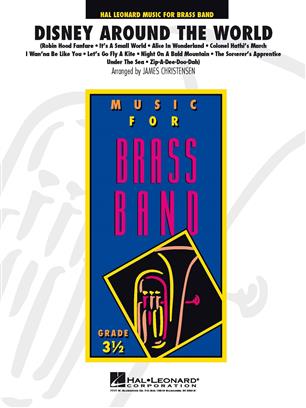
£22.50For the World (Brass Band - Score only) - Creamer, Sam
Originally written for the Melbourne Staff Band 125th Anniversary, this developed work features many genres of music but keeps as?its central theme the song 'The World for God'. This is bright and abounds in energy throughout. Other tunes featured are 'Christ?for the world we sing', 'He's got the whole world' (in a 'Dixieland' style) and 'Christ for the whole world' (in a 'Swing' style).
Estimated dispatch 7-14 working days
-
£54.95WORLD WITHIN, A (Brass Band Parts) - Scott, Andy
Brass Band parts only. 'A World Within' is a one-movement work that starts with a simple theme stated by the Soprano Cornet before an ostinato figure in 6/8 time emerges (Vibraphone, Horns and muted 2nd and 3rd Cornets) over which firstly Solo Cornet, and then both Solo Cornets (1 & 2), play a sustained melody. A shift between major and minor harmonies characterises the 'B' section, before making way for a virtuosic Flugel solo. When the Flugel leaves centre stage the front line Cornets take over, leading to a full bodied reprise of the 'B' section. The low brass bridge the gap between what is in effect the end of the first main section of the piece and the second section. The constant time shift between 3/4 and 6/8 that has been prevalent through-out 'A World Within', re-emerges towards the end of the 'slow, heavy blues' section, leading into an intricate almost fugue-like passage (Horn and Baritone leading the way). Out of this comes a short transitional bridge section that leads us back to the (transposed) original 6/8 time theme and feel, this time scored with a bold directness that leads to a powerful 2/4 time passage. The climax of 'A World Within' is heralded by one dark and dissonant chord that is repeated three times. A flashback moment occurs where the 'hymn' is stated (muted Cornets) in a bitonal harmonic world. A final statement emerges from the denseness of sound, a re-working of the initial theme (Solo Cornet), with the last work being left to Solo Eb Bass. Dur: 13:00
Estimated dispatch 7-14 working days
-
£20.00WORLD WITHIN, A (Brass Band Score) - Scott, Andy
Brass Band score only. 'A World Within' is a one-movement work that starts with a simple theme stated by the Soprano Cornet before an ostinato figure in 6/8 time emerges (Vibraphone, Horns and muted 2nd and 3rd Cornets) over which firstly Solo Cornet, and then both Solo Cornets (1 & 2), play a sustained melody. A shift between major and minor harmonies characterises the 'B' section, before making way for a virtuosic Flugel solo. When the Flugel leaves centre stage the front line Cornets take over, leading to a full bodied reprise of the 'B' section. The low brass bridge the gap between what is in effect the end of the first main section of the piece and the second section. The constant time shift between 3/4 and 6/8 that has been prevalent through-out 'A World Within', re-emerges towards the end of the 'slow, heavy blues' section, leading into an intricate almost fugue-like passage (Horn and Baritone leading the way). Out of this comes a short transitional bridge section that leads us back to the (transposed) original 6/8 time theme and feel, this time scored with a bold directness that leads to a powerful 2/4 time passage. The climax of 'A World Within' is heralded by one dark and dissonant chord that is repeated three times. A flashback moment occurs where the 'hymn' is stated (muted Cornets) in a bitonal harmonic world. A final statement emerges from the denseness of sound, a re-working of the initial theme (Solo Cornet), with the last work being left to Solo Eb Bass. Dur: 13:00
Estimated dispatch 7-14 working days