
Results
-
 £44.95
The Dawning (Brass Band - Score and Parts) - Graham, Peter
This early Peter Graham work in Sinfonietta form, takes as its central theme Joy Webb's original melody 'There will be God', which speaks of 'the dawning of a brand new day'. Peter Graham's dramatic treatment takes us into a world of 'cosmic power' and evokes ideas that one day wars will end as God will rule supreme.
Estimated dispatch 7-14 working days
-
£22.50
The Dawning (Brass Band - Score only) - Graham, Peter
This early Peter Graham work in Sinfonietta form, takes as its central theme Joy Webb's original melody 'There will be God', which speaks of 'the dawning of a brand new day'. Peter Graham's dramatic treatment takes us into a world of 'cosmic power' and evokes ideas that one day wars will end as God will rule supreme.
Estimated dispatch 7-14 working days
-
 £60.99
Symphony No.9 (Brass Band - Score and Parts) - Dvorak, Antonin - De Haan, Jan
From the New World. Duration: 7.45
Estimated dispatch 7-14 working days
-
 £134.99
Crazy Twenties - Thierry Deleruyelle
Crazy Twenties takes place in the 1920s, a decade otherwise known as the "Roaring Twenties". This work retraces an exceptional period in social, cultural and artistic terms, when a new generation dreamt of a new world. The work opens with a bright and lively movement, followed by a nostalgic interlude. A gracious slow movement accompanies the Parisian district of Montparnasse. Written in the style of an unstable blues, the next movement evokes characters sipping their Bloody Marys in a cafe. The final movement is a fugue with the main motif as the subject.
Estimated dispatch 5-14 working days
-
 £44.99
Ceremonial Fanfare - Johan de Meij
The Ceremonial Fanfare was originally written for orchestral brass and percussion, commissioned by The Orchestra Osaka Symphoniker from Osaka, Japan. The world premiere performance took place on April 12, 2005 at The Symphony Hall in Osaka, conducted by maestro Heiichiro Ohyama.In April 2009, the combined brass sections of the New York Philharmonic and the Royal Concertgebouw Orchestra gave an impressive performance in New York City. The concert commemorated the Henry Hudson Quadricentennial and 400 years of friendship between The United States and The Netherlands.This version for brass band was written at the request of EBBC, the European Brass Band Contest 2012in Rotterdam, to serve as the opening fanfare of the festival.
Estimated dispatch 5-14 working days
-
 £23.50
A Brussels Requiem - SCORE ONLY - Bert Appermont
The attacks in Brussels on 22 March 2016 created a shockwave throughout Belgium and the rest of the world. Equally, the attacks in Paris and Nice led to great public indignation, fear and disbelief. What has happened to the western world? Have our cultures grown apart to such an extent that we do not understand each other anymore? Bert Appermont's intention was to voice certain emotions that these acts of terror have caused: particularly fear, grief, anger, and helplessness. He uses the French children's song Au Claire de la Lune as a connecting thread throughout the work. This piece is also about hope and faith in another world, and is meant to pay homage to all victims, resulting in a dignified remembrance. The musical development is presented in four through-composed parts, titled Innocence, In Cold Blood, In Memoriam - We Shall Rise Again and A New Day. This work was commissioned by the Brassband Oberosterreich (Brass Band Upper Austria) to be played at the European Brass Band Championships 2017.
Estimated dispatch 5-14 working days
-
 £154.99
A Brussels Requiem - Bert Appermont
The attacks in Brussels on 22 March 2016 created a shockwave throughout Belgium and the rest of the world. Equally, the attacks in Paris and Nice led to great public indignation, fear and disbelief.What has happened to the western world? Have our cultures grown apart to such an extent that we do not understand each other anymore? Bert Appermont's intention was to voice certain emotions that these acts of terror have caused: particularly fear, grief, anger, and helplessness. He uses the French children's song Au Claire de la Lune as a connecting thread throughout the work.This piece is also about hope and faith in another world, andis meant to pay homage to all victims, resulting in a dignified remembrance. The musical development is presented in four through-composed parts, titled Innocence, In Cold Blood, In Memoriam - We Shall Rise Again and A New Day.This work was commissioned by the Brassband Obersterreich (Brass Band Upper Austria) to be played at the European Brass Band Championships 2017.
Estimated dispatch 5-14 working days
-
 £89.99
Dragonfly - Thierry Deleruyelle
Dragonfly was commissioned by Bastien Baumet, an international French soloist, as a new departure in euphonium repertoire. The concerto can be accompanied by wind band or brass band, as well as with piano accompaniment.Written in three uninterrupted parts, a slow and warm theme separates two dynamic, swift, and agile sections. Like a dragonfly, the music flies sometimes with jolts, sometimes with serenity, allowing us to discover landscapes, colours, and changing horizons. Dragonfly showcases the soloist's inspired melodic curves, beautiful tone, and virtuosity.A graduate of the Paris Conservatoire and first prize winner in the prestigious Jeju International Competition in South Korea, Bastien Baumet is a leading figure in the euphonium world. He will be performing this concerto all over the world, to triumphant acclaim wherever he goes.
Estimated dispatch 5-14 working days
-
 £154.99
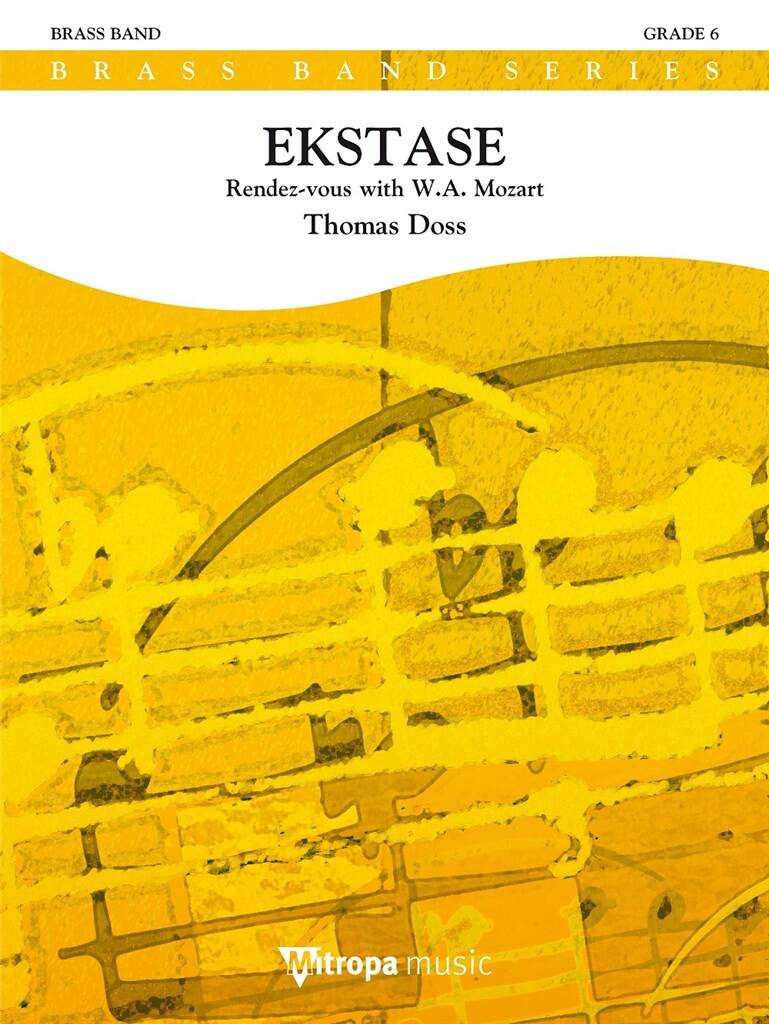
EKSTASE - Thomas Doss
EKSTASE is a piece about a mentally ill patient who is kept completely shut off from the outside world. His condition is worsening, and due to his medication the border between the real world and his hallucinations becomes increasingly vague. One day the patient discovers an old piano and begins to play Mozart which brings both himself and other patients back to life. A very innovative and virtuoso new work from Thomas Doss.
Estimated dispatch 5-14 working days
-
 £90.00
Another world's hell - Simon Dobson
Another World's Hell was commissioned in versions for brass, wind and fanfare bands by the Socit Cantonale des Musiques Vaudoises and the Association Cantonale des MusiquesNeuchteloises for the 2013 Swiss Cantonales festivals. It is inspired by a passage in Aldous Huxley's classic 1932 science-fiction novel Brave New World, which describes in unusually close detail themusic that is being played at a dance. This is Dobson's interpretation of the imagined 'future music' that Huxley dreamed of. Brass Band Grade 5Duration: 13 minutes
Estimated dispatch 5-14 working days
 View Music