
Results
-
 £64.95
Dance Spirit (Brass Band - Score and Parts) - Wiffin, Rob
Dance Spirit is a three movement suite of dances comprising Stomping Dance, Waltz Interlude and Duende linked by solo dancer cadenzas. It started life as the wind band piece Spirit of the Dance. In it I attempted to capture some of the elements of this most fundamental of human activities, the urge to move our bodies to the rhythm of the music. In re-working it for brass band I extended the duration of the Waltz Interlude and increased the technical level in some areas with the intention of making it a suitable test piece.Stomping Dance - The suite starts with perhaps the most basic dance feeling, the desire to stomp our feet to the music, unrefined, no knowledge of steps needed. The heavy stomp is not always present in the music here, and sometimes you can sense the dancers trying something a little more refined, but it is always lurking in the background, ready to draw us back to the elemental rhythm of the beat.Waltz Interlude - Of course, dance does not always have to have heat, it can be elegant and restrained, emphasising fluidity of line and movement. In the waltz it is occasionally suspended by the held poses before the motion starts again. Unlike the outer movements, the Waltz Interlude is cool, danced in moonlight rather than under the sun. The two dancers sometimes move as one and at other times the man provides a frame for the more intricate arabesques of his partner.Duende - During my time living in Spain I went to watch some flamenco dancing. I was expecting the normal tourist cliches but the dancers were serious students of Flamenco Nuevo y Viejo (new and old). They performed with passion to some pounding asymmetric rhythms and their performance was the inspiration for Duende. Duende as a term is hard to define. It is a spirit of performance - that moment when you are right in the middle of the creative spirit of the music. It is about soul and a heightened state of emotion. Federico Garcia Lorca wrote: I have heard an old maestro of the guitar say, The duende is not in the throat; the duende climbs up inside you, from the soles of the feet. Meaning this: it is not a question of ability, but of true, living style, of blood, of the most ancient culture, of spontaneous creation.- Rob WiffinDuration: 13.45
Estimated dispatch 7-14 working days
-
 £118.90
How To Train Your Dragon (Brass Band - Score and Parts) - Powell, John - Schjelderup, Fredrick
"How to Train Your Dragon" is an American animated film about a small Viking village that is constantly being attacked by dragons. In the film, the shy teenager, Hiccup, must convince his father and the rest of the village that he can become a true Viking warrior and fight the dragons. The tension in the film revolves around the fact that the young warrior would rather befriend the dragons than fight them. The original score is composed by John Powell and conveys excitement, drama, and romance that unfolds throughout. In this arrangement, you will find the themes "This is Hiccup" and "Dragon Battle" linked together.
Estimated dispatch 7-14 working days
-
 £174.99
Tales and Legends (Brass Band - Score and Parts) - Crausaz, Etienne
This three-movement work by the Swiss composer Etienne Crausaz reflects three true stories and fascinating legends from the Middle Ages. The first movement tells the dramatic story of the 'witch' Catherine 'Catillon' Repond (1662-1731). She was the last woman ever to be executed for sorcery. In the second movement, the famous court jester Girard Chalamala occupies centre stage. This jester, the last one at the castle of Count Greyerz, could make everyone laugh. The third movement tells the story of Count Michael. He went down in history as a spendthrift bon-vivant. His burden of debt became so high that he did a moonlight flit and never came back! Duration: 21.00
Estimated dispatch 7-14 working days
-
 £84.95
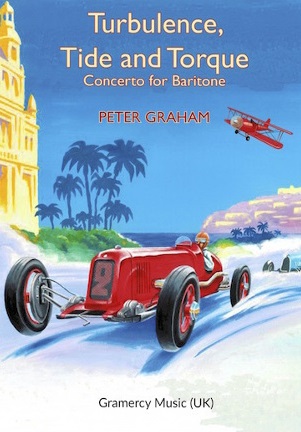
Turbulence, Tide and Torque (Baritone Solo with Brass Band - Score and Parts) - Graham, Peter
Concerto for BaritoneTurbulence, Tide and Torque can be considered to be a companion piece to my 2008 Euphonium Concerto In League with Extraordinary Gentlemen, and indeed can be performed on Euphonium (vintage or medium bore instrument preferred). Whereas the gentlemen in question in the latter work were fictional (e.g. Sherlock Holmes and Phileas Fogg), the former pays tribute to three real life women who were very much true pioneers and heroines of their age.Turbulence: Harriet Quimby (b. 1875) was one of the world's best woman aviators, her significant and historic achievement being the first woman to fly across the English Channel. Sadly, in her lifetime very few people were aware of her 1912 accomplishment; potential press coverage was dominated by the sinking of The Titanic only two days before.Grace Darling (b. 1815) is a name much more familiar to the public today, and in her lifetime she was lauded as a national heroine. A humble lighthouse keeper's daughter from Northumberland, her participation in the rescue of survivors from the wrecked paddle-steamer Forfarshire is well documented (a museum dedicated to her achievements located in Bamburgh, the town of her birth). This movement, Tide, develops a main theme from my large scale work Harrison's Dream, reflecting on the souls lost in the disaster.The final movement Torque, opens with a sudden gear change such as might have been undertaken by Dorothy Levitt (b. 1882), the woman's world land speed record holder, in her Napier racing car. Levitt, who following her 1906 record-breaking achievement was described as the Fastest Girl on Earth, went on to write extensively about her experiences, encouraging females to take up motoring through her articles in The Graphic newpaper.Turbulence, Tide and Torque was commissioned by and is dedicated to Katrina Marzella as part of an Arts Council of England funded residency I was awarded with the Black Dyke Band in 2018.- Peter GrahamDuration: 15.00
Estimated dispatch 7-14 working days
-
 £59.99
A Klezmer Karnival (Brass Band - Score and Parts) - Sparke, Philip
Klezmer music originated in the 'shtetl' (villages) and the ghettos of Eastern Europe, where itinerant Jewish troubadours, known as 'klezmorim', had performed at celebrations, particularly weddings, since the early Middle Ages. Since the 16th century, lyrics had been added to klezmer music, due to the 'badkhn' (the master of ceremony at weddings), to the 'Purimshpil' (the play of Esther at Purim) and to traditions of the Yiddish theatre, but the term gradually became synonymous with instrumental music, particularly featuring the violin and clarinet. In recent years it has again become very popular and in A Klezmer Karnival Philip Sparke has used three contrasting traditional tunes to form a suite that will bring a true karnival atmosphere to any concert.Duration: 4:30
Estimated dispatch 7-14 working days
-
 £44.95
Life Divine (Brass Band - Score and Parts) - Jenkins, Cyril
Programme Notes:Certain phases of Life are common to most if not all men and the music of the Tone Poem carries the listener through four of such phases.a) In the Andante Molto Maestoso a man's outlook on Life as a thing of seriousness and dignity is shown.b) The Allegro Vivace which follow shows him facing its problems with a spirit of vigorous optimism, while two tributary themes suggest that Life, with all its seriousness, is not devoid of humour and happiness.c) The short section which follows, Maestoso, is a reminder that times of stress and trouble are inevitable but these are quickly dispelled by thed) Andante Nobilemente, portraying the helping and ennobling power of true love.The music again proceeds to review these four phases of Life, the concluding section showing Love triumphant over all.
Estimated dispatch 7-14 working days
-
 £45.00
Toccata (from Symphony No.8) (Brass Band - Score and Parts) - Vaughan Williams, Ralph - Littlemore, Phillip
Ralph Vaughan Williams' Symphony in D minor (his eighth) was composed in 1956, when he was in his 84th year. It is noticeably different from its predecessors in its diminutive scale and comparatively short length. However, the symphony is scored for an unusually large percussion ensemble including vibraphone, xylophone, tubular bells, glockenspiel, tuned gongs and celeste. In the Toccata, the fourth and final movement, Vaughan Williams uses the enlarged percussion forces extensively - the eight symphony is therefore in some ways a highly imaginative work, perhaps even an experimental one.. This brass band transcription tries to remain as true to the original percussion writing as possible, but with the omission of the tuned gongs and celeste--for obvious practical performance reasons. Duration: 5:00
Estimated dispatch 7-14 working days
-
 £44.95
Patterns (Brass Band - Score and Parts) - Gregson, Edward
Building musical paragraphs using short, irregular rhythmical patterns became a favourite Gregson formula in the early 1970s. Patterns is the clearest and most disciplined example. By limiting himself to a single musical motif, heard at the outset on trombones, Gregson offers a true test of technique and musicianship in a concise three part structure. The opening is another Gregson prelude with alternating patterns of 3s, 4s, 5s and 7s that are bonded by a constant quaver pulse. The music here possesses a neo-classical, pristine quality. In the central episode, the same triadic figure is transformed into a lilting barcarolle-like dialogue beginning on solo cornet and horn. When the whole band becomes involved, the trombones add a moment of bi-tonal ambiguity, which sets in motion an exuberant Latin dance and final flourish.Patterns was commissioned by the Butlins Youth Brass Band Championships for the 1974 competition at the Royal Albert Hall.Duration: 5.00
Estimated dispatch 7-14 working days
-
 £91.99
Hermitage (Brass Band - Score and Parts) - De Haan, Jan
Concertante Variations on an original theme after Pyotr Ilyich TchaikovskyJan de Haan drew inspiration for this work from five paintings exhibited in The Hermitage in Saint Petersburg, one of the largest and most versatile museums in the world. He used the melodious Andante cantabile from the String Quartet Op. 11 by the Russian composer Pyotr Ilyich Tchaikovsky as its starting point. Thus, he created his own musical painting, which is just as varied as the underlying canvases, from Cheerful Company by Dirck Hals to Dance II by Henri Matisse. A true work of art!Duration: 13.30
Estimated dispatch 7-14 working days
-
 £44.95
Euphony (Euphonium Solo with Brass Band - Score and Parts) - Redhead, Robert
Previously only available in manuscript form, this euphonium solo with brass band accompaniment is now available in printed format. Euphony (meaning a pleasant, sweet sound) is based on the tunes of Sidney Cox with material taken from the songs; 'He found me', 'This one thing I know', 'You can tell out the sweet story' and 'Deep and wide'. At the time of writing, the composer remarked; 'The euphonium is often associated with melodies and harmonies that lend themselves to pleasing sounds'. That is true of this solo but it also presents considerable technical challenges for the soloist in terms of range and technique.
Estimated dispatch 7-14 working days
 View Music