
Results
-
 £30.00
Merry-Go-Round - Tim Paton
I heard a recording of a fairground organ playing a fabulous concert waltz from the early 20th century. It struck me that this music was in the same league as another popular concert waltz, "Nights of Gladness". I aurally transcribed it, and set about creating an exciting piece for brass band, aiming to capture the 'fun of the fair'. The piece needs a good principal cornet, and an efficient glock player would not go amiss!
In Stock: Estimated dispatch 3-5 working days
-
£30.00
On Ilkley Moor Pastiche
I was commissioned to write a piece for the RNCM Trombone Quartet by the bass trombonist Trevor Slade, a true Yorkshireman. I have created a full brass band version. There is an element of comedy, (though not irreverent). The introduction is a direct reference to a well known film theme about bouncing bombs! We then hear the famous Yorkshire melody with overtones of the old BBC Grandstand theme, (for those old enough to remember). A 'patriotic' section is a mixture of "Ilkley Moor", and those bouncing bombs again! We are then taken to a 'Dixieland' treatment, with 'overtones' of a 'Hootenannyish' piece, which every bandsman/woman is familiar with! What follows is a rather pretty 'Edmundo Ross(ish)' beguine. After a brief Beethovian bit, we are taken back once again to the original pastiche, with a BIG ending. A good piece for the lighter element of the concert programme.
In Stock: Estimated dispatch 3-5 working days
-
£30.00
Presley In Mind
Includes: "Are You Lonesome Tonight?", "Can't Help Falling in Love", and "Wonder of You".Whether you like Elvis or not, audiences will love this medley. Three of his well known ballads, to which the audience can sing along.Talking of singing, the middle section of the band get their chance too! A very popular medley, which has also been included in 'entertainment contests'. The Parr Band won their section at Wychavon in 2004, judged by Goff Richards."Presley in Mind" is featured on Flixton Band's CD (order from [email protected] price �10).Robert Childs commented:"The brass writing is very accessible. The third tune in this triptych of Presley's pop songs requires the entire horn, baritone, trombone and euphonium sections to sing as well - all good fun I'm sure".
In Stock: Estimated dispatch 3-5 working days
-
 £30.00
Wired - Lucy Pankhurst
A fantastically funky piece! So good it was featured on BBC television during the 2010 general election campaign coverage for the North West and at the 2014 International Women's Brass Conference.Originally written in 2009 for Jason Katsikaris and the Leyland Band, Lucy Pankhurst has created a vivacious, energetic work which is strong on percussion and style!It's fast-moving, completely engaging and makes for compulsive toe-tapping and the need to 'get into the groove'! Huge opportunities for the kit player/percussion section to show their wild side and, so as not to be outdone, plenty of other moments for improvisation-esque solos from other quarters.If you can keep up, this is a really great contribution to your concert programme.Look and Listen (performance courtesy of Oslofjord Brass from their appearance at the 2010 Grenland International Brass Festival 2010):
In Stock: Estimated dispatch 3-5 working days
-
 £25.00
BA-Rock - Steve Robson
This can definitely be described as a fun piece from Steve Robson, with a bit of clever styling thrown in for good measure!With an initial, melodious theme written in the style of a 'Baroque' composition, it is then recreated in a modern 'Rock' idiom, joining the two extremes and presenting a great little number to brighten your concert programme.Whilst this already demonstrates one instance of its play on words, it's also worth noting that this composition also formed part of the writer's portfolio for his BA degree!Whilst written withfour percussion parts of Timpani, Kit, Tambourine, Glockenspiel & Cow Bell, the tambourine part can be omitted if necessary.
In Stock: Estimated dispatch 3-5 working days
-
£30.00
Varushkin
Whilst at the RNCM, Thomas Pitfield asked me to write a set of variations on a Russian folk tune, (the same one used by Tchaikovsky in his Serenade for Strings). Pianist Heather Slade-Lipkin said that it sounded like it should be played by a band!! So here it is! A pretty tune, and a good programme filler."The variations are divided into two sections with an interconnecting bridge. Tim Paton subjects his theme to a number of transions, which includes a 'grand waltz' and comic effects". Rodney Newton
In Stock: Estimated dispatch 3-5 working days
-
 £10.00
Fanfare for Christmas - Tim Paton
A short fanfare created by Tim Paton for brass band, to begin your Christmas Concert, start the Carol Service, or welcome a special guest. Based on the well known carol "Good Christian Men Rejoice", this little number is a short and sweet, festive attention grabber.
In Stock: Estimated dispatch 3-5 working days
-
£127.30
Dancing Trolls [Norwegian Dance] - Øystein Olsen Vadsten
"Dancing Trolls" is a sequel to "The Battle of the Hats", which was published in 2015. Like "The Battle of the Hats", "Dancing Trolls" is a piece of music based on Norwegian traditional dances. This time around,its the reinlender dance which takescentre stage.The music is composed by Oystein Olsen Vadsten who keeps the strong melodic and tempo, which is dear to this kind of dance. Admittedly given a make-over with a more rhythmic accompaniment and more exciting harmonization.Thismakes it a fun piece, both to Listen to and play. The reinlender dance derives from the Rhineland in Germany,and is also known as the German Polka.To the conductor:Because this is a dance form whichis dependent on the right "swing",it is of great importance to keep as close to the metronome mark as possible. A steady groove, primarily specified by the drum set, is also essential for a good result. Remember to keep a good balance between the melody carrying instruments and theaccompaniment. Good luck and have fun with this "crazy" little tune.
Estimated dispatch 5-14 working days
-
 £115.60
Klabb - Øyvind Moe
Klabb was written in 2010 for the brass band at Manger Folkehogskule and conductor Bjorn Sagstad. The piece consists of a series of short related episodes based on the whole-tone scale, but intermittently tending towards traditional "major" tonality. "Klabb" can refer to punching someone - and the piece is certainly meant to pack a punch - but the common meaning of the word comes from snow clumping to the undersides of skis, or more generally, something that makes for laborious progress. The whole-tone scale is directionless in that it has no implicit pull towards a tonal center, complicating the creation of meaningful and believable harmonic development. In thisrespect, the title can be seen as the composer's expression of frustration with his own choice of basic material (it seemed like a good idea at the time ...). For the performers, the unusual fingering combinations are what constitute the "klabb". Good luck, and don't forget to wax!
Estimated dispatch 5-14 working days
-
 £87.99
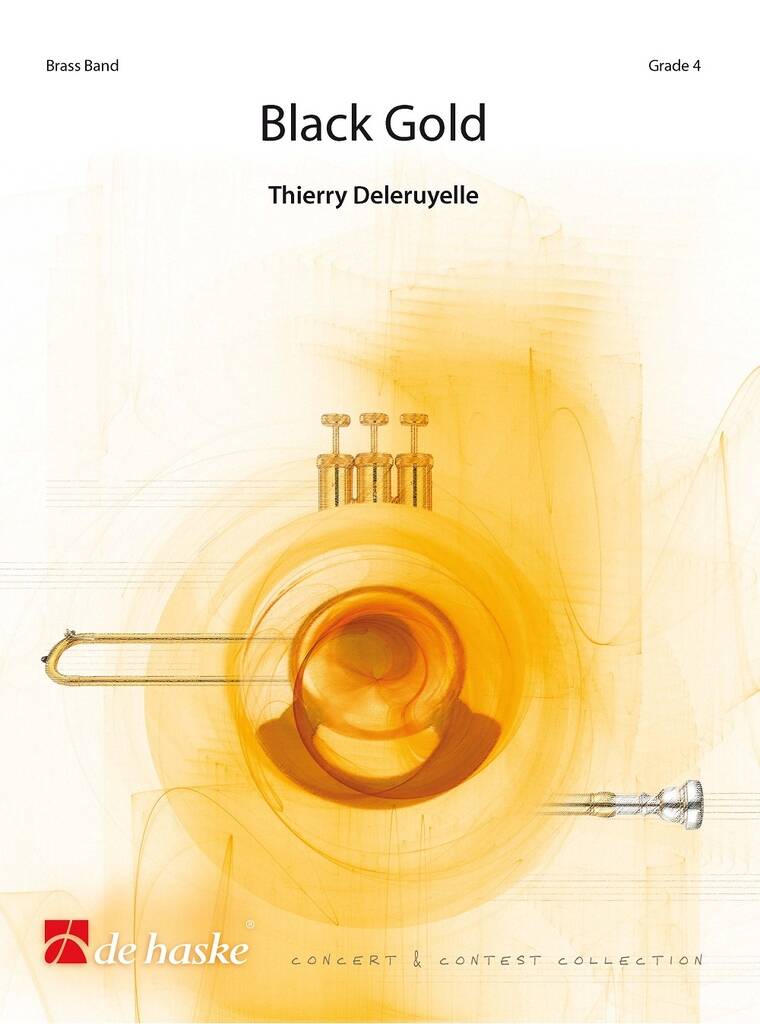
Black Gold - Thierry Deleruyelle
Black Gold was commissioned by Musikverein 1891 "Harmonie" Saarwellingen e.V. (Germany) to mark its 130th anniversary. This composition pictures the history of the mining industry in the town of Saarwellingen and its surrounding region, where the life of the miners as well as their families revolved around coal, or black gold, for centuries on end. The piece is based on motifs from the famous song "Gluck auf, Gluck auf, der Steiger kommt..." ("Good luck, good luck, the mining foreman comes"), a veritable anthem for miners the world over.
Estimated dispatch 5-14 working days
 View Music