
Results
-
 £46.50
Semper Fidelis (Brass Band - Score and Parts)
This march was written in 1888 and dedicated to the US Marine Corps, later being adopted as its official march. At the time of its composition Sousa was director of the US Marine Band.This brass band version contains a small amount of optional movement around the stage and a percussion feature. These will enhance the presentation.The arrangement was prepared for the Summer concerts presented by Brass Band of the Western Reserve, musical director Keith M Wilkinson, in 2008.
Estimated dispatch 7-14 working days
-
 £30.00
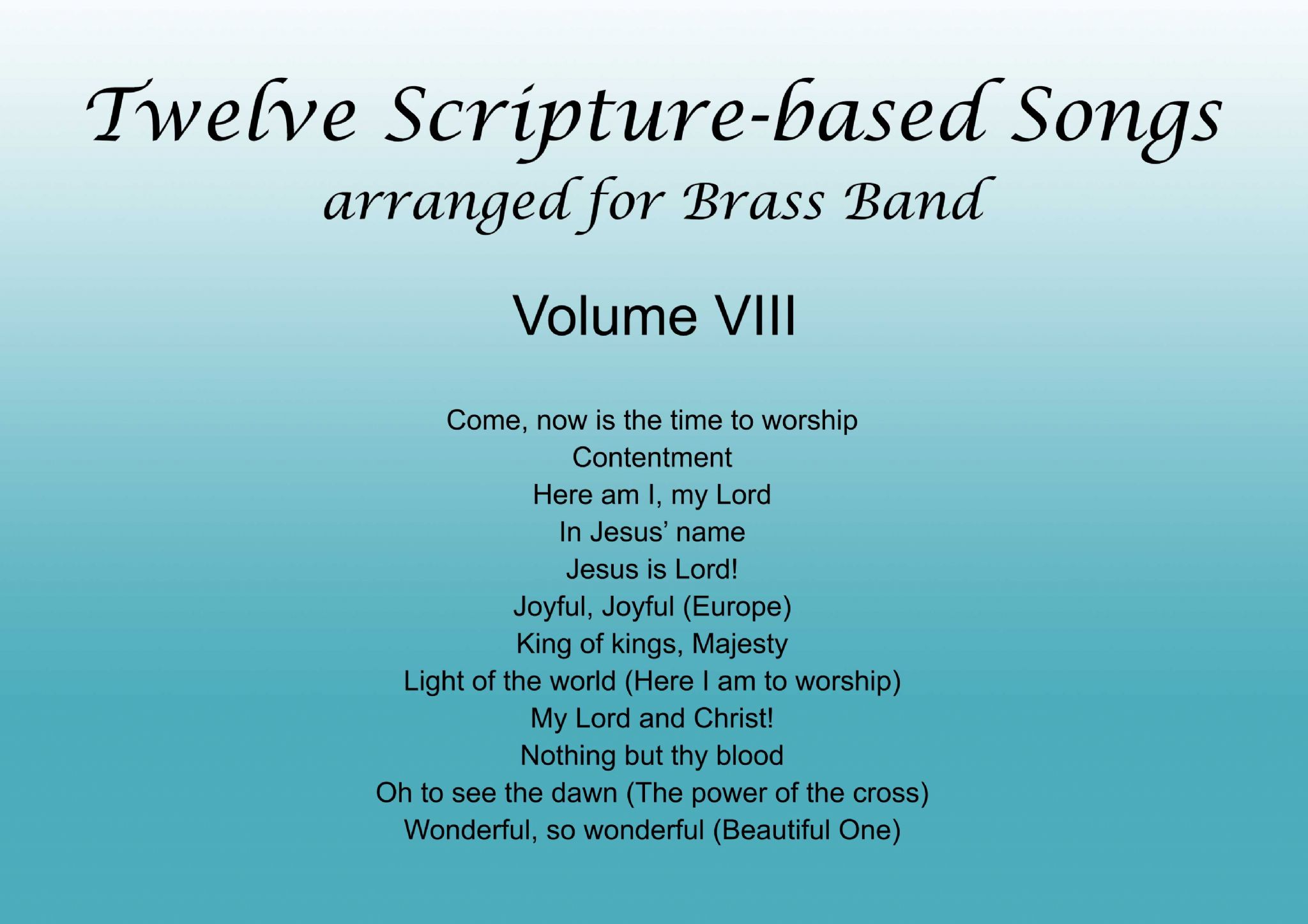
Twelve Scripture-Based Songs Volume VIII
Twelve scripture-Based Songs arranged for Brass Band (Volume VIII) are packaged and marketed in complete sets which include a full score and a set of master parts. It is intended that these parts be used as 'masters', for the purpose of photocopying a quantity of parts to accommodate the precise instrumentation needs of the band for which this has been purchased.Come, now is the time to worshipContentmentHere am I, my LordIn Jesus' nameJesus is Lord!Joyful, Joyful (Europe)King of kings, MajestyLight of the world (Here I am to worship)My Lord and Christ!Nothing but thy bloodOh to see the dawn (The power of the cross)Wonderful, so wonderful (Beautiful One)
Estimated dispatch 7-14 working days
-
 £94.95
Waiting for a Pain Hit!??!!? (Brass Band - Score and Parts)
Waiting For a Pain Hit!??!!? was written during November and December 2006 as an entry in the 2006/07 Swiss Brass Band Association Composers Competition. It was later chosen as the Championship Section set test piece for the 2010 Swiss National Brass Band Championships.The piece originates from sketches for a Brass Quintet which was written whilst I was in my second year of studies at the Royal Welsh College of Music and Drama. The piece, now being much more elaborate both musically and structurally than the original, aims to explore the many various textures available to a large brass ensemble. The aims of the piece, from its earliest stages, were mainly exploration of textures as well as dealing with issues of continuity and whilst the piece certainly contains challenging technical elements, they were not a driving force behind its inception and more organically grew from the primary aims of the piece. I was purposefully looking throughout the writing and editing process to create a piece of music with a seamless, ethereal quality to both the structure and the musical content.There are no 'performance directions' throughout the piece, the reasoning for this is explained below. However, I have spent much time and thought over the tempo markings throughout the piece and the tempos throughout the piece are the desired tempi and care should be taken with these. The tempo markings contained throughout the piece form a vital part of the structure and affect the continuity of the piece. Metronome marks contained within a box show the tempo of the new section in relation to the tempo that precedes it by use of metronome modulations. Any alterations to the tempo of the section that precedes it will alter the boxed metronome marks.The title of a piece of music, please forgive my generalisation, is to give an insight into 'what a piece is about'. I suppose that this piece is no different, but with the title being slightly abstract I shall resist the temptation to reveal what it means to me. The title, I feel, needs to be open to interpretation along with the music within. That's the way, with this piece especially, I like my music to be. Freedom to find our own meaning and a way to express it from within the score is vital. It is only then that the piece can take on its own identity and grow in ways that even I might not have imagined, revealing different sides to its personality with each performance.Before the music begins I have included some text. Do these words hold the key to the music?! Can they help??! I DON'T KNOW!!! I just like the rhythms, the pulse and the imagery. Hopefully, all of this can help to create a picture. But let it be your picture...- Paul McGhee, June 2010
Estimated dispatch 7-14 working days
-
 £94.95
Rhapsody on a Theme by Purcell (Brass Band - Score and Parts)
Contest VersionIn his relatively short lifetime, Henry Purcell (1659 -1695) achieved stellar musical success and was known and admired internationally by his contemporaries. He is justifiably considered one of England's greatest composers.I thought long and hard before using this magnificent theme as the basis for a band piece because I think that Benjamin Britten has said just about everything possible regarding it in his The Young Person's Guide to the Orchestra. Bearing this in mind, I tentatively set about working on this composition. Once started though, the job became fun because the theme still yielded possibilities - even after Britten!The piece is basically a set of linked variations, much like Rachmaninov's great Rhapsody on theme by Paginini. The music starts slowly and makes much use of crisply dotted rhythms - a Purcellian characteristic. The theme is heard twice before the music changes into a jaunty duple time variation based on the opening motif of Purcell's theme. After this, the mood changes to a waltz-like variation in which clear references to the original theme can be heard. The slow movement follows, and is based on rising and descending scalic figures. This variation is an 'A-B-A' movement with two similar passages framing a more vigorous middle section which features antiphonal fanfare-like figures. Without any preamble, the last variation launches itself - a rumbustious dance which has a distinctive feel to it.The theme eventually reappears as a counter-melody to this dance music before a final triumphant treatment of the melody featuring a somewhat athletic bass line. The music accelerates at the Coda and disappears in a 'puff of smoke'.- Kevin Norbury
Estimated dispatch 7-14 working days
-
£39.95
Rhapsody on a Theme by Purcell (Brass Band - Score only)
Contest VersionIn his relatively short lifetime, Henry Purcell (1659 -1695) achieved stellar musical success and was known and admired internationally by his contemporaries. He is justifiably considered one of England's greatest composers.I thought long and hard before using this magnificent theme as the basis for a band piece because I think that Benjamin Britten has said just about everything possible regarding it in his The Young Person's Guide to the Orchestra. Bearing this in mind, I tentatively set about working on this composition. Once started though, the job became fun because the theme still yielded possibilities - even after Britten!The piece is basically a set of linked variations, much like Rachmaninov's great Rhapsody on theme by Paginini. The music starts slowly and makes much use of crisply dotted rhythms - a Purcellian characteristic. The theme is heard twice before the music changes into a jaunty duple time variation based on the opening motif of Purcell's theme. After this, the mood changes to a waltz-like variation in which clear references to the original theme can be heard. The slow movement follows, and is based on rising and descending scalic figures. This variation is an 'A-B-A' movement with two similar passages framing a more vigorous middle section which features antiphonal fanfare-like figures. Without any preamble, the last variation launches itself - a rumbustious dance which has a distinctive feel to it.The theme eventually reappears as a counter-melody to this dance music before a final triumphant treatment of the melody featuring a somewhat athletic bass line. The music accelerates at the Coda and disappears in a 'puff of smoke'.- Kevin Norbury
Estimated dispatch 7-14 working days
-
 £164.99
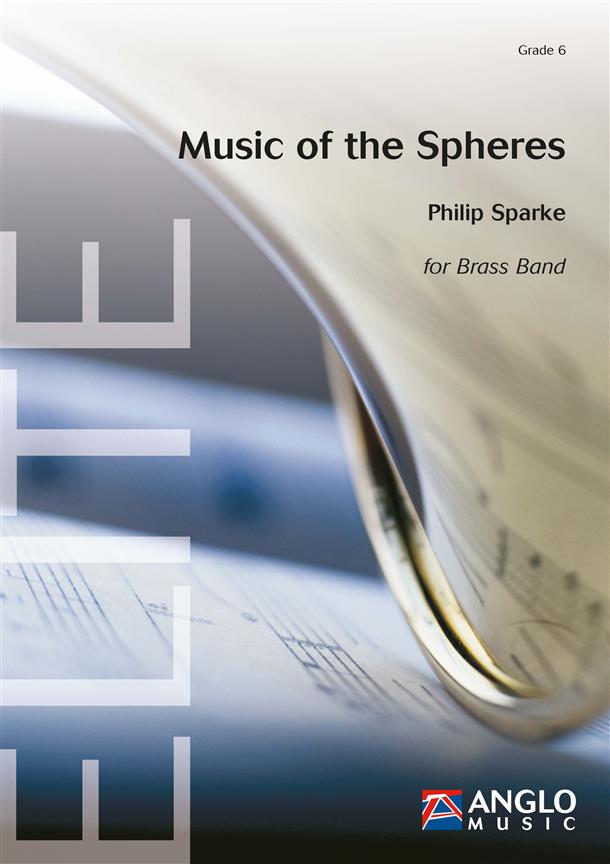
Music of the Spheres (Brass Band - Score and Parts)
Music of the Spheres was commissioned by the Yorkshire Building Society Band and first performed by them at the European Brass Band Championships in Glasgow, May 2004. The piece reflects the composers fascination with the origins of the universe and deep space in general. The title comes from a theory, formulated by Pythagoras, that the cosmos was ruled by the same laws he had discovered that govern the ratios of note frequencies of the musical scale. ('Harmonia' in Ancient Greek, which means scale or tuning rather than harmony - Greek music was monophonic). He also believed that these ratios corresponded to the distances of the six known planets from the sun and thatthe planets each produced a musical note which combined to weave a continuous heavenly melody (which, unfortunately, we humans cannot hear). In this work, these six notes form the basis of the sections Music of the Spheres and Harmonia. The pieces opens with a horn solo called t = 0, a name given by some scientists to the moment of the Big Bang when time and space were created, and this is followed by a depiction of the Big Bang itself, as the entire universe bursts out from a single point. A slower section follows called The Lonely Planet which is a meditation on the incredible and unlikely set of circumstances which led to the creation of the Earth as a planet that can support life, and the constant search for other civilisations elsewhere in the universe. Asteroids and Shooting Stars depicts both the benign and dangerous objects that are flying through space and which constantly threaten our planet, and the piece ends with The Unknown, leaving in question whether our continually expanding exploration of the universe will eventually lead to enlightenment or destruction.Duration: 18:00
Estimated dispatch 7-14 working days
-
 £44.99
Our Flirtations (Brass Band - Score and Parts)
The name John Philip Sousa is no stranger to any brass band aficionado. Our Flirtations has its origins in incidental music written by Sousa for a play of the same name. It was written around 1880, about the time he was appointed Director of the U.S. Marine Band, a position he held until he formed his own civilian band in 1892. Sousa wrote over 130 marches, many of which have been transcribed for brass band.
Estimated dispatch 7-14 working days
-
 £42.50
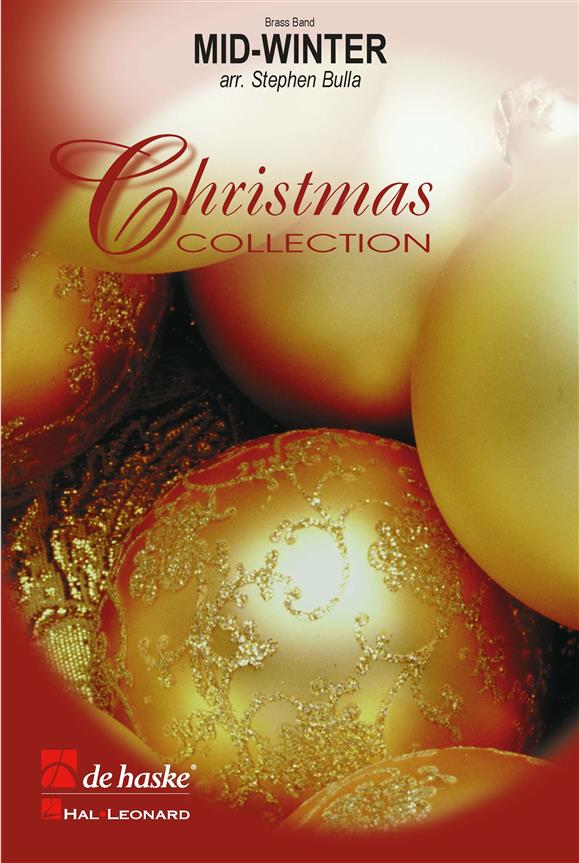
Mid-Winter (Brass Band - Score and Parts)
This beautiful Christmas tune by Stephen Bulla sets the perfect atmosphere for your Christmas concert. Light the candles and enjoy the most wonderful time of the year with friends, family and music.Duration: 4:40
Estimated dispatch 7-14 working days
-
 £89.95
Diversions for Brass Band, Op.97 (Brass Band - Score and Parts)
This work was commissioned in1985 by Skellerup, Christchurch, New ZealandMovements:Allegro VivaceAndante Con Moto Molto ExpressivoAllegro VivaceDerek Bourgeois wrote Diversions in the summer of 1985 to a commissioned from the Skellerup Brass Band.Bourgeois previous test piece, Blitz, was aggressive and forceful, therefore the composer decided to write a work of a completely different character, which although technically very demanding, is light-hearted in style, and easy on the ear, as the title suggests.The first and third movements share the same tempo, but are rather different in character. The first movement is a sonata allegro contrasting two main themes. The first is bold and jaunty and is heavily scored, the second announced by the solo horn is more lyrical in character. The development section and recapitulation are merged into a continuous interplay of the two themes.The second movement is an expressive andante in free rondo form. It is lightly scored for the most part with a lot of solo passages that make demands on the musicianship of the players and conductor alike. The very simplicity of its textures and the breadth of its melodic writing demand firm control of vibrato, phrasing and rubato.The brief finale is nothing short of a romp. Its ternary structure is highly rhythmic in character and only rarely do the performers enjoy the luxury of two consecutive bars in the same time signature!Duration: 11.00
Estimated dispatch 7-14 working days
-
 £37.95
The Year of the Dragon (Score Only)
The highlight of Cory's centenary celebrations throughout 1984 was a concert held in St. David's Hall, Cardiff, in March. The band, with the aid of funds provided by the Welsh Arts Council, commissioned Philip Sparke to write a work for first performance at this concert. The result was "The Year of the Dragon" of which the composer writes:"At the time I wrote The Year of the Dragon, Cory had won two successive National Finals and I set out to write a virtuoso piece to display the talents of this remarkable band to the full."The work is in three movements:TOCCATA opens with an arresting side drum figure and snatches of themes from various sections of the band, which try to develop until a broad and powerful theme from the middle of the band asserts itself. A central dance-like section soon gives way to the return of this theme, which subsides until faint echoes of the opening material fade to a close.INTERLUDE takes the form of a sad and languid solo for trombone. A chorale for the whole band introduces a brief spell of optimism but the trombone solo returns to close the movement quietly.FINALE is a real tour-de-force for the band with a stream of rapid semi-quavers running throughout the movement. The main theme is heroic and march-like but this is interspersed with lighter, more playful episodes. A distant fanfare to the sound of bells is introduced and this eventually returns to bring the work to a stirring close.
Estimated dispatch 7-14 working days