
Results
-
 £33.20
Menuet (Brass Band) Ravel arr. Rob Bushnell
Le Tombeau de Couperin (The Grave of Couperin) was written by Maurice Ravel between 1914 and 1917, originally a suite of piece for solo piano. Based on what was considered a traditional Baroque suite, Ravel wanted to pay homage to Baroque French keyboard music, whilst retaining his 20th-century chromaticism, making the work neoclassicist. Each movement is dedicated to the memory of a friend of the composer who died fighting in World War I. Ravel produced an orchestral version in 1919, omitting two of the original six movements. The Menuet was written in memory of Jean Dreyfus; Ravel had recuperated at his home. This arrangement is for the British-style brass band, with alternative parts for horns in F and bass-clef lower brass. A recording of the original composition can be found here: www.youtube.com/watch?v=jnNwEcBTSmk. Duration: Approx. 4 minutes Difficulty Level: 2nd Section + Duration: 4 minutes (depending on tempo and without any cuts) PDF download includes parts and score. Sheet music available at www.brassband.co.uk (UK) or https://satradecentral.org (USA) Instrumentation: Soprano Cornet Eb Solo Cornet Bb Repiano Cornet Bb 2nd Cornet Bb 3rd Cornet Bb Flugel Horn Bb Solo Horn Eb 1st Horn Eb 2nd Horn Eb 1st Baritone Bb 2nd Baritone Bb 1st Trombone Bb 2nd Trombone Bb Bass Trombone Euphonium Bb Bass Eb Bass Bb Timpani Percussion - Vibraphone & Glockenspiel
In Stock: Estimated dispatch 1-3 working days
-
 £29.95
Badinerie - Jonathan Bates
DURATION: 2'00". DIFFICULTY: Difficult. J.S Bach originally composed 'Badinerie' as part of his Orchestra Suite No. 2 in B Minor, and quickly became one of the most popular virtuoso show-pieces for flute players due to it's quick pace and complexity. In more modern times, the melody has become synonymous with the Nokia mobile phone ringtone, one of 2 famous early ringtones based on the music of Bach (alongside his Prelude to Cello Suite No.1). One lesser known take on the classic Badinerie is by Italian drummer Andrea Vadrucci (alias Vadrum) who has made a global reputation for himself by taking various well-known classical works and re-imagining them into a rock/metal style, and it is this interpretation which acts as the inspiration for this showy, yet tongue-in-cheek feature for percussion. .
In Stock: Estimated dispatch 1-3 working days
-
.png) £34.95
£34.95Christmas Carol, A - Jonathan Bates
DURATION: 4'00". DIFFICULTY: 3rd+. Composed for Strata Brass in 2020 as part of their COVID-19 induced, virtually recorded 'A Christmas Carol' (a new suite for brass bandlasting around 30 minutes in total), 'A Christmas Carol' was used as the grand finale to the whole show in which Ebenezer Scrooge has been shown the error of his ways by 3 ghosts on Christmas Eve and becomes a transformed man just in time for Christmas day. This uplifting and energetic work portrays all the joyous emotions associated with the festive period, incorporating a number of well-cherished Christmas carols and various quotes from through the 'A Christmas Carol' suite of music. .
In Stock: Estimated dispatch 1-3 working days
-
 £59.95
Heroes of Erin - Richard Rock
A suite of Irish music commissioned by Prof. David King for the University of Salford Brass Band. The suite is in 4 movements 'Mo Ghile Mear' - full band with small flugel feature, 'Bohemian' - Horn Solo, 'Lucht Siuil' - Cornet Solo and 'Molly's Wake' - Band feature
Titles No Longer Available
-
 £55.00
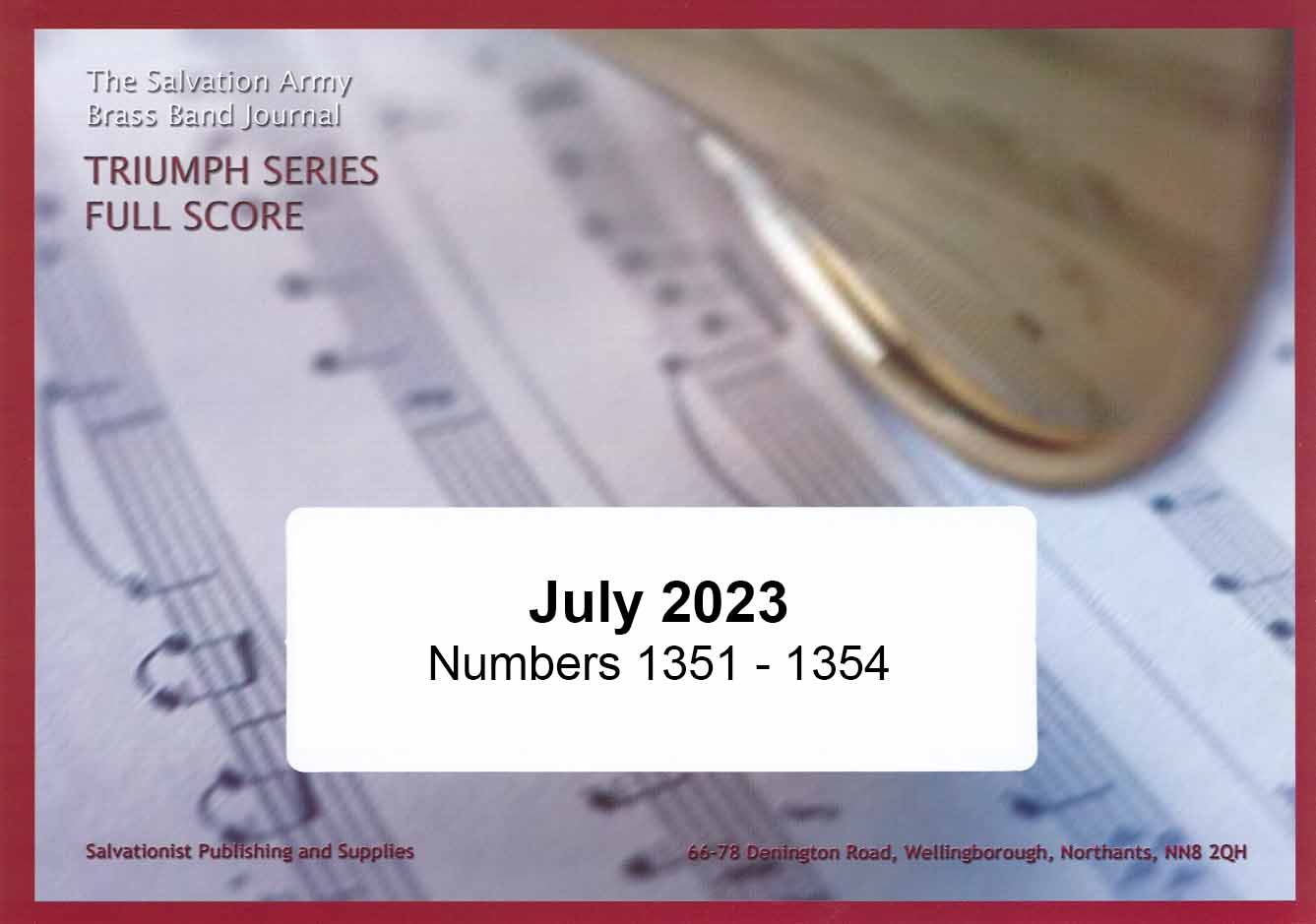
Triumph Series Brass Band Journal, Numbers 1351 - 1354, July 2023
1351: The anointed King (Marcus Venables)This piece was originally written as a massed band item for the Ontario Central-East Divisional Music Day in 2019. The updated version includes two songs, King of kings, majesty (S.A.S.B. 376) and O worship the King (S.A.S.B. 52) to a rhythmic setting of the tune Laudate Dominum (T.B. 481). Both songs present the contrasting characteristics of God; the powerful King and gentle, loving Saviour.1352: A suite of English Christmas carols (Kenneth Downie)This suite is the result of a request for a piece of music featuring exclusively English Christmas carols.The first movement features The holly and the ivy (C.C. 87). In sharp contrast, the second movement calls for a broad, sensitive, song-like approach. Using The cherry tree carol (C.C. 85), a much slower tempo than is normally applied to encourage the listener to see this beautiful tune in a new light. The rumbustious arrival of the finale is based on I saw three ships come sailing in (C.C. 44) with the festive mood prevailing until the end.1353: Nothing but thy blood (Norman Bearcroft)This two-verse setting of Richard Slater's much-loved hymn Nothing but thy blood (S.A.S.B. 769) appears straight-forward in nature, but requires a careful sense of the musical line across all parts.1354: Meditation - Reflections on Advent (Andrew Blyth)Two well-known carols, Away in a manger (C.C. 12) and Silent Night! (C.C. 77) are featured alongside original material. The piece attempts to convey a sense of reflection and meditation on the wonderful and awe-inspiring Advent story.
Estimated dispatch 7-14 working days
-
 £38.95
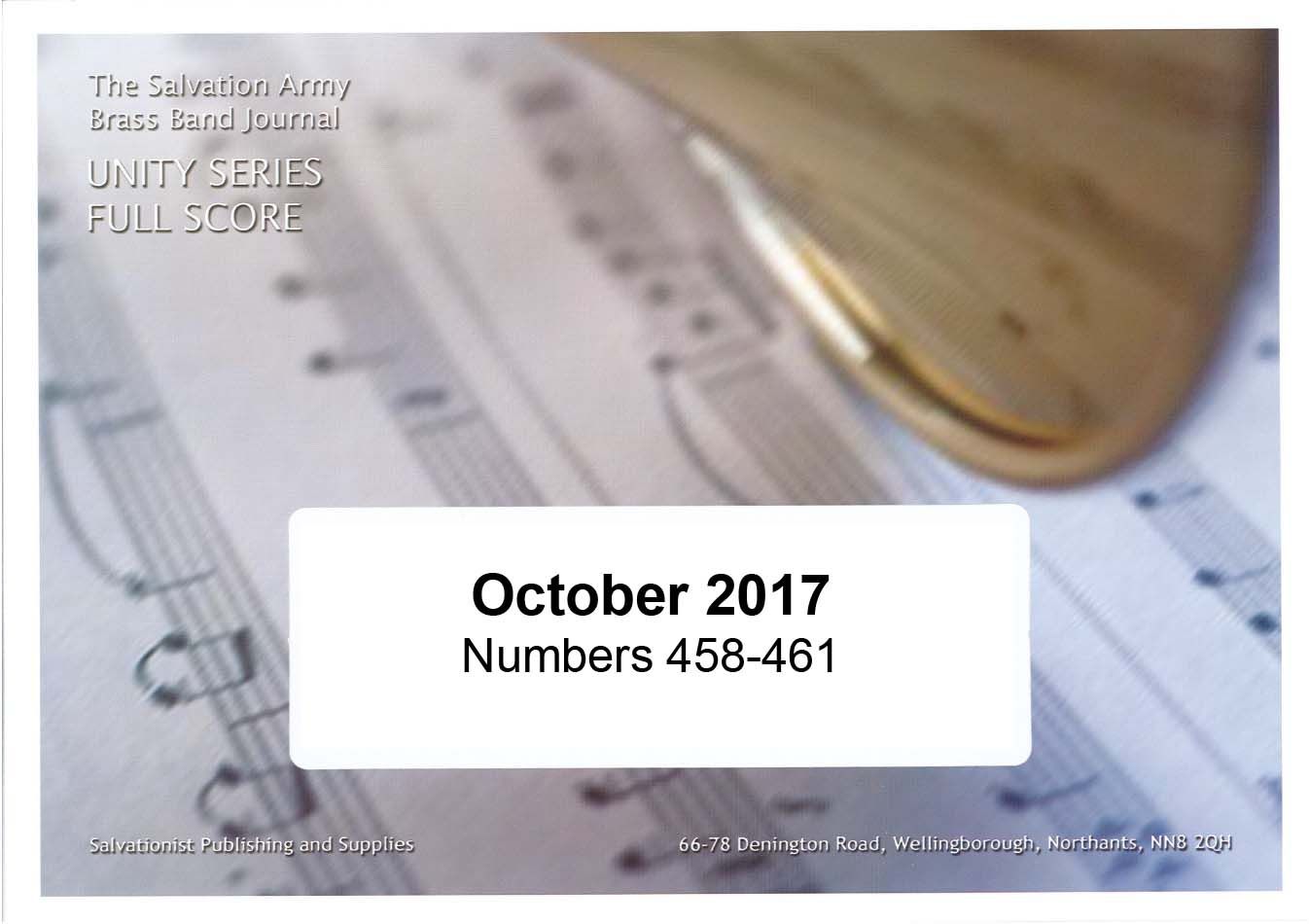
Unity Series Band Journal October 2017 Numbers 458-461
March Medley I Believe (Noel Jones)This potpourri of songs brings the strong assurance of faith and hope together in an attractive and enjoyable manner. The tunes featured are 'I believe we shall win', 'I believe God answers prayer', 'I believe in God the Father' and 'I believe in the word of God'.Horn Solo - Promises (Jorgen Ljserdorn)This is a brass setting of a song by Captain Matthew Spencer with the same title. The contemporary setting is simple in design and should prove to be popular amongst many who feature this journal.Suite Like a melody (Steve Forman)Major Stephen Foreman has written a short suite which will bring an easy yet attractive addition to most band's repertoire. I am praying (Jared Proellocks)A contemporary setting of the much loved chorus 'I am praying blessed Saviour' written by a young Salvationist from the Australian Southern Territory.
Estimated dispatch 7-14 working days
-
 £50.00
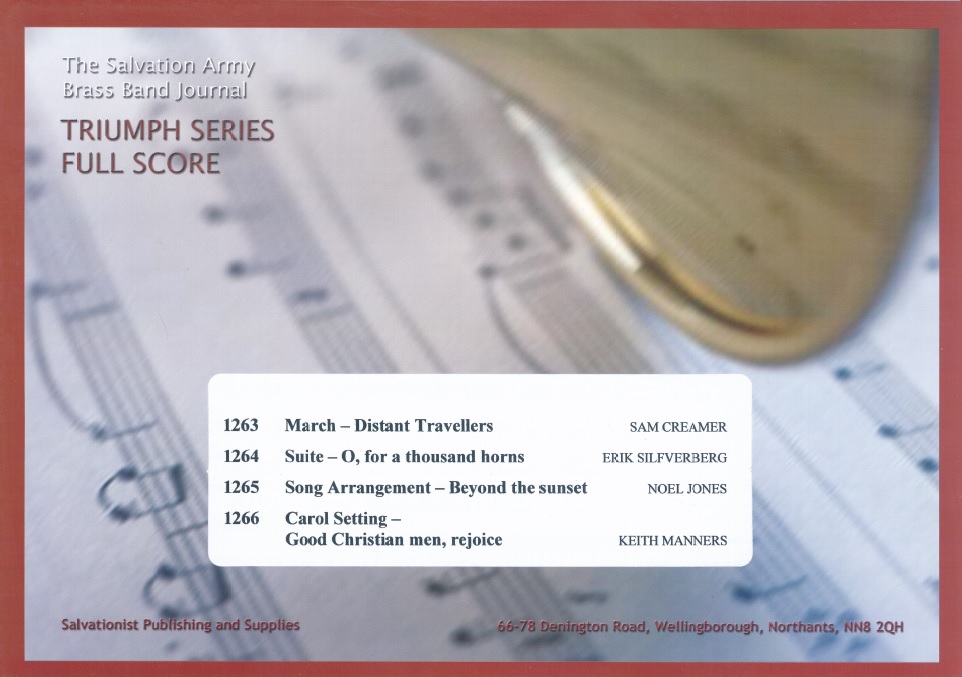
Triumph Series Band Journal July 2015 Numbers 1263 - 1266
No. 1263 March - Distant Travellers (Sam Creamer)With this Christmas march, we introduce a new contributor to our journals. Sam Creamer is a bandsman and songster at the Carindale Corps in Brisbane, Australia Eastern Territory. This march should prove a useful addition to the Christmas repertoire of many groups, as it features the well-known Christmas carols; When wise men come seeking (NCP 92) and While shepherds watched (NCP 93), as well as brief references to others.No. 1264 Suite - O, for a thousand horns (Erik Silfverberg)Bandmaster Erik Silfverberg OF has taken the song O for a thousand tongues by Charles Wesley, and has composed a suite in three movements with each of the movements exploring the sentiments of one of the verses. The tune Grimsby is heard in part throughout, but the majority of the musical material used is original.No. 1265 Song Arrangement - Beyond the sunset (Noel Jones)A three-verse setting of the song Beyond the sunset which speaks of the Christian's eternal home in Heaven.No. 1266 Carol Setting - Good Christian men, rejoice (Keith Manners)A bright setting of the well-known Christmas carol.
Estimated dispatch 7-14 working days
-
 £45.00
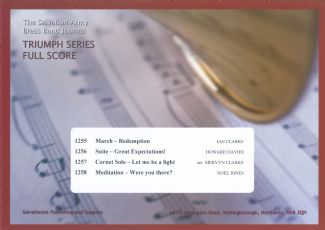
Triumph Series Band Journal November 2014 Numbers 1255 - 1258
No. 1255 March - Redemption (Ian Clarke)The words redemption and salvation are synonymous with each other. In theology, the word redemtion is defined as 'delivering from sin' or 'saving from evil'; sentiments that are expressed in some of the words associated with the songs that are featured in this music.No. 1256 Suite - Great Expectations! (Howard Davies)Three songs (written over a period of 25 years) are drawn together in this suite as a reminder of the great expectations rightfully held by every child of God.No. 1257 Cornet Solo - Let me be a light (arr. Mervyn Clarke)A setting for Cornet and band of Major Joy Webb's song, 'Let me be a light'.No. 1258 Meditation - Were you there? (Noel Jones)This meditation on Christ's crucifixion features the song, 'Were you there?', and the chorus, 'He died of a broken heart'.
Estimated dispatch 7-14 working days
-
 £110.00
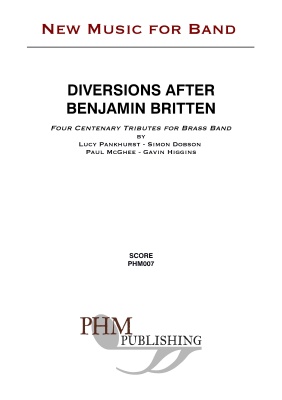
Diversions After Benjamin Britten (Brass Band - Score and Parts)
Suite by Lucy Pankhurst, Simon Dobson, Paul McGhee and Gavin HigginsHaving devised a collective centenary tribute for Michael Tippett at the 2006 RNCM Festival of Brass (Variations on a Theme of Michael Tippett by five eminent composers of brass band music, PHM002), I commissioned this companion piece as a Benjamin Britten tribute for the 2013 festival. In the late 1970s, while researching a book about the English composer, and Britten's first teacher, Frank Bridge (1879 - 1941), I came across a copy of the printed score of Benjamin Britten's Variations on a Theme of Frank Bridge (Op.10) for string orchestra, in which Britten had written descriptive titles for each of the variations suggesting appropriate character traits of his much loved mentor and guide. The character variations are cast in march, song and dance forms.Taking inspiration from Britten's youthful tribute, I invited four award-winning composers, who have all made significant contributions to the brass band medium, to create their own personal reflections on four aspects of Britten's character and music, designed to form a suite of Diversions after Benjamin Britten, but which can also be played separately.Lucy Pankhurst's hauntingly lyrical Prelude: His Depth refers to the emotional and symbolic subtexts that underpin Britten's operas, taking its musical cue from Britten's many arrangements of folk songs. The flugel horn takes a prominent role throughout.Simon Dobson's breathless Scherzo: His Vitality reminds us with its rapid passage work and leaping bass 'groove' that Britten loved tennis and fast cars in his younger days.Paul McGhee's evocative interpretation of the March: His Sympathy represents Benjamin Britten's pacifism, as the composer writes: 'We view the music through the eyes of a pacifist. Whilst war and violence surround us, we do not engage in it and though it continues to happen around us. With the use of muted effects in most of the band throughout the piece, the flugel horn is the lone voice of reason, standing firm against the mechanical and destructive society in which it is forced to live. As the machine of war continues around the lone voice, the voice is gradually dismissed and mocked as the war machine rumbles on into the distance.'In an extended finale, entitled Toccata: His Skill, Gavin Higgins celebrates Benjamin Britten's consummate creativity. For the RNCM Festival of Brass premiere, the four contrasting movements were framed and connected by Britten's Fanfare for St. Edmundsbury for three trumpets, with the trumpet soloists spaced round the hall. I am grateful to the Britten Estate and publishers Boosey & Hawkes for giving permission for the elements of Britten's fanfare to be incorporated in the collective work.- Paul HindmarshDuration: 19.30
Estimated dispatch 7-14 working days
-
£45.00
Diversions After Benjamin Britten (Brass Band - Score only)
Suite by Lucy Pankhurst, Simon Dobson, Paul McGhee and Gavin HigginsHaving devised a collective centenary tribute for Michael Tippett at the 2006 RNCM Festival of Brass (Variations on a Theme of Michael Tippett by five eminent composers of brass band music, PHM002), I commissioned this companion piece as a Benjamin Britten tribute for the 2013 festival. In the late 1970s, while researching a book about the English composer, and Britten's first teacher, Frank Bridge (1879 - 1941), I came across a copy of the printed score of Benjamin Britten's Variations on a Theme of Frank Bridge (Op.10) for string orchestra, in which Britten had written descriptive titles for each of the variations suggesting appropriate character traits of his much loved mentor and guide. The character variations are cast in march, song and dance forms.Taking inspiration from Britten's youthful tribute, I invited four award-winning composers, who have all made significant contributions to the brass band medium, to create their own personal reflections on four aspects of Britten's character and music, designed to form a suite of Diversions after Benjamin Britten, but which can also be played separately.Lucy Pankhurst's hauntingly lyrical Prelude: His Depth refers to the emotional and symbolic subtexts that underpin Britten's operas, taking its musical cue from Britten's many arrangements of folk songs. The flugel horn takes a prominent role throughout.Simon Dobson's breathless Scherzo: His Vitality reminds us with its rapid passage work and leaping bass 'groove' that Britten loved tennis and fast cars in his younger days.Paul McGhee's evocative interpretation of the March: His Sympathy represents Benjamin Britten's pacifism, as the composer writes: 'We view the music through the eyes of a pacifist. Whilst war and violence surround us, we do not engage in it and though it continues to happen around us. With the use of muted effects in most of the band throughout the piece, the flugel horn is the lone voice of reason, standing firm against the mechanical and destructive society in which it is forced to live. As the machine of war continues around the lone voice, the voice is gradually dismissed and mocked as the war machine rumbles on into the distance.'In an extended finale, entitled Toccata: His Skill, Gavin Higgins celebrates Benjamin Britten's consummate creativity. For the RNCM Festival of Brass premiere, the four contrasting movements were framed and connected by Britten's Fanfare for St. Edmundsbury for three trumpets, with the trumpet soloists spaced round the hall. I am grateful to the Britten Estate and publishers Boosey & Hawkes for giving permission for the elements of Britten's fanfare to be incorporated in the collective work.- Paul HindmarshDuration: 19.30
Estimated dispatch 7-14 working days
 View Music