
Results
-
 £59.95
Bonnie Northumbria - Brass Band - LM786
COMPOSER: Laurie JohnstonProgramme NotesNorthumberland, or Northumbria as it is also known, is the most northern county in England and has magnificent and stunning landscapes just waiting to be explored. Filled with mystical castles, atmospheric ruins and historical sites and edged by spectacular coastal scenery, there is something wonderful to see at every turn. The Devils Causeway passes through Northumbria and reaches Berwick upon Tweed at the coast. Walkers and cyclists can also take the Coast and Castles Cycle Route or the North Sea Trail which journey through some of the most beautiful scenery along the way.The Blaydon Races is aGeordiefolk songwritten in the 19th century byGeordie Ridley, in a style deriving frommusic hall. It is regarded by many as the unofficialanthemofTynesideand is frequentlysungby supporters ofNewcastle United Football ClubandNewcastle Falconsrugby club.Blaydonis a small town inGateshead, situated about 4 miles (6.4km) fromNewcastle upon Tyne, inNorth East England. The race used to take place on the Stella Haugh 1 mile (1.6km) west of Blaydon.Stella South Power Station(demolished in 1995) was built on the site of the track in the early 1950s, after the races had stopped taking place in 1916.Water of Tyne (sometimes rendered as The Waters of Tyne) is a folk song (Roud number1364) from the north-east of England. The song is sung by a girl or woman lamenting the fact that her paramour is on the opposite bank of theRiver Tyne. Sleeve notes to Michael Hunt's recording of Tyneside songs states that "the ferry is believed to be that atHaughton Castleon theNorth Tyne". Alternatively the "rough river" in the last line may indicate a point further downstream, possiblyTynemouth.The song was collected byJohn Bellin 1810 and published two years later inRhymes of Northern Bards.The Keel Row is a traditional Tyneside folk song evoking the life and work of thekeelmenofNewcastle upon Tyne. A closely related song was first published in aScottishcollection of the 1770s, but may be considerably older, and it is unclear whether the tune is Scottish or English in origin.The opening lines of the song set it inSandgate, that part of the quayside overlooking the River Tyne to the east of the city centre where the keelmen lived and which is still overlooked by theKeelmen's Hospital.Versions of the song appear in both England and Scotland, with Scottish versions referring tothe Canongaterather than Sandgate. The earliest printing was in the 1770s inEdinburghin A Collection of Favourite Scots Tunes, edited by Charles Maclean, though the tune was also found in several late eighteenth-century English manuscript collections. As the term "keel" was used both sides of the border, it has not been determined which version was the original, althoughFrank Kidsonsurmised that like many other songs collected by Maclean it may originally have been aJacobiteair from the time of the1745 rebellion. Some versions of the song make reference to a "blue bonnet[...] with a snowy rose upon it", a clear attempt to evoke Jacobite symbolism, whether dating from 1745 or not.Kidson, however, also noted that he had found the tune of The Keel Row associated with an early dance called "The Yorkshire Lad" as early as 1748.By the 19th century the tune was well associated with the River Tyne; a few years before the 1850s the keelmen had met yearly to celebrate the founding of the Keelmen's Hospital, perambulating the town to the accompaniment of bands playing The Keel Row.Dance To Thy Daddyis a traditional Englishfolksong, originating inNorth East England. An early source for the lyrics, Joseph Robson's "Songs of the bards of the Tyne", published 1849, can be found on the Farne archive. In Farne's notes to the song, it is stated that these lyrics were written by William Watson around 1826.
In Stock: Estimated dispatch 3-5 working days
-
£44.95
TRAILBLAZERS (Brass Band Set) - Andrew Mackereth
This overture draws its inspiration from the story of the first Household Troops Band. It tells the story of the 1887 band, the subsequent lull of nearly a hundred years and the re-awakening of the Troops phenomenon in 1985. It was originally written in 1995 and featured prominently by the band on its North American tour of 2002. Given the history of the Household Troops Band, it is fitting that this composition is preoccupied with marching. It begins with a marching song played by a solitary muted cornet, symbolic not only of the call to bandsmen to join the evangelical effort but also a muso-dramatic device to indicate the steady increase in members and technical ability! The music quickly develops into stirring versions of 'A robe of white' and 'Storm the forts of darkness' with two early day Salvation Army tunes crucially adding to the narrative; 'Marching on in the light of God' and 'Soldiers of our God, arise!' The second section is a reflective setting of the Herbert Booth song, 'The penitent's plea'. This song serves to represent the many people who were 'saved' during those early day campaigns. The expressive music transports the listener through a period of uncertainty and angst until finally reaching the song, 'There is a message, a simple message, and it's a message for us all'. The final section deals first with the emergence from the annals of history with the muted cornet figure again before, symbolically, the present day band bursts forth with an emphatic statement of 'Would you be free from your burden of sin? There's power in the blood'. The stirring climax represents a fitting tribute to those gallant pioneering musicians and their equally impressive and dedicated contemporaries.
Estimated dispatch 7-14 working days
-
£67.00
Riv i hjertet - Sondre Justad - John Philip Hannevik
The singer/ songwriter Sondre Justad was born in Lofoten in the north of Norway in 1990. His first album Riv i hjertet was released in 2015, and it became a huge success. He got very fine reviews in some of the largest norwegian newspapers, and the title-song was played frequently on the national radio-stations.The song title could loosely be translated as pulling at my heartstrings, and the song has a deep and dark meaning, with the opening lyrics sounding:If I knew - that I would be dying soon, would I be happy with the way I am living my life
Publisher Closed for Holidays. Est Delivery 13-14th Aug
-
 £55.00
California Dreamin'
ABOUT THIS PIECE: Bring a unique and evocative twist to your next concert with this arrangement of California Dreamin', as featured in the film San Andreas. Originally written by John and Michelle Phillips of The Mamas & The Papas, this iconic song from 1965 became an anthem of the 1960s counterculture, celebrated for its longing melody. In San Andreas, California Dreamin' takes on a haunting and dramatic tone, reflecting the tension and emotion of the film's story before erupting into high tempo drama. Perfect for any concert or special event, this arrangement of California Dreamin' offers a fresh take on a classic. A standout addition to any programme, it's sure to captivate audiences and leave a lasting impression. ENSEMBLE: Standard British Brass Band WHEN YOU BUY THIS PRODUCT, YOU GET: High-quality printed score and parts - DUE TO COPYRIGHT LAW THIS WORK IS NOT AVAILABLE IN AUSTRALIA, NEW ZEALAND OR NORTH AMERICA LEVEL: 2 LISTEN: DURATION: 3-minutes 30-seconds EXAMPLE SCORE: Click here LEVEL GUIDE: Level 1- Accessible to all Level 2 - c. UK third section and higher Level 3 - c. UK second section and higher Level 4 - c. UK first section and higher Level 5 - c. UK championship section level
Estimated dispatch 5-7 working days
-
 £27.00
Edward Gregson: Birthday Prelude for Brass Band
DescriptionThis short work for brass band was written in 1982 for a concert to celebrate the 80th birthday of Harry Mortimer, one of the great figures in the world of brass bands. Not surprisingly, it references the well-known song Happy Birthday, in a breezy, up-tempo, short concert prelude.The premiere was given at the Free Trade Hall in Manchester by the Fodens Band, conducted by Howard Snell.In 2014 the composer revised it for a trip to the North American Brass Band Championships, where it was performed, also as an 80th birthday tribute, this time to the composer's brother Bram; it was subsequently dedicated to both Harry Mortimer and Bram Gregson.For more information on Edward Gregson's music please visit the composer's website: www.edwardgregson.com
Estimated dispatch 7-14 working days
-
 £44.95
Trailblazers (Brass Band - Score and Parts) - Mackereth, Andrew
This overture draws its inspiration from the story of the first Household Troops Band. It tells the story of the 1887 band, the subsequent lull of nearly a hundred years and the re-awakening of the Troops phenomenon in 1985. It was originally written in 1995 and featured prominently by the band on its North American tour of 2002. Given the history of the Household Troops Band, it is fitting that this composition is preoccupied with marching. It begins with a marching song played by a solitary muted cornet, symbolic not only of the call to bandsmen to join the evangelical effort but also a muso-dramatic device to indicate the steady increase in members and technical ability! The music quickly develops into stirring versions of 'A robe of white' and 'Storm the forts of darkness' with two early day Salvation Army tunes crucially adding to the narrative; 'Marching on in the light of God' and 'Soldiers of our God, arise!' The second section is a reflective setting of the Herbert Booth song, 'The penitent's plea'. This song serves to represent the many people who were 'saved' during those early day campaigns. The expressive music transports the listener through a period of uncertainty and angst until finally reaching the song, 'There is a message, a simple message, and it's a message for us all'. The final section deals first with the emergence from the annals of history with the muted cornet figure again before, symbolically, the present day band bursts forth with an emphatic statement of 'Would you be free from your burden of sin? There's power in the blood'. The stirring climax represents a fitting tribute to those gallant pioneering musicians and their equally impressive and dedicated contemporaries.
Estimated dispatch 7-14 working days
-
£22.50
Trailblazers (Brass Band - Score only) - Mackereth, Andrew
This overture draws its inspiration from the story of the first Household Troops Band. It tells the story of the 1887 band, the subsequent lull of nearly a hundred years and the re-awakening of the Troops phenomenon in 1985. It was originally written in 1995 and featured prominently by the band on its North American tour of 2002. Given the history of the Household Troops Band, it is fitting that this composition is preoccupied with marching. It begins with a marching song played by a solitary muted cornet, symbolic not only of the call to bandsmen to join the evangelical effort but also a muso-dramatic device to indicate the steady increase in members and technical ability! The music quickly develops into stirring versions of 'A robe of white' and 'Storm the forts of darkness' with two early day Salvation Army tunes crucially adding to the narrative; 'Marching on in the light of God' and 'Soldiers of our God, arise!' The second section is a reflective setting of the Herbert Booth song, 'The penitent's plea'. This song serves to represent the many people who were 'saved' during those early day campaigns. The expressive music transports the listener through a period of uncertainty and angst until finally reaching the song, 'There is a message, a simple message, and it's a message for us all'. The final section deals first with the emergence from the annals of history with the muted cornet figure again before, symbolically, the present day band bursts forth with an emphatic statement of 'Would you be free from your burden of sin? There's power in the blood'. The stirring climax represents a fitting tribute to those gallant pioneering musicians and their equally impressive and dedicated contemporaries.
Estimated dispatch 7-14 working days
-
 £49.99
Chorale for Peace (Brass Band - Score and Parts) - Deleruyelle, Thierry
Chorale for Peace is a song of hope and peace for humanity. In commissioning this work, the wind band of Le Portel (France) wanted to pay tribute to the victims of 8 September 1943, when around 100 Allied planes dropped more than 5,000 bombs on the town of Boulogne and the surrounding area. In fact, this operation was nothing more than a diversion to make the enemy believe that a landing was imminent in the north of France. This music is slow, an adagio commemorating the human sacrifice of this operation. But more broadly, the composer also wanted to express his support for the peoples who, even today, suffer oppression.This set includes an optional choir part that offers the possibility of making an even deeper impression on the listener.Duration: 6.00
Estimated dispatch 7-14 working days
-
 £38.95
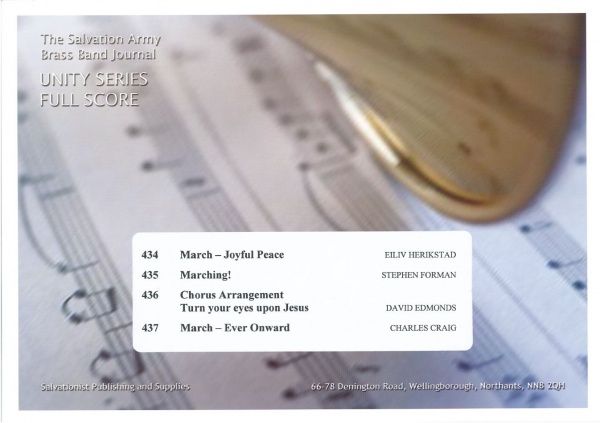
Unity Series Band Journal October 2015 Number 434 - 437
No. 434 March - Joyful Peace (Eiliv Herikstad)This march will pose few technical difficulties to most Unity Series bands. Keep the playing light and distinct throughout. Although the music is simple, please warn against carelessness!No. 435 Marching! (Stephen Forman)This bright energetic work from Major Stephen Forman features the well-known song 'We are marching' as its main theme. This South African song, called 'Siyahamba' in the original Zulu language, became popular in North American churches in the 1990s and soon spread internationally becoming a much featured song within many churches.No. 436 Chorus Arrangement - Turn your eyes upon Jesus (David Edmonds)A very simple, yet effective arrangement of this much-loved chorus, the words of which simply say:Turn your eyes upon Jesus,Look full in his wonderful face;And the things of earth will grow strangely dimIn the light of his glory and graceNo. 437 March - Ever Onward (Charles Craig)The Devonshire Corps of Tiverton celebrated its 140th birthday in 2014. Although small in number, it is highly regarded and respected for its Christian witness and work throughout the community.The march is written in a traditional style and should present no difficulties to the average band.
Estimated dispatch 7-14 working days
-
 £19.95
Judd: I Wonder as I Wander
'I wonder as I wander' was originally collected from North Carolina by the leading folksong collector, John Jacob Niles. It is said that he paid a young travelling evangelist, Annie Morgan, 25 cents an hour to sing the song until he had memorised it! Often referred to as a traditional Appalachian carol, it is unclear exactly how old the melody is.
Estimated dispatch 7-14 working days
 View Music