
Results
-
 £48.56
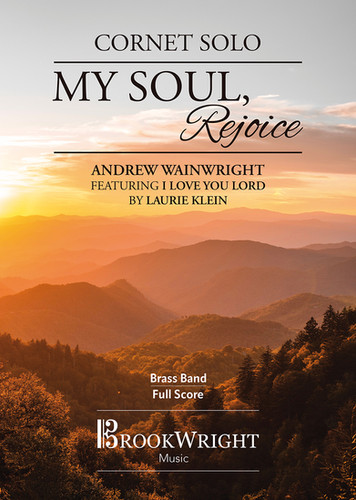
My soul, rejoice (Cornet Solo with Brass Band) Andrew Wainwright
My soul, rejoice (Andrew Wainwright) was commissioned in 2022 by Elizabeth Malovance, principal cornet of the Chicago Staff Band. A spirited and celebratory work, it is designed to showcase the dual nature of the cornet: its sparkling technical agility and its rich, vocal lyricism. The music begins in meditative fashion before transitioning into a joyful caprice featuring playful syncopations which are handed around the band. This is followed by a reflective section based on the much-loved worship song I love you Lord by Laurie Klein. The work concludes with a reprise of the original theme, building in momentum and intensity. Through a series of brilliant runs and virtuosic flourishes, the soloist leads the charge toward a majestic and triumphant finale, bringing the work to a ringing, glorious close. The solo was recorded by Richard Marshall on the 2026 CD Gothique Fantasy - The Music of Andrew Wainwright, which was his last solo recording of his 20-year tenure as principal cornet of Black Dyke Band. Technical Requirements & Electroacoustic Integration This work features an optional digital delay effect for the soloist, indicated in the score by "pedal on" and "pedal off" markings. If the required equipment is unavailable, the piece can be performed entirely acoustically. To listen to Beth Malovance performing the work with the Chicago Staff Band please visit https://on.soundcloud.com/c8IoU3CF3srTD4z0wX Duration: approx. 8 minutes Difficulty Level (Band): 2nd Section + Soloist: Advanced This PDF download includes the full score and parts. Sheet music available at www.brassband.co.uk (UK) or https://satradecentral.org (USA) Instrumentation: Soprano Cornet Eb Solo Cornet Bb 1st Cornet Bb 2nd Cornet Bb Flugel Horn Bb Solo Horn Eb 1st Horn Eb 2nd Horn Eb 1st Baritone Bb 2nd Baritone Bb 1st Trombone Bb 2nd Trombone Bb Bass Trombone Euphonium Bb Bass Eb Bass Bb Timpani & Bass Drum Percussion 1-3
In Stock: Estimated dispatch 1-3 working days
-
£70.00
A Tallis Anthem - Geert Jan Kroon
A Tallis Anthem is based on If Ye Love Me by Thomas Tallis (1505-1585). He was one of the first who set English words to the Rites of the Church of England. If Ye Love Me is a classic example of the new English anthems: mainly homophonic, but with brief moments of imitation. The opening is a triumphant version of the first homophonic phrases of the song, interrupted by a calm melody build with material from a motive from the original. The anthem is played by a quartet placed in front of the band or of stage for efect. This is followed by a more modern anthem leading to a triumphant finale.
-
 £30.00
Amazing Grace (W. Walker arr. by Paul Pennicotte-Henrie) - Brass Band Sheet Music Full Score and Parts - LM642
COMPOSER: W. WalkerARRANGER: Paul Pennicotte-Henrie"Amazing Grace" is a Christian hymn published in 1779 by English Anglican clergyman, abolitionist, and poet John Newton. It is possibly the most sung and most recorded hymn in the world and is especially popular in the United States, where it is used for both religious and secular purposes. Newton wrote the words from personal experience; he grew up without any particular religious conviction, but his life's path was formed by a variety of twists and coincidences that were often put into motion by others' reactions to what they took as his recalcitrant insubordination. He was pressed into service with the Royal Navy, and after leaving the service, he became involved in the Atlantic slave trade.In 1748, a violent storm battered his vessel off the coast of County Donegal, Ireland, so severely that he called out to God for mercy. While this moment marked his spiritual conversion, he continued slave trading until 1754 or 1755, when he ended his seafaring altogether. Newton began studying Christian theology and later became an abolitionist.Ordained in the Church of England in 1764, Newton became the curate of Olney, Buckinghamshire, where he began to write hymns with poet William Cowper. "Amazing Grace" was written to illustrate a sermon on New Year's Day of 1773. It is unknown if there was any music accompanying the verses; it may have been chanted by the congregation. It debuted in print in 1779 in Newton's and Cowper's Olney Hymns, but settled into relative obscurity in England. In the United States, "Amazing Grace" became a popular song used by Baptist and Methodist preachers as part of their evangelizing, especially in the American South, during the Second Great Awakening of the early 19th century. It has been associated with more than 20 melodies. In 1835, American composer William Walker set it to the tune known as "New Britain" in a shape note format; this is the version most frequently sung today.
In Stock: Estimated dispatch 3-5 working days
-
£34.95
SOUTHERN CROSS, The (Brass Band Set) - Brian Bowen
The Southern Cross is one of several excellent marches by Brian Bowen in which he carried on the more sophisticated pattern of British marches by Wilfred Heaton, Leslie Condon and Ray Steadman-Allen. It was written for the Box Hill (Australia) Corps jubilee celebrations in 1970 and formed part of the band's repertoire when it toured Great Britain in the same year. The first half of the march features part of the song, 'March on!' by Klaus Ostby, an early pioneer of Salvation Army music in Scandinavia. The contrapuntal layering of melodies in the trio, especially in the finale where 'March on!' sounds one more triumphant time, is notable, as is the shift to a slower, more stately tempo. The harmonic and rhythmic style also represents the more modern sounds of Salvation Army brass band music in the late 1960s and early 1970s. Right from the opening gestures, listeners at early performances knew that a page had turned in the evolution of the Salvation Army march.
Estimated dispatch 7-14 working days
-
£44.95
LIFE ABUNDANT (Cornet Solo with Brass Band Set) - Robert Redhead
Life Abundant is a cornet solo written as a musical biography of the search of soul to find the meaning of life. The music begins with the dawning of life, then the abundant joy of childhood ('My cup is full and running over'), followed by the uncertainty of the youth who longs to say 'I want to live right' but doesn't know how. The answer comes in a meditative setting of the composer's own song 'One life to live, O may I live for Thee', after which the music confidently builds to a climax which expresses the joy of abundant life found in Jesus".
Estimated dispatch 7-14 working days
-
 £30.00
Leviathan - Paul Denegri
Leviathan began its evolution as a workshop work inspired by the poem written by Heathcote Williams entitled; Whale Nation. At the time of this workshop the tentet brass repertoire existed of extremely well written original or arranged works of a lighter nature but there was a shortage of works with a greater emotional depth and edge, hence Leviathan's early conception as an atmospheric and emotive work. The workshop piece explored whale sound and song and was a 25-minute work in two parts. After many years of the workshop sketches sitting dormant the new work Leviathan is a much shorter and concise work. It contains only one of the original melodic themes of the workshop work. Leviathan is driven and underpinned by melodic and rhythmic elements. It is a programmed work following the awe inspiring majestic might and beauty of whales through to a hunt scene, the chase and the ultimate demise of earth's largest mammal.
-
 £25.95
African Trio - Kenneth Downie
As it's title suggests, this piece consists of three distinct elements, all of which maximise the stylish creativity of Kenneth Downie's renowned writing talent.After a rich, warm and hymnal opening 'movement' based upon Kum Ba Yah, the work develops and lifts into a fascinating take on 'The Lord's Prayer'. Bringing the piece to an even more positive, up-tempo close is the final section which references the South African traditional song We Are Marching (Siyahamb' ekukhanyen' kwenknos')Kenneth Downie composed this work in support of a charitable project, known in 2005 as Brass Band Aid. The organisation called for original compositions to be included in a follow-up CD release - Into Africato help raise funds for projects in Adet, Africa, and to build awareness of theMake Poverty History campaign. African Trio was featured on the CD with a recording by The National Youth Band of Wales.Now that the original BBA projects are complete, funds raised by the titles we publish from theBrass Band Aidseries continue to support other music-related projects on a regular basis.Look and Listen (performance courtesy of Golden Gate British Brass Band in 2019):
In Stock: Estimated dispatch 3-5 working days
-
 £30.00
Down By The Salley Gardens
A new brass band release for 2023 which also welcomes Fiona Neary as a new member of our ever-growing family of writers!This traditional Irish folk tune has been beautifully arranged for brass band, offering a tranquil moment to your programme with a memorable jaunty jig section to keep your listeners on their toes!Every concert needs that 'Aaahhhh' element, and Down By The Salley Gardens certainly brings all the qualities required to meet that need.This original traditional Irish melody has been referred to by a variety of titles: 'Mourne Shore', 'Moorlough Shore' and 'The Maids of Mourne Shore', and is believed to have dated back to the 17th-18th century.In 1889, William Butler Yeats had his poem 'Down By The Salley Gardens' published in The Wanderings of Oisin and Other Poems. The verse was then later set to the Irish melody by Herbert Hughes in 1909. Since this combining, the music has become synonymous with the poem and naturally adopted the poem's title.Due to the beauty of the melody and the emotive words of the associated poem, both elements of this work has been embraced by a variety of artistes, including recordings by The Corrs and Sinead O'Connor; John Ireland (1879-1962) set the words to an original melody in his song cycle Songs Sacred and Profane, written in 1929-31; there is a vocal setting by the poet and composer Ivor Gurney, which was published in 1938; and Benjamin Britten published a setting of the poem in 1943.
In Stock: Estimated dispatch 3-5 working days
-
 £15.00
Jupiter from the Planet Suite - Holst
Programme notes:The hauntingly beautiful theme from Jupiter, from The Planets Suite has a rare qualityexpressing both optimism and dignity which makes it a popular choice for many formalpublic events such as opening and award ceremonies.The tune is originally found in the Jupiter movement from the large-scale work fororchestra called 'The Planets Suite'. Written by the English composer Gustav Holt ThePlanets Suite is thought to be his finest work.The theme has a steady 3/4 rhythm which provides a contrast in terms of tempo andmeter to the rest of the movement, and has been made popular as a patriotic song called'I vow to Thee My Country'.Performance notes:This arrangement makes use of a gradual increase in dynamics, beginning p and ending ff.With this gradual increase in dynamics is a gradual increase in the scoring starting offwith only the lower instruments playing p and ending up with everyone playing ff.The percussion part is very minimal in this arrangement (only 2 notes for the suspendedcymbal) and is an optional part.Just before the final chord there is a cut off marked in the parts. This may be a newconcept for some inexperienced players so it should be fully explained by the conductor.The Flexi-Collection ApproachFlexible scoring tailored to your needs - A perfect solution for expanding the repertoire of training and junior brass bands. The Flexi-Collection currently offers two series - Popular Classics and World Tour. Based on four-part harmony, these collections provide groups with the advantage of complete flexibility when they may not be balanced. If players or instruments are missing, the show can still go on!The Flexi-Collection - Popular Classics Series, encapsulates all that is great about the wonderful range of musical styles produced by Holst, Elgar, Handel, Verdi, Tchaikovsky, Grieg, Bizet and Parry.The thoughtful scoring and arranging by Andrew Duncan now means that groups of all abilities have access to a truly flexible set of music for their needs. With world parts, rudimentary theory, terminology translations and large format typesetting, The Flexi-Collection ticks all the boxes when it comes to bringing interesting music to the training and junior band/brass group environment.Available individually or as part of the money-saving Flexi-Collection Popular ClassicsAlbum.Scored for Brass Band and supplied with additional Easy Bb, Easy Eb and world parts - The Flexi-Collection offers flexibility in every sense of the word.
In Stock: Estimated dispatch 3-5 working days
-
 £41.09
Allegro Spirito from Symphony No.2 (Brass Band) Borodin arr. Harold Burgmayer
Alexander Borodin's Second Symphony in B minor dates from the years 1869-76, a time when he was also working on his enduring opera Prince Igor. Flavors of the exotic and outdoor celebration seemed to have spilled over from the opera in this brilliant sonata movement. Borodin seldom quotes Russian folk tunes, but his graceful melodic lines are permeated with the spirit of his native song, supported by iridescent harmonies and bright colors. This arrangement for brass band was premiered by The Salvation Army's New York Staff Band, with Ronald Waiksnoris conducting, at Alice Tully Hall in New York City on 11 April 2001. This complete transcription of the Finale movement of Borodin's Second Symphony has an approximate duration of 6.40 minutes. To alternatively utilize the piece as an opener, a cut from bar 173 to 272 is indicated with Coda signs, reducing the piece to 4.30 seconds. To view a rolling score video of the work please visit www.youtube.com/watch?v=x4SqSXLopRo Difficulty Level: 2nd Section + PDF download includes parts and score. Sheet music available at www.brassband.co.uk (UK) or https://satradecentral.org (USA) Instrumentation: Soprano Cornet Eb Solo Cornet Bb Repiano Cornet Bb 2nd Cornet Bb 3rd Cornet Bb Flugel Horn Bb Solo Horn Eb 1st Horn Eb 2nd Horn Eb 1st Baritone Bb 2nd Baritone Bb 1st Trombone Bb 2nd Trombone Bb Bass Trombone Euphonium Bb Bass Eb Bass Bb Timpani Percussion 1-3
In Stock: Estimated dispatch 1-3 working days
 View Music