
Results
-
£60.99
Soul Time - Roland Kernen
Soul Time by Roland Kernen has the two most important elements of any hit pop song - a driving rhythm and an attractive and catchy melody. This work has a three-part structure - a lively and exciting opening, a more peaceful middle section and an exuberant reprise. Get into the groove with this soulful work for brass band.
Estimated dispatch 5-14 working days
-
 £54.99
Feelings - Morris Albert - Roland Kernen
Feelings is a well-known easy listening hit that was written halfway through the 1970s, by the Brazilian singer-songwriter Morris Albert. However, the melody is derived from a French song (Pour toi) from 1957, written by Louis Gaste, who made this claim successfully. Over the years, Feelings has been performed by famous artists like Ella Fitzgerald, Frank Sinatra and Elvis Presley. Numerous arrangements have been made for various instrumentations. This arrangement by Roland Kernen does justice to the original.
Estimated dispatch 5-14 working days
-
 £84.99
Christmas Brass - Richard Peaslee
Christmas Brass is a fantasy on six carols, originally commissioned by Mark Freeh for the Manhattan Brass Choir. Duration: 16:30The well-known tune, O Come, O Come Emmanuel, a hymn originally based on a plainsong melody, is here set in 5/4 meter. Modal harmonies are combined with big band style as the piece gains momentum, greatly accentuating the mood of the words, "Rejoice! Rejoice! Emmanuel." The opening 5/4 statement of the theme returns, and the piece ends quietly.In Beautiful Savior (also known by the title Fairest Lord Jesus), a hushed beginning featuring horns, euphoniums, and a muted trumpet, leads through a key change to a satisfying, chorale-likeclosing passage.In Away in a Manger, Peaslee sets two tunes, Cradle Song and Away in a Manger. Following a straightforward presentation of each melody, Peaslee plays them against one another. The music swells to a full climax followed by a hushed ending.Peaslee employs a gentle hand in It Came Upon a Midnight Clear, using flugelhorn solos and duets in a jazz-waltz style.In Silent Night, the traditional carol gets an untraditional harmonization, propelled forward by give-and-take between the two groups of brass instruments in the brass choir: trumpets and trombones versus horns, euphoniums, and tuba.Hark! The Herald Angels Sing begins with a humorous blast of discordant harmonies as multiple carols are sounded at the same time. An up-tempo 4/4 announcement of the melody in the trombone is followed by a metrical modulation in 6/8-3/4 time. An additional metrical modulation bring the music back into 4/4, but at a slower tempo and in a pronounced jazz style. Tempo I returns, and the set of six pieces closes with a big ending.Instrumentation: 4 Trumpets, 2 Horns in F, 4 Trombones, 2 Euphoniums, Tuba, Guitar, Bass, Percussion
Estimated dispatch 5-14 working days
-
 £55.00
The Dreaded Groove and Hook - Simon Dobson
The Dreaded Groove and Hook is an up-tempo acid-jazz number that draws inspiration from bands like Jamiroquai and The Youngblood Brass Band. The groove in question is the main tune that is shared round theband, whilst the hook, in 'pop' terms, is the catchy bit of the song. The whole band joins in to play a huge 'riff' that acts as a chorus to the jazz-like verses. The piece was commissioned by JasonKatsikaris and The Leyland Band, who gave the first performance as part of their programme for the Brass In Concert Championships, held at The Sage, Gateshead on the 16th November 2008. It has now been recorded by the same bandandconductor on the CD entitled Penlee.Brass Band Grade 5: 1st SectionDuration: 4 minutes
Estimated dispatch 5-14 working days
-
 £177.00
The Phantom of the Opera - Andrew Lloyd Webber - Erik Janssen
The English composer Andrew Lloyd Webber has managed to create one worldwide success after another during the last fifteen years. After the musical 'Jesus Christ Superstar' in 1971 which caused quite a stir, 'Evita' followed (1976), 'Cats' (1981), 'Song and Dance' (1982, a combination of 'Variations' and 'Tell me on a Sunday'), 'Starlight Express' (1984) and 'Requiem' (1985). His musical 'The Phantom of the Opera' saw its first performance in 1986 in London, featuring Sarah Brightman and Michael Crawford. This musical won both the Laurence Olivier Award and the Evening Standard Drama Award for the 'Best Musical of 1986'.
Estimated dispatch 5-14 working days
-
 £61.00
Caro Mio Ben - T. Giordano - Willy Hautvast
Here we have one of the most famous 'Arie antiche' (ancient aria's) from the 18th century, written in the style of Handel. For many years it has been attributed to Giuseppe Giordani, opera and sacred music composer of the Neapolitan school. However, recent investigations clearly established that this song had actually been composed by his son Tommaso (1733-1806). This delicate wind band arrangement by Willy Hautvast can also be performed with a vocal soloist or a mixed choir.
Estimated dispatch 5-14 working days
-
 £68.60
Fanfare, Dance and Choral - Giovanni Giacomo Gastoldi - Henk van Belcum
Henk van Belcums used the festive and much loved song 'In Thee is Gladness', in this arrangement. Better known as 'Geest van hierboven' (Hymn 477) from the Songs for the Church (NL). A glorious fanfare opens the piece, which is then followed by a bright dance. The hymn is heard in the chorale section, in a fancy new setting, and the piece closes with a reprise of the opening fanfare.
Estimated dispatch 5-14 working days
-
 £105.20
I Don't Know How to Love Him - Andrew Lloyd Webber - Øystein Sjøvaag Heimdal
This is a ballad from the rock-opera "Jesus Christ Superstar" written by Andrew Lloyd Webber (Music) and Tim Rice (Lyrics). Together with the title song, this ballad is the most popular tune from Jesus Christ Superstar. It's recorded and performedlive by many artists since the music saw the light of day in 1971.This arrangement can be performed with a vocal- or instrumental solist. In addition to the vocal solo part, there are also solo-options for the followinginstruments:Eb-Cornet Bb-Cornet Eb-Horn Flugelhorn Baritone - Euphonium - Trombone
Estimated dispatch 5-14 working days
-
 £115.60
En bitte liten funklende stjerne - Numme - Øystein Sjøvaag Heimdal
This song written by Yngvar Numme and Benny Borg was made popular by Norwegian group Dizzie Tunes on one of their Christmas-albums. This arrangement is based on the Dizzie Tunes version and features the original solo for trumpet or cornet. The Drum Set part is optional so one can perform the arrangement without this part.
Estimated dispatch 5-14 working days
-
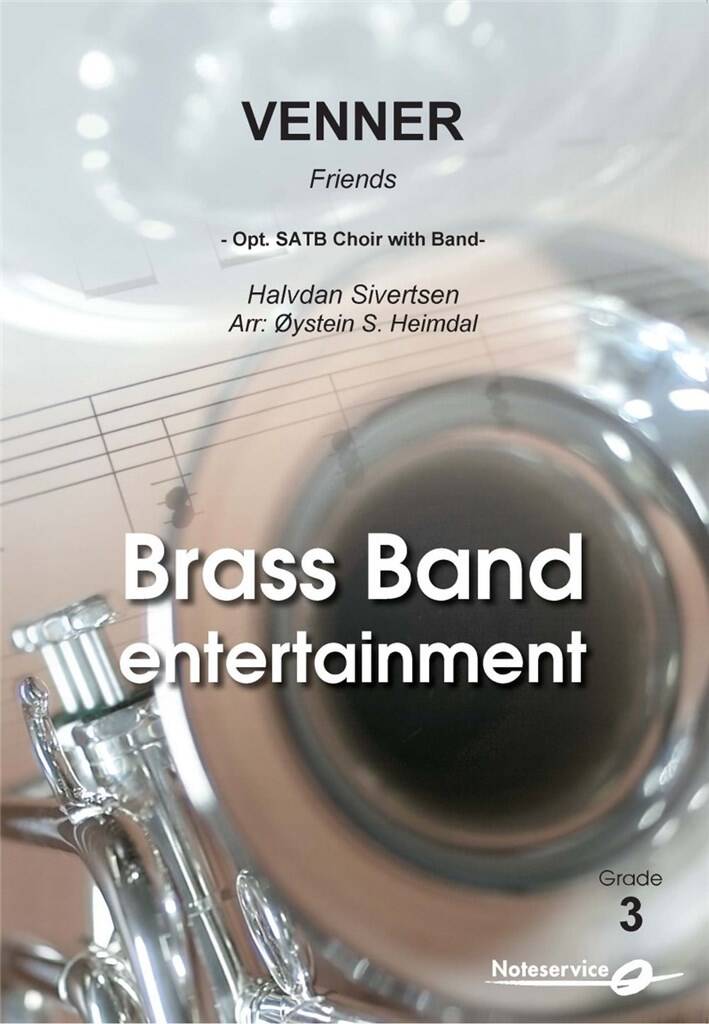 £127.30
Venner - Halvdan Sivertsen - Øystein Sjøvaag Heimdal
This pop-song written and performed by Halvdan Sivertsen was first released on the record album "Hilsen Halvdan" in 1991. Since then, is has been a classic song in Norway. The lyrics is about the benefits of having a lifelong friendship. This arrangement can be performed with SATB choir but works very well also as an instrumental piece. Choir parts are available for purchase separately.
Estimated dispatch 5-14 working days
 View Music