
Results
-
 £46.00
Amazing Grace (Eb Tenor Horn) - Kevin Ackford
Score & Parts One of the most popular Hymns of all time. This arrangement from Kevin has a touch of something different about it. A great crowd pleaser.
Estimated dispatch 5-7 working days
-
 £59.95
Bonnie Northumbria - Brass Band - LM786
COMPOSER: Laurie JohnstonProgramme NotesNorthumberland, or Northumbria as it is also known, is the most northern county in England and has magnificent and stunning landscapes just waiting to be explored. Filled with mystical castles, atmospheric ruins and historical sites and edged by spectacular coastal scenery, there is something wonderful to see at every turn. The Devils Causeway passes through Northumbria and reaches Berwick upon Tweed at the coast. Walkers and cyclists can also take the Coast and Castles Cycle Route or the North Sea Trail which journey through some of the most beautiful scenery along the way.The Blaydon Races is aGeordiefolk songwritten in the 19th century byGeordie Ridley, in a style deriving frommusic hall. It is regarded by many as the unofficialanthemofTynesideand is frequentlysungby supporters ofNewcastle United Football ClubandNewcastle Falconsrugby club.Blaydonis a small town inGateshead, situated about 4 miles (6.4km) fromNewcastle upon Tyne, inNorth East England. The race used to take place on the Stella Haugh 1 mile (1.6km) west of Blaydon.Stella South Power Station(demolished in 1995) was built on the site of the track in the early 1950s, after the races had stopped taking place in 1916.Water of Tyne (sometimes rendered as The Waters of Tyne) is a folk song (Roud number1364) from the north-east of England. The song is sung by a girl or woman lamenting the fact that her paramour is on the opposite bank of theRiver Tyne. Sleeve notes to Michael Hunt's recording of Tyneside songs states that "the ferry is believed to be that atHaughton Castleon theNorth Tyne". Alternatively the "rough river" in the last line may indicate a point further downstream, possiblyTynemouth.The song was collected byJohn Bellin 1810 and published two years later inRhymes of Northern Bards.The Keel Row is a traditional Tyneside folk song evoking the life and work of thekeelmenofNewcastle upon Tyne. A closely related song was first published in aScottishcollection of the 1770s, but may be considerably older, and it is unclear whether the tune is Scottish or English in origin.The opening lines of the song set it inSandgate, that part of the quayside overlooking the River Tyne to the east of the city centre where the keelmen lived and which is still overlooked by theKeelmen's Hospital.Versions of the song appear in both England and Scotland, with Scottish versions referring tothe Canongaterather than Sandgate. The earliest printing was in the 1770s inEdinburghin A Collection of Favourite Scots Tunes, edited by Charles Maclean, though the tune was also found in several late eighteenth-century English manuscript collections. As the term "keel" was used both sides of the border, it has not been determined which version was the original, althoughFrank Kidsonsurmised that like many other songs collected by Maclean it may originally have been aJacobiteair from the time of the1745 rebellion. Some versions of the song make reference to a "blue bonnet[...] with a snowy rose upon it", a clear attempt to evoke Jacobite symbolism, whether dating from 1745 or not.Kidson, however, also noted that he had found the tune of The Keel Row associated with an early dance called "The Yorkshire Lad" as early as 1748.By the 19th century the tune was well associated with the River Tyne; a few years before the 1850s the keelmen had met yearly to celebrate the founding of the Keelmen's Hospital, perambulating the town to the accompaniment of bands playing The Keel Row.Dance To Thy Daddyis a traditional Englishfolksong, originating inNorth East England. An early source for the lyrics, Joseph Robson's "Songs of the bards of the Tyne", published 1849, can be found on the Farne archive. In Farne's notes to the song, it is stated that these lyrics were written by William Watson around 1826.
In Stock: Estimated dispatch 3-5 working days
-
 £30.00
Christmas Morn - Brass Band - LM825
COMPOSER: VariousARRANGER: Derick KaneSomething new for your band this Christmas from the pen of Derick KaneA collection of Christmas tunes skilfully woven together into a wonderful festive medley
In Stock: Estimated dispatch 3-5 working days
-
 £30.00
God Rest Ye, Merry Gentlemen - Brass Band - LM157
COMPOSER: TraditionalARRANGER: Mike KempsterSomething new for your band this Christmas from the pen of Mike KempsterA light swing arrangement of this classic Christmas tune.
In Stock: Estimated dispatch 3-5 working days
-
 £30.00
Romance (Bruce Jackson) - Brass Band & Baritone Solo Sheet Music Full Score & Parts - LM442
COMPOSER: Bruce JacksonSomething new for your band this concert season from the pen of Bruce JacksonA brand new Baritone solo suitable for 4th section and aboveLM442- ISMN : 9790570004423
In Stock: Estimated dispatch 3-5 working days
-
 £25.00
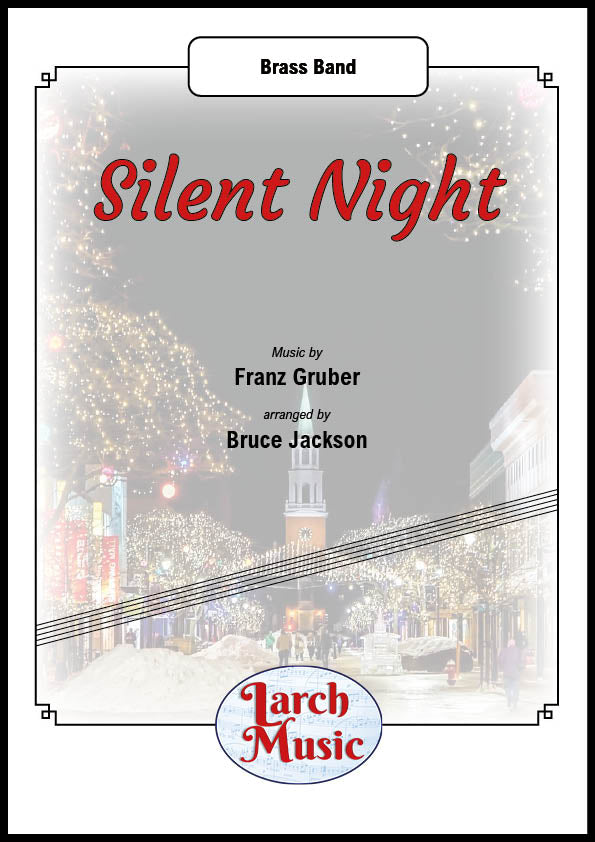
Silent Night (Bruce Jackson) - Brass Band Full Score and Parts - LM441
COMPOSER: Franz Xaver GruberARRANGER: Bruce JacksonSomething new for your band this Christmas from the pen of Bruce JacksonA lightly scored and different arrangement of this classic Christmas tune.LM441 - ISMN : 9790570004416
In Stock: Estimated dispatch 3-5 working days
-
 £25.00
Silent Night (Davis) - Brass Band Sheet Music Full Score & Parts - LM945
COMPOSER: Franz Xaver GruberARRANGER: John DavisSomething new for your band this Christmas from the pen of John DavisA lightly scored arrangement of this classic Christmas tune.LM945 - ISMN : 9790570009459
In Stock: Estimated dispatch 3-5 working days
-
 £25.00
Silent Night (Kempster) - Brass Band Sheet Music Full Score & Parts - LM930
COMPOSER: Franz Xaver GruberARRANGER: Mike KempsterSomething new for your band this Christmas from the pen of Mike KempsterA lightly scored arrangement of this classic Christmas tune.LM930 - ISMN : 9790570009305
In Stock: Estimated dispatch 3-5 working days
-
 £69.00
Festa Latina - Peter Boris Koval
An up-tempo rhythmic Latin-style piece, with lots of incidental percussion to propel the music to a triumphant climax. Melody and harmony are key elements, and every instrument group has something interesting to contribute in this sparkling arrangement.
Estimated dispatch 10-14 working days
-
 £18.00
Scarborough Fair
DescriptionScarborough Fair is a traditional English ballad about the Yorkshire town of Scarborough. The song relates the tale of a young man who instructs the listener to tell his former love to perform for him a series of impossible tasks, such as making him a shirt without a seam and then washing it in a dry well, adding that if she completes these tasks he will take her back. Often the song is sung as a duet, with the woman then giving her lover a series of equally impossible tasks, promising to give him his seamless shirt once he has finished.As the versions of the ballad known under the title Scarborough Fair are usually limited to the exchange of these impossible tasks, many suggestions concerning the plot have been proposed, including the theory that it is about the Great Plague of the late Middle Ages. The lyrics of "Scarborough Fair" appear to have something in common with an obscure Scottish ballad, The Elfin Knight which has been traced at least as far back as 1670 and may well be earlier. In this ballad, an elf threatens to abduct a young woman to be his lover unless she can perform an impossible task.As the song spread, it was adapted, modified, and rewritten to the point that dozens of versions existed by the end of the 18th century, although only a few are typically sung nowadays. The references to the traditional English fair, "Scarborough Fair" and the refrain "parsley, sage, rosemary, and thyme" date to 19th century versions. A number of older versions refer to locations other than Scarborough Fair, including Wittingham Fair, Cape Ann, "twixt Berwik and Lyne", etc.The earliest notable recording of it was by Ewan MacColl and Peggy Seeger, a version which heavily influenced Simon and Garfunkel's later more famous version. Amongst many other recordings, the tune was used by the Stone Roses as the basis of their song "Elizabeth my Dear".
Estimated dispatch 7-14 working days


 View Music