
Results
-
 £52.01
A Renaissance Christmas (Brass Band) Kevin Norbury
VIEW SCORE PDFThis magnificent festive suite was written by Kevin Norbury for the Pierre Elliott Trudeau High School Wind Symphony and features several well known carols set in a Renaissance style. Here it has been set for brass band. Three contrasting movements comprise the work:i. Processional (Personent hodie - On this day earth shall ring)This is a short piece imagining a torchlight Yuletide procession (perhaps bearing the traditional roasted wild boar), using a well-known Christmas melody from the large collection of music compiled in the 16th century called Piae Cantiones (1582). The tune is presented twice with accompanying, related melodic material.ii. Pastorale (Quem pastores laudavere - Shepherds sang their praises o'er him)This is a 14th-century melody which was originally collected by Michael Praetorius at the end of the 16th-century. The treatment throughout is very lyrical without overly complex harmonies. The melody is heard three times with brief linking episodes and a short coda.iii. Celebration! (In dulci jubilo - In sweet celebration - Ding-dong merrily on high))This magnificent 13th-century melody was also a part of Michael Praetorius's collection. It is traditional associated with the words 'Good Christian men, rejoice!' The opening is a straight transcription of the great chorale prelude for organ by J.S.Bach. After the grandeur of the opening, the tune is heard in more of a 'folky' style. A lot of related melodic material is then presented before the tune Ding-dong merrily on high is heard. After another episode of previously used music In dulci jubilo reappears in a joyful conclusion to the piece.Sheet music available from:UK - www.brassband.co.ukUSA - www.solidbrassmusic.comDifficulty Level: 3rd Section +Instrumentation:Soprano Cornet EbSolo Cornet BbRepiano Cornet Bb2nd Cornet Bb3rd Cornet BbFlugel Horn BbSolo Horn Eb1st Horn Eb2nd Horn Eb1st Baritone Bb2nd Baritone Bb1st Trombone Bb2nd Trombone BbBass TromboneEuphonium BbBass EbBass BbPercussion 1-4
In Stock: Estimated dispatch 1-3 working days
-
 £37.15
Simply Carols - 45 Favourite Christmas Carols - Brass Band Set
VIEW SCORE PDFThis resource features 45 Favourite Christmas Carols aimed at Intermediate Ensemble and above. All arranged by Kevin Larsson, who has over 20 years' experience working with youth ensembles, they are designed to be flexible and playable by a wide range of different groups, including brass, winds and strings. The arrangements use limited ranges, keys and rhythms and fingerings and slide positions are included for accidentals on the brass parts. PDF parts come in both march card an A4 size. Scored for quartet, the arrangements will work just as well with larger groups.Promotional videos for this product can be viewed at:www.youtube.com/watch?v=dTwB-Zy-c08 (short version)www.youtube.com/watch?v=g4IsIM8x7NU (extended version)Sheet music available at www.brassband.co.uk (UK) or https://satradecentral.org (USA). At Solid Brass Music parts, score and piano reduction can be purchased individually.Included in Brass Band Set:Full Score1st Part Eb1st Part Bb2nd Part Bb2nd Part Eb3rd Part Eb3rd Part Baritone Bb3rd Part Trombone Bb4th Part Eb4th Part Bb4th Part Bass ClefPercussion (optional)Full Set available at www.brookwrightmusic.com/product-page/simply-carols-45-favourite-christmas-carols-for-intermediate-ensemble and includes Piano ReductionWind Band Set available at www.brookwrightmusic.com/product-page/simply-carols-45-favourite-christmas-carols-wind-band-setFull Score available at www.brookwrightmusic.com/product-page/simply-carols-45-favourite-christmas-carols-full-score
In Stock: Estimated dispatch 1-3 working days
-
 £10.00
The Once and Future King
DescriptionThe Once and Future King is a suite of three movements; each movement was inspired by an Arthurian legend. The first movement, 'Tintagel', concerns the famous Cornish promontory said to be the birthplace of King Arthur. In Arthur's time, Tintagel was part of the court of King Mark of Cornwall and the music imagines a visit by the King of the Britons to his Cornish neighbour and the place of his birth, reflecting the ceremony and drama of such an occasion; the music is strongly antiphonal, contrasting the more strident fanfares of the cornets and trombones with the warmth of the saxhorns and tubas.The second movement, 'Lyonesse', takes its inspiration from the mythical land which once joined Cornwall to the Isles of Scilly. One legend claims that after the disastrous battle of Camlan where Arthur and Mordred were both killed, the remnants of Arthur's army were pursued across Lyonesse to Scilly, whereupon Merlin cast a spell to sink Lyonesse behind them and drown the pursuers. Some say the bells of the 140 churches inundated that day can still be heard ringing. All the material in this movement derives from two short motifs heard in counterpoint at the very beginning, which are intentionally dissonant and bitonal in character.The final movement, 'Badon Hill', takes its title from the legendary site of Arthur's last battle with the Saxons and is a lively toccata based on the medieval secular song L'Homme Armee ('The Armed Man'). The music uses a number of medieval devices including "hocketing" (passing melody from one voice to another). The actual site of Badon Hill is unknown but it has been associated with Badbury Rings in Dorset and a lot of evidence now points towards the town of Bath. Arthur's victory at Badon Hill was the last great victory for Celtic Britain over the Saxon invaders, but in the end only set the conquest back by a few decades. Arthur himself was dead by then, betrayed and defeated by his nephew Mordred, but it is said that Arthur only sleeps and will return in a time of dire need - hence the legend that Arthur's dying words were: Bury me in Britain, for I am the Once and Future King.Performance NotesWhere space and practicality permits the opening movement should be played with cornets and trombones standing behind the band facing the audience; they should retake their seats for the second and third movements.PercussionConcert Bass Drum (ideally NOT Kit/Pedal Bass Drum), Suspended Cymbal, pair of Clash Cymbals, Glockenspiel, Snare Drum, Tambourine, 2 x Timpani (Eb-G, Bb-D), 2 x Tom-toms, Triangle, Tam-Tam* (only if available), Tubular Bells *(only if available).MutesBaritones, all cornets and trombones will require metal straight mutes; all trombones and cornets will require cup mutes.*The Once and Future King was set as the test-piece for the 3rd section of the Swiss National Championships in 2007. The score was then slightly revised in July 2008, the main alteration being the exclusion of the tubular bells part for the Regional Championships of Great Britain in 2009. Some parts which were optional (or cued on other instruments) at the request of the Swiss Brass Band Association were restored to their original octaves and instruments. In 2015 the tubular bells part was restored in the optional Percussion 3 part; all parts in Percussion 3 are optional, although some are cued in the percussion 1 & 2 parts (and the cues should be played if only two players are available).Listen to a preview and follow along with the score below!
Estimated dispatch 7-14 working days
-
Peterborough Mass - Jeremy Cladd - Len Jenkins
Peterborough Mass comprises 5 Movements, Kyrie, Gloria, Sanctus, Benedictus and Agnus Dei. It was composed by Jeremy Cladd who became Head Chorister during his teenage yearsat Peterborough Cathedral. Total immersion in the music within such an inspiring building caused Jeremy to look deeper into the liturgical aspects of the Mass in order to understand the origins of the literary text being sung, so that he could paint a musical landscape based upon his interpretation of the text. From a musical perspective, Jeremy's Kyrie takes its inspiration from Philippians 2 vv1-11 (NIV) "Imitating Christ's Humility", and is structured AB where A refers to humility and submission "lord have mercy" and B relates to "united with Christ", with the latter evoking feelings of salvation and joy. In sympathy with the literary text, the Kyrie has a short introduction, and then a ternary form ABA structure where A is influenced by polyphonic choral writing and B by homophonic choral writing. This is the first of the five Movements to be arranged for Brass Band with Choir and comprises a full brass band score, parts for all instruments and a choral practice score.
-
 £29.72
Call (Brass Band) Zachary Docter
This short concert opener by American composer Zachary Docter is built around a trumpet-call motif, first heard in canon at the outset. The motif is gradually developed before a broader, more substantial theme emerges in the trombones. This new material is then explored and expanded, eventually combining with the original motif in a grand, climactic conclusion.Harmonically, the work draws on the perfect intervals of the opening call, creating a sound world that feels contemporary while remaining accessible. Energetic and effective, it makes an ideal concert opener without presenting excessive technical demands for most bands.To view a rolling score video of this piece please visit https://www.youtube.com/watch?v=YxCuFLMdh6cDuration: 1.40 minutesDifficulty Level: 4th Section +This PDF download includes the full score and parts.Sheet music available at www.brassband.co.uk (UK) or https://satradecentral.org (USA)Instrumentation:Soprano Cornet EbSolo Cornet BbRepiano Cornet Bb2nd Cornet Bb3rd Cornet BbFlugel Horn BbSolo Horn Eb1st Horn Eb2nd Horn Eb1st Baritone Bb2nd Baritone Bb1st Trombone Bb2nd Trombone BbBass TromboneEuphonium BbBass EbBass BbTimpaniPercussion 1-2
In Stock: Estimated dispatch 1-3 working days
-
 £33.43
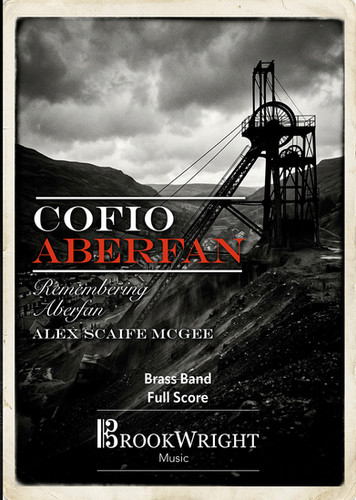
Cofio Aberfan (Brass Band) Alex Scaife McGee
Cofio Aberfan (Remembering Aberfan) is a deeply moving musical work composed to mark the 60th anniversary of the 1966 Aberfan disaster. On that tragic day, a collapsing coal tip devastated a close-knit Welsh village, claiming 144 lives - including 116 children attending their final day of term at Pant Glas Primary School.Designed for commemorative programs, civic events, and concert performances, this piece serves as both a solemn homage to those who perished and an inspiring tribute to the survivors. Moving fluidly between deep reflection and powerful affirmation, the composition captures the poignant sense of a childhood cut short while honoring the extraordinary tenacity of a community that refused to let tragedy define its destiny.Duration: 4.30 minutesDifficulty Level: 4th Section +To view a rolling score video of this piece please visit https://www.youtube.com/watch?v=X4XB5HCV6RYThis PDF download includes the full score and parts.Sheet music available at www.brassband.co.uk (UK) or https://satradecentral.org (USA)Instrumentation:Soprano Cornet EbSolo Cornet BbRepiano Cornet Bb2nd Cornet Bb3rd Cornet BbFlugel Horn BbSolo Horn Eb1st Horn Eb2nd Horn Eb1st Baritone Bb2nd Baritone Bb1st Trombone Bb2nd Trombone BbBass TromboneEuphonium BbBass EbBass BbTimpaniPercussion 1-2
In Stock: Estimated dispatch 1-3 working days
-
 £33.43
Excursion (Brass Band) Christopher Cook
Excursion was the winner of the 2022 BrookWright International Brass Band Composition Competition.The composer Christopher Cook writes:'In this short and effervescent study for brass band, I wanted to take the listener and players on a journey which moves from a soundworld of bristling, bubbling energy to a triumphant fanfare and finally a moment of repose.The initial fast flurry of notes, highlighted and emphasised by precise elements of percussion, informs the motivic development of the rest of the piece and eventually forms the basis for the textural backdrop to the filmic sounding melody heard around halfway through the piece. The unexpected final passage is intended to be a nod to works for brass band by Paul Patterson and Harrison Birtwistle.'To view a rolling score video of the piece performed by the Royal Northern College of Music (RNCM) Brass Band please visit www.youtube.com/watch?v=rSCrQIv_W2kPDF download includes score and parts.Sheet music available from www.brassband.co.ukDifficulty Level: 1st Section +Instrumentation:Soprano Cornet EbSolo Cornet BbRepiano Cornet Bb2nd Cornet Bb3rd Cornet BbFlugel Horn BbSolo Horn Eb1st Horn Eb2nd Horn Eb1st Baritone Bb2nd Baritone Bb1st Trombone Bb2nd Trombone BbBass TromboneEuphonium BbBass EbBass BbTimpaniPercussion 1-3
In Stock: Estimated dispatch 1-3 working days
-
 £33.43
Disinformation! (Brass Band) Joe Galuszka
This atmospheric work by English composer Joe Galuszka is set in three movements:I. FearII. HopeIII. Solidarity (March for Truth)The composer writes:'All around us is mistrust in the information we receive. Chinese misinformation. Russian disinformation. 'Fake News' in the United States. At every turn we doubt what we hear, what we see.Disinformation was composed in response to the ever-growing and all powerful misinformation campaigns worldwide that reached dizzying levels of influence, coming from some of the most eminent heads of states, during the turn of the 21st century. With division and disillusionment now rife and engrained in Western democracies, the unravelling of the social order is reflected in this short work for brass band.Opening with Fear, Disinformation starts with vast amounts of noise taking over the establishment and paints a world with people coming to terms with the cacophony of sound that is 'false information'. With a retreat to a brief moment of solace, Hope conjures up a calm escapism where on the outside, the brave and the wise look on to what is becoming of our new world. Maybe there is chance to pull together?Ending with a frenzied, brazen climax, the piece concludes with Solidarity - where people and the politicians come to loggerheads in a battle - where those who seek division are called out and the lies are laid bare for all to see, as we enter, once more, the unknown.'To listen to a recording of Solna Brassperforming the work please visit https://open.spotify.com/track/2gvPdCsvmykdWpm2yjz3Uk?si=68cc33805d16449cTo view a rolling score video of this work please visit www.youtube.com/watch?v=z-0I47yfvM0PDF download includes score and parts.Sheet music available from www.brassband.co.ukDifficulty Level: 1st Section +Length: 4.35 minutesInstrumentation:Soprano Cornet EbSolo Cornet BbRepiano Cornet Bb2nd Cornet Bb3rd Cornet BbFlugel Horn BbSolo Horn Eb1st Horn Eb2nd Horn Eb1st Baritone Bb2nd Baritone Bb1st Trombone Bb2nd Trombone BbBass TromboneEuphonium BbBass EbBass BbTimpaniPercussion 1-4 (Part 2 optional)
In Stock: Estimated dispatch 1-3 working days
-
 £57.00
Conspirators Overture for Brass Band composed by Andrew Duncan
Composer: Andrew Duncan Conspirators Overture was written for Katrina Marzella-Wheeler and the Cooperation Band for their winning programme played at the 2025 Brass in Concert competition at the Glass House in Gateshead England. The piece describes a meeting in a cafe in Paris in 1912 between three very influential Russians. The composer Igor Stravinsky, the dancer Vaslav Nijinsky and the impresario Sergei Diaghilev. Together they conspired about how Stravinsky's new Ballet, Le Sacre du Printemps (The rite of Spring) was going to disrupt what was then a very conservative, classical music scene in Paris. Stravinsky's music would forever change the way harmonies and rhythms are used in classical and jazz music. Starvinsky's full name is Igor Fyodorovich Stravinsky. The piece uses the morse code rhythm for IFS, which is Stravinsky's initials as a pulsating 11/8 rhythm which is the foundation of the overture. The opening notes from the Rite of Spring, played by a solo bassoon, are also quoted in the piece in a jazz waltz setting and in a short fugue towards the end of the piece. Composer: Andrew Duncan Difficulty: Suitable for Championship or First Section Bands. Duration: 4mins Score and Parts Publisher: Duncan Music Press
-
 £32.00
The Cistercians
DescriptionThe Cistercianswas written during December 2003 and January 2004 as an entry for Morecambe Band's Centenary New Music Competition, which it went on to win. The first two performances were at the final of this competition, part of the band's 100th Anniversary Concert at The Dome in Morecambe on 9 July 2004.The music was inspired by visits to three of Britain's great Cistercian Abbeys; Valle Crucis, Fountains and Rievaulx. The Cistercian Order was founded at Citeaux in France in the 11th Century and was based on the principles of austerity, humility and piety. Cistercian Abbeys were deliberately sited in remote, difficult areas. Despite this many of them, especially Rievaulx, became immense centres of commerce and power, with ever more complex administration and hierarchies.In a way the music reflects this; all the material in the piece is derived from two simple motifs played by flugel and solo horn in the opening bars and becomes more complex and further removed from the original material as the piece develops. After a tranquil opening section a fugal chorale develops over a medieval-style "tenor" - a stretched out version of one of the original motifs. A burst of semiquavers leads into a faster, folk-dance type section - our medieval abbey has become a bustling trade centre - before rhythmic quaver pulses in the horns and cornets accompany powerful chords in the low brass; this is another "tenor" derived from the opening motifs. A short development section, including the folk dance "hocketing" round the band and a slightly disjointed 10/8 section leads to a restatement of the fugal chorale from the beginning before a frenetic coda brings the work to a triumphant conclusion.Performance Notes:Percussion instruments required are Bass Drum, Suspended Crash Cymbal, Glockenspiel, 2 x Tom-toms, Snare Drum, Tambourine, Tam-Tam, 2 x Timpani (G-C, C-F), Triangle, Wood Block. All cornets will require metal stratight mutes and all except soprano require cup mutes. All trombones require cup and metal straight mutes.You can follow a preview of the score in the video below.
Estimated dispatch 7-14 working days
 Watch video