
Results
-
 £168.50
Music of the Spheres - Philip Sparke
Music of the Spheres was commissioned by the Yorkshire Building Society Band and first performed by them at the European Brass Band Championships in Glasgow, May 2004.The piece reflects the composers fascination with the origins of the universe and deep space in general. The title comes from a theory, formulated by Pythagoras, that the cosmos was ruled by the same laws he had discovered that govern the ratios of note frequencies of the musical scale. ('Harmonia' in Ancient Greek, which means scale or tuning rather than harmony - Greek music was monophonic). He also believed that these ratios corresponded to the distances of the sixknown planets from the sun and thatthe planets each produced a musical note which combined to weave a continuous heavenly melody (which, unfortunately, we humans cannot hear). In this work, these six notes form the basis of the sections Music of the Spheres and Harmonia.The pieces opens with a horn solo called t = 0, a name given by some scientists to the moment of the Big Bangwhen time and space were created, and this is followed by a depiction of the Big Bangitself, as the entire universe bursts out from a single point. A slower section follows called The Lonely Planet which is a meditation on the incredible and unlikely set of circumstances which led to the creation of the Earth as a planet that can support life, and the constant search for other civilizations elsewhere in the universe. Asteroids and Shooting Stars depicts both the benign and dangerous objects that are flying through space and which constantly threaten our planet, and the piece ends with The Unknown, leaving in question whether our continually expanding exploration of the universe will eventually lead to enlightenment or destruction.
Estimated dispatch 5-14 working days
-
 £38.95
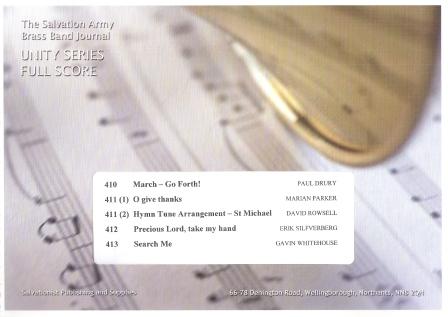
Unity Series Band Journal October 2013 Numbers 410 - 413
No. 410 March - Go Forth! (Paul Drury)This march was written as a tribute to Bandmaster Jack Spowart and the Bo'ness Salvation Army Band. The composer lives in the twon of Bo'ness and has had numerous opportunities to share with the band and the wider corps at various events. This march serves as recognition of the faithful service given in the Lord's name in the town by The Salvation Army for over 100 years. Two tunes are featured, both well-known and instantly recognisable, namely, Forward! be our watchword and We're marching on.No.411 (1) O give thanks (Marian Parker)The composer, Marian Parker, is a new contributor and is the Recruiting Sergeant at Leicester South Corps. This simple, yet rhythmic piece should not pose any technical problems for most bands and features the attractive arrangement of Joanne Pond's contemporary song, 'O give thanks'.No.411 (2) Hymn Tune Arrangement - St Michael (David Rowsell)The hymn tune 'St Michael' was composed in 1551 by French composer Louis Bourgeois and the composer provides a very useful arrangement of this historic hymn.No. 412 Precious Lord, take my hand (Erik Silfverberg O.F.)This well-known Gospel Song is a favourite of many. It has been recorded by many great artists, including Rosetta Tharpe, Elvis Presley and Aretha Franklin. The words were written by Reverend Thomas A. Dorsey, who is often known as the 'Father of Gospel song'.No. 413 Search Me (Gavin Whitehouse)The second new contributor to this journal is Gavin Whitehouse. gavin is the Assistant Music Director for the Greater New York Division and is also the USA Eastern Territorial Songster Leader. This piece combines two songs - one old and one new - which speak of a God who knows us intimately. 'Search me, O God and know my heart today' (associated with the beautiful Maori melody, 'Now is the hour') is woven with a contemporary setting of Psalm 139 by Rebecca St James, the first line of which says, 'You searchme, you know me'.
Estimated dispatch 7-14 working days
-
 £124.95
Hyperlink - Peter Graham
Hyperlink was commissioned by the National Youth Brass Band of Great Britain (funded by Arts Council England and the Department for Education) for its 70th Anniversary Year. Since the anniversary coincided with other significant celebrations in 2022 (including the Royal Albert Hall/Ralph Vaughan Williams 150th and the Platinum Jubilee of Elizabeth II) it was requested that these also be recognised in some way.
Where better to begin this challenging brief but with a computer search for the NYBBGB founder Dr Denis Wright (coincidently born in Kensington, home of the RAH). The subsequent rabbit warren of hyperlinks led me to structure the work through a series of "associations":
Movement I - The Voice of Jupiter.
Alongside the discovery that Denis Wright had been a church organist was the realisation that while the RAH has hosted thousands of musical events the fabric of the building actually incorporates a musical instrument, the famous Henry Wills organ (aka The Voice of Jupiter).Organ and J S Bach are synonymous (e.g. Toccata in D min) and so both become fundamental to the content of the movement. An opening 7 note quote from the Toccata leads to a mammoth sound cluster, as if every note on the huge RAH organ is sustained. The material which follows is based upon the notes BACH (in German notation). The notes are manipulated in various ways in a 12 tone matrix; reversed, inverted and so on. Other techniques employed in the movement are ones of which Bach was master, including ground bass and fugue.
Movement II - Remember Me.
The lives of Salvationist composer Ray Steadman-Allen (born 1922) and Ralph Vaughan Williams are remembered here, with "RSA" in musical notation and fragments of RVWs famous Tuba Concerto providing the source material.While writing the movement my father passed away and to close his funeral service the family chose the uplifting Robert Lowry hymn They'll sing a welcome home. It seemed fitting to conclude the movement with a reflective setting of the chorus, the repeated phrase "Welcome, welcome home" eventually disappearing into the ether.
Movement III - Vivat.
The finale takes the form of a short fantasy upon Hubert Parry's marvellous coronation anthem I Was Glad, truly a celebratory note with which to conclude.The first performance of Hyperlink was given by the NYBBGB conducted by Martyn Brabbins at the Royal College of Music, London on August 6th 2022.
Estimated dispatch 3-7 working days
-
 £29.66
Fanfare from La Peri(Brass Band) Dukas arr. Rob Bushnell
La Peri is a one-act ballet by the French composer Paul Dukas, best known for The Sorcerer's Apprentice (L'apprenti sorcier) as in the 1940 Disney film Fantasia. Dukas was commissioned to write La Peri by the Ballets Russes, producing a Poeme danse en un tableau ('dance poem in one scene') in 1911; this become his last published work. With Natalia Trouhanova due to play the Peri and Vaslav Nijinsky to play Iskender (the name of Alexander the Great in Persian, who is scouting around Iran in search of the Flower of Immortality), the production was ultimately cancelled because Serge Diaghilev feel Trouhanova was not a skilled enough dancer to be partnered to Nijinsky. Trouhanova later hired Ivan Clustine to choreograph the music, with the ballet premiering at the Theatre du Chatelet in Paris on 22 April 1912.The brilliant fanfare that precedes the ballet is often performed separately and is the arrangement available here. Arranged for British-style brass band, it has optional percussion parts as well as alternative parts for horns in F and bass-clef lower brass. The piece has been lowered by a tone compared to the original. A recording of the original composition can be found here: www.youtube.com/watch?v=7EDekMos1ok. Duration: Approx. 2 minutes Difficulty Level: 2nd Section + Duration: 4 or 5 minutes (depending on tempo and without any cuts) PDF download includes parts and score. Sheet music available at www.brassband.co.uk (UK) or https://satradecentral.org (USA) Instrumentation: Soprano Cornet Eb Solo Cornet Bb Repiano Cornet Bb 2nd Cornet Bb 3rd Cornet Bb Flugel Horn Bb Solo Horn Eb 1st Horn Eb 2nd Horn Eb 1st Baritone Bb 2nd Baritone Bb 1st Trombone Bb 2nd Trombone Bb Bass Trombone Euphonium Bb Bass Eb Bass Bb Timpani Percussion 1 - Snare Drum Percussion 2 - Bass Drum & Cymbal
In Stock: Estimated dispatch 1-3 working days
-
£34.95
MARCH OF THE HOURS (Brass Band Set) - Emil Soderstrom
March of the Hours was first performed at Star Lake Music Camp in 1962 with the composer supplying an informative listening guide which was printed in the published score; "The phrases are of 12 crotchets each (three bars) signifying the 12 hours. Up to the trio, the music describes the headlong search for pleasure by the thoughtless. Abruptly, the trio brings 'I need thee every hour', but an episode employing the original theme pushes it aside until it reappears, this time against a background of chimes of the full hour (Westminster chimes). While the hour strikes 12, a paraphrase of the opening strains of 'When the trumpet of the Lord shall sound and time shall be no more' is heard. Here the music stops, to be followed by the trumpet sounding (cornets and trombones) and the rest of the band responds with 'When the roll is called up yonder' with a final 'I'll be there'."
Estimated dispatch 7-14 working days
-
£44.95
LIFE ABUNDANT (Cornet Solo with Brass Band Set) - Robert Redhead
Life Abundant is a cornet solo written as a musical biography of the search of soul to find the meaning of life. The music begins with the dawning of life, then the abundant joy of childhood ('My cup is full and running over'), followed by the uncertainty of the youth who longs to say 'I want to live right' but doesn't know how. The answer comes in a meditative setting of the composer's own song 'One life to live, O may I live for Thee', after which the music confidently builds to a climax which expresses the joy of abundant life found in Jesus".
Estimated dispatch 7-14 working days
-
£24.95
NOW IS THE HOUR (Cornet Solo with Brass Band Set) - Ray Steadman-Allen
This romantic Maori song of farewell was arranged as a cornet solo for David Daws. Within The Salvation Army, the words 'Search me, O God, and know my heart today' are now associated with this beautiful tune.
Estimated dispatch 7-14 working days
-
 £30.00
Brass Band Warm Up - Chris Houlding
I believe the practice of using a choral or hymn tune to develop fundamental playing basics in order to 'warm up' a brass ensemble is universally supported. However, this imaginative little exercise combines the virtues of choral playing with additional challenges addressing ensemble, phrasing, balance, dynamics (inc. crescendos and diminuendos), intonation (inc. unison passages) and varied articulations. For the discerning band in search of quality, not quite as easy as it looks !
-
£33.00
Where Did My Snowman Go? - Venis & Poser - Broadbent, D
This arrangement of the classic Christmas song Where Did My Snowman Go? adds lovely festive charm to any concert. The piece narrates a child's whimsical search for their snowman, who has mysteriously disappeared.A true Christmas Classic
In Stock: Estimated dispatch 1-3 working days
-
 £12.00
Of Men and Mountains (Brass Band Study Score)
Of Men and Mountains was commissioned by the Netherlands Brass Band Championships for their 10th Anniversary Contest, held in Drachten in December 1990.The title of the work and its genesis came about as a result of a train journey the composer took in July 1989 across Canada from Toronto to Vancouver. The awe-inspiring journey through the Rocky Mountains, with its high peaks and shafts of sunlight breaking through the clouds, with its canyons and ferocious rapids, made the composer understand a little more about the majesty of nature and the fragility of humanity. The eternal struggle between man and nature was personified in the building of this incredible railway, hence the title (after Blake).The work is dedicated to the memory of Eric Ball, who died shortly before the writing of the work commenced.Of Men and Mountains is in one continuous movement and lasts about 17 mins. Its form is difficult to describe because of its motivic and accumulative nature, but it is essentially a symphonic tone poem in search of a theme, which eventually comes in its final and complete state in the majestic ending after an ever-increasing paced scherzo.Duration: 17.00
Estimated dispatch 7-14 working days
 View Music