
Results
-
 £67.24
Pyrenean Carol Suite (Brass Band) David Taylor
This attractive suite for brass band by David Taylor features five traditional carols from the Pyrenees region of Spain, as follows: i. Nadal Tindaire (Jingling Christmas) - Occitan traditional This Occitan Christmas song tells of musical instruments used to celebrate the Nativity - 'fifes and trumpets, timpani and pipes, or you, clear little bells, along with the angels' choir.' ii. Gabriel's Message (Birjina Gaztetto Bat Zegoen) - Basque traditional The most widely-known of the chosen carols, honouring Jesus's mother Mary, this is often sung in its English version, but the melody came from the Basque country. The Basque words were adapted from the Mediaeval song Angelus ad Virginem. Here, we feature the flugel horn. This movement was originally written on its own, with organ accompaniment, for the composer's wife, Diane Scott. iii. El Noi de la Mare (The Child of the Mother) - Catalan traditional A beautiful Catalan carol celebrating the birth of Jesus, telling of the tasty gifts that the singer would bring - 'Raisins and figs and nuts and olives; Raisins and figs and honey and mato [a Catalan dessert cheese traditionally served with honey.]' Here we feature the euphonium. The tune was made famous by guitarist Andres Segovia, who used it as a favourite encore, and by John Rutter, who made a widely-used setting for choir. iv. Paure Satan (Poor Satan) - Occitan traditional This rather unusual carol tells of the pain that Satan is put to by the arrival of the infant Jesus. Its mocking and sarcastic tone is reflected here, where the tuba soloist (as Satan) is given musical trouble throughout by the other parts. At first they conflict with the soloist, then the soloist makes overtures of friendship, which are treated with suspicion followed by contempt. The soloist finally gives in to their accompaniment (or do they?). There are plenty of opportunities for little theatrical touches here, if the tuba player is so inclined! The tuba part in this movement is notably more difficult than the rest of the music, and a number of optional changes have been marked to make the part easier to play, if so desired. The player is also welcome to add suitable extra embellishments to taste if they wish, within the character of the music. v. Fum, Fum, Fum! - Catalan traditional A favourite Catalan Christmas song for centuries, this rousing melody provides a fitting way to round off the suite, with its repeated rhythmic refrain of the nonsense title phrase. It tells of the Nativity, and then it tells of the celebratory feasting and good times that the singers look forward to to honour it. Although the suite is intended to be performed whole, it is also intended for usage with a selection of movements on occasions where a shorter piece is wanted. Suggested formats include a single movement alone (2, 3, and 5 are likely most appropriate), a pair of movements (any of the first four, plus 5), and a suite of three or four movements (1 and 5, plus one or two of 2, 3, or 4 in the middle). It is suggested that a good way to design a 'pick-your-own-suite' from the movements is to think of the earlier movements as introductory to the final movement. To view a rolling score video featuring Kidlington Concert Brass please visit www.youtube.com/watch?v=QIGdul-yxxg PDF download includes score and parts. Sheet music available from: UK - www.brassband.co.uk USA - https://satradecentral.org Difficulty Level: 3rd Section + Length: 9.45 minutes Instrumentation: Soprano Cornet Eb Solo Cornet Bb Repiano Cornet Bb 2nd Cornet Bb 3rd Cornet Bb Flugel Horn Bb Solo Horn Eb 1st Horn Eb 2nd Horn Eb 1st Baritone Bb 2nd Baritone Bb 1st Trombone Bb 2nd Trombone Bb Bass Trombone Euphonium Bb Bass Eb Bass Bb Timpani Percussion 1-2
In Stock: Estimated dispatch 1-3 working days
-
 £37.35
Resilience (Brass Band) Andrew Wainwright
Resilience was composed by Andrew Wainwright for the River City Brass Band Composer Competition 2022, later being awarded first prize. The work celebrates the band's short but rich history, with a particular focus on the determination it has shown, like so many bands around the world, to continue its tradition of musical excellence despite the unprecedented challenges of the pandemic that led to an extended hiatus in music making. To view a video of River City Brass performing the work please visit www.youtube.com/watch?v=6y_MEm2eEeQ PDF download includes score and parts. Sheet music available from: UK - www.brassband.co.uk USA - www.solidbrassmusic.com Difficulty Level: 1st Section + Instrumentation: Soprano Cornet Eb Solo Cornet Bb Repiano Cornet Bb 2nd Cornet Bb 3rd Cornet Bb Flugel Horn Bb Solo Horn Eb 1st Horn Eb 2nd Horn Eb 1st Baritone Bb 2nd Baritone Bb 1st Trombone Bb 2nd Trombone Bb Bass Trombone Euphonium Bb Bass Eb Bass Bb Percussion 1-3
In Stock: Estimated dispatch 1-3 working days
-
 £33.62
Spanish Dance - Brass Band (Traditional arr. Andrew Wainwright)
Based on the traditional Spanish carol 'Riu Riu Chiu', this exciting foot-tapping item was premiered at Butlins Mineworkers Championships in 2010. Recorded on Virtuosi GUS Band's CD 'Christmas Fantasia - The Music of Andrew Wainwright', it has since proved to be a popular concert item. "Spanish Dance winds up to a whirlwind climax with a respectful nod in the direction of Morley Calvert's 'Canadian Folk Song Suite' - very clever." Paul Hindmarsh, British Bandsman magazine For a follow-the-score video of this work please visit: https://www.youtube.com/watch?v=jjskWuOH_YU Includes score and full set of parts. Sheet music available exclusively from World of Brass - www.worldofbrass.com Difficulty Level: 1st Section + Instrumentation: Soprano Cornet Eb Solo Cornet Bb Repiano Cornet Bb 2nd Cornet Bb 3rd Cornet Bb Flugel Horn Bb Solo Horn Eb 1st Horn Eb 2nd Horn Eb 1st Baritone Bb 2nd Baritone Bb 1st Trombone Bb 2nd Trombone Bb Bass Trombone Euphonium Bb Bass Eb Bass Bb Timpani Percussion 1-2
In Stock: Estimated dispatch 1-3 working days
-
 £37.35
The First Nowell (Brass Band, opt. Choir & Piano) Traditional arr. Barrie Gott
This charming setting by Australian composer Barrie Gott is of the favourite carol The First Nowell. Although this version is for brass band, choir and piano, it is orchestrated such that it will work for standalone brass band. The arranger writes: 'I have always been fascinated with the words and music of this majestic carol. It was first written for choir and piano and then orchestrated for the Brisbane Lord Mayor's Carols with the Queensland Pops Orchestra. A further arrangement for brass band was prepared for a Salvation Army event. The setting is for four verses (1,2,5 and 6) and tells the Gospel story in a nutshell. It starts very simply and builds to a spectacular climax.' To view a rolling score video of this work please visit www.youtube.com/watch?v=2KH6u0MUiaY Duration: 4.45 minutes approx. Difficulty Level: 3rd Section + PDF download includes parts and score. Sheet music available from www.brassband.co.uk or www.durhammusicshop.co.uk (UK) or https://satradecentral.org (US) Instrumentation: Soprano Cornet Eb Solo Cornet Repiano Cornet Bb 2nd Cornet Bb 3rd Cornet Bb Flugel Horn Bb Solo Horn Eb 1st Horn Eb 2nd Horn Eb 1st Baritone Bb 2nd Baritone Bb 1st Trombone Bb 2nd Trombone Bb Bass Trombone Euphonium Bb Bass Eb Bass BbTimpani Percussion 1-2 SATB Choir (optional) Piano (optional)
In Stock: Estimated dispatch 1-3 working days
-
 £37.35
The Huron Carol - Brass Band (Canadian Traditional arr. Andrew Wainwright)
A magical arrangement of the beautiful Canadian Christmas hymn (Canada's oldest Christmas song), which is also known as 'Twas in the Moon of Wintertime. 'In The Huron Carol, Andrew responds to the ethereal quality and wintery mood of Canada's oldest Christmas song, setting this beautifully simple tune in an ambiguous, Downie-Himes inspired landscape. The layering of texture is magical.' Paul Hindmarsh - Music critic To view a video of the work please visit: www.youtube.com/watch?v=gB7DhDTWBCA Sheet music available from: UK - www.brassband.co.uk USA - www.solidbrassmusic.com Difficulty Level: 4th Section + Instrumentation: Soprano Cornet Eb Solo Cornet Bb 2nd Cornet Bb 3rd Cornet Bb Flugel Horn Bb Solo Horn Eb 1st Horn Eb 2nd Horn Eb 1st Baritone Bb 2nd Baritone Bb 1st Trombone Bb 2nd Trombone Bb Bass Trombone Euphonium Bb Bass Eb Bass Bb Timpani Percussion 1-2
In Stock: Estimated dispatch 1-3 working days
-
 £33.62
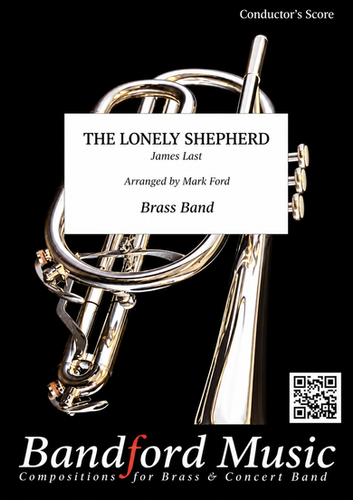
The Lonely Shepherd (Brass Band) James Last arr. Mark Ford
Few melodies possess the haunting beauty and instant recognizability of The Lonely Shepherd. Originally composed by legendary bandleader James Last for a solo project titled Filmmusik Ohne Filme (Film Music Without Films), the track eventually found its home on the 1977 album Memories of Russia. It was this recording that catapulted pan flutist Gheorghe Zamfir to international superstardom, reaching the Top 25 on the German charts and becoming a permanent fixture in the global musical lexicon. While the original album title suggested "films without movies," the track didn't stay "homeless" for long. Its evocative, melancholic atmosphere has made it a favorite for directors across decades and continents. This brass band arrangement preserves the ethereal quality of the original, the soaring melodic lines and rhythmic intensity of the finale offering a brilliant showcase of phrasing and emotional depth. To view a rolling score video of the work please visit https://youtu.be/DgwjIij93Os Duration: Approx. 4.00 minutes Difficulty Level: 3rd Section + This PDF download includes the full score and parts. Sheet music available at www.brassband.co.uk (UK) or https://satradecentral.org (USA) Instrumentation: Soprano Cornet Eb Solo Cornet Bb Repiano Cornet Bb 2nd Cornet Bb 3rd Cornet Bb Flugel Horn Bb Solo Horn Eb 1st Horn Eb 2nd Horn Eb 1st Baritone Bb 2nd Baritone Bb 1st Trombone Bb 2nd Trombone Bb Bass Trombone Euphonium Bb Bass Eb Bass Bb Drum Kit Percussion 1-2
In Stock: Estimated dispatch 1-3 working days
-
 £33.62
The Lord Bless You and Keep You (Brass Band) John Rutter arr. Andrew Wainwright
John Rutter's popular choral benediction is based on Numbers 6:24-26, and has here been arranged for brass band by Andrew Wainwright. It is a setting of a biblical benediction, followed by an extended 'Amen'. Rutter originally scored the piece for four vocal parts (SATB) and organ. He composed it in 1981 for the memorial service of Edward T. Chapman, the director of music at Highgate School, London, with whom he had studied when he attended the school. The arrangement sounds a semi-tone down from the original choral setting although otherwise maintains the same format, so can be performed with choir if they sing down a semi-tone. To view a rolling score video with Wellington Brass performing the work please visit www.youtube.com/watch?v=ijJ2Nir3wRQ PDF download includes score and parts. Additional parts (Horn in F and Baritone, Trombone, Euphonium & Tuba in Bass Clef) available here. Sheet music available from: UK - www.brassband.co.uk USA - https://satradecentral.org Difficulty Level: 4th Section + Length: 2.50 minutes Instrumentation: Soprano Cornet Eb Solo Cornet Bb 1st Cornet Bb 2nd Cornet Bb Flugel Horn Bb Solo Horn Eb 1st Horn Eb 2nd Horn Eb 1st Baritone Bb 2nd Baritone Bb 1st Trombone Bb 2nd Trombone Bb Bass Trombone Euphonium Bb Bass Eb Bass Bb Timpani Percussion
In Stock: Estimated dispatch 1-3 working days
-
 £33.62
The Piano Preludes (Brass Band) George Gershwin arr. Rob Bushnell
First performed by the composer at the Roosevelt Hotel in New York in 1926, The Piano Preludes (or Three Preludes) are a collection of short pieces by George Gershwin, show casing early-20th-century American classical music, as influenced by jazz. Gershwin originally planned to compose 24 preludes, wrote seven, performed only six publically and was further reduced to three when first published. The work was dedicated to friend and musical advisor Bill Daly. The first prelude begins with a five-note blues motif. It features syncopated rhythms based on the Brazilian baiao and minor-seventh chords throughout. The second prelude, which Gershwin said was "a sort of blues lullaby" consists of two sections: the first a "lazy" melody upon a steady beat of crotchets; the second the bass takes the melody, continuing with the steady beats. The third prelude was called "Spanish" by Gershwin, and features a question-and-answer type melody, starting in a minor tonality and ending in major one. This arrangement is for the British-style brass band, with alternative parts for horns in F and bass-clef lower brass. To view a follow-the-score video please visit www.youtube.com/watch?v=XqIQ0j1SWlc PDF download includes score and parts. Sheet music available from: UK - www.brassband.co.uk USA - www.solidbrassmusic.com Difficulty Level: 1st Section + Instrumentation: Soprano Cornet Eb Solo Cornet Bb Repiano Cornet Bb 2nd Cornet Bb 3rd Cornet Bb Flugel Horn Bb Solo Horn Eb 1st Horn Eb 2nd Horn Eb 1st Baritone Bb 2nd Baritone Bb 1st Trombone Bb 2nd Trombone Bb Bass Trombone Euphonium Bb Bass Eb Bass Bb Timpani Drum Kit Mallet Percussion
In Stock: Estimated dispatch 1-3 working days
-
 £37.35
The Vow (Brass Band) Andrew Wainwright
VIEW SCORE PDF A majestic processional in the spirit of Elsa's Procession to the Cathedral, this powerful work blends the heartfelt beauty of William Himes' worship song All That I Am with an original theme by Andrew Wainwright. The piece was originally written for the composer's wedding. The piece features expressive interplay between solo lines and rich accompaniment, offering performers a dynamic canvas to shape and build the music. Gradually expanding in depth and intensity, it culminates in a stirring and triumphant conclusion - ideal for sacred ceremonies, concert halls, or moments of solemn celebration. PDF download includes score and full set of parts. Sheet music available from: UK - www.brassband.co.uk USA - www.solidbrassmusic.com To view a video of the Southern Territorial Band performing the work please visit: www.youtube.com/watch?v=h2VUSKHMbho Difficulty Level: Second Section + Instrumentation: Soprano Cornet Eb Solo Cornet Bb 1st Cornet Bb 2nd Cornet Bb Flugel Horn Bb Solo Horn Eb 1st Horn Eb 2nd Horn Eb 1st Baritone Bb 2nd Baritone Bb 1st Trombone Bb 2nd Trombone Bb Bass Trombone 1st Euphonium Bb 2nd Euphonium Bb Bass Eb Bass Bb Timpani Percussion 1-3
In Stock: Estimated dispatch 1-3 working days
-
 £33.62
There's no-one like Jesus (Brass Band) African Trad. arr. Andrew Wainwright
This popular African praise song exists in a staggering number of variations, depending on the country, language, and denominational background of the community singing it. This foot-tapping arrangement for brass band was made by Andrew Wainwright for the 2008 Zambia Territorial Music School of The Salvation Army. To view a video of the ULID BRASS performing the work please visit https://www.youtube.com/watch?v=q_EfH1t7NDY Length: 3.00 minutes PDF download includes score and parts. Sheet music available from www.brassband.co.uk Difficulty Level: 4th Section + Instrumentation: Soprano Cornet Eb 1st Cornet Bb 2nd Cornet Bb 1st Horn Eb 2nd Horn Eb 1st Baritone Bb 2nd Baritone Bb 1st Trombone Bb 2nd Trombone Bb Bass Trombone Euphonium Bb Bass Eb Bass Bb Percussion 1-2
In Stock: Estimated dispatch 1-3 working days